

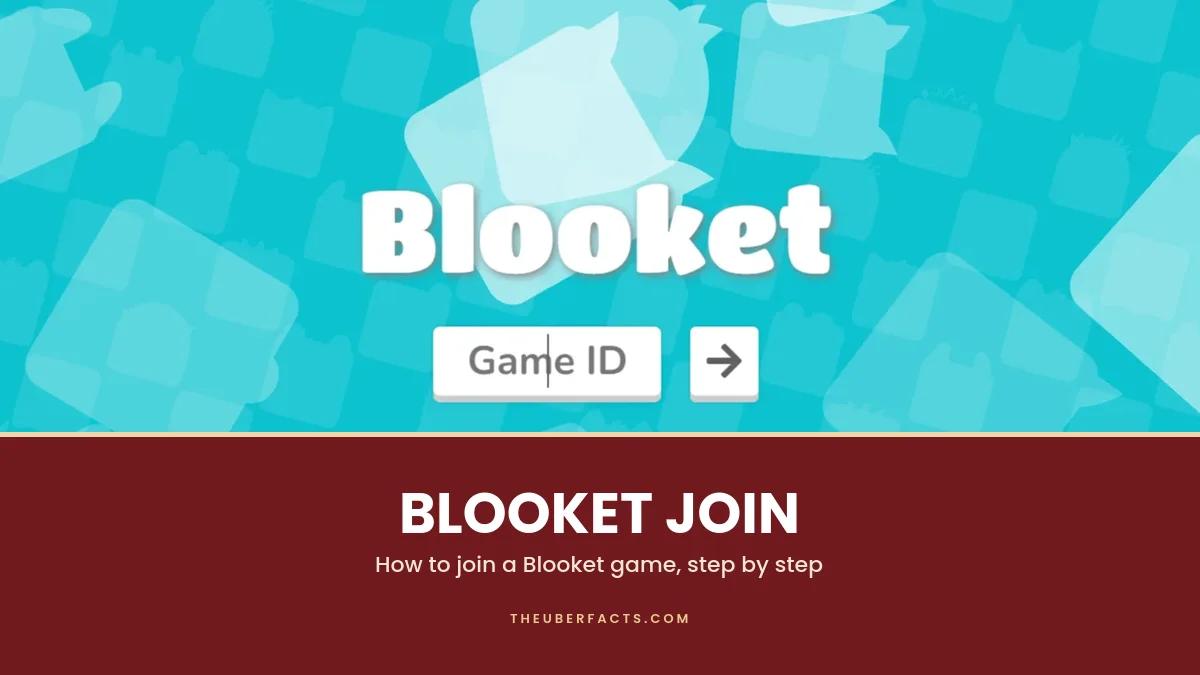
Blooket is a game based learning website for classrooms: a teacher picks a set of quiz questions, chooses a game mode, and students answer those questions on their own devices to score points in the game. Blooket join is the step players take to get into a live game: they go to play.blooket.com and enter the Game ID that the host shows on screen, or scan the host’s QR code, or open a join link. Blooket’s help centre is clear that players do not need an account to join a game. This guide covers joining, hosting, homework, game modes, the free plan against Plus, device needs, common code problems and Blooket’s age rules, all checked against Blooket’s own pages in November 2026.
Blooket at a glance
- What it is: an online quiz game platform for teachers, students and other players, pronounced “blue kit”.
- Who runs it: Blooket LLC, a company whose service is hosted in the United States. The footer of blooket.com says the site was created by Ben Stewart.
- Join page: play.blooket.com, where players type the Game ID.
- Game ID: a seven digit code shown on the host’s screen.
- Other ways in: QR code or a join link shared by the host.
- Account to join: not required for live games or homework.
- Account to host: required, plus a question set.
- Price: the Starter plan is free; Blooket Plus costs extra (prices below).
- Players per live game: up to 60 on Starter, up to 300 on Plus.
- Works on: any device with a web browser and an internet connection.
How to join a Blooket game
These are the steps from Blooket’s student guide. Your teacher or host must already have a game open, because the Game ID only appears once a game is hosted.
- Get in with one of three methods. Go to play.blooket.com and type the seven digit Game ID from the host’s screen, then press the arrow. Or scan the QR code on the host’s screen with your device camera. Or, if the host shared a join link, simply open it.
- Enter a nickname. This is the name shown on the game screen. If the host turned on “Use Random Names”, Blooket gives you a random name instead.
- Choose a Blook. Blooks are the small characters that represent players. You pick one while you wait in the lobby.
- Wait for the start. When everyone has joined, the host presses Start and the questions begin.
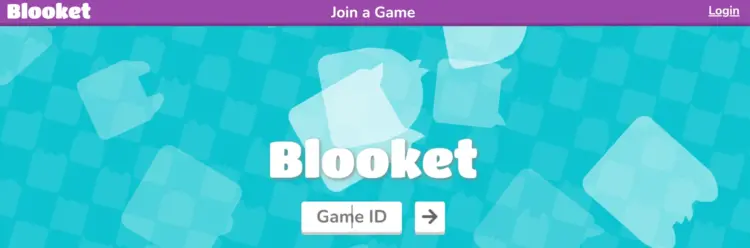
Type the address yourself rather than clicking an advert or a search result for a lookalike site. The real join page is on the blooket.com domain, and joining a live game only asks for the Game ID and a nickname, not a password.
Do you need a Blooket account to join?
No. Blooket’s help centre states that student accounts are not required to join live games or to complete homework. An account is optional. Students who log in before joining can use their own Blook and earn points, XP and tokens that are saved to their profile; tokens can be spent in the in game Market. A host can also switch off “Allow Student Accounts”, which hides the account creation prompts from students.
Blooket’s terms describe the no account mode directly: when students use a Game Code started by an account holder, they may have to give a username, and only their responses are collected.
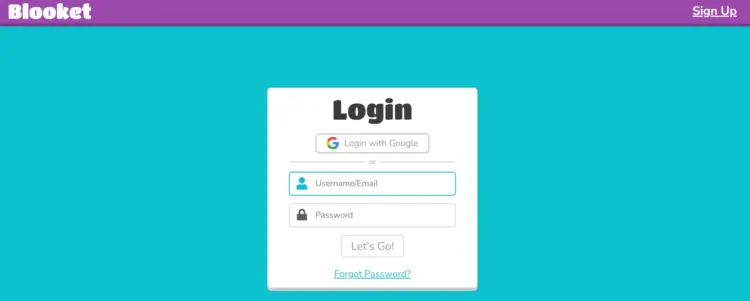
The login screen above is an earlier design; logging in now happens at id.blooket.com, but the choice is the same: sign in with Google or with a username or email and password. Usernames are case sensitive, so type yours exactly as you registered it.
How a teacher hosts a game and where the Game ID appears
To host, you need a Blooket account, a question set, a computer with an internet connection and at least one player with a connected device. The help centre lists the steps:
- Log in at blooket.com and open My Sets for your own question sets, or Discover to find a public set.
- Open a set, check it with Show Answers if you like, and select Host.
- Choose a live game mode. Each mode’s description box shows the skills it uses, its player limit and a suggested number of players.
- Adjust the settings and select Host Now.
The settings decide how the game ends (after a set time or when a player reaches a score goal) and how it behaves. Useful ones for joining are “Allow Late Joining”, which lets players come in after the game has started, “Use Random Names”, which replaces typed nicknames, and “Banned Blooks”. Blooket suggests that students use initials or first names so the report after the game is easier to read.
After you select Host Now, the lobby opens. This is where the Game ID, the QR code and the join link appear. Put the lobby on a projector or a large screen in class, or share your screen in a video call for a remote class. Players then join by one of the three methods above, choose a Blook, and you select Start when everyone is in.
Homework and solo play
Homework lets students play on their own schedule instead of in a live session. A teacher opens a question set, selects Assign (or Assign HW on a public set), sets a due date and a goal, chooses which game modes students may use, and selects Assign Now. The teacher then shares the homework link or QR code, for example in the school’s learning management system. On the free Starter plan the due date can be up to 14 days ahead; on Plus it can be up to 365 days. Students cannot open the homework after it closes.
For students, joining homework works like this:
- Open the homework link or scan the QR code. No Game ID is used for homework.
- Read the Homework Details screen: title, teacher, due date and the goal you must reach.
- Select Get Started, choose one of the allowed solo game modes and select Play.
- Type a nickname your teacher will recognise, then play until you meet the goal.
Finish in one sitting if you can: Blooket warns that closing the tab or leaving it inactive too long means starting again from the link or QR code. Once you meet the goal you can end the homework or keep playing, and your teacher sees the result either way.
Students with an account can also play solo games outside homework. They open any question set, select Solo, pick a mode and start a new game. The Arcade, reached from the Map page, starts solo games on Blooket Curriculum sets in Mastery Mode and saves progress on each skill.
Blooket game modes as of November 2026
Blooket’s help centre has an overview page for each of these game modes: Snake Escape, Claw Mania, Battle Royale, Crazy Kingdom, Blook Rush, Busy Bees, Café, Classic, Coco Cabana and Cocoa Cottage, Deceptive Dinos, Egg Hunt (seasonal), Factory, Fishing Frenzy, Gold Quest, Laser Tag, Mini Mine, Monster Brawl, Pirate Pool, Plushie Panic, Racing, Star Grazer, Study, Tower Defense, Tower Defense 2 and Zorblitz.
Not every mode is available everywhere. Blooket says the modes you can host may depend on your account, since some are only for Plus users, and that some games support only solo or homework play. Classic is a good example of a live mode: every player gets the same question at the same time, and faster correct answers earn more points. It can be played alone or in teams, with up to 60 players on the free plan or 300 on Plus.
Modes also differ in how hard they push a device. Blooket lists Classic, Gold Quest, Racing and Fishing Frenzy as friendly to older devices, and Tower Defense 2, Monster Brawl, Star Grazer and Zorblitz as more demanding.
Blooket free plan vs Blooket Plus
Students never pay to join a game. The plans matter to the teacher who hosts. The prices below are the ones shown on Blooket’s upgrade page in November 2026, in US dollars.
| Feature | Starter | Plus |
|---|---|---|
| Price | Free | $4.99 a month, yearly |
| Monthly option | None needed | Plus Flex, $9.99 |
| Live game size | Up to 60 players | Up to 300 players |
| Homework deadline | Up to 14 days | Up to 365 days |
| Game modes | Standard modes | Adds Plus only modes |
| Game reports | Basic | Per question, per student |
| Folders, audio | No | Yes |
The yearly Plus plan is billed as $59.88. Plus also adds a question bank, copying and merging of sets, and 10 extra tokens for students after every game. Schools and districts can buy Group Plans for several teachers. Blooket renews Plus every year and Plus Flex every month until it is cancelled in the account settings.
Devices and browsers
Blooket runs in a web browser, so there is nothing to install. Players need a device with an internet connection, such as a Chromebook, a laptop, a tablet or a phone; the host needs a computer. Blooket’s own troubleshooting guide gives setup tips for Chrome, Edge, Firefox and Safari and for Chromebooks, Windows and Mac.
Its advice for lag or freezing: close other tabs, plug the device in (Chrome’s Energy Saver can slow games below about 20 percent battery), try a private window to switch off extensions, clear cached images and files, and keep hardware acceleration turned on. On busy school networks it helps to let students join in small groups rather than all at once.
Why a Blooket code does not work
If the Game ID is rejected or the join page will not load, these are the usual causes, based on Blooket’s troubleshooting pages:
- A typing mistake. Check all seven digits against the host’s screen, or scan the QR code instead.
- The game is not open any more, or has started. A Game ID belongs to a game the host has open. If the game ended, ask for the new ID. If it already started and late joining is off, the host has to turn on “Allow Late Joining” or host again.
- You are on the wrong site. Make sure the address is play.blooket.com, not a copy site from an advert.
- A browser extension. Blooket says ad blockers and similar extensions are the main reason players cannot log in, join or host, even though Blooket shows no ads. Try a private window or turn the extension off.
- A school firewall. Live games use firebaseio.com for part of the backend. If a network blocks it, or blocks parts of blooket.com, joining fails. Blooket’s test page at debug.blooket.com shows what is blocked, and IT staff can allow the domains.
- “Access Blocked” on a school Google account. Select “request access” and tell the school’s Google Workspace administrator, who can allow Blooket as a third party app.
If none of this helps, Blooket’s support address is contact-us@blooket.com.
Blooket age rules, privacy and fair play
Blooket’s rules for children come from two documents. The Blooket Terms of Service (last updated 14 January 2026) say that only students who have been invited by their teacher, school or district may use the service, unless they are of an age in their country that allows them to create an account. They also note that the US Children’s Online Privacy Protection Act (COPPA) bars services from knowingly collecting personal information from children under 13 without verifiable parental consent, and that in a school setting the school can consent on behalf of parents.
The Blooket Privacy Policy (last updated 1 June 2026) states that Blooket does not let children under 13 create an account without the consent, and at the direction, of a parent or a school official acting in place of the parent. When a school uses Blooket in class, Blooket may rely on the school’s consent instead of each parent’s. For the European Union and the United Kingdom, the policy points to the GDPR rule that a child can consent alone only from age 16, unless a country has set a lower age, which cannot be under 13. Blooket’s help centre sign up page puts it simply: to create an account you must certify that you are above 13, or at least 16 outside the US.
Joining a game without an account asks only for a nickname, which is why young students can play in class without signing up. The privacy policy also says no student profile is shown publicly or to other students, although classmates can see names and scores when the teacher projects the game.
One more rule: Blooket’s terms forbid cheats, bots and hacks, so tools that claim to give free points or automatic answers break the terms of service.
Blooket Join FAQs
What is the website to join a Blooket game?
The join page is play.blooket.com. Type the seven digit Game ID shown on your host’s screen and press the arrow, or scan the host’s QR code or open the join link instead.
Do students need a Blooket account to join a game?
No. Blooket’s help centre says accounts are not required to join live games or to complete homework. Logging in is optional and lets students earn and keep XP, tokens and their own Blook.
Where does the teacher find the Blooket Game ID?
The Game ID appears in the lobby after the host picks a question set, chooses a game mode and selects Host Now. The same screen shows a QR code and a join link, so it is usually shown on a projector or shared in a video call.
Why does my Blooket code say it is invalid?
The code may be mistyped, the game may have ended, or it may have started with late joining switched off. If the code is right, an ad blocker or a school firewall blocking firebaseio.com can stop the join; Blooket’s test page at debug.blooket.com shows what is blocked.
Can I join Blooket homework with a Game ID?
No. Homework is opened with the link or QR code your teacher shares, not with a Game ID. You then pick an allowed solo game mode, type a nickname and play until you reach the goal set by your teacher.
Is Blooket free?
Yes, the Starter plan is free and students never pay to join a game. In November 2026 Blooket Plus cost $4.99 a month billed yearly ($59.88), or $9.99 a month as Plus Flex, and adds bigger games, longer homework deadlines and more game modes.
Can children under 13 use Blooket?
Yes, through school or with a parent. Blooket’s privacy policy says children under 13 can only create an account with the consent of a parent or of a school acting for the parent, and its terms say students may use the service when invited by their teacher, school or district.
Sources checked in November 2026: help.blooket.com, help.blooket.com (2), help.blooket.com (3), help.blooket.com (4), help.blooket.com (5), blooket.com, blooket.com (2), dashboard.blooket.com, help.blooket.com (6), help.blooket.com (7), help.blooket.com (8), help.blooket.com (9), help.blooket.com (10), help.blooket.com (11), help.blooket.com (12), blooket.com (3).