

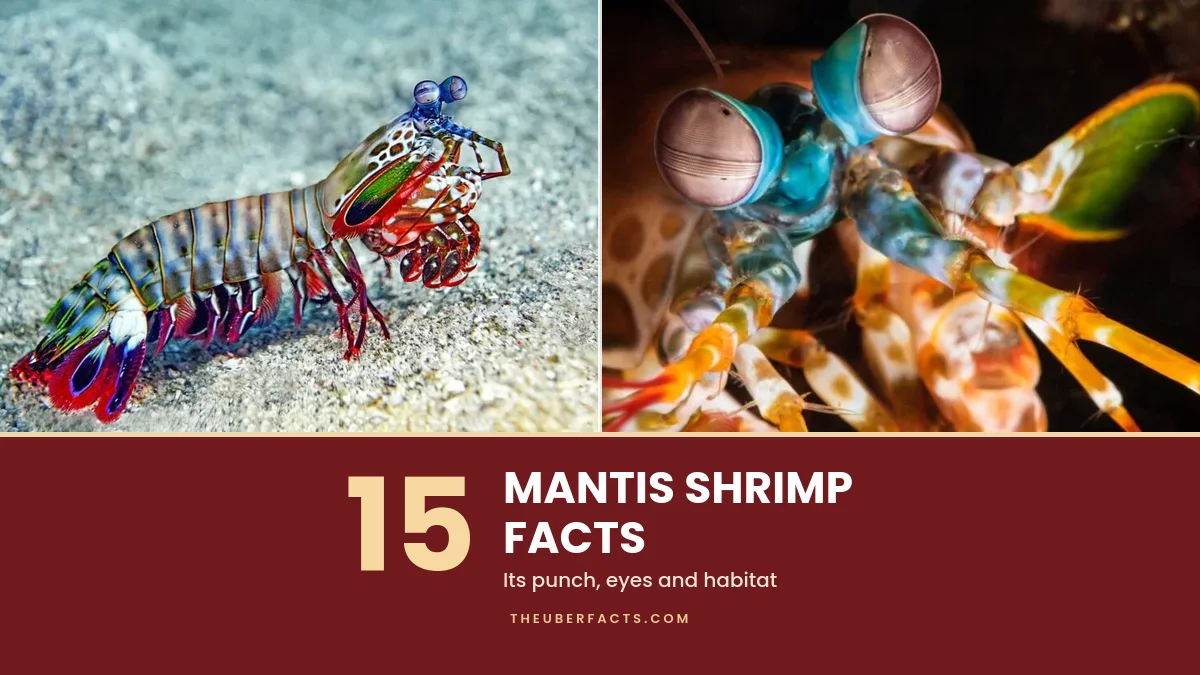
The mantis shrimp is a marine crustacean of the order Stomatopoda, a group of predators that lives mainly in warm, shallow seas. Despite the name, it is not a true shrimp. Mantis shrimp are best known for two things: a strike from their folded front limbs that is one of the fastest movements in the animal kingdom, and eyes with far more types of photoreceptor than human eyes.
The best studied species is the peacock mantis shrimp (Odontodactylus scyllarus) of the Indo-Pacific, the animal in the pictures on this page. Below are 15 mantis shrimp facts, each checked against museum, university and scientific sources, including the original research of biologist Sheila Patek on how the strike works.
Mantis shrimp at a glance
- Scientific group: order Stomatopoda, the only living order of the subclass Hoplocarida
- Class and phylum: Malacostraca (with crabs, lobsters and shrimp), phylum Arthropoda
- Number of species: about 450 to more than 500 described species, depending on the source
- Two hunting types: smashers, with a hard club, and spearers, with a barbed spike
- Best known species: peacock mantis shrimp, Odontodactylus scyllarus, a smasher
- Habitat: tropical and subtropical seas, mostly shallow water; burrows in sand or mud, or holes in rock and coral
- Range of the peacock mantis shrimp: Indo-Pacific, from eastern Africa to Guam, south of Japan and north of Australia
- Size: about 2.5 cm in the smallest species to 38 cm or more in the zebra mantis shrimp
- Diet: carnivore; crabs, snails, clams and other shelled prey for smashers, fish and shrimp for spearers
- Lifespan: about 4 to 6 years for the peacock mantis shrimp; pairs of some large spearers stay together for 15 to 20 years
- Strike speed: up to 23 meters per second (about 83 km/h or 51 mph) in the peacock mantis shrimp
- Eyes: up to 12 color photoreceptor types and 16 functional classes in all; can detect ultraviolet and polarized light
- Conservation status: the peacock mantis shrimp has not been evaluated by the IUCN and is not considered threatened
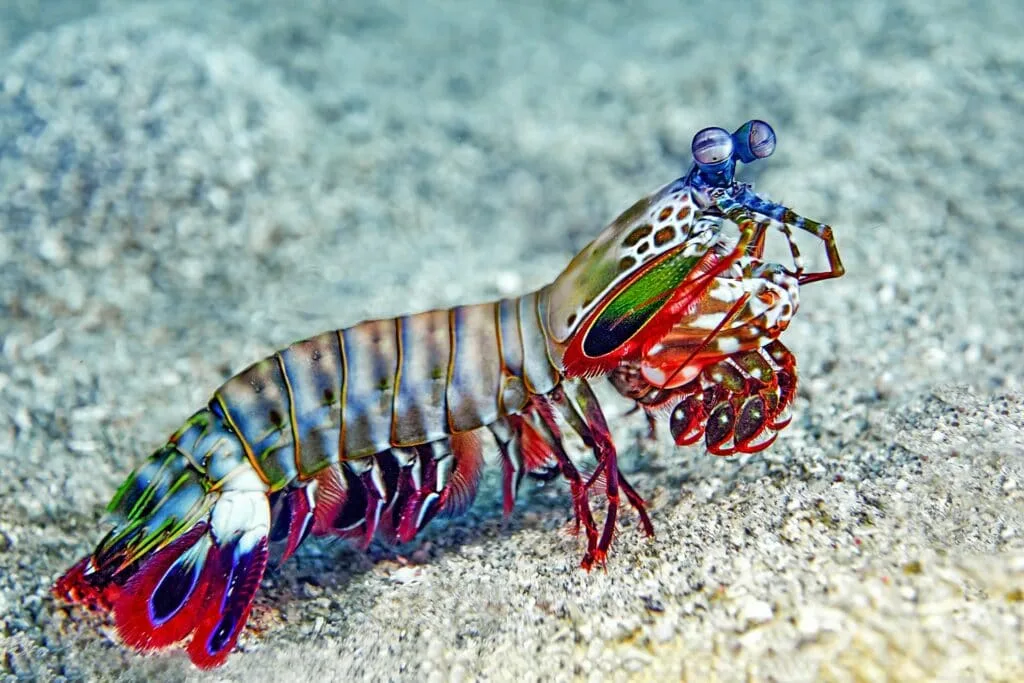
1. A mantis shrimp is not a true shrimp
True shrimp belong to the order Decapoda, the ten legged crustaceans that also include crabs and lobsters. Mantis shrimp sit in a separate order, Stomatopoda, which is the only living group of the subclass Hoplocarida. They are only distant relatives of shrimp, crabs and lobsters, as the University of California Museum of Paleontology points out. The name comes from the folded front limbs, which look like the arms of a praying mantis. Misleading common names are frequent in the animal world: the Mexican walking fish in our axolotl facts is a salamander, not a fish.
2. There are about 450 to 500 species
Counts vary as new species are described. A standard reference puts the order at about 450 species in 17 families and five superfamilies, while the UC Museum of Paleontology says more than 500 species are recognized. National Geographic gives “more than 400”. Some species are eaten: the Mediterranean and Adriatic support a fishery for Squilla mantis.
3. Smashers and spearers hunt in different ways
Every mantis shrimp uses a pair of raptorial appendages, the folded second pair of limbs, to strike. What the limb ends in splits the group into two types. Smashers, such as the peacock mantis shrimp, have a heavy, hardened club that cracks crabs, snails and clams. Spearers have a slim limb lined with sharp barbs that impales soft bodied prey such as fish and shrimp. Smashers mostly live in holes in rock and coral; spearers mostly dig burrows in sand or mud.
4. Spearers ambush; smashers go looking for food
Spearers are ambush hunters. A spearer sits in the mouth of its burrow, often with only its eyes showing, and waits. When a fish or shrimp passes, it shoots its barbed limbs out and up and drags the prey inside. Smashers do not wait in this way: they crawl or swim out to hunt, hit shelled prey repeatedly until it breaks, and carry it back to their hole. This sit and wait method is the same strategy the shoebill stork uses when it stands still over the water for long periods before striking at a fish.
5. The peacock mantis shrimp strikes at up to 23 meters per second
In 2004 Sheila Patek, then at the University of California, Berkeley, filmed the peacock mantis shrimp at 5,000 frames per second together with Wyatt Korff and Roy Caldwell. They measured club speeds of 14 to 23 meters per second, more than twice earlier estimates for mantis shrimp, as the UC Berkeley report on the study in Nature describes. 23 meters per second is about 83 km/h or 51 mph, one of the fastest limb movements known in any animal. The whole strike is over in less than three thousandths of a second.
6. A spring in the arm powers the strike
Muscles alone cannot move a limb that fast. The team found a saddle shaped structure in the arm that works like a spring: the animal loads it with muscle power, then releases the stored energy all at once. In a follow up paper, Patek and Caldwell describe accelerations of over 100,000 meters per second squared, more than 10,000 times the pull of gravity.
7. The blow can hit with over 1,500 newtons
In 2005 Patek and Caldwell measured the strike of the peacock mantis shrimp with a force sensor. Peak impact forces ranged from 400 to 1,501 newtons, which the authors describe as thousands of times the animal’s body weight. That is why smashers can break the shells of crabs and snails, and why the strike is often compared to the impact of a .22 caliber bullet.
8. Each strike makes a second hit with cavitation bubbles
The club moves so fast that the water pressure in front of it drops and vapor bubbles form. When the bubbles collapse, they release energy in a second hit. The 2005 study in the Journal of Experimental Biology found two force peaks in each strike, about 390 to 480 microseconds apart: the first from the club and the second from collapsing bubbles, with cavitation forces of up to 504 newtons. On average the cavitation peak was half the force of the impact, but it was sometimes higher. The collapse also gives off small flashes of light and wears down the surface of the club, which is renewed when the animal molts. The popular claim that the bubbles reach the temperature of the surface of the Sun was not found in this research and is not repeated here.
9. Yes, a mantis shrimp has cracked aquarium glass
The best documented case is from April 1998, when a peacock mantis shrimp about 10 cm (4 inches) long, nicknamed Tyson by staff, cracked a quarter inch (about 6 mm) glass wall at the Sea Life Centre in Great Yarmouth, England, and was moved to a stronger tank, as reported by National Geographic. Large smashers can damage thin tanks, so they are kept in thick glass or acrylic, but a mantis shrimp does not routinely break aquariums. Fishermen call them “thumb splitters” for a reason: both smashers and spearers can cut or bruise a hand that handles them carelessly.
10. Each eye moves on its own and judges depth alone
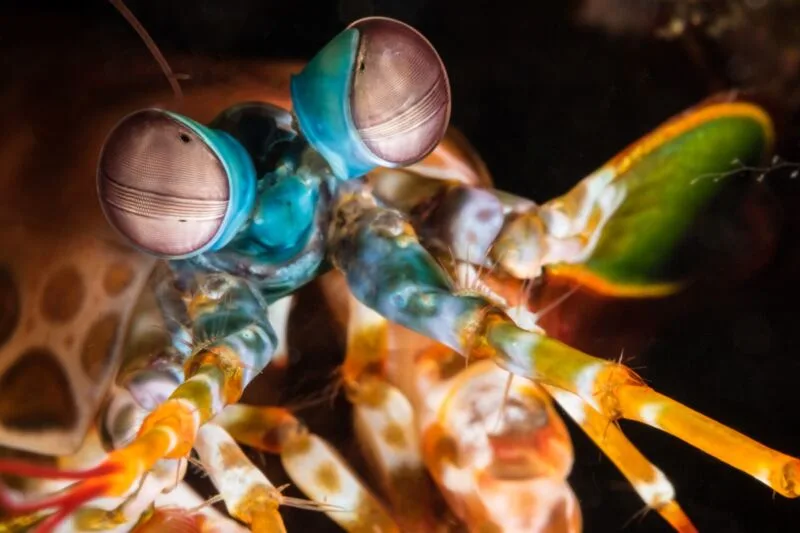
A mantis shrimp’s two compound eyes sit on mobile stalks, and each one moves independently of the other. Each eye is divided into three parts: an upper and a lower half with a band of specialized rows, the midband, between them. Because the three regions look at the same point, a single eye can judge depth and distance without the other, which is often called trinocular vision.
11. They have 12 types of color receptor, against our three
Humans see color with three types of cone. Some mantis shrimp have 12 photoreceptor types for color, covering wavelengths from deep ultraviolet to far red, about 300 to 720 nanometers. Counting the receptors that detect polarized light as well, the eyes hold 16 functional classes of photoreceptor, the most complex set known in any animal, according to a 2014 review by Thomas Cronin, Justin Marshall and colleagues.
12. Their color discrimination is weaker than ours
More receptors do not mean finer color vision. In a 2014 study in Science, Hanne Thoen and Justin Marshall at the University of Queensland trained the mantis shrimp Haptosquilla trispinosa to choose a color for food, then moved the second color closer and closer until the animals made mistakes. They could only tell apart colors that differed by about 15 to 25 nanometers in wavelength, while humans can separate colors about 5 nanometers apart. The researchers suggest that mantis shrimp recognize colors quickly from which receptor responds, as they scan their eyes, instead of comparing receptors the way human brains do.
13. Mantis shrimp can see circularly polarized light
Many animals detect linearly polarized light, but in 2008 a team from the University of Maryland, Baltimore County and the University of Queensland showed that mantis shrimp can also tell apart left handed and right handed circularly polarized light. It was the first animal known to do this. Special rows in the midband convert the circular signal for the receptors beneath, and parts of the body of some Odontodactylus species reflect circularly polarized light, which may be used as a private signal between mantis shrimp. The eyes have also inspired engineers: cameras that copy their polarization filters have been built to help spot cancerous tissue. The mantis shrimp itself does not detect cancer, a claim that circulated in older articles.
14. They live in burrows in warm, mostly shallow seas
Most mantis shrimp live in shallow tropical and subtropical waters, and a few live in cool temperate seas or as deep as 1,500 meters. The peacock mantis shrimp lives at depths of about 3 to 40 meters and digs U shaped burrows in sand and rubble near the base of coral reefs, according to the University of Michigan Animal Diversity Web, which records a lifespan of about 4 to 6 years. The order ranges in length from about 2.5 cm in Nannosquilla decemspinosa to 38 cm or more in the zebra mantis shrimp, Lysiosquillina maculata. For animals at the opposite extreme of age, see which animal has the shortest life span.
15. Some spearers pair for life
Most mantis shrimp live alone and meet only to mate. A few spearers in the families Lysiosquillidae and Nannosquillidae are different: a male and a female share one burrow for years. The female guards the eggs and the male hunts for both. Pairs of the zebra mantis shrimp may stay together for 15 to 20 years, as long as both partners live, and Roy Caldwell of UC Berkeley had been following one pair in Hawaii since 1985, the National Wildlife Federation reported in 2005. Long term monogamy like this is very rare among invertebrates.
Mantis shrimp FAQs
Is a mantis shrimp a shrimp?
No. Mantis shrimp belong to the order Stomatopoda in the subclass Hoplocarida, while true shrimp are decapods. They are only distant relatives of shrimp, crabs and lobsters.
How fast is a mantis shrimp punch?
Sheila Patek and colleagues measured the club of the peacock mantis shrimp at 14 to 23 meters per second, up to about 83 km/h or 51 mph. The strike is over in less than three thousandths of a second.
How strong is a mantis shrimp punch?
In the 2005 study by Patek and Caldwell, peak impact forces of the peacock mantis shrimp ranged from 400 to 1,501 newtons. Collapsing cavitation bubbles added a second force peak of up to 504 newtons.
Can a mantis shrimp break aquarium glass?
It has happened. In 1998 a peacock mantis shrimp about 10 cm long cracked a quarter inch glass wall at the Sea Life Centre in Great Yarmouth, England, so large smashers are kept in strong tanks.
Do mantis shrimp see more colors than humans?
They have 12 color receptor types against our three, but a 2014 study found they tell apart only colors about 15 to 25 nanometers apart, while humans manage about 5. They seem to recognize colors quickly rather than discriminate fine shades.
Are mantis shrimp dangerous to humans?
They are not aggressive toward people, but they can injure a hand that grabs or handles them. Fishermen nicknamed them thumb splitters because of such injuries.
How long do mantis shrimp live?
The peacock mantis shrimp lives about 4 to 6 years, according to Animal Diversity Web. Some large spearers live much longer: pairs of the zebra mantis shrimp may stay together for 15 to 20 years.
Sources checked in November 2026: ucmp.berkeley.edu, encyclopedia.com, newsarchive.berkeley.edu, journals.biologists.com, nationalgeographic.com, nationalgeographic.com (2), nwf.org, ucmp.berkeley.edu (2), news.uq.edu.au, research-information.bris.ac.uk, nationalgeographic.com (3), pmc.ncbi.nlm.nih.gov, sciencedaily.com, animaldiversity.org, ece.illinois.edu.