

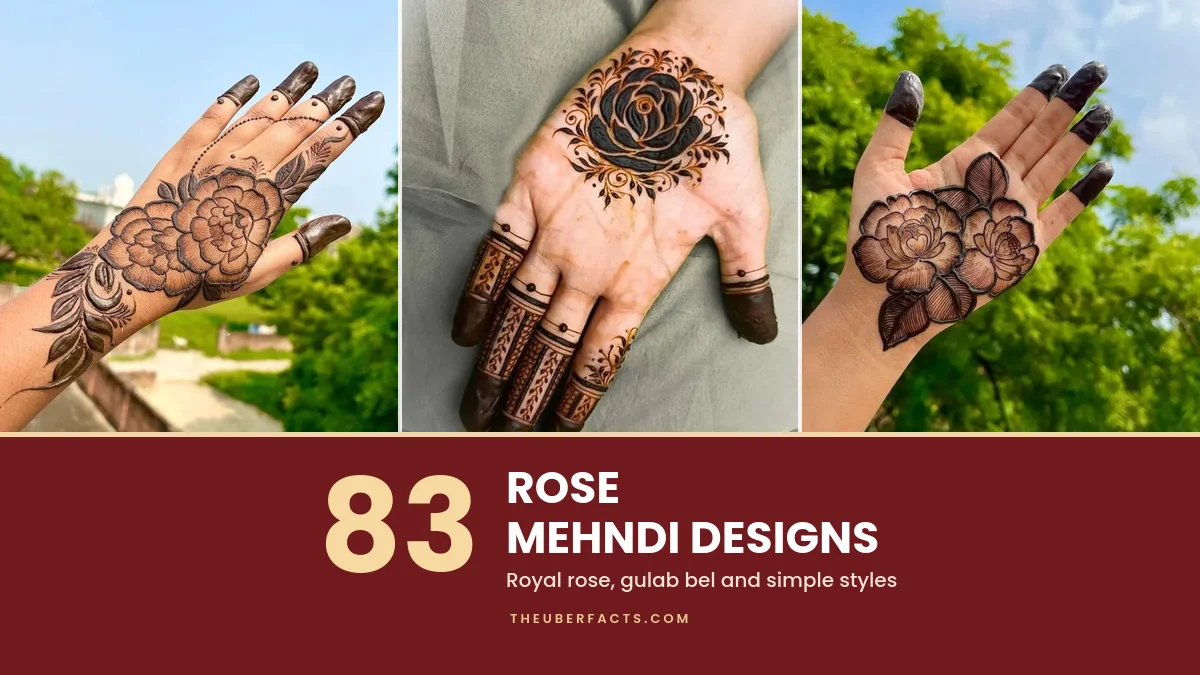
A rose mehndi design uses the rose, called gulab in Hindi and Urdu, as its main motif. The rose can be one large shaded flower that fills the back of the hand, a trail of small roses running from a finger to the wrist, or a single spiral bud in the centre of the palm. Because a rose is built from curved petals that overlap, it gives a design more depth than a flat five-petal flower, and the way the petals are shaded decides whether it looks simple or royal.
This page shows 83 rose mehndi designs, each with a photo and a short note on what sets it apart: how the rose is drawn, where it sits on the hand, how much skin it covers and how hard it is to apply. The first sections are all roses: royal shaded roses, back hand and palm placements, bridal full hands, bridal feet and wedding photo ideas, and easy roses for beginners. The last three sections hold the floral, leaf and mandala designs that were published with this collection and pair well with a rose.
Rose Mehndi Design at a Glance
- Other names: gulab mehndi design, royal rose mehndi, rose flower mehndi design, rose bel mehndi.
- Ways the rose is drawn: spiral rose, layered petal rose, shaded rose, rose with leaves, rose bel (vine) and rose cut out of a filled background.
- Where it is applied: back hand on a diagonal, centre of the palm, wrist and forearm, fingers and the top of the foot.
- Style families: Arabic and Gulf style with one bold rose and open skin, Pakistani and Indo-Arabic shaded roses, and Indian bridal designs where roses sit between jaal (net) and lattice.
- Skill level: beginner for a spiral rose, intermediate for a layered rose with leaves, advanced for a large shaded royal rose.
- Time to apply: about 5 minutes for one small rose, 20 to 40 minutes for a back hand bel, 2 to 4 hours for bridal hands and arms.
- Stain colour: orange when the paste comes off, deepening to red-brown or maroon over 24 to 48 hours. Thick outlines stain darker than thin shading.
- How long it lasts: 1 to 3 weeks, longest on the palm.
- Popular occasions: Eid ul-Fitr and Chand Raat, Eid ul-Adha, mehndi night and weddings, Karwa Chauth, Teej and Diwali.
Royal Rose Mehndi Designs with One Large Shaded Rose
A royal rose mehndi design is built around one big rose with many overlapping petals, shaded so that the centre looks deeper than the edges. Everything else on the hand, leaves, a few finger bands or a chain, is kept light so the rose stays the focus. These designs need a steady hand and a fine-tipped cone, and they look best on clean skin with a dark stain.

1. Shaded rose with a flower cluster. One large shaded rose sits low on the back of the hand, with a cluster of small flowers above it and a trail of leaves running down to the wrist. Fine leaf bands on the fingers finish it without stealing attention.
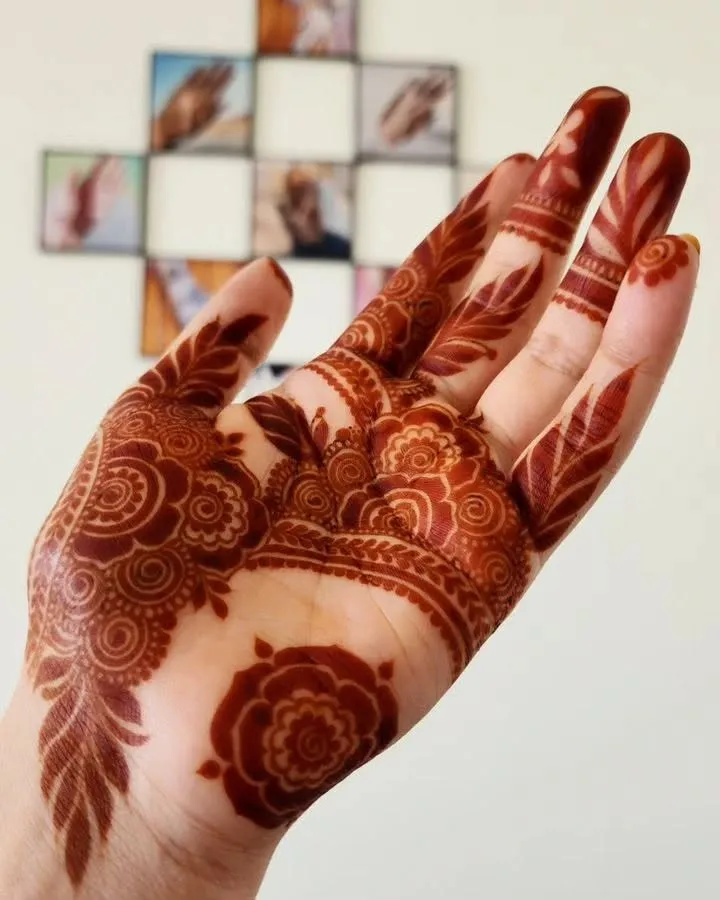
2. Maroon palm roses. Big layered roses cross the palm in a deep maroon stain, a second rose sits on the wrist, and the fingers carry leaf shapes. The colour shows how dark a rose can go on palm skin.
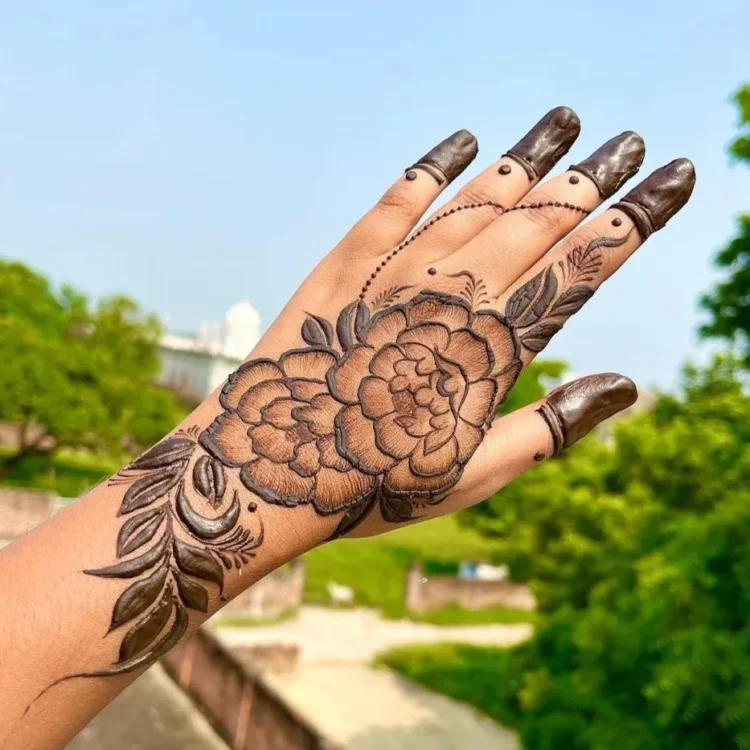
3. Realistic rose with a dotted chain. A realistic rose with dozens of shaded petals covers the middle of the back hand. Leaves trail to the wrist, a dotted chain runs to the index finger, and the fingertips are fully dipped.
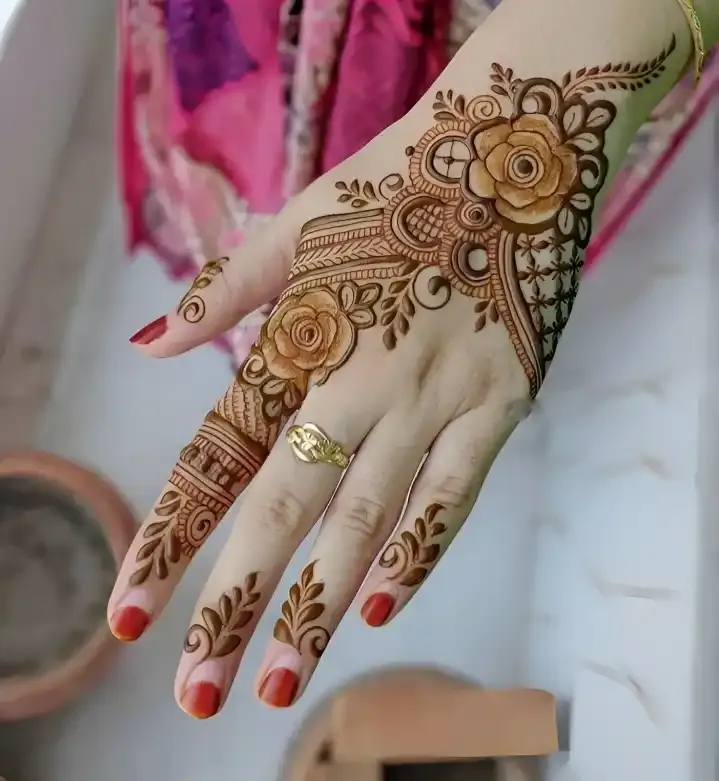
4. Two roses with geometric lines. Two shaded roses in a golden fresh stain are linked by straight geometric lines and a small lattice panel. Leaf sprigs on the fingers keep the Arabic look light.
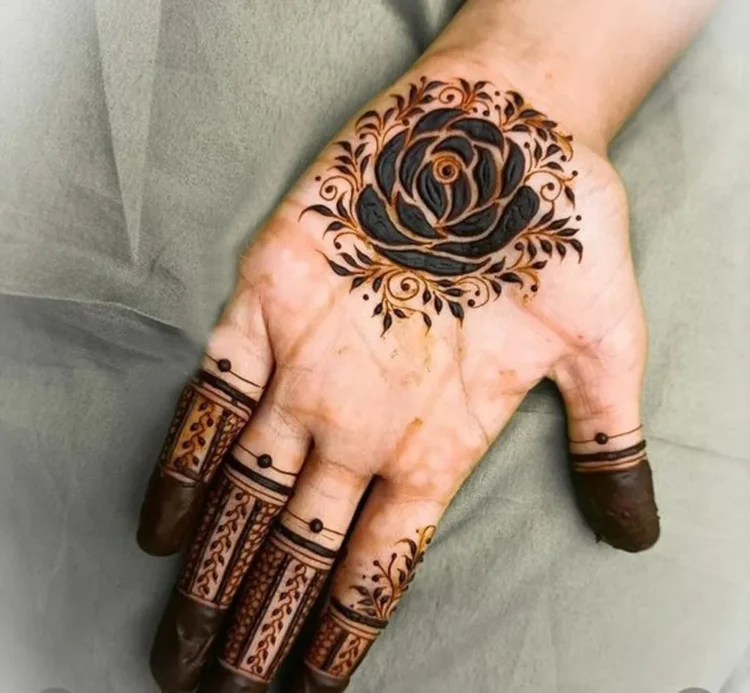
5. Solid rose in the palm. The rose is filled almost solid, with only thin petal lines left as bare skin, and a ring of curling filigree frames it. The fingers carry bands and a dipped thumb, so the palm centre stays the star.
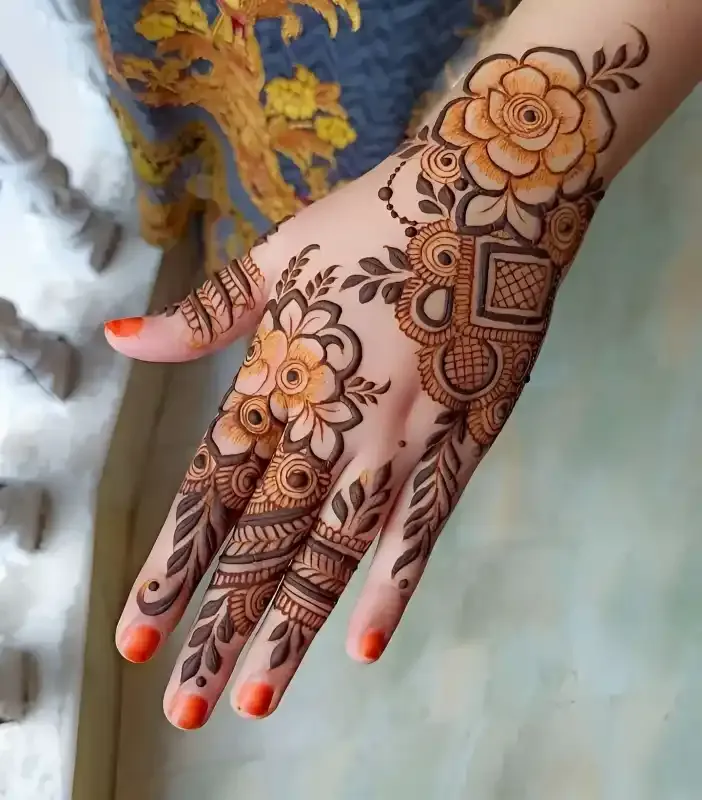
6. Wrist rose with a diamond motif. A shaded rose sits on the wrist above a diamond set inside a square, and a smaller rose with leaves rests near the knuckles. Leaf sprays fill the fingers.
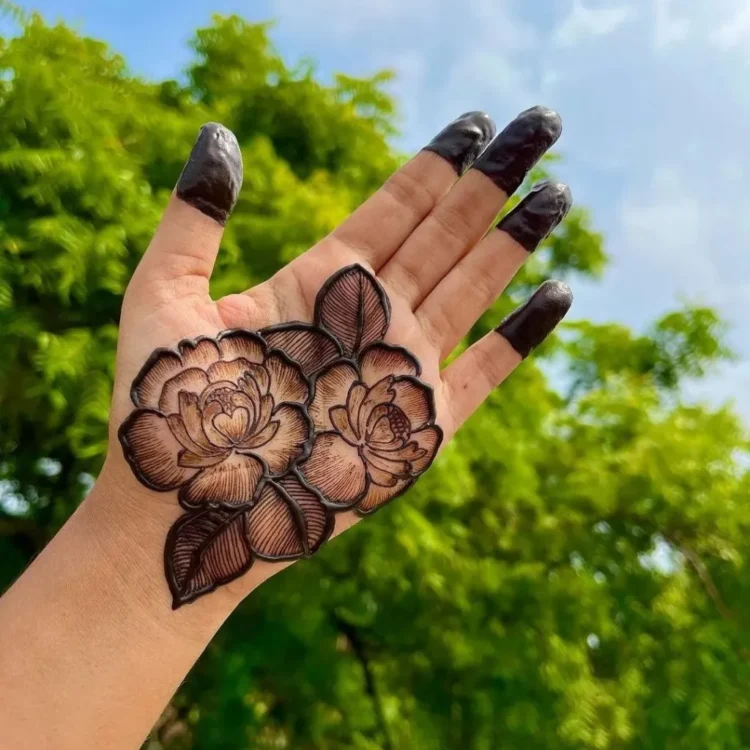
7. Two outlined roses with hatching. Two large roses and their leaves are drawn in outline and shaded with fine hatched lines, like a pencil sketch. The rest of the palm is bare apart from dipped fingertips, which gives a modern look.
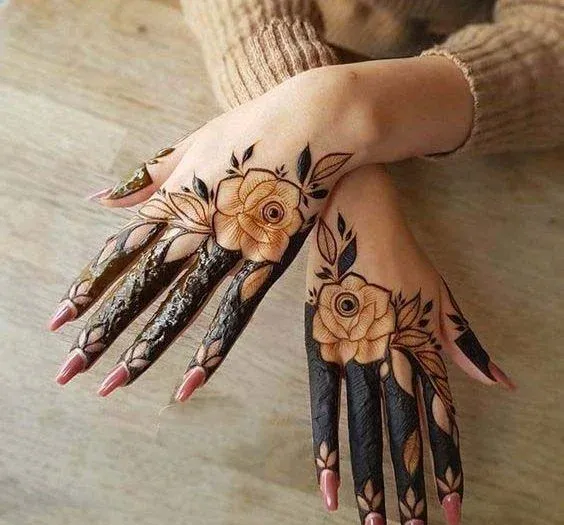
8. One rose per hand with filled fingers. Each back hand has a single shaded rose with a few leaves, and the fingers are filled dark with leaf shapes left in bare skin. The contrast between the soft rose and the heavy fingers is the whole idea.
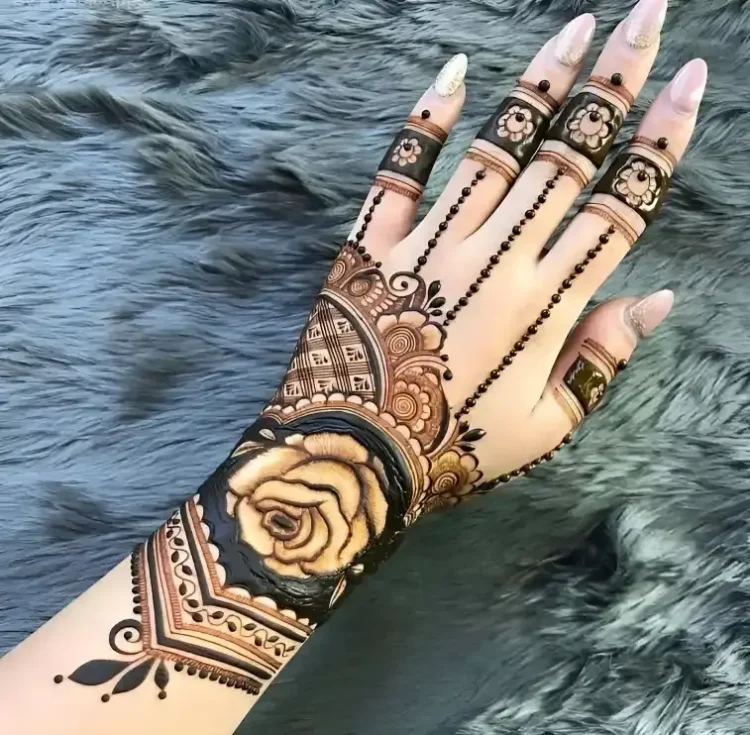
9. Rose in a black wrist band. A big rose is framed by a solid band of paste at the wrist, edged with a lace border. Fine dotted chains run up to rings on the fingers, in the style of a haath phool (hand chain).
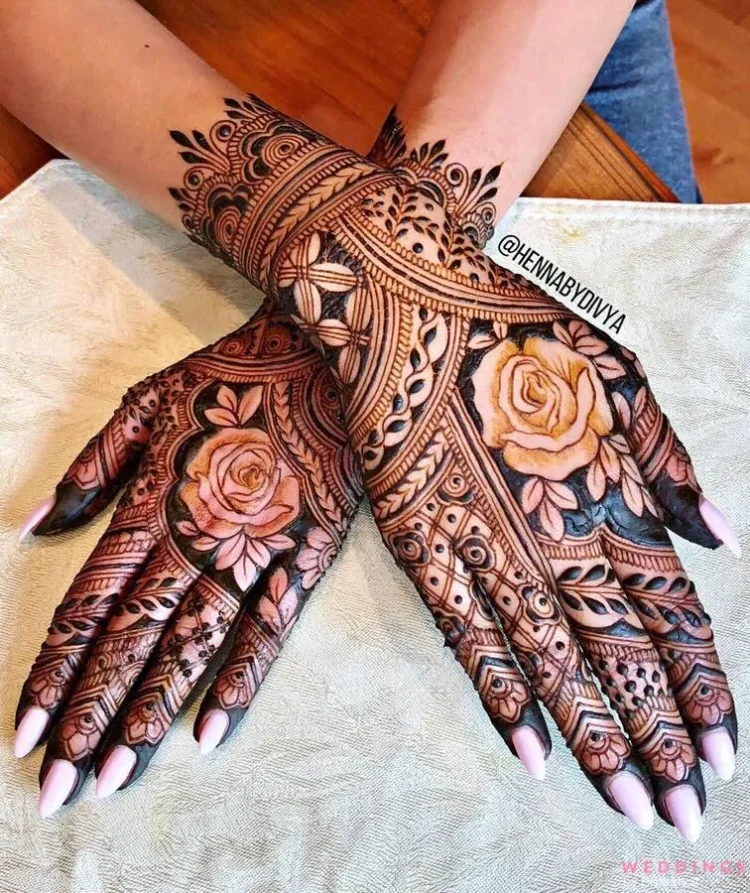
10. Crossed hands with shaded roses on dark fill. Each back hand carries one large shaded rose set against a dark filled background, with leaf vines and fine patterns running down every finger. Where the hands cross, wide bands with leaf veins wrap the wrists.
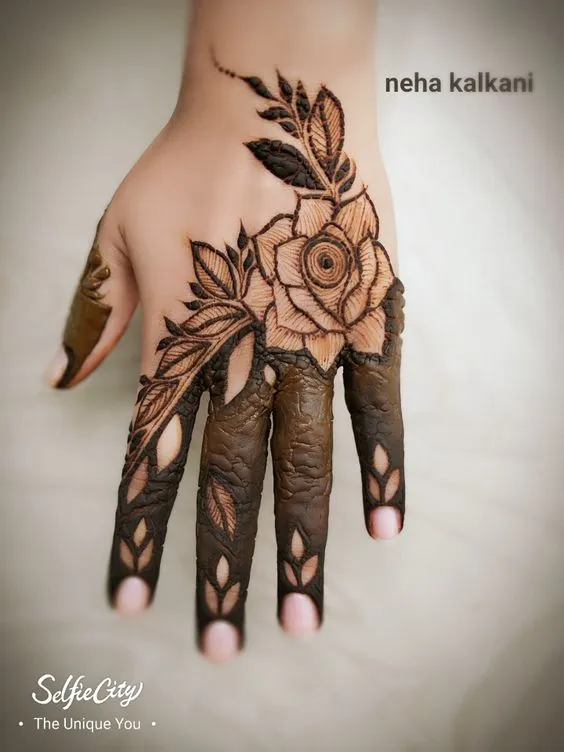
11. Rose with tall leaves and solid fingers. A single shaded rose sits at the knuckles, and a stem of tall leaves rises from it toward the wrist. Three fingers are filled solid with small leaf shapes left bare near the tips, a heavy contrast to the open rose.
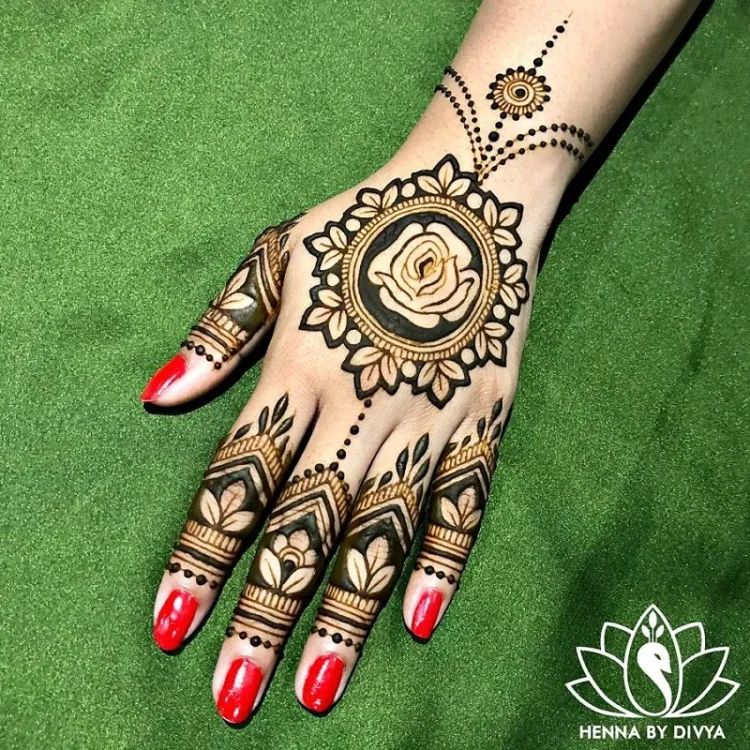
12. Rose inside a dark circle. The rose is left as bare skin inside a solid dark disc, ringed by a border of small leaves. Dotted chains link it to a small mandala at the wrist, and each finger carries a chevron band with leaf motifs.
Rose Mehndi Design for Back Hand: Bel, Bands and Full Cover
On the back of the hand a rose is usually placed on a diagonal, from the index finger knuckle down toward the outer wrist, which follows the natural line of the hand. A rose mehndi design for the back hand can be one bel (vine) of roses with open skin around it, or a full cover of roses mixed with lattice. The back hand stains a shade lighter than the palm, so slightly thicker outlines help. More ideas for this side are in our back hand mehndi designs and royal back hand mehndi designs.

13. Fern-leaf rose with a knuckle band. A rose with long fern-like leaves spreads across the back hand toward the wrist. A wide band of small roses and scrolls crosses the knuckles, and the fingers are filled with a checkered lattice.
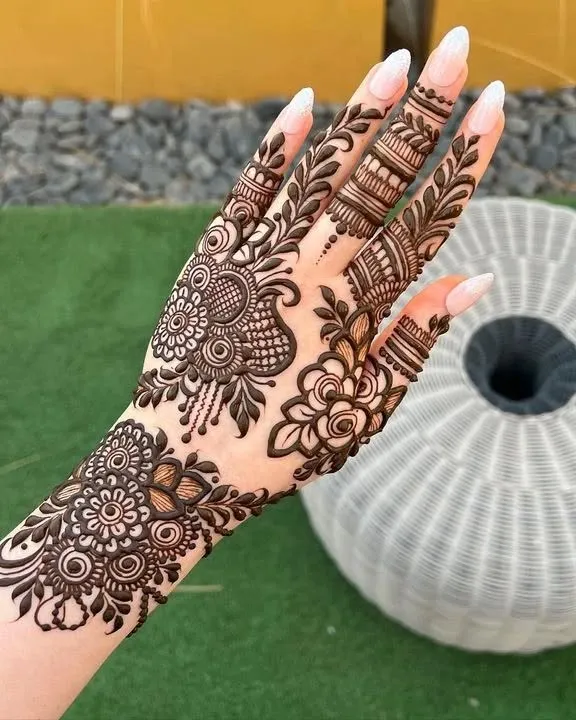
14. Spiral roses with a lattice mandala. Clusters of spiral roses and leaf sprays grow out of a mandala with lattice fill on the side of the hand. A second mandala covers the wrist, so the design reads as heavy party mehndi.
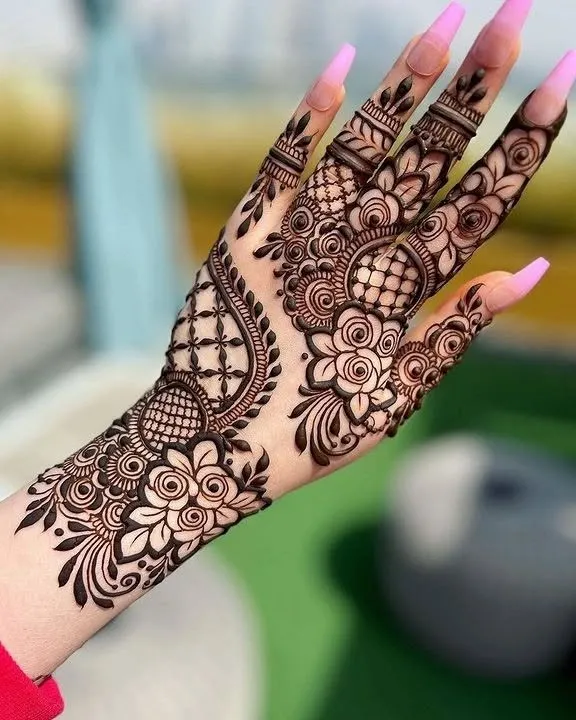
15. Lattice panel with rose clusters. A curved lattice panel runs diagonally across the hand, and spiral rose clusters fill the knuckles and the base of the fingers. The mix of straight net and round roses keeps it balanced.
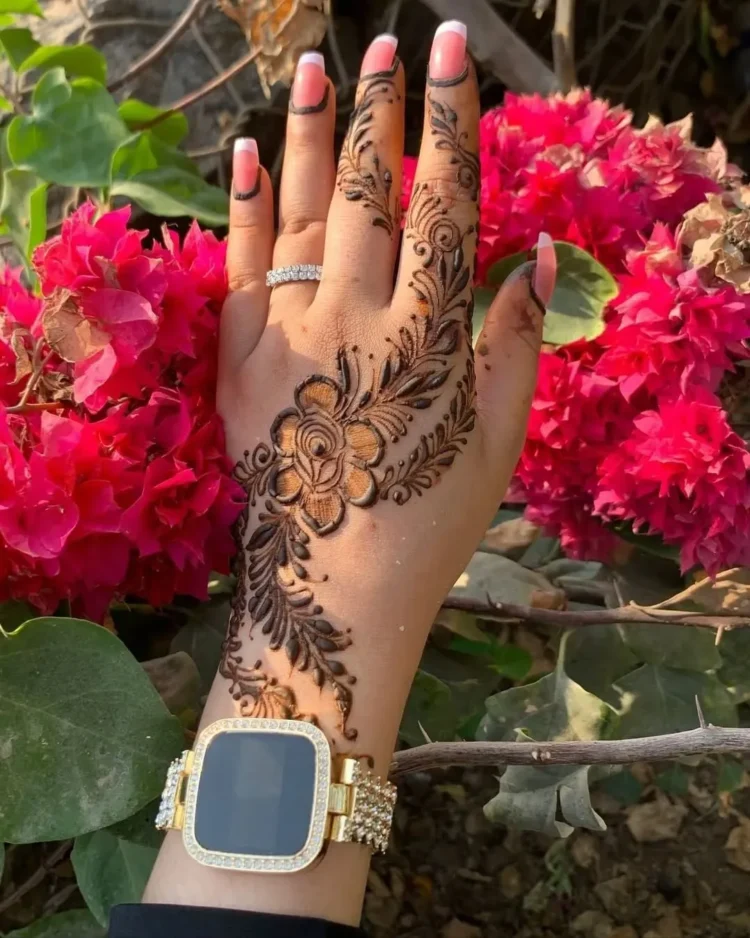
16. Diagonal rose bel. A single bel of shaded roses and leaves runs from the middle finger to the wrist, leaving the rest of the hand bare. It takes about 20 minutes and suits Eid or a wedding guest outfit.
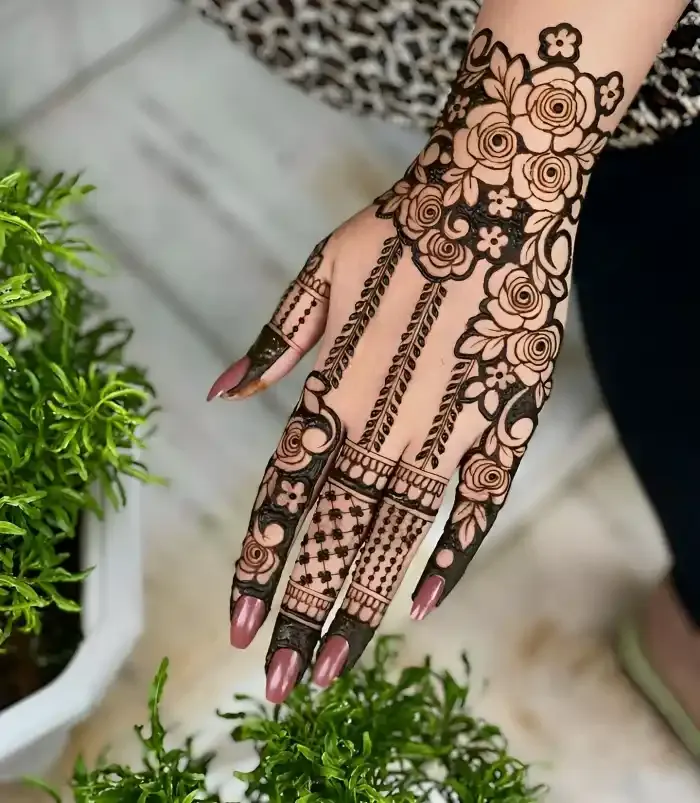
17. Rose cuff with finger lines. A cuff of outlined roses wraps the wrist, and straight vertical lines drop from it to fingers filled with checks and lattice. Roses repeat on one finger to tie both parts together.
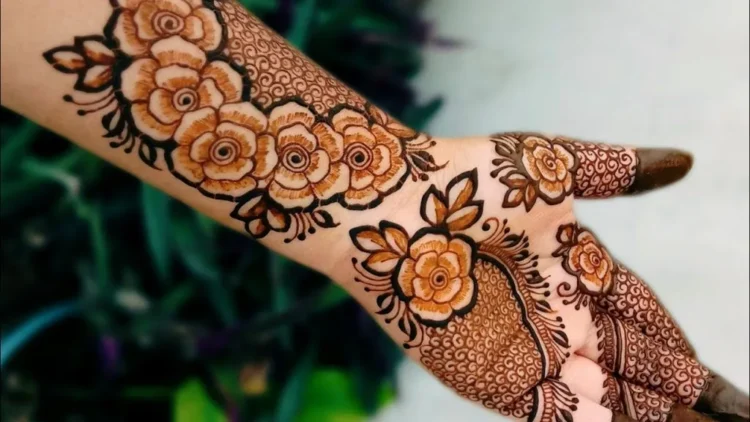
18. Row of orange roses on the forearm. A row of shaded roses with dark outlines follows the forearm and ends in a smaller rose on the hand. Dotted fill around them makes the orange petals stand out.
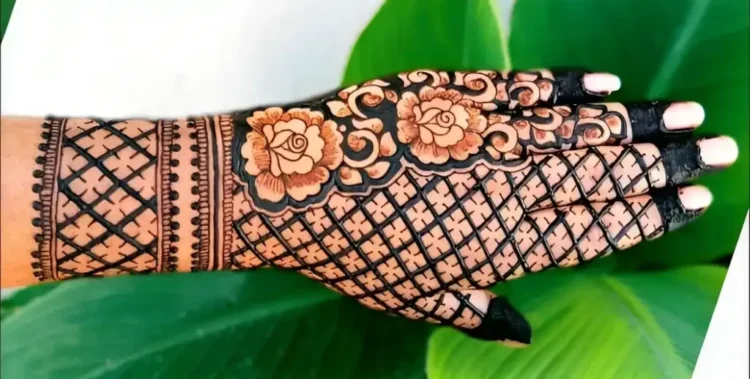
19. Roses over a full net. Roses sit in a band across the knuckles while a bold lattice net covers the rest of the hand and the wrist. The repeated net is quick to draw and makes the roses look like embroidery.
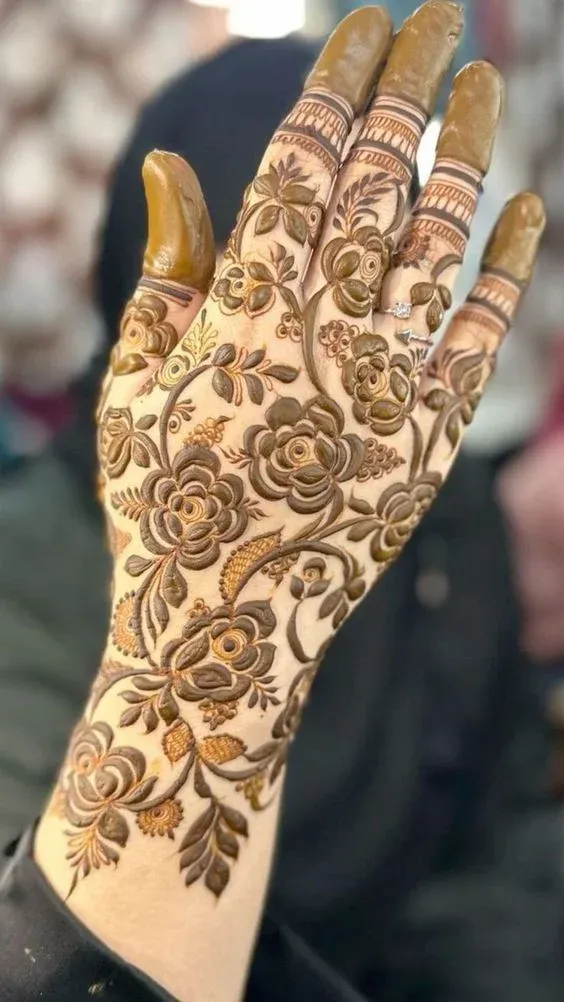
20. Back hand covered in rose vines. Small layered roses on curling vines cover the whole back of the hand, shown with the paste still on the fingertips. Even spacing between the roses is what makes this full design look calm.
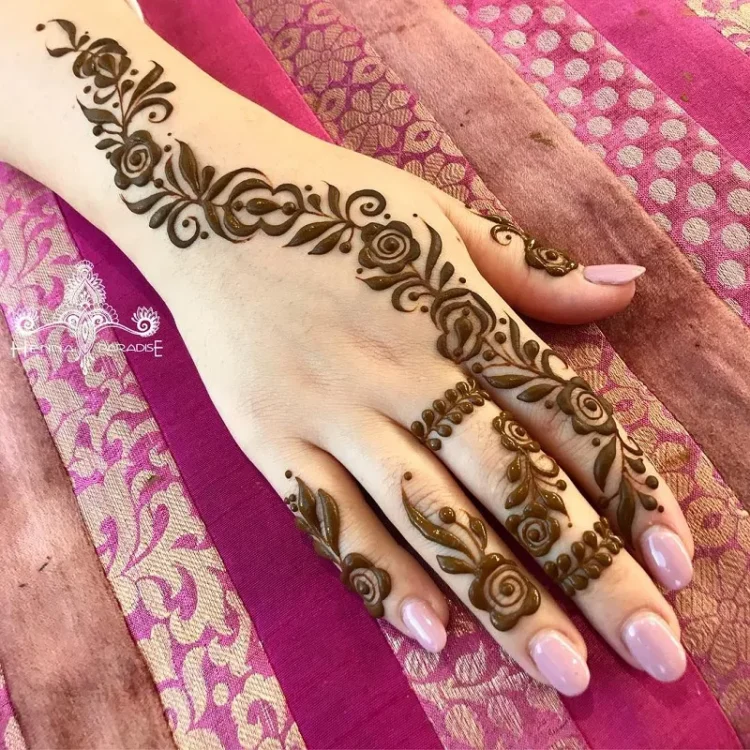
21. Bold rose bel to the index finger. Small spiral roses and leaves form one thick bel from the wrist to the index finger, and short rose sprigs repeat on the other fingers. Bold lines like these stain evenly and are easy to see from a distance.
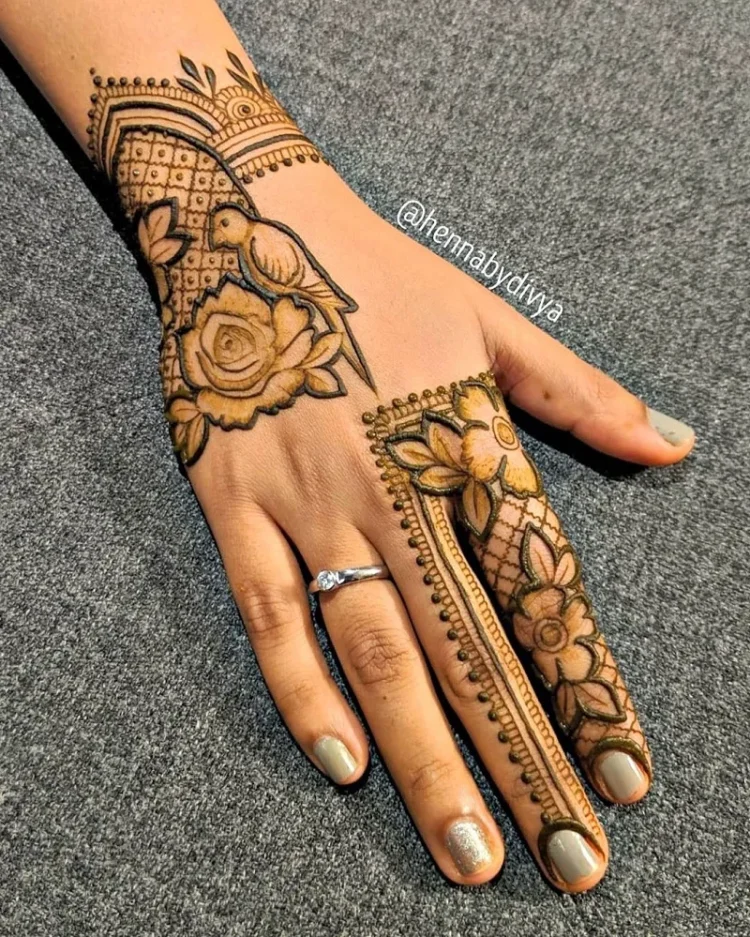
22. Rose with a bird and lattice. A shaded rose sits below a small bird and a lattice panel topped by a half mandala at the wrist. One finger is fully patterned with roses and a dotted edge, while the other fingers stay bare.
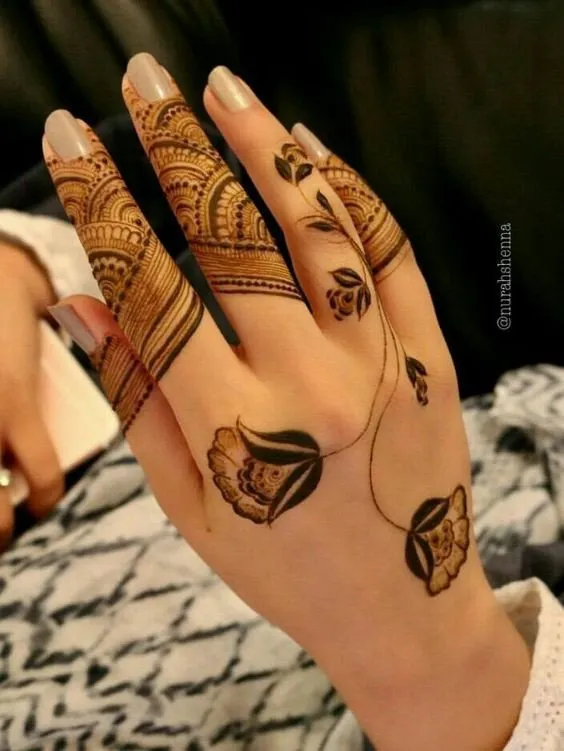
23. Rose buds on long stems. Two rose buds hang from long thin stems that start on the middle finger, leaving the rest of the back hand open. Two fingers are covered in fan and band patterns, which keeps the look light and modern.
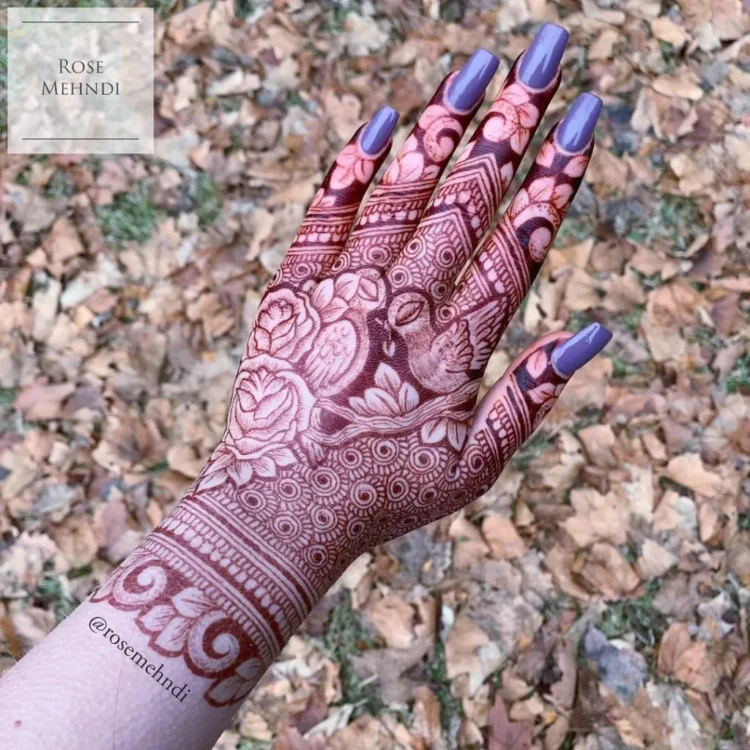
24. Full cover roses in a deep red stain. Large outlined roses and leaves cover the back hand, a panel of small circles sits above the wrist and a band of scrolls closes the design. Small roses continue up the fingers, so almost no skin is left bare.
Rose Mehndi Design for Front Hand (Palm)
Palm skin is much thicker than the skin on the back of the hand, so a rose drawn on the palm stains darker and lasts longer. Roses on the front hand are placed either in the centre of the palm or along a curve from the wrist to the index finger. For more palm layouts see our front hand mehndi designs and royal front hand mehndi designs.
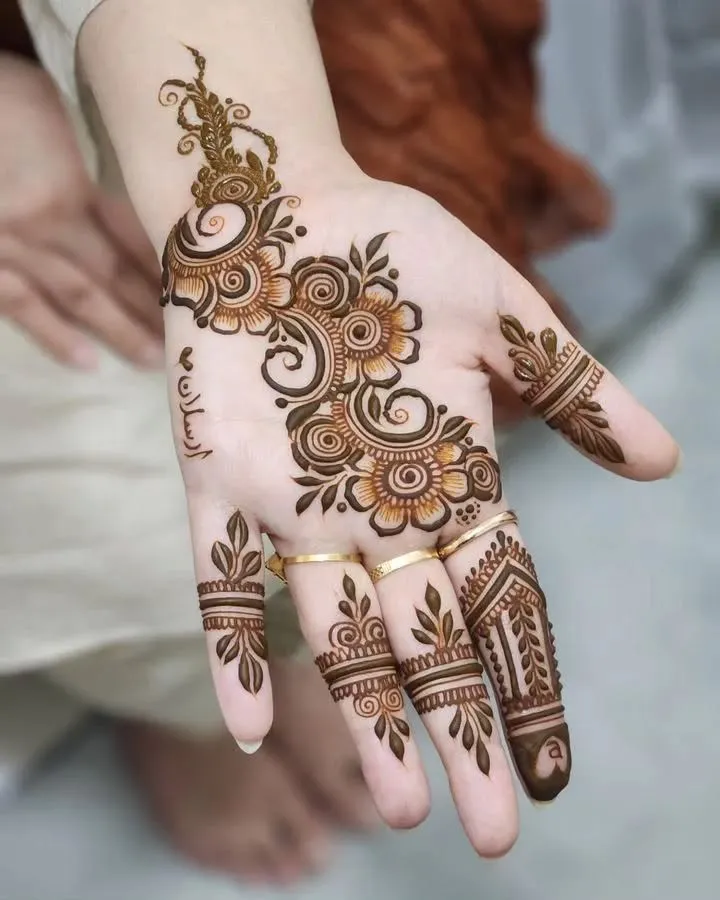
25. Spiral roses with a name. Spiral roses and open swirls curve from the wrist toward the index finger, and a name is written beside them in Urdu script with a small heart. Each finger has a band with leaf sprigs.
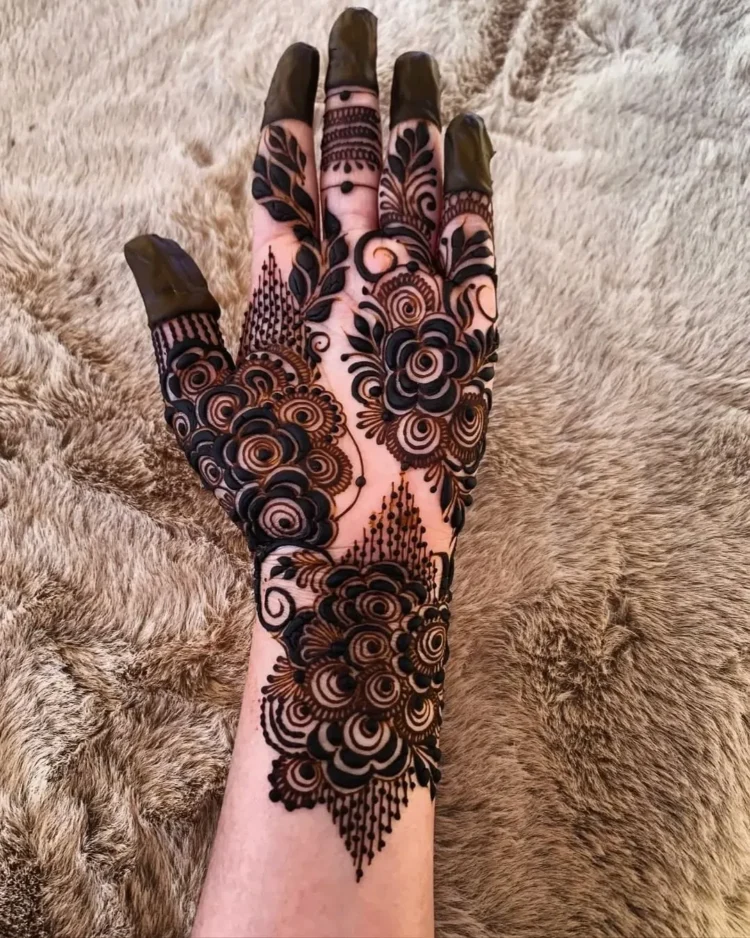
26. Dark packed roses. Bold roses with thick outlines are packed from the wrist to the base of the fingers, with a small lattice triangle between them. The paste is still on, which is why the design looks almost black.
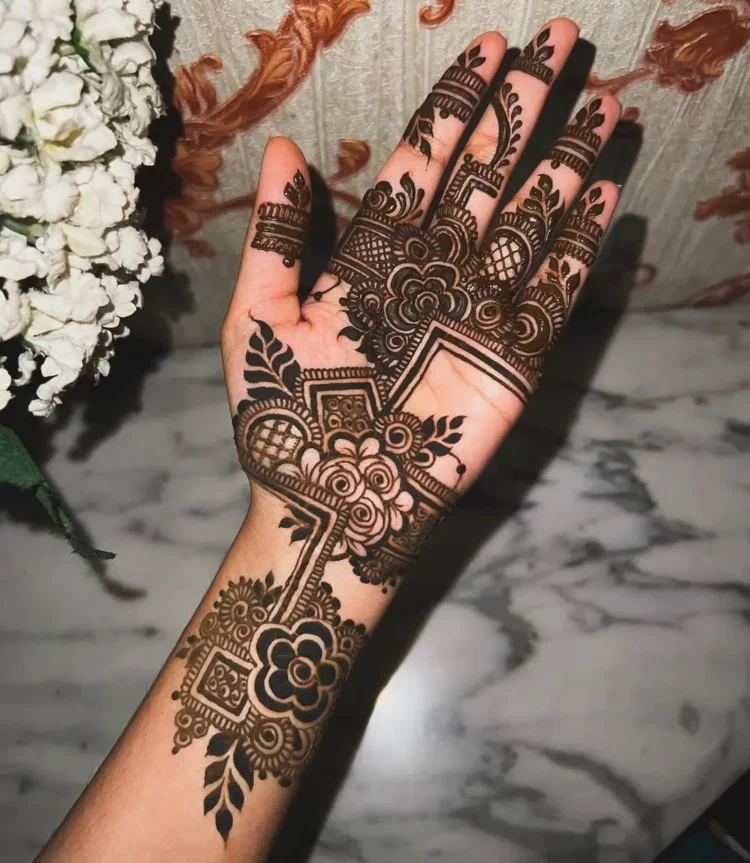
27. Roses in a geometric frame. Roses are set inside straight square frame lines that run from the palm down the forearm, ending in a rose on the arm. The mix of rose and geometry is typical of modern Pakistani mehndi.
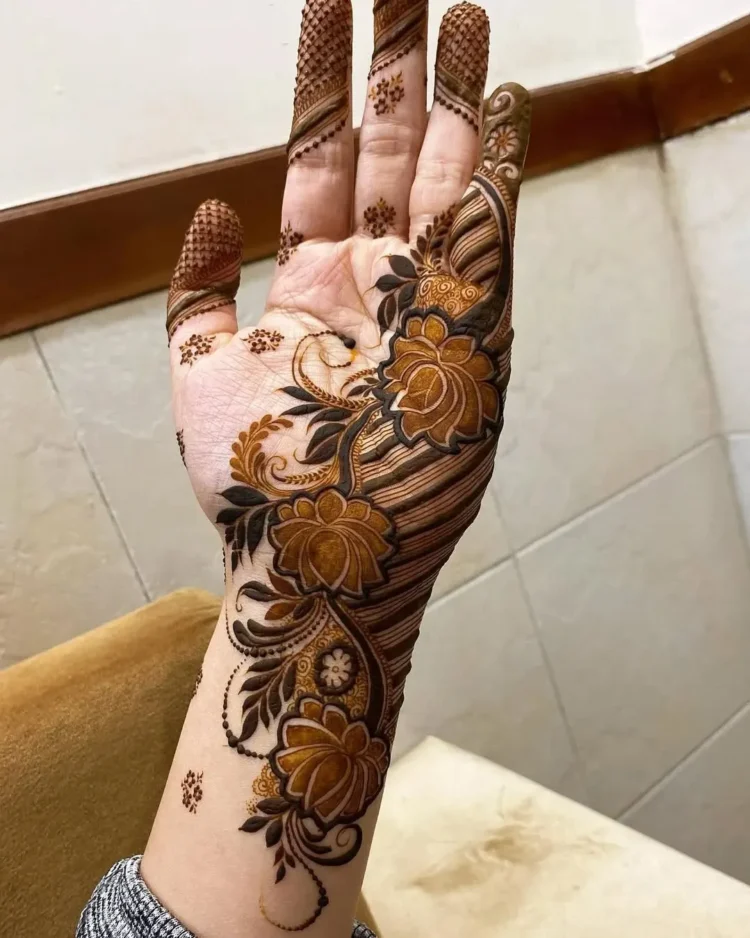
28. Shaded roses on a striped band. Orange shaded roses and leaves follow a diagonal band of stripes from the wrist to the fingers. Two fingers carry fine lattice, and the rest of the palm is left open.
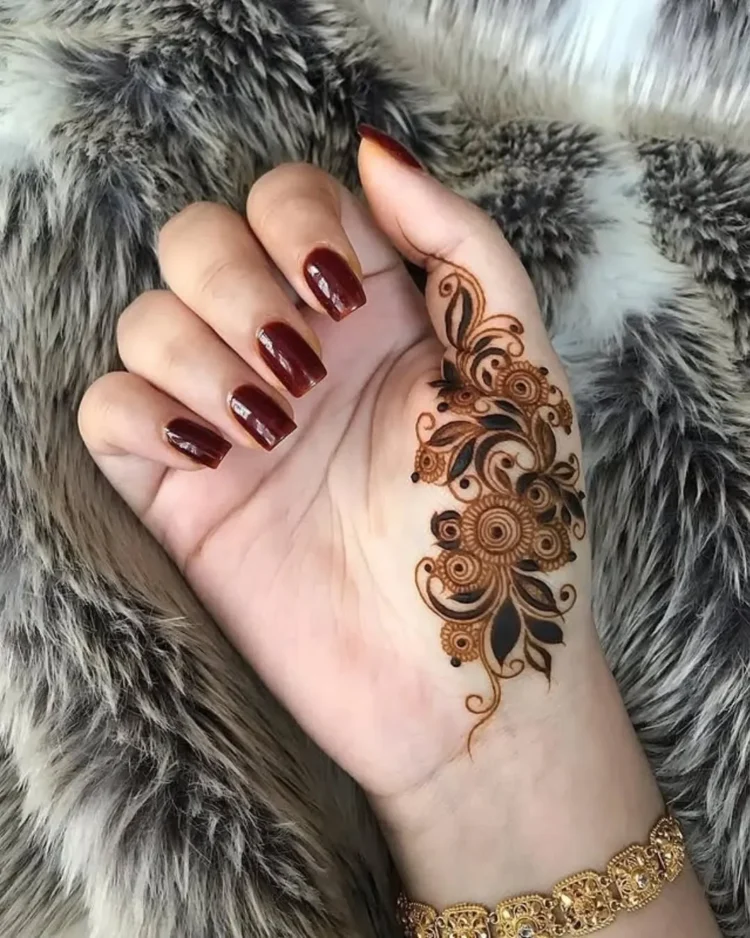
29. Small rose column on the palm edge. A short column of spiral roses and leaves runs along the outer edge of the palm and ends in a curl near the wrist. The fingers stay bare, so it takes only about ten minutes.
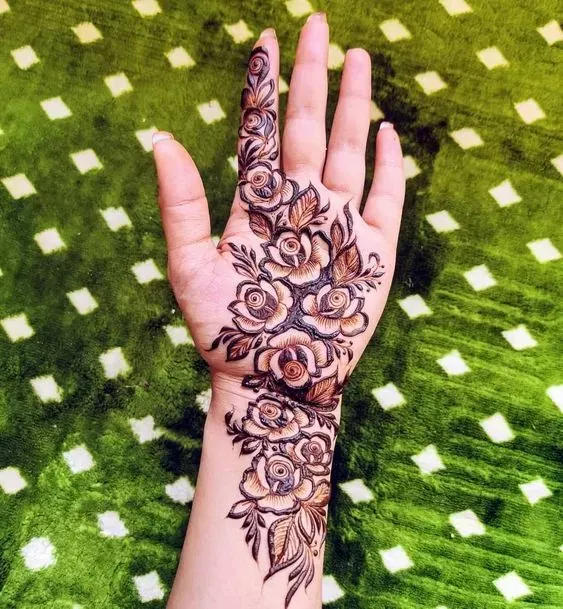
30. Rose column from finger to wrist. Outlined roses and leaves are stacked in one column from the middle finger to the wrist, with no other fingers decorated. A good choice when you want a palm design that is quick but not plain.
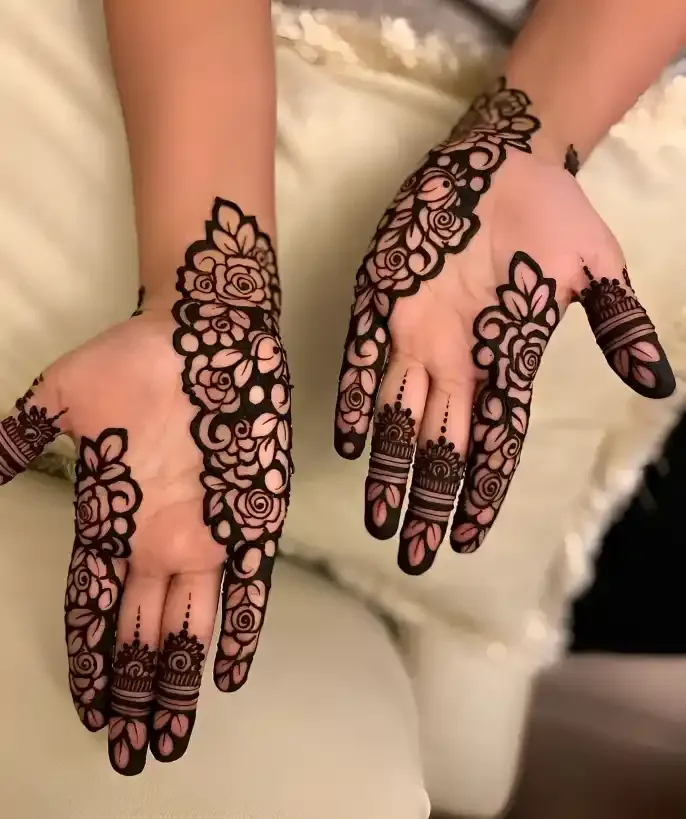
31. Cut-out roses on both palms. The roses are left as bare skin inside thick dark fill along the palm edge and fingers, so they appear in negative space. It needs a lot of paste but very little fine detail.
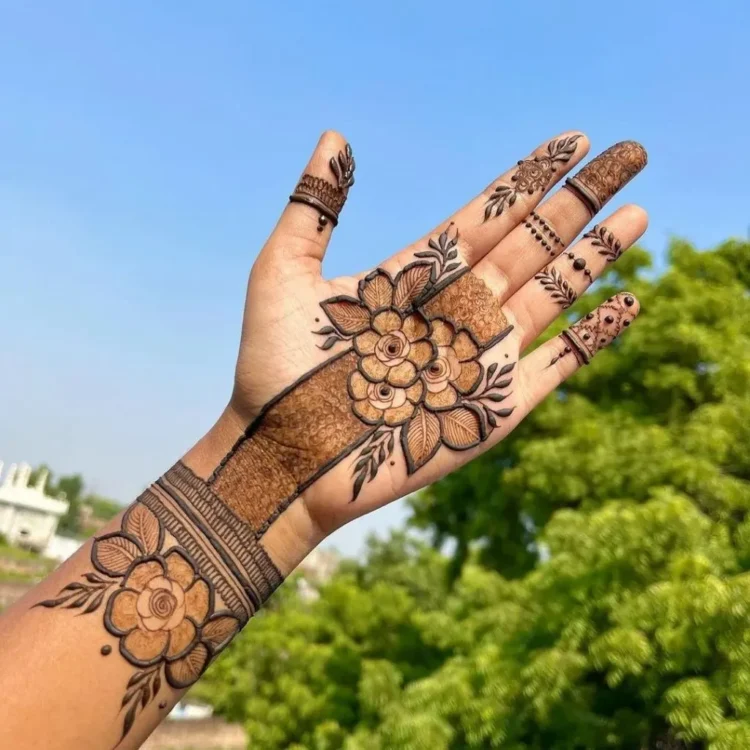
32. Palm rose cluster with a wrist rose. A cluster of roses and leaves fills the palm centre, a solid band runs from it to the wrist, and a second rose sits on the wrist. Thin rings on the fingers balance the heavy band.
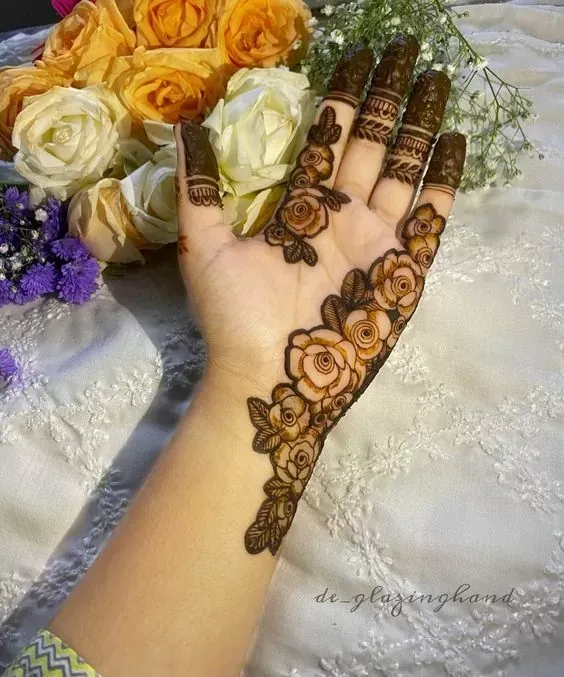
33. Rose column along the palm edge. Outlined roses and leaves climb along the outer edge of the palm from the wrist toward the index finger, with two more roses on that finger. The fingertips are dipped and banded, and the centre of the palm stays bare.
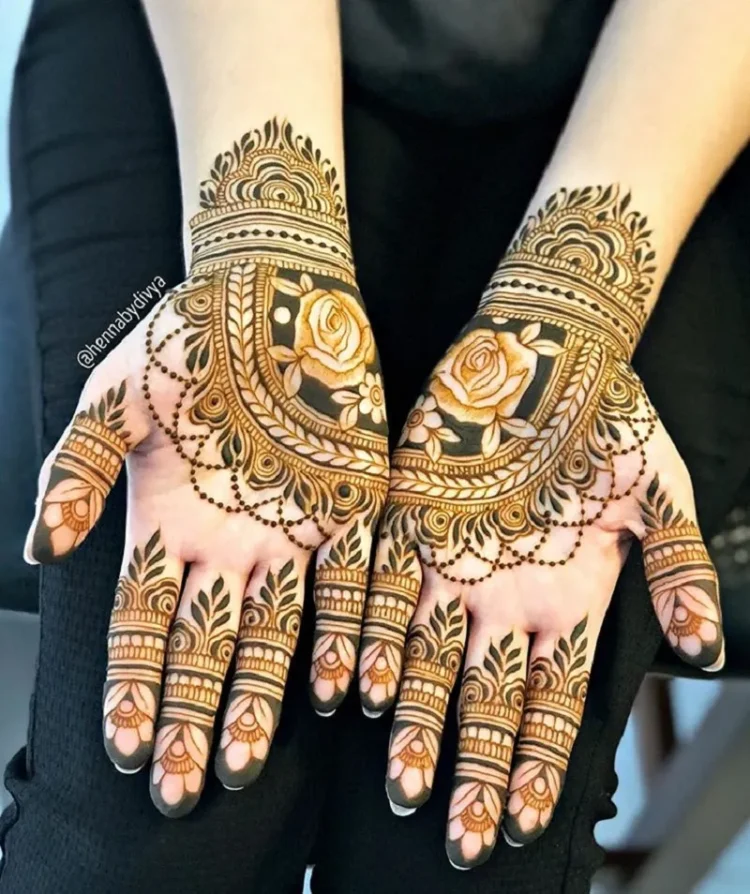
34. Palm roses in a dark arch. On each palm a rose sits in a dark half circle framed by a braided band and loops of beaded chain. A crown-shaped cuff covers the wrist, and leaf motifs fill the fingers above dipped tips.
Bridal Rose Mehndi Designs for Full Hands and Arms
In bridal mehndi the rose is placed between jaal, lattice, arches and bands that reach the elbow. Indian bridal designs often add figures or the groom’s initials, while Pakistani and Indo-Arabic brides tend to choose a few large shaded roses with fine fill around them. Bridal hands take two to four hours and are usually applied one or two days before the wedding so the stain peaks on the day. See also our full hand mehndi designs.
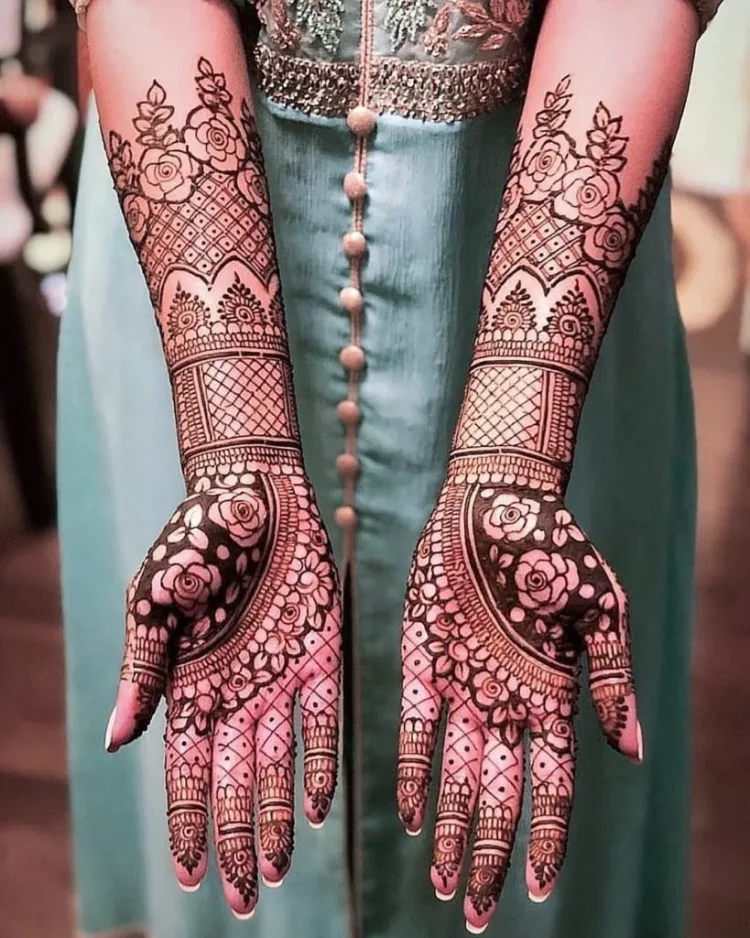
35. Roses over lattice to the elbow. Roses sit over lattice panels and arches on both forearms, and more roses fill the palms above fully patterned fingers. The design is symmetrical, so the two arms read as a pair.
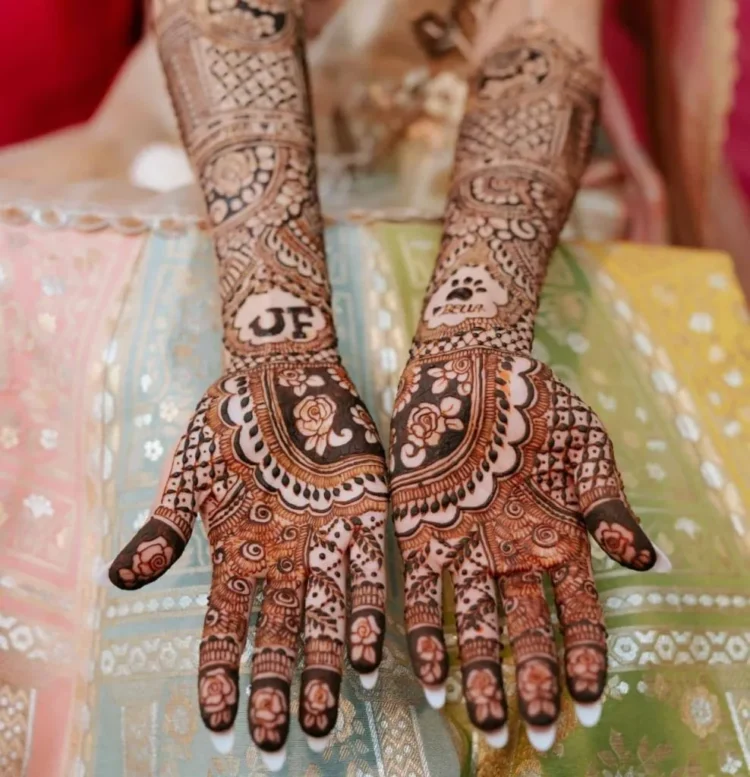
36. Bridal palms with initials. Initials are written on each wrist, roses sit inside arched panels on the palms and the fingers carry lattice. Hiding the couple’s initials is a common bridal custom.
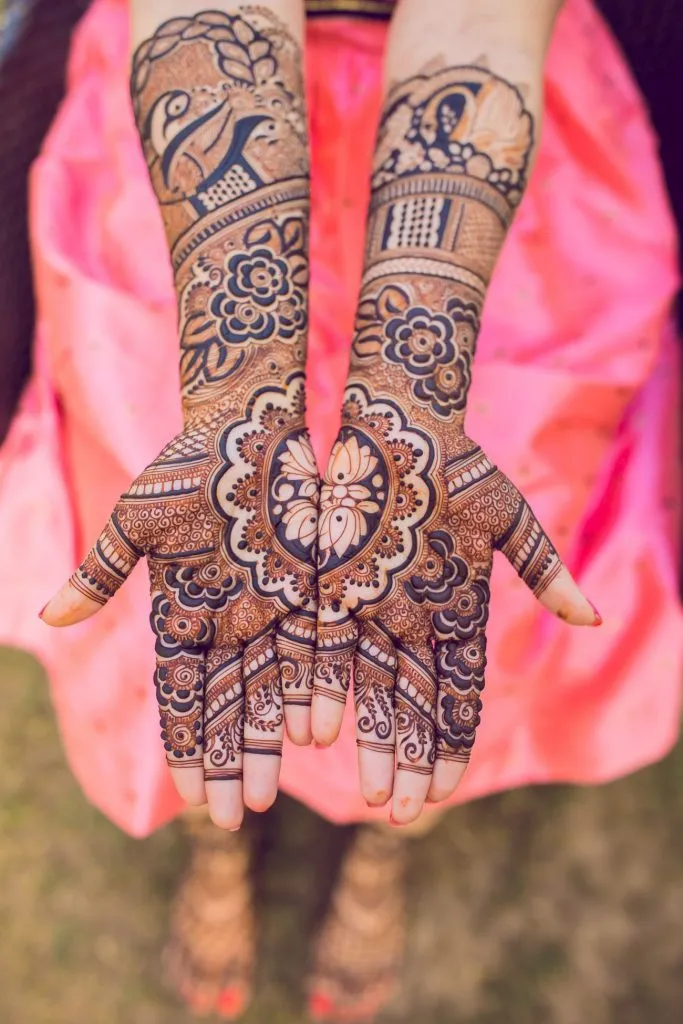
37. Lotus centre with rose forearms. When the palms are held together a lotus medallion forms across both, and bold rose-style flowers repeat up the forearms. The very dark stain shows strong, fresh henna.
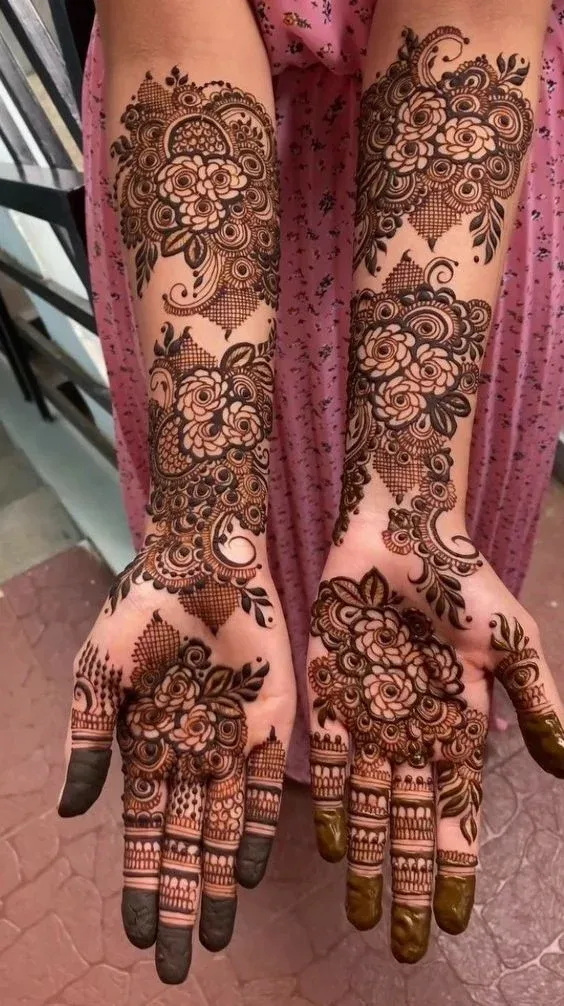
38. Stacked rose panels. Dense clusters of roses are stacked in panels from the wrist to the elbow, with lattice between them. The fingers are banded and still carry paste on the tips.
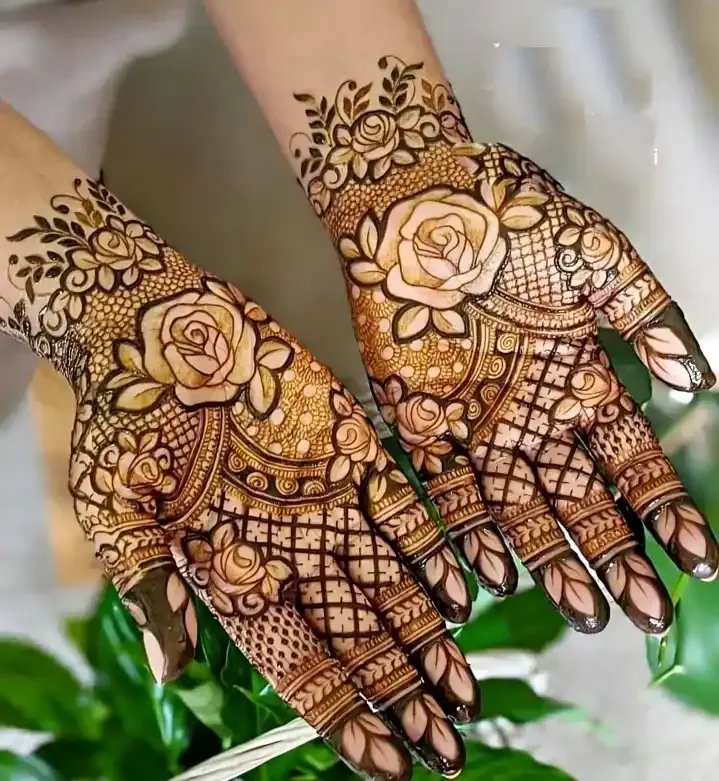
39. Large shaded palm roses. Each palm holds one large shaded rose, with smaller roses at the wrist and in the palm. Lattice fills the fingers, and the tips end in leaf shapes left as bare skin.
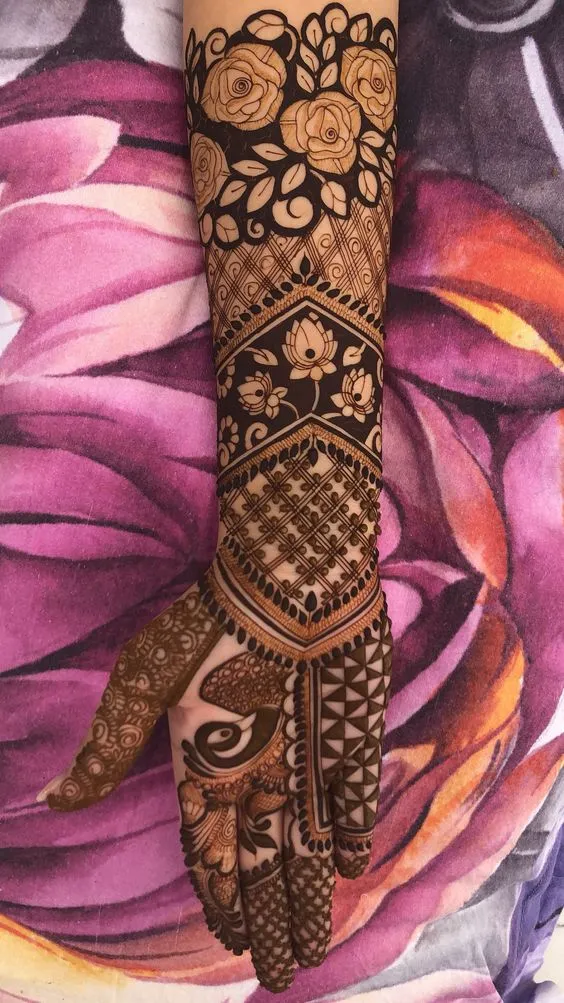
40. Rose cuff with a lotus panel. A cuff of shaded roses tops the forearm, followed by a hexagon panel of lotus flowers, a lattice diamond and geometric triangles on the fingers. Three motifs, each in its own frame.
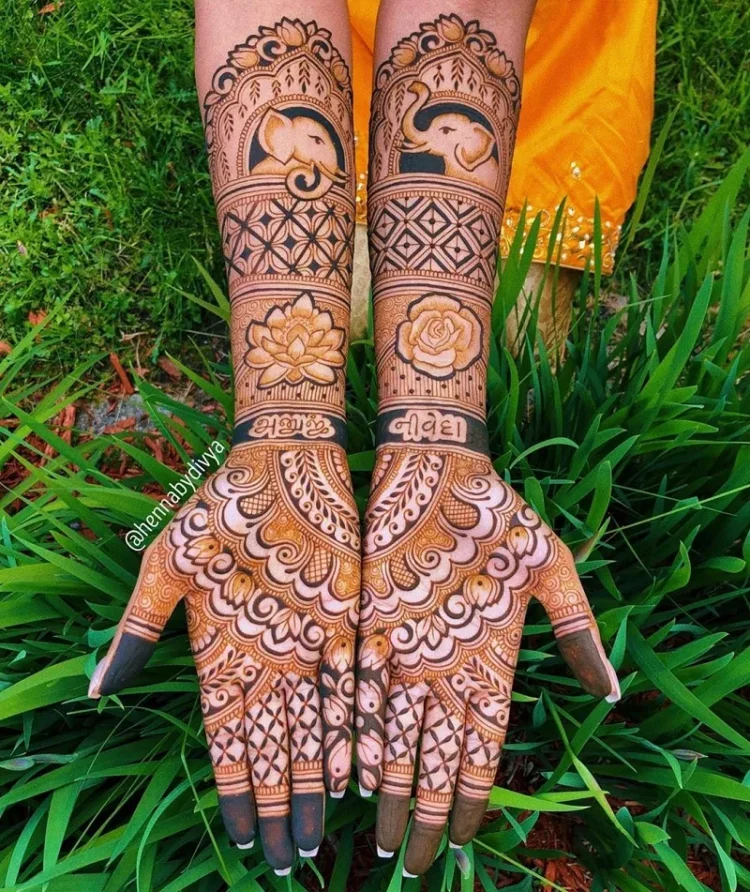
41. Elephant panels with a lotus and a rose. Elephant panels sit near the elbows above lattice diamonds, and one forearm carries a lotus while the other carries a rose. The palms are filled with scalloped layers and the fingers with lattice above dipped tips.
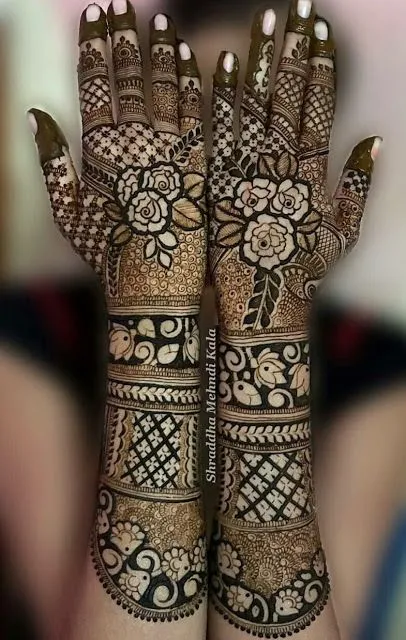
42. Palm roses with banded forearms. Large outlined roses with leaves fill both palms, and the forearms are divided into bands of lattice, leaf scrolls and flowers. Dark, crisp lines make each band easy to tell apart.
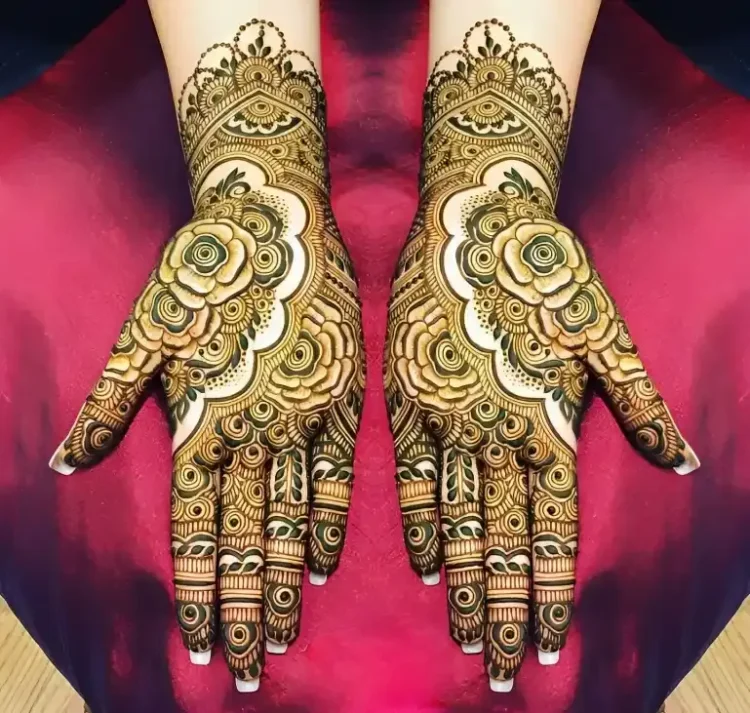
43. Golden palms with layered roses. Large layered roses fill a curved panel on one side of each palm, edged by a scallop of bare skin. Small circles and bands cover every finger, and crown-shaped bands decorate the wrists.
Bridal Rose Mehndi for Feet and Wedding Photos
A bride’s feet often repeat the motifs on her hands: roses set in lattice on the top of the foot, bands on the toes and a border at the ankle. The other pictures in this group show rose mehndi as it is photographed at weddings, with crossed arms, real flowers or floral wrist garlands, poses that show the back hand and the forearm together.
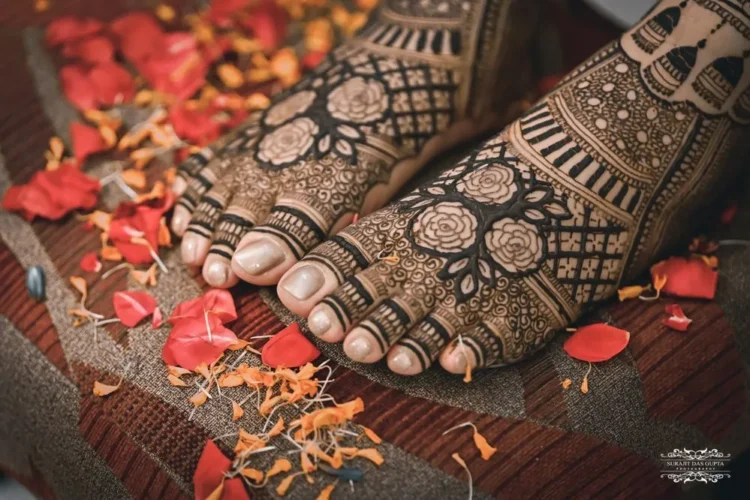
44. Rose and lattice bridal feet. Roses are set inside a bold lattice net on the top of each foot, every toe carries bands and the ankles end in a border of bell shapes. The feet repeat the rose motif so they match bridal hands.
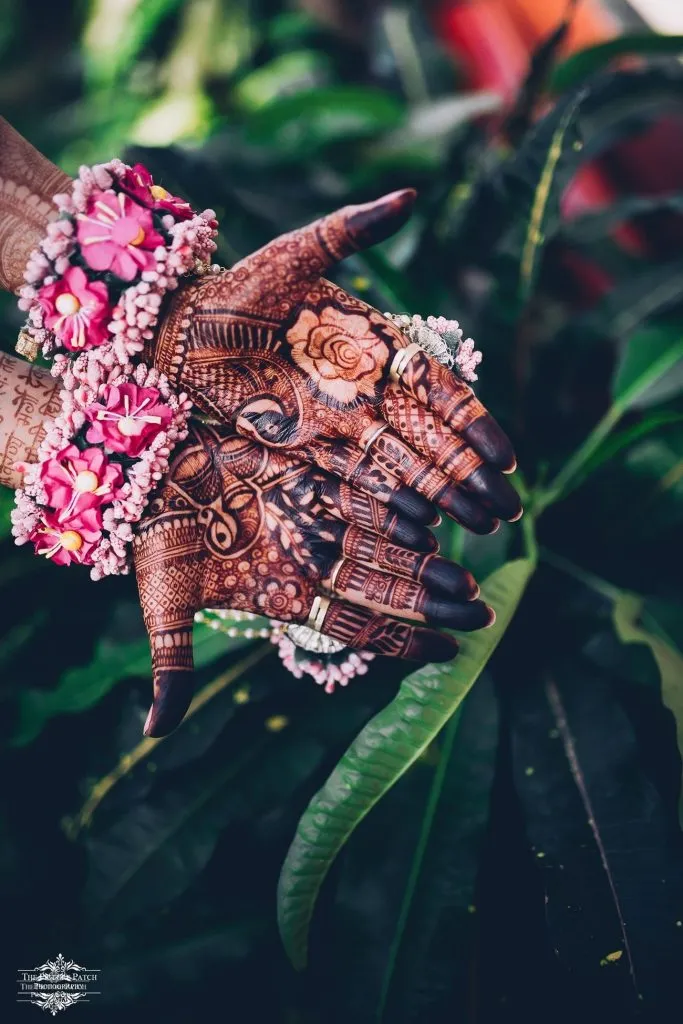
45. Rose hands with floral garlands. A shaded rose sits on the back of the hand among dense fine patterns, and the fingertips are dipped dark. Pink floral garlands on the wrists pick up the rose theme for a mehndi night photo.
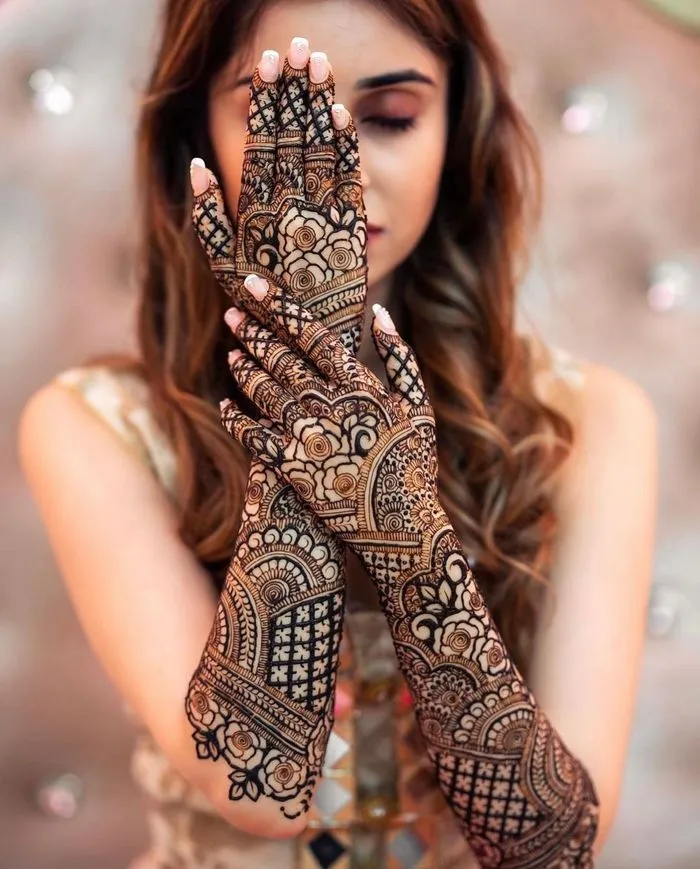
46. Crossed bridal arms with roses. Shown on a bride with crossed arms: roses, lattice panels and arches cover the back hands and forearms from the fingertips to the elbow.
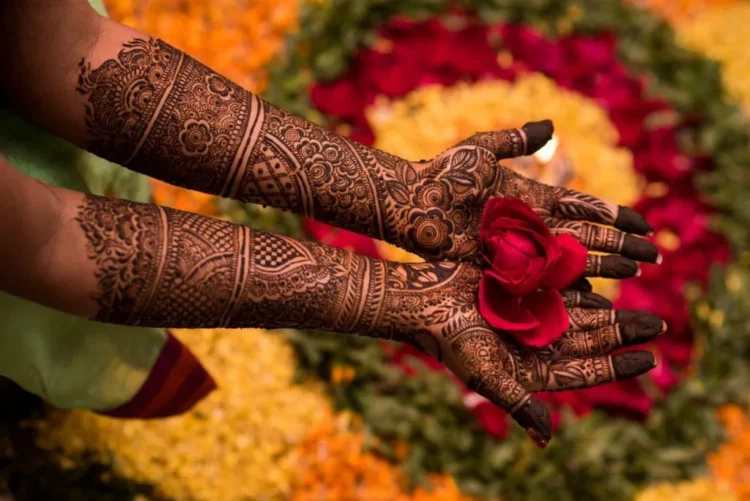
47. Bridal arms holding a real rose. Both arms are covered to the elbow in fine bands, flowers and lattice, and the bride holds a real red rose. A popular photo idea for a rose themed mehndi night.
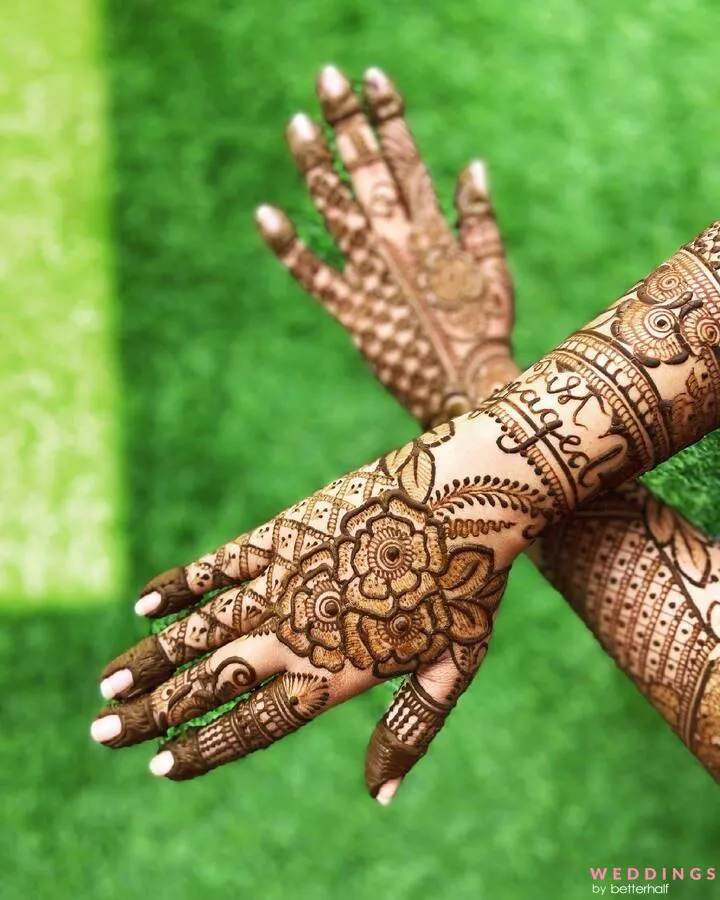
48. Crossed arms with a large rose. One large layered rose with leaf sprays fills the back hand, and fine bands and lattice run up the forearm. Crossing the arms in the photo shows both the hand and the arm design at once.
Simple Rose Mehndi Designs for Beginners and Kids
A simple rose mehndi design uses one or two small roses and leaves most of the skin bare. Start with a spiral rose: it is just a coil with curved petals around it, and small mistakes disappear inside the curls. These designs dry in minutes, so they suit children and anyone trying a cone for the first time.
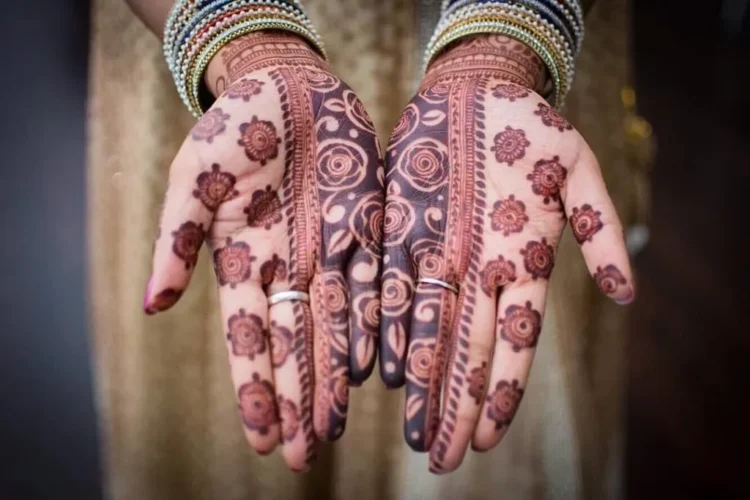
49. Rose booti on both palms. Small rose booti (single motifs) are scattered over both palms and fingers, with two fingers filled solid. Each rose is drawn the same way, so it is easy practice for repeating one shape.
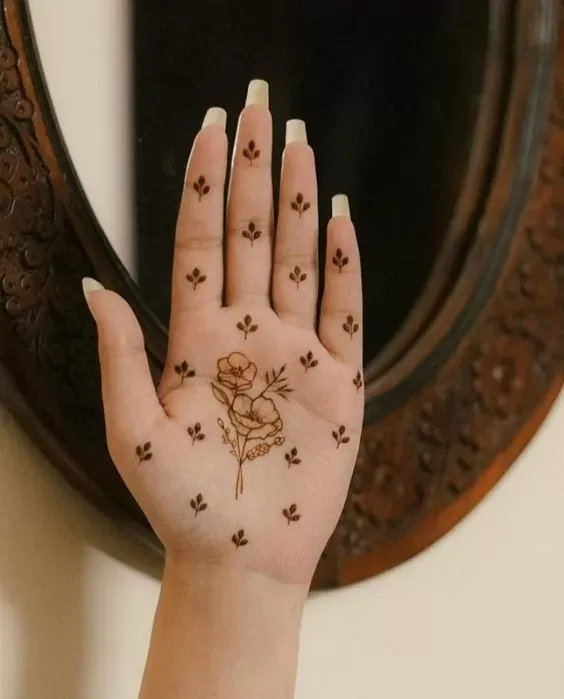
50. Fine-line rose sprig. One small rose sprig is drawn in fine lines in the centre of the palm, with tiny leaf booti dotted around it and on the fingers. Minimal enough for school or the office.
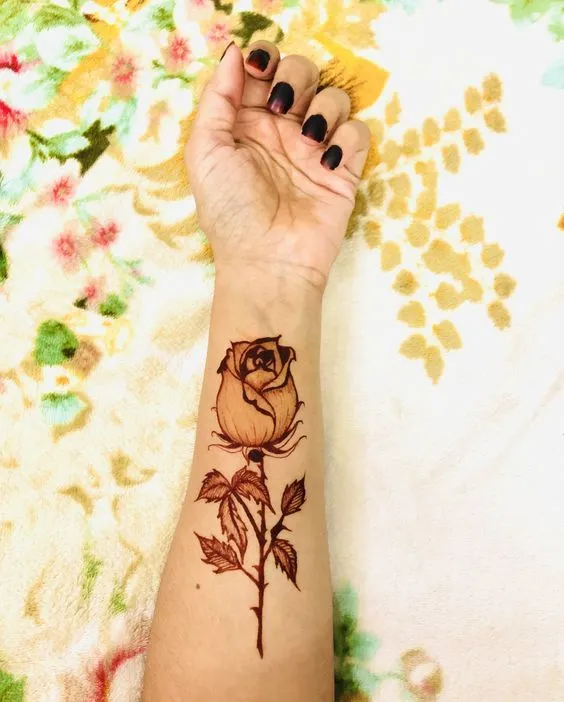
51. Long-stem rose on the wrist. A single rose on a long stem with leaves and small thorns runs up the inner forearm, drawn like a tattoo. It takes about ten minutes and needs only one clean line for the stem.
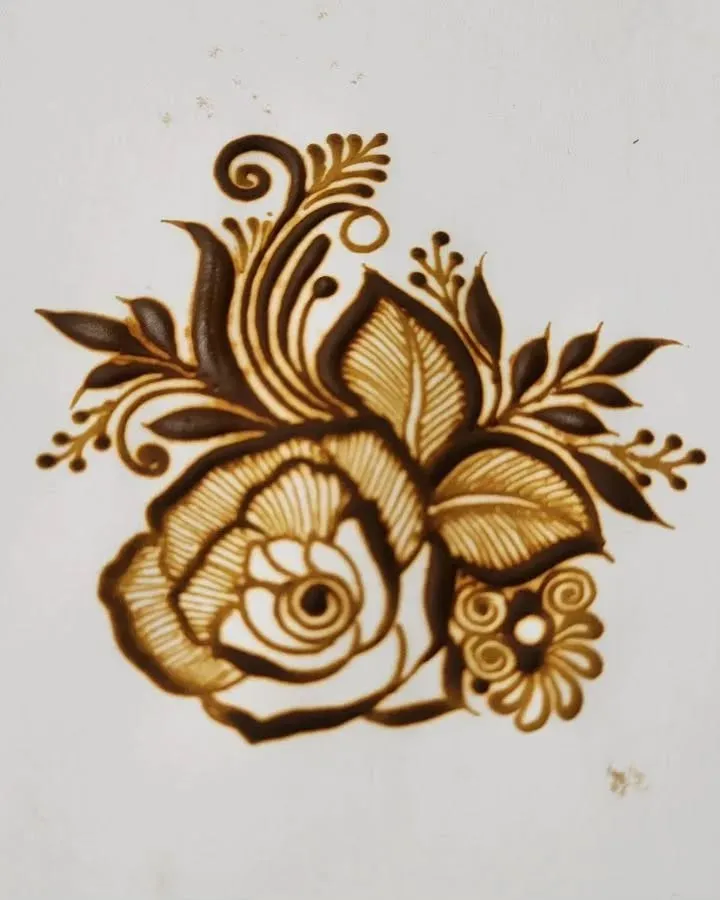
52. Rose practice sketch. Drawn on paper rather than skin, this practice sketch shows how a rose is built: a coiled centre, wide layered petals, leaves behind it and a small flower beside. Copy it a few times before trying it on the hand.
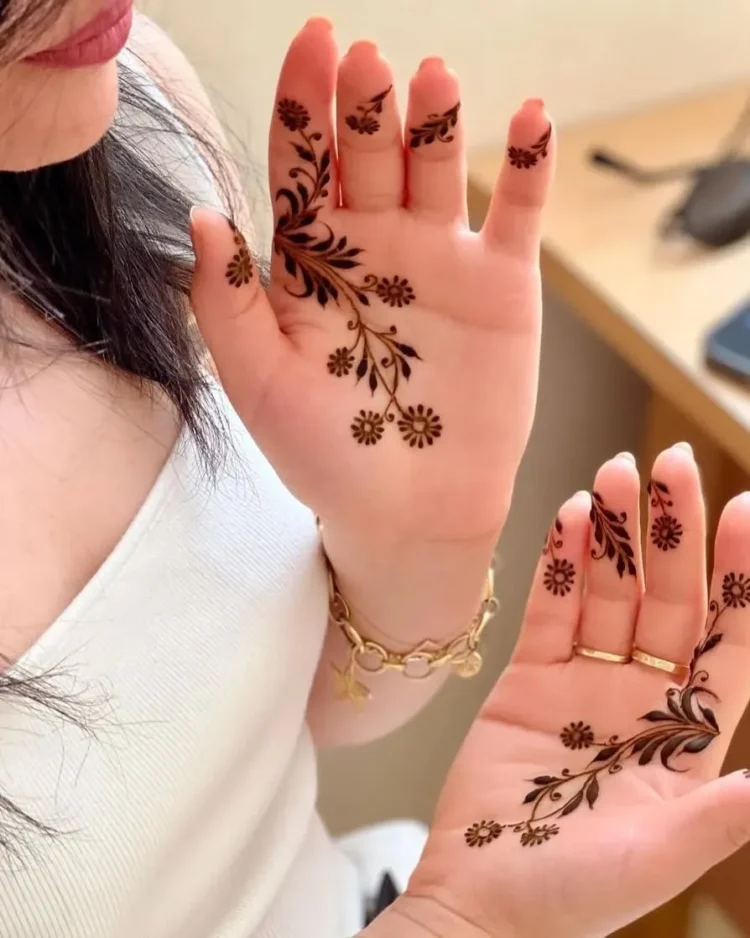
53. Tiny flowers on thin vines. Not a rose, but a good first step: tiny round flowers on thin vines along the palms and fingers of both hands. Thin lines dry quickly, so the same pattern also works for young children.
Floral Mehndi Designs with Layered Petals (No Rose)
These designs use layered flowers that are not roses, such as five-petal blooms and round flowers with spiral centres. They are drawn with the same petal and shading skills as a rose, so they make a good next step, and many people mix them with one rose in the same design.

54. Round flower with a leaf trail. A round layered flower sits beside the thumb with a smaller flower above it, and a long leaf trail sweeps toward the wrist. The fingers carry neat ring bands.
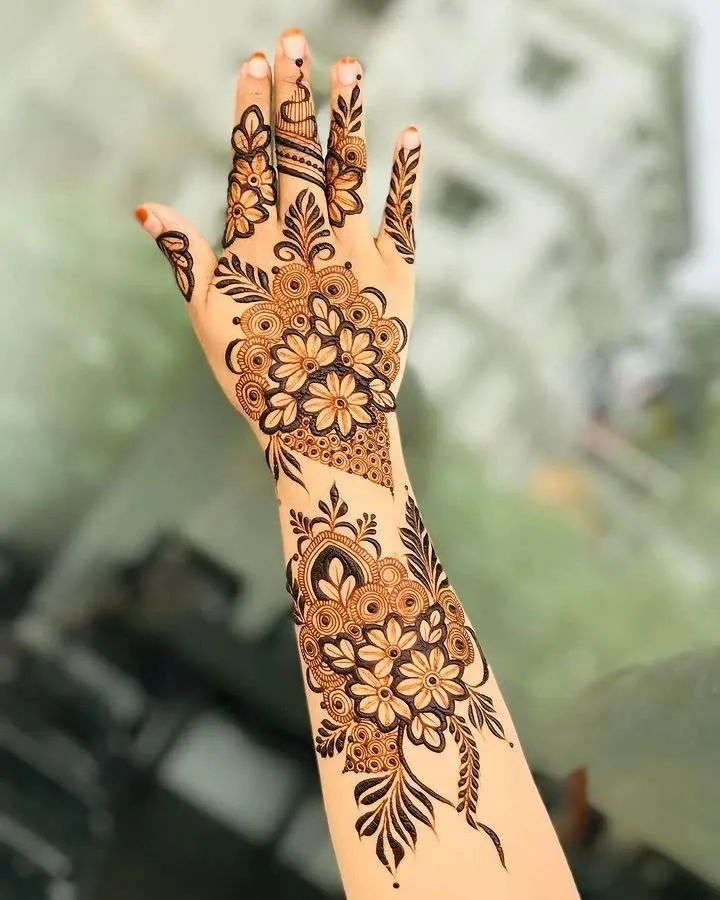
55. Flower clusters on hand and forearm. Two clusters of multi-petal flowers in shaded orange, one on the hand and one on the forearm, are joined by a small lattice triangle and leaf sprays.
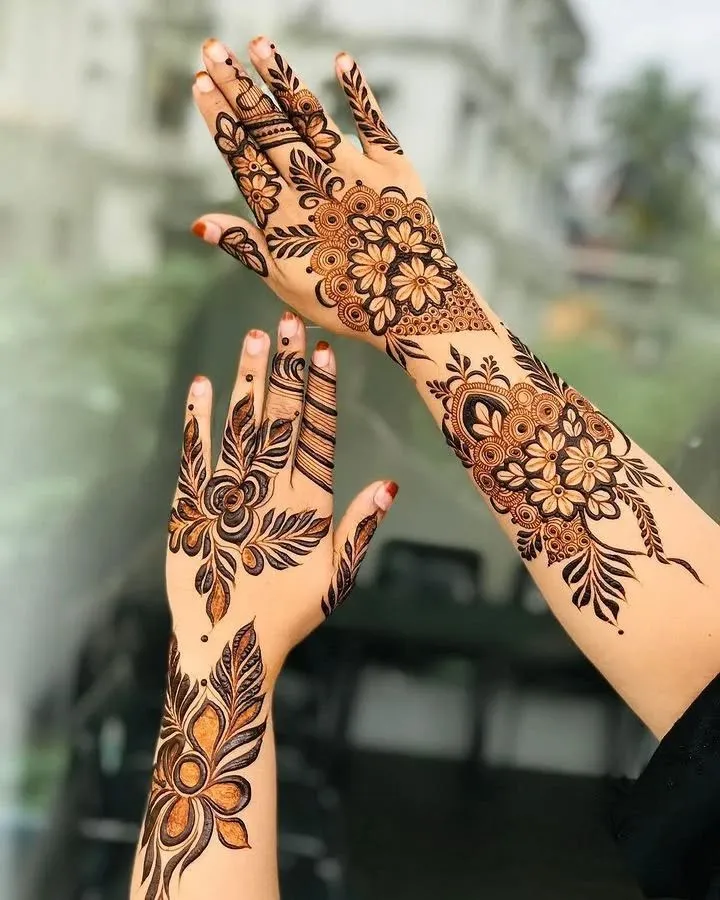
56. Shaded flower clusters on two hands. Both hands carry shaded flower clusters with leaf trails, one placed on the back hand and one on the forearm. The layout changes from hand to hand while the motifs stay the same.
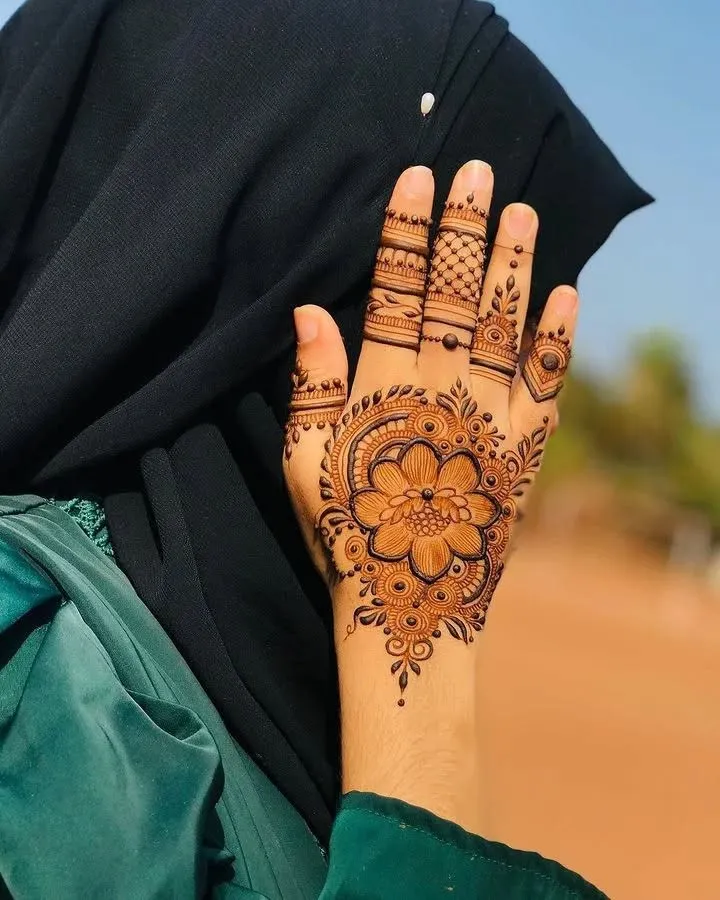
57. Single large flower in a dotted ring. One large flower with filled petals sits inside a dotted ring in the middle of the back hand. The fingers carry lattice and bands, and a small drop hangs toward the wrist.
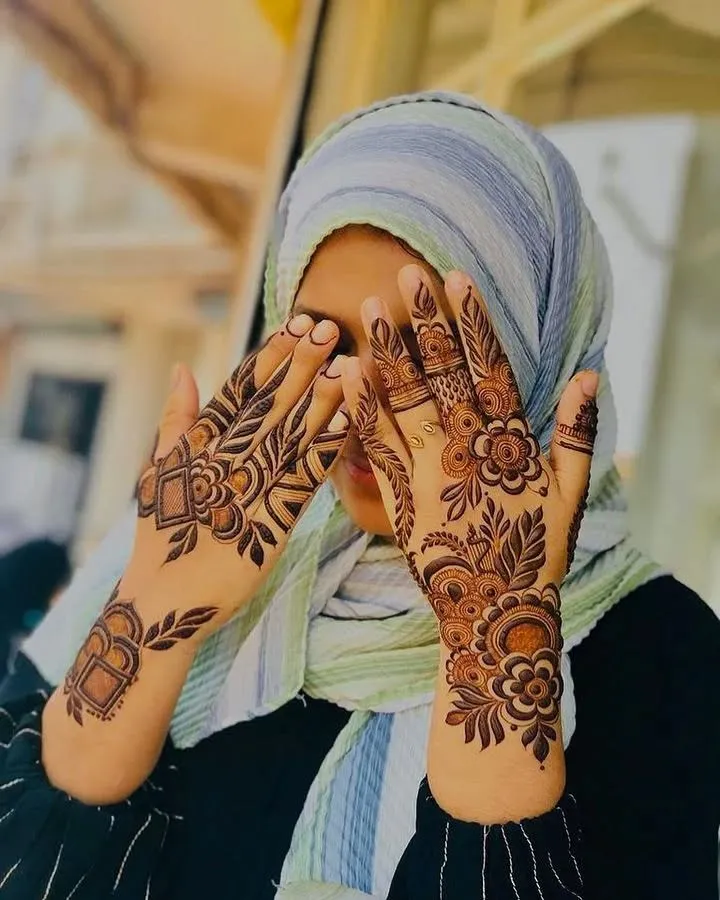
58. Spiral-centre flowers with a square motif. Flowers with spiral centres and leaf sprays cover both back hands, and one wrist carries a square geometric motif instead of a flower.
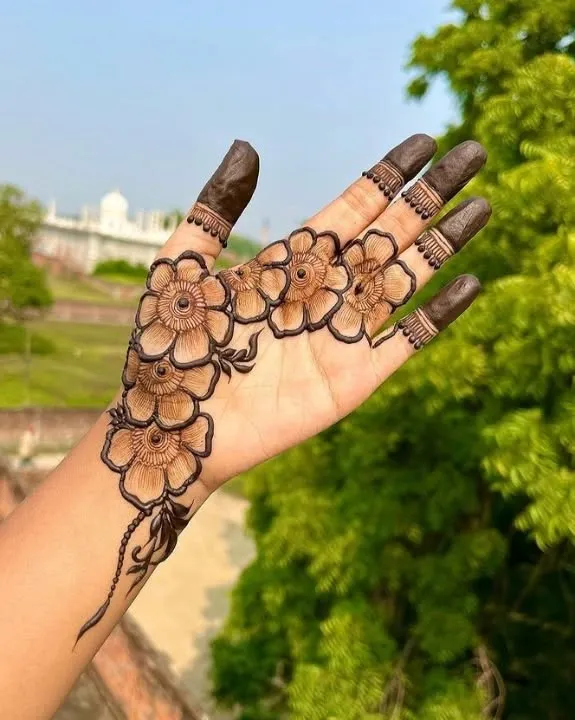
59. Chain of outlined five-petal flowers. Large five-petal flowers drawn in outline with light shading form a chain from the index finger across the palm to the wrist. The fingertips are dipped dark.
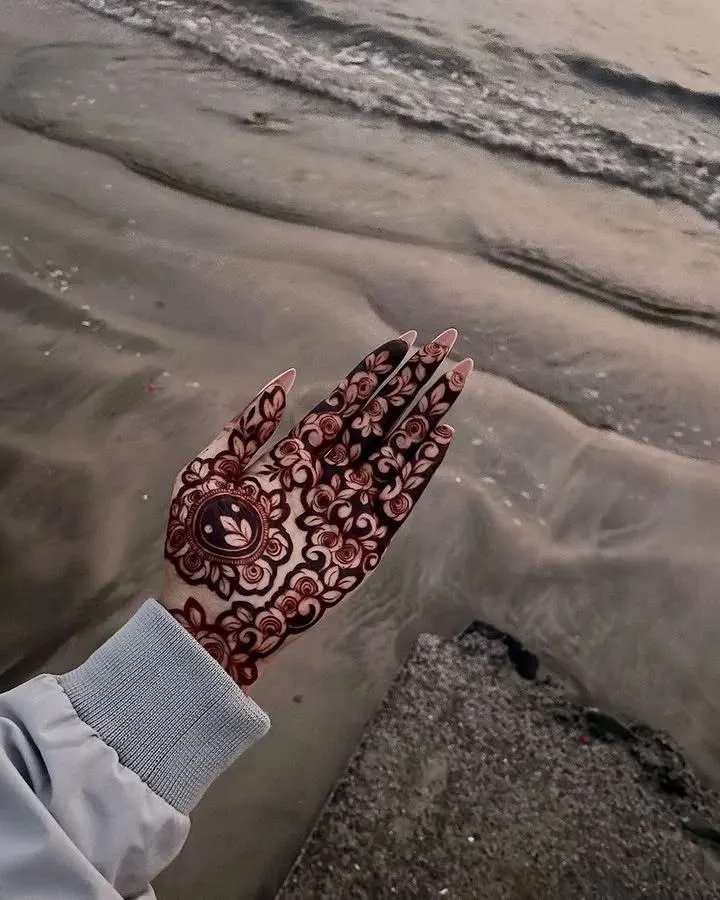
60. Maroon flowers over the palm. Small layered flowers cover the palm and every finger in a deep maroon stain. A dense design like this hides uneven lines well.
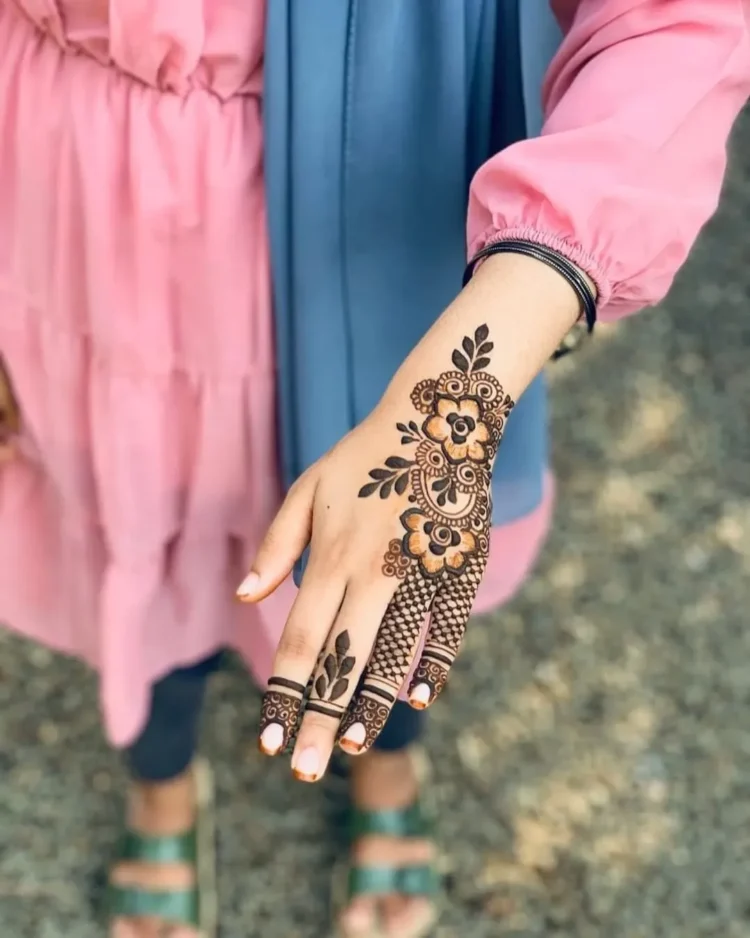
61. Two outlined flowers with a lattice finger. Two outlined flowers and a few leaves sit near the knuckles, and one finger carries lattice. A light design that leaves most of the hand open.
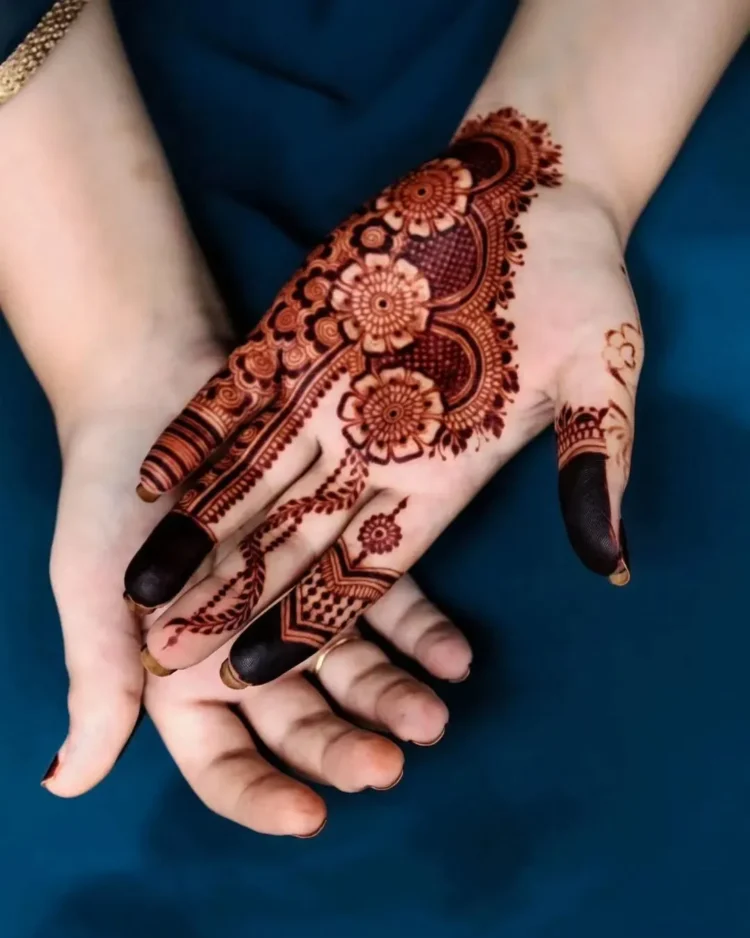
62. Red flowers with lattice. Dense red flowers and lattice cover the back hand, and the fingertips are dipped. The bright red tone is typical of a stain one day after the paste comes off.
Stylised Flower, Leaf and Arabic Geometric Mehndi
Arabic mehndi uses bold shapes and plenty of open skin. In this group the flowers are stylised rather than realistic, and some designs swap flowers for leaves, paisleys or geometric frames. They are quicker than a shaded rose and work well for Eid and parties.

63. Square frames with flowers. Square frames, flower clusters and dotted chains climb the back hand, and the fingers repeat small square motifs. The straight lines need care but no shading.

64. Paisley and lattice diagonal. Paisleys, lattice and scalloped layers run diagonally from the fingers to a half mandala at the wrist, in a light brown stain. A classic Indo-Arabic layout.
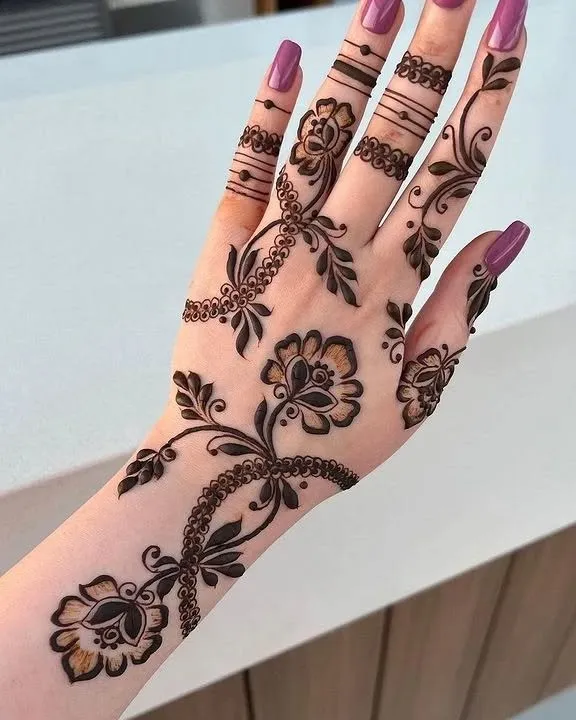
65. Bold blooms on a curving vine. Open-petal blooms in thick outline hang from a curving vine with a dotted chain, and the fingers carry simple bands. The bold lines make it easy to read from a distance.
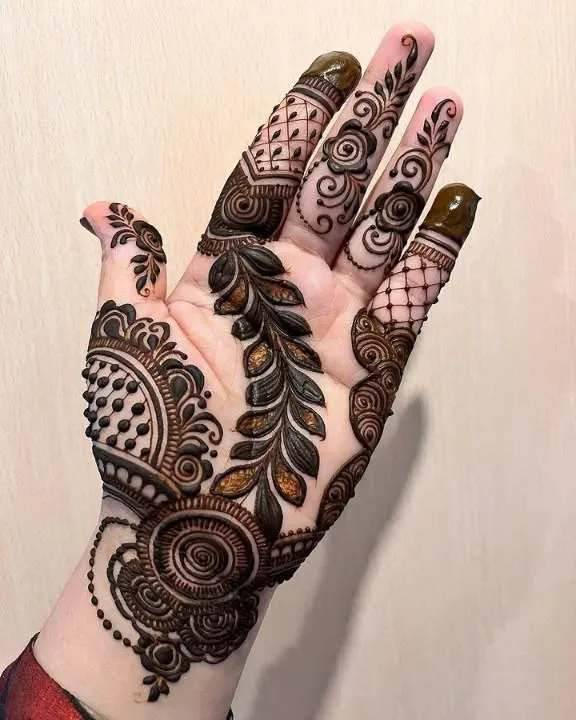
66. Half mandala with a leaf vine. A dotted half mandala fills one side of the palm, a leaf vine runs down the centre and a spiral mandala sits on the wrist. Small spiral motifs repeat on the fingers.
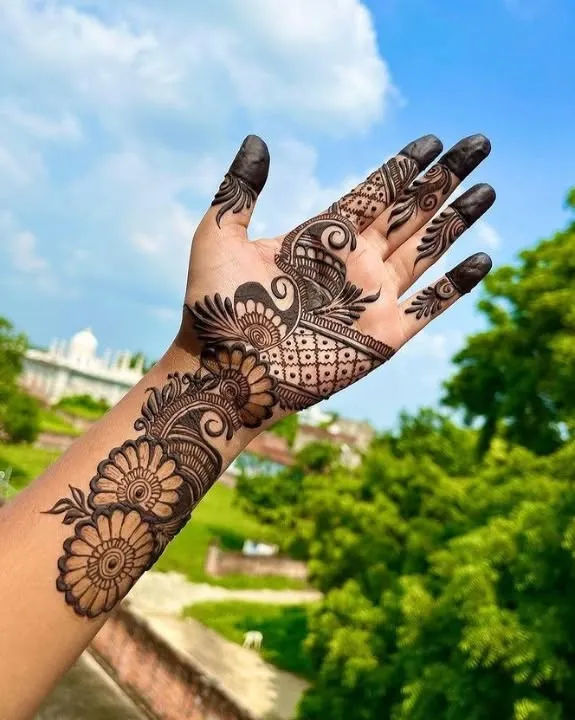
67. Paisley and sunflower discs. Paisley and lattice fill the palm, and round sunflower-like discs continue down the forearm. The dipped fingertips give it a traditional finish.
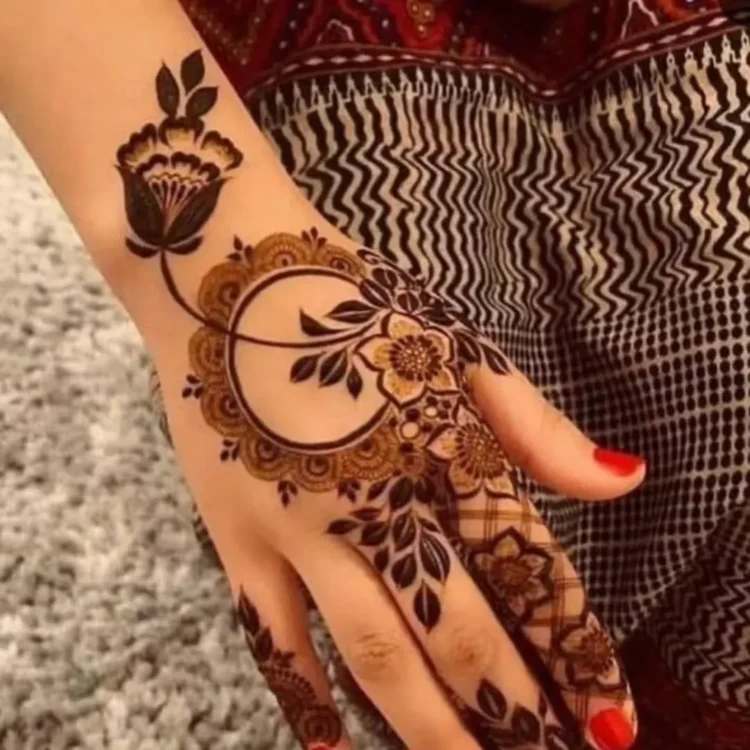
68. Stylised bloom with a crescent. A single stylised bloom on a stem rises from a crescent ring, with leaves around it and filled patterns on the fingers. The crescent makes it a good fit for Eid.
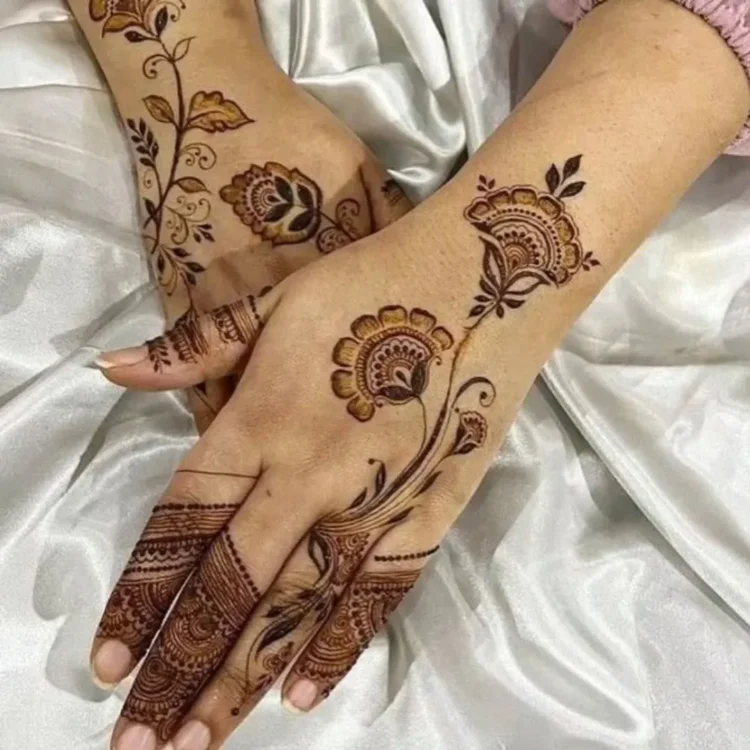
69. Long-stem flowers on two hands. Stylised flowers grow on long thin stems from the wrist toward the knuckles, with fine fill on the fingers. The long stems make the hands look slimmer.
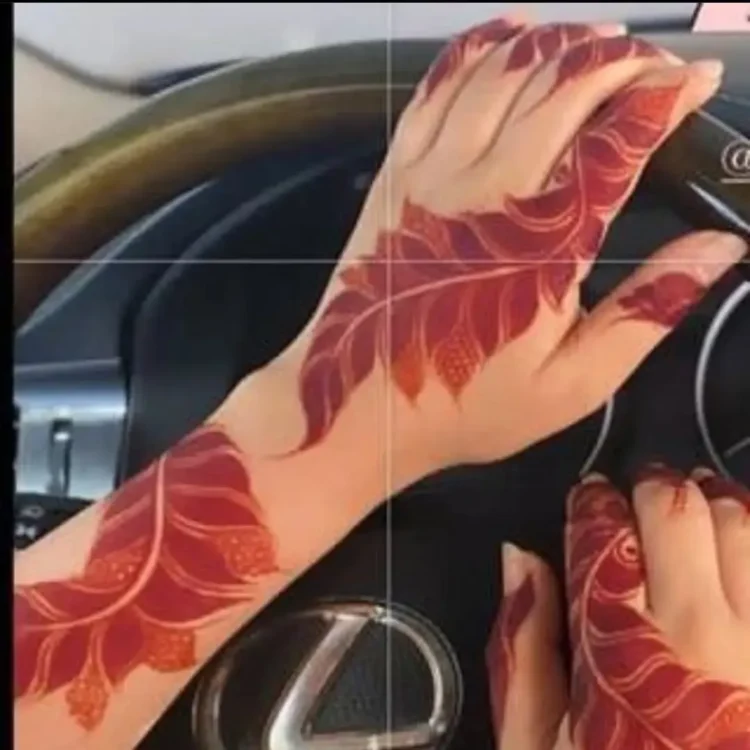
70. Red feather leaves. Large feather-shaped leaves in a bright red stain cover the back hand and forearm. There is no flower at all, only big leaf shapes with fine veins.
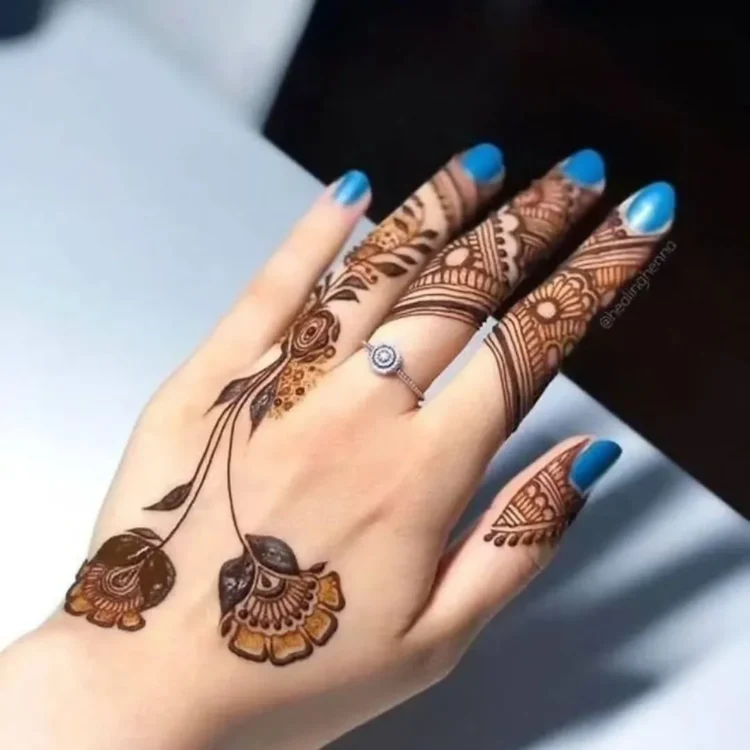
71. Hanging flowers on thin stems. Two stylised flowers hang on thin curving stems that start between the fingers, and the fingers carry fan and band patterns. Most of the back hand is left open, which is typical of Arabic mehndi.
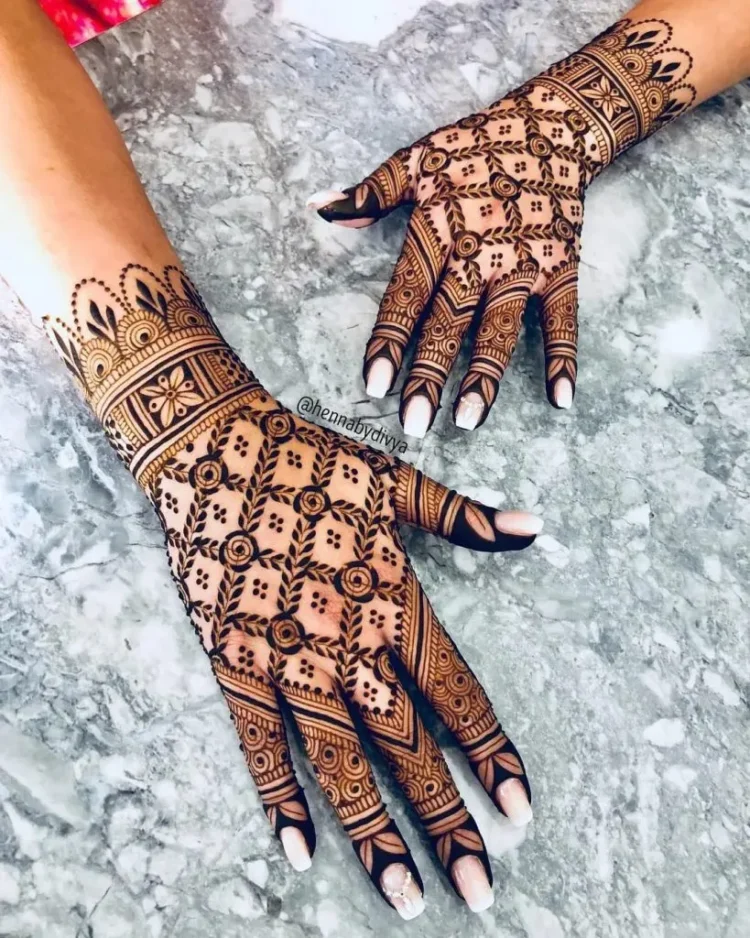
72. Lattice net with round flowers. A diagonal net covers the whole back hand, with a small round flower at every crossing and dots between them. A scalloped cuff with a starburst panel closes the design at the wrist.
Circle and Mandala Mehndi Designs (No Rose)
A round mandala or gol tikki is the other classic centre for a hand design, and it often appears next to roses in the same collection. None of these use a rose, but a spiral rose can replace the centre of any of them. Our circle mehndi designs show many more.
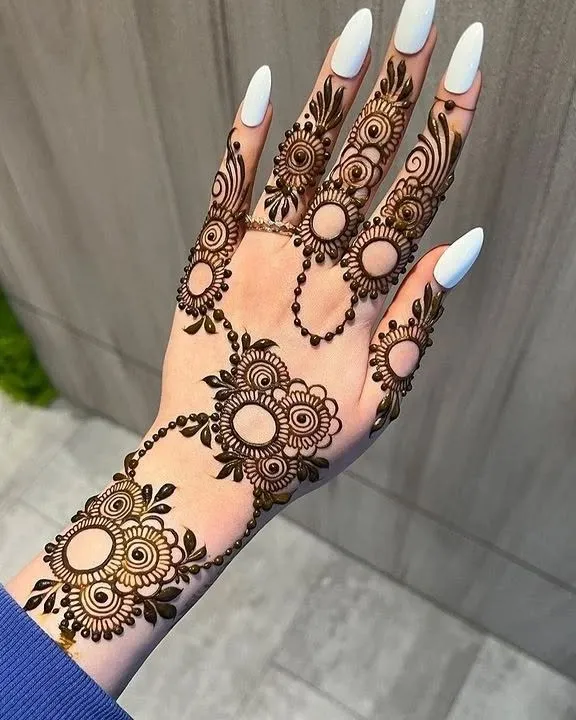
73. Open mandalas joined by chains. Mandalas with empty centres are linked by dotted chains from the fingers down to the wrist, like jewellery. Most of the skin between them is left bare.
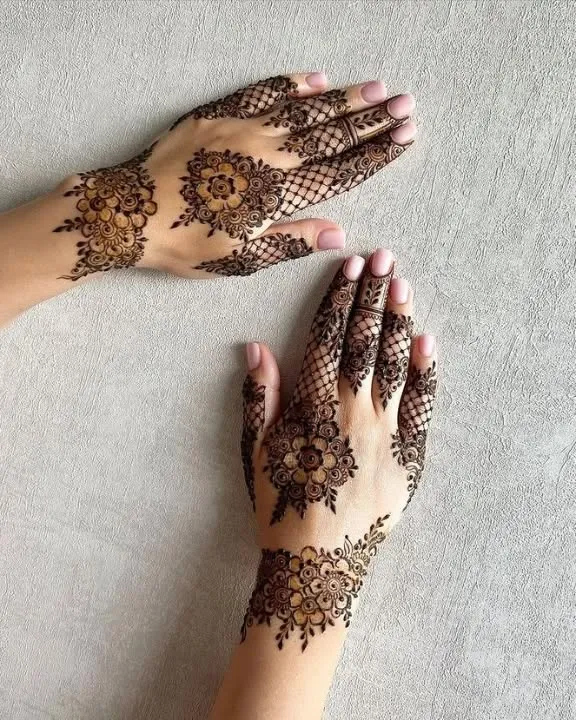
74. Small mandalas with lattice fingers. Small mandalas sit on each back hand, the fingers are filled with lattice and one wrist carries a floral band. Light enough for daily wear.
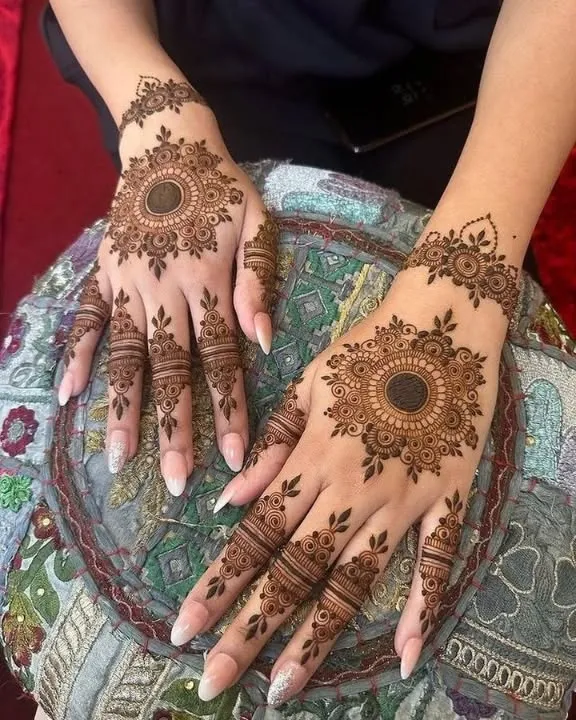
75. Large mandala with a wrist motif. A large dark-centred mandala fills the back hand, a smaller one sits on the wrist and the fingers carry bands with leaf tips.
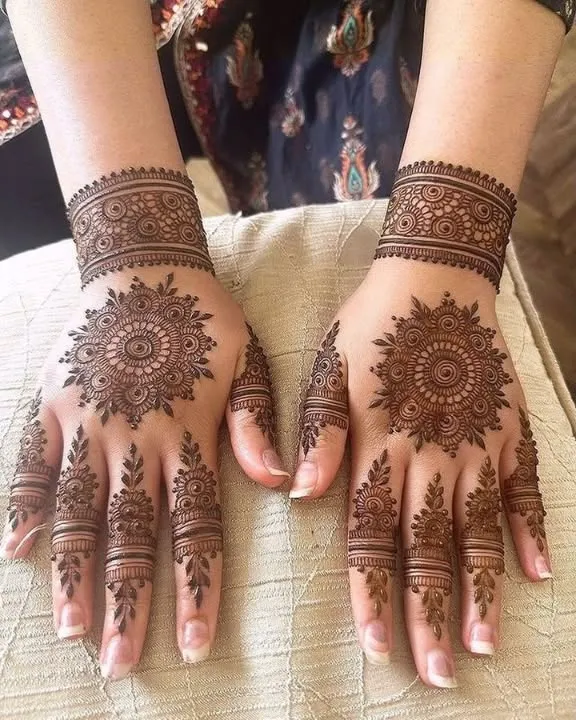
76. Mandalas with wide wrist cuffs. Matching mandalas on both back hands are paired with wide patterned cuffs at the wrists, and each finger carries bands and leaf sprigs.
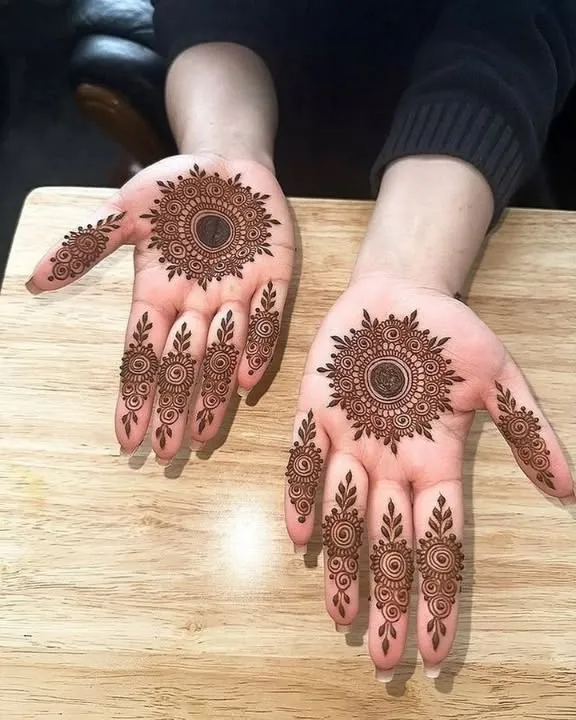
77. Palm mandalas with leaf fingers. A dark-centred mandala sits in the middle of each palm, and the fingers carry small leaf and dot motifs. Simple to match on both hands.
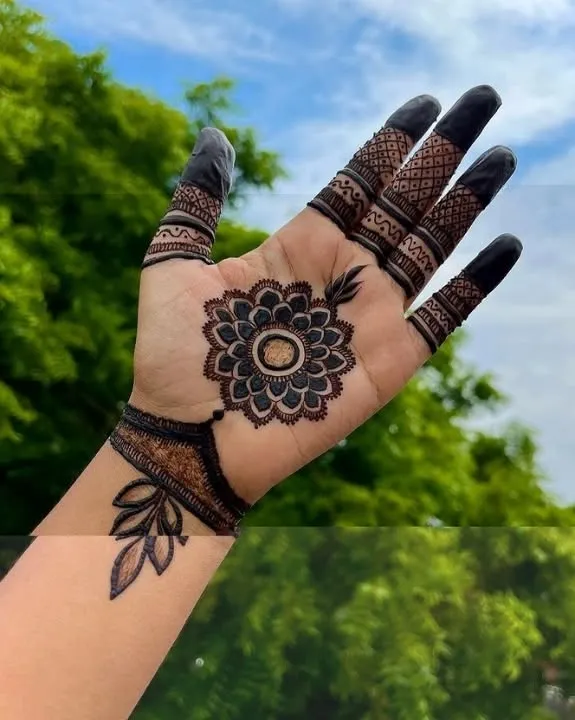
78. Dark-petal flower mandala. A flower mandala with dark filled petals and an open centre sits in the palm, joined to a band at the wrist. The fingers are lined and dipped.
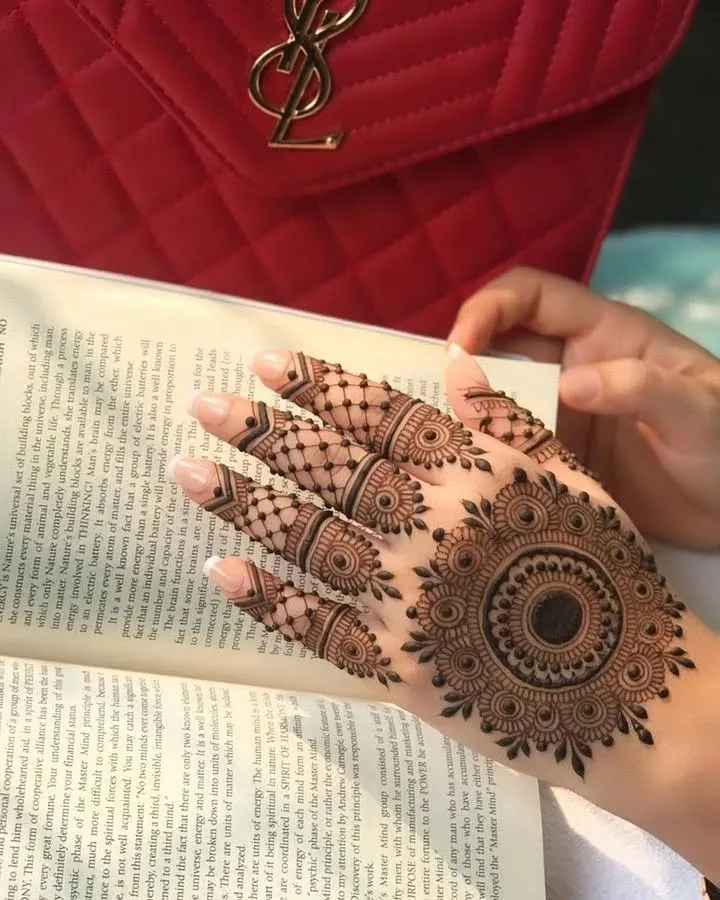
79. Large mandala with lattice fingers. A large mandala with a dark centre and several dotted rings covers the back hand, and the fingers are filled with fine lattice.
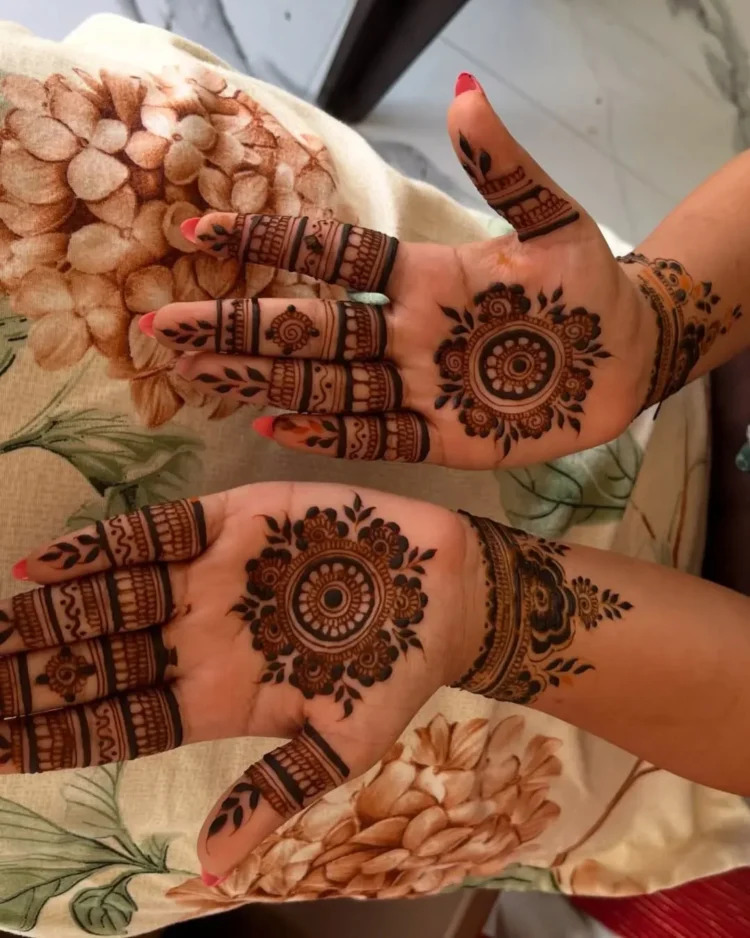
80. Palm mandalas with wrist bands. Two palms show neat mandalas with banded fingers and floral bands at the wrists, in an even red-brown stain.
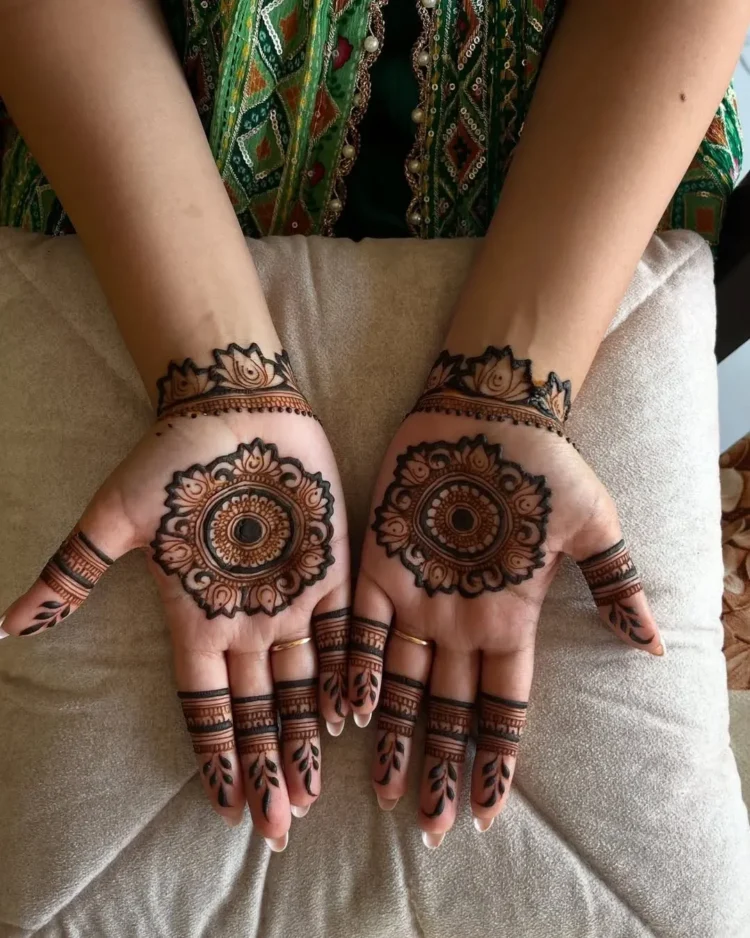
81. Palm mandalas with wrist crowns. Matching mandalas fill both palms, crown-shaped bands decorate the wrists and the fingers end in leaf shapes.
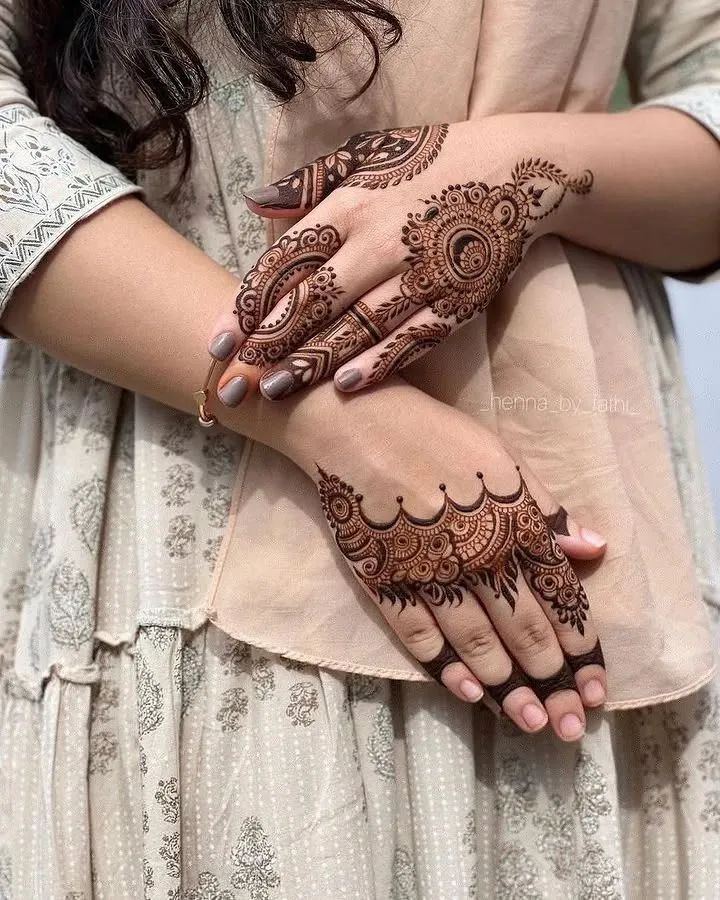
82. Mandala and scalloped knuckle band. One back hand carries a round mandala with patterned fingers, while the other has a scalloped band across the knuckles and dark rings at the finger bases. Two different layouts that still look like a pair.
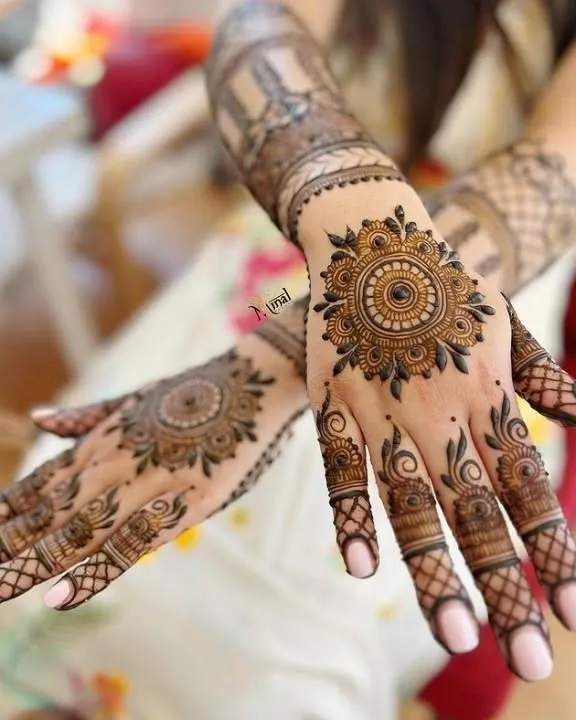
83. Leaf-tipped mandalas with lattice fingers. A round mandala ringed with small leaf points sits in the middle of the back hand, and the fingers carry swirl motifs over lattice. A lattice cuff covers the wrist.
Ways to Draw a Rose in Mehndi
| Rose style | How it looks | Skill level |
|---|---|---|
| Spiral rose | Coil with C-shaped petals | Beginner |
| Layered petal rose | Rows of outlined petals | Intermediate |
| Shaded rose | Petals partly filled | Advanced |
| Rose with leaves | Rose plus 3 to 5 leaves | Beginner to mid |
| Rose bel | Roses along a vine | Intermediate |
| Cut-out rose | Rose left as bare skin | Intermediate |
How to Draw a Simple Spiral Rose Step by Step
- Prepare the skin. Wash with soap and dry well. Skip lotion and oil, because they stop the dye from reaching the skin.
- Draw the coil. Make a small tight spiral, about the size of a fingernail, turning two or three times.
- Add the first petals. Draw two or three C-shaped curves that hug the coil, each starting where the last one ends.
- Open the rose. Add a second, wider row of curved petals. Leave a thin gap of skin between rows so the stain does not merge.
- Add leaves. Draw two or three pointed leaves behind the rose, with a centre vein in each.
- Finish. Add a few dots or a short vine, then let the paste dry for 20 to 30 minutes without touching it.
How to Shade a Rose with a Mehndi Cone
- Outline first. Draw every petal edge with a firm line before you shade anything.
- Fill the base of each petal. Fill the part of the petal nearest the centre and stop halfway, so the inner rose stains darker than the edges.
- Use thin strokes for mid tones. Close parallel lines or a thin smear of paste stain lighter than a thick fill, which gives the soft shaded look of a royal rose.
- Keep the cone tip fine. Cut only a tiny opening so thin lines stay thin.
- Shade in one direction. Work from the centre of the rose outward on every petal so the light seems to come from one side.
Where to Place a Rose and Which Style Suits the Occasion
On the back hand, a rose looks best on the diagonal between the index finger knuckle and the outer wrist. On the palm, a single rose goes in the centre or a bel follows the curve from the wrist to the index finger. A rose on the wrist works like a bracelet, as our bracelet mehndi designs show, and a small rose also fits the top of the foot, see our foot mehndi designs.
| Occasion | Rose style | Time, both hands |
|---|---|---|
| Bride | Shaded roses with jaal | 2 to 4 hours |
| Mehndi night guest | Rose bel on back hand | 30 to 60 min |
| Eid and Chand Raat | One royal rose | 30 to 45 min |
| Karwa Chauth, Teej | Palm rose with dipped tips | 20 to 40 min |
| Beginners | Spiral rose with leaves | 10 to 15 min |
| Children | Rose booti | 5 to 10 min |
For more festival ideas see our Eid mehndi designs. If you like flowers with a round, open shape, our lotus mehndi designs are a good next step.
Getting a Dark Stain on Rose Mehndi
Mehndi paste is made from the dried leaves of the henna plant (Lawsonia inermis). Its dye, lawsone, binds to the outer layer of the skin. The stain is orange when the paste comes off and darkens to red-brown or maroon over the next 24 to 48 hours.
- Leave the paste on for 4 to 8 hours, or overnight for shaded roses, because thin shading strokes hold less paste.
- Seal the dry paste with a dab of lemon juice and sugar so it stays on the skin longer.
- Scrape, do not wash. Remove the dry paste with the back of a spoon and keep water away for 12 to 24 hours.
- Protect the stain with a thin layer of coconut or mustard oil before bathing.
Avoid black henna. Natural henna never stains black. Products sold as black henna may contain the hair dye chemical PPD (p-phenylenediamine), which can cause serious skin reactions. The US Food and Drug Administration explains the risk in its fact sheet on henna and black henna.
Rose Mehndi Design FAQs
What is a royal rose mehndi design?
A royal rose mehndi design has one or two large roses with many overlapping petals, shaded so the centre looks deeper than the edges. The rest of the hand is kept light with leaves, bands or a chain so the rose stays the focus.
How do I draw an easy rose with a mehndi cone?
Draw a small tight spiral, then add two or three C-shaped petals around it and a second, wider row of petals. Finish with two or three pointed leaves. This spiral rose takes under a minute once you have practised it on paper.
Is a rose mehndi design good for beginners?
Yes, if you start with a spiral rose or small rose booti. Large shaded roses need more control, so try them once you can draw even, thin lines.
Where should a rose go on the back hand?
Place it on the diagonal between the index finger knuckle and the outer wrist, with leaves or a bel trailing toward the wrist. This follows the natural line of the hand and leaves room for finger bands.
What does gulab mean in gulab mehndi design?
Gulab is the Hindi and Urdu word for rose. A gulab mehndi design is simply a rose mehndi design.
How long does rose mehndi last?
A natural henna stain lasts about 1 to 3 weeks. It stays longest on the palm and fades sooner on the back hand and with frequent washing.


Comments 1