
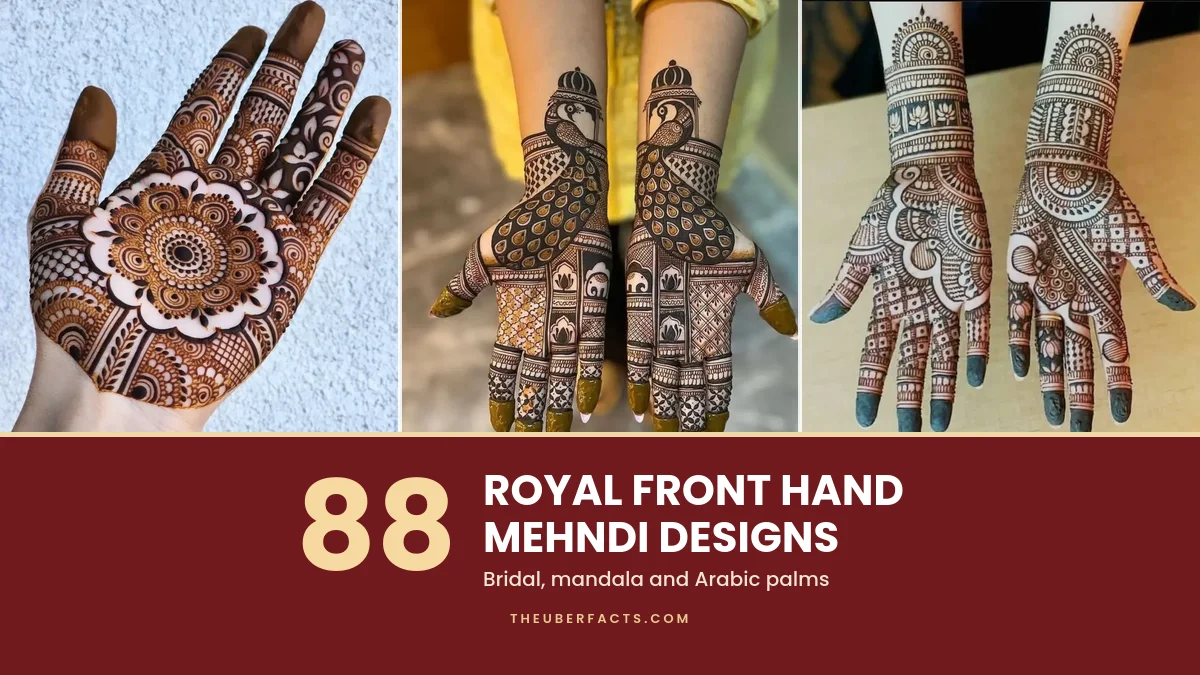
A royal front hand mehndi design covers the palm from the fingertips to the wrist, and often past it, with a dense and symmetrical pattern built around one strong centre motif. Where a simple palm design leaves open skin, a royal design fills almost every part of it: jaal (net) panels, lace scallops, layered cuffs at the wrist and, on bridal hands, peacocks, elephants, domed canopies or a bride and groom drawn as figures. It is the style most brides in India and Pakistan choose for the palm, because palm skin takes the darkest henna stain on the body and the whole pattern shows when the hands are held open for photos.
This page shows 88 royal front hand mehndi designs, each with a photo and a note on its motifs, coverage and difficulty. They are grouped by what you see in them: bridal figure work, peacocks and birds, centre mandalas, net and cuff designs, geometric panels, floral palms, Arabic trails, lighter options and matching back hand designs. If you want a quick, light palm instead, our front hand mehndi designs are the better place to start.
What Makes a Royal Front Hand Mehndi Design Royal
- Dense, even fill: very little bare skin is left, and what remains is planned, such as bare-skin petals, a scalloped edge or a heart on a fingertip.
- Symmetry: the two palms mirror each other, or one large motif sits exactly in the middle of the palm.
- A strong centre motif: a mandala, a lotus, a peacock, a medallion holding initials, or a portrait.
- Layered wrist cuffs: two or more bands at the wrist, often ending in a pointed crest or a rounded arch on the forearm.
- Figures and architecture: peacocks (mor), elephants, domed canopies and bride and groom figures appear on the most detailed bridal work only.
- Finished fingers: every finger carries bands, checks or net, usually ending in fully dipped tips.
| Feature | Simple front hand | Royal front hand |
|---|---|---|
| Coverage | Centre or one side | Full palm to wrist |
| Centre motif | Optional | Always |
| Wrist | Bare or one band | Layered cuffs |
| Fingers | Tips or one band | Every finger filled |
| Time per palm | 10 to 20 min | 45 min to 2 hours |
| Skill level | Beginner | Intermediate to expert |
| Best for | Eid, parties | Bride, close family |
Bridal Royal Front Hand Mehndi Design with Peacocks and Figures
These are the most detailed designs on the page. Indian bridal mehndi often tells a small story on the palms: a peacock for beauty and love, elephants and domed canopies that recall a wedding procession, or the bride and groom themselves. Work like this needs an experienced artist and usually two to four hours for both palms, so it is normally booked for the bride alone. For the other side of the wedding, see our dulha (groom) mehndi designs.
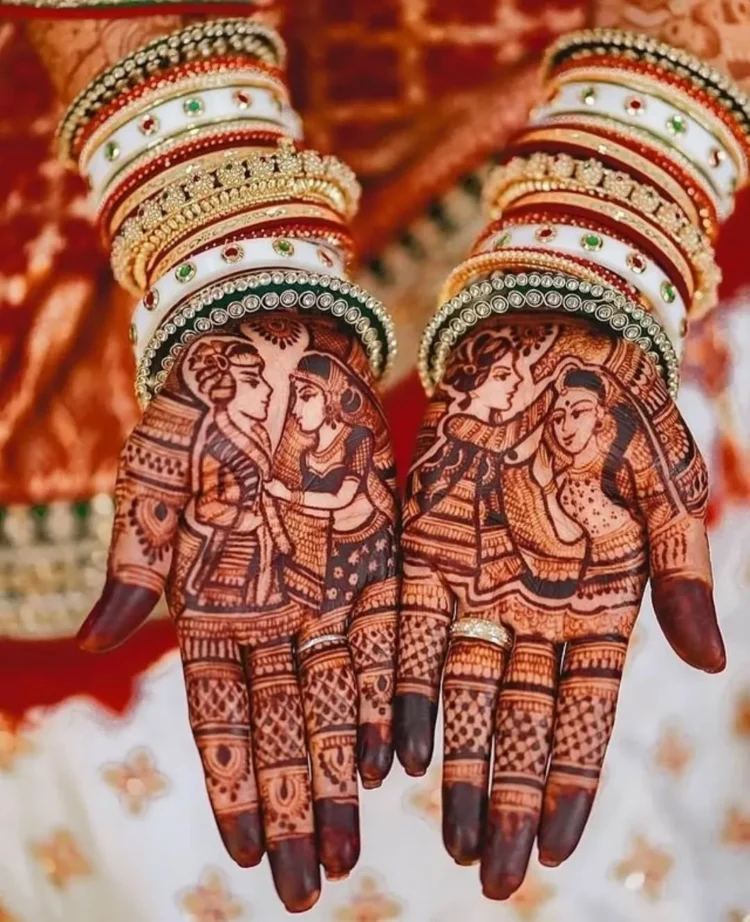
1. Bride and groom figures. Bride and groom figures fill the upper part of both palms, worn here with red and white bridal bangles. The fingers carry checks and bands down to dipped tips, and the fine shading makes this one of the slowest designs to apply.
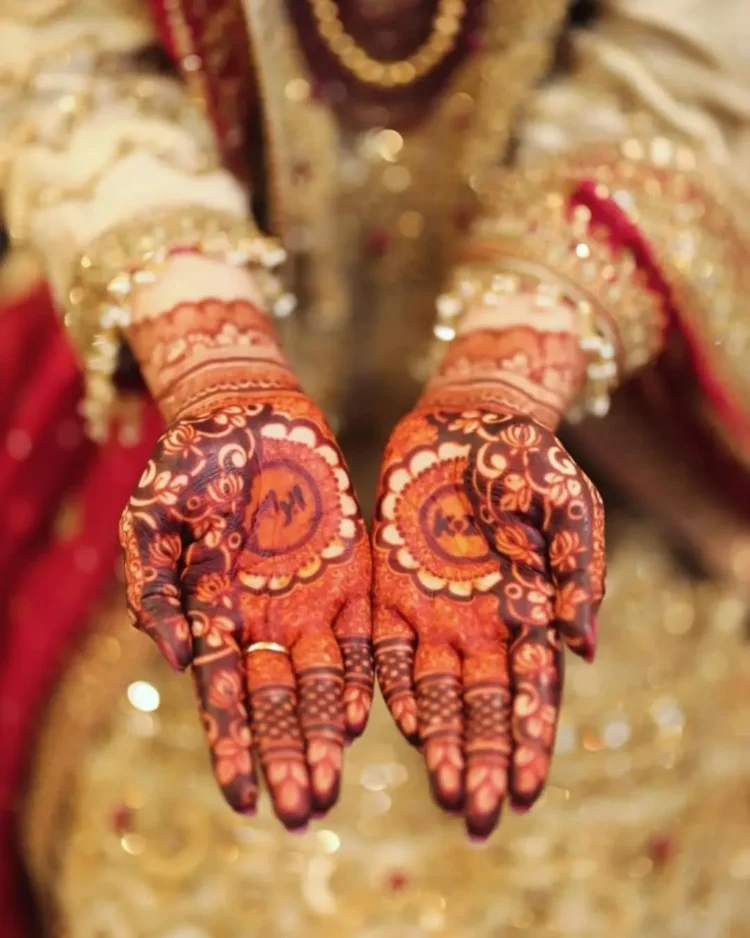
2. Initials inside palm medallions. Each palm holds a round medallion with letters written inside, surrounded by lotus and floral fill. Hiding the couple’s initials in the palm is a well loved bridal custom.
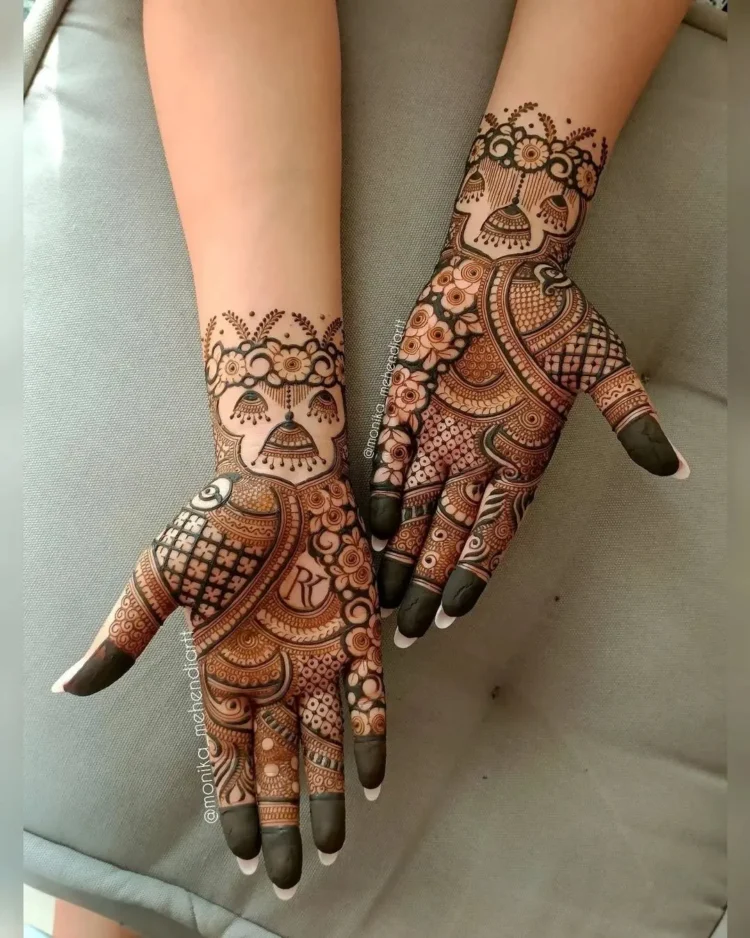
3. Bell drops under flower crowns. Each wrist carries a band of small flowers like a crown, with jhumka style bells hanging from it onto the palm. Below, rose fill, check net on the thumb and fully dipped tips complete a dense bridal palm.
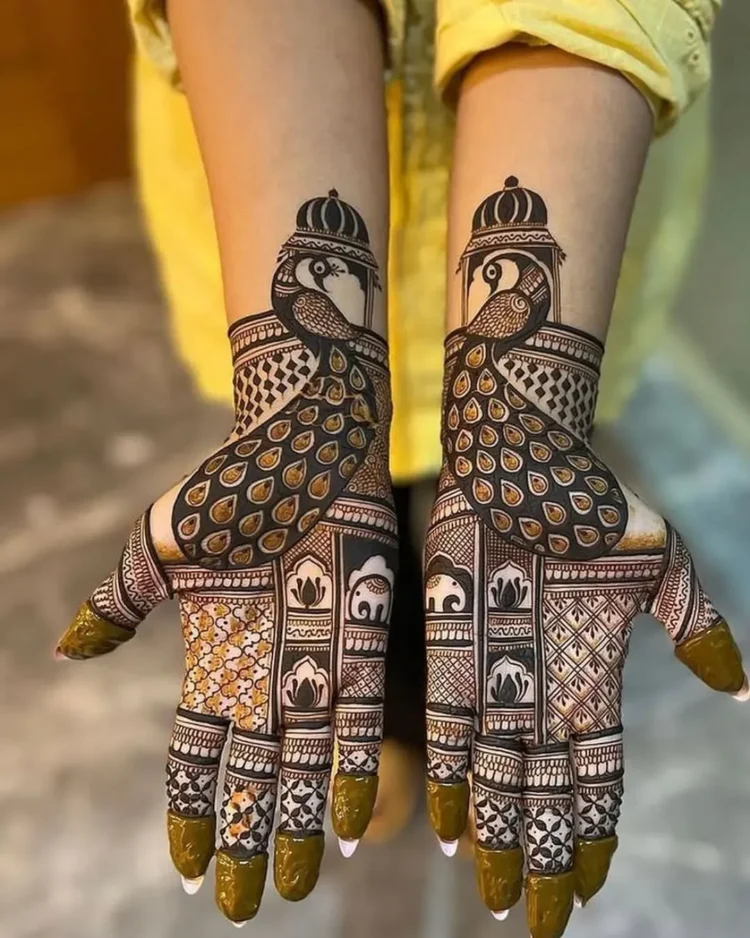
4. Twin peacocks under domed canopies. A large peacock with teardrop feathers fills each palm, topped by a domed canopy on the wrist. Small panels below hold an elephant and lotus flowers, and the tips are still covered in fresh paste.
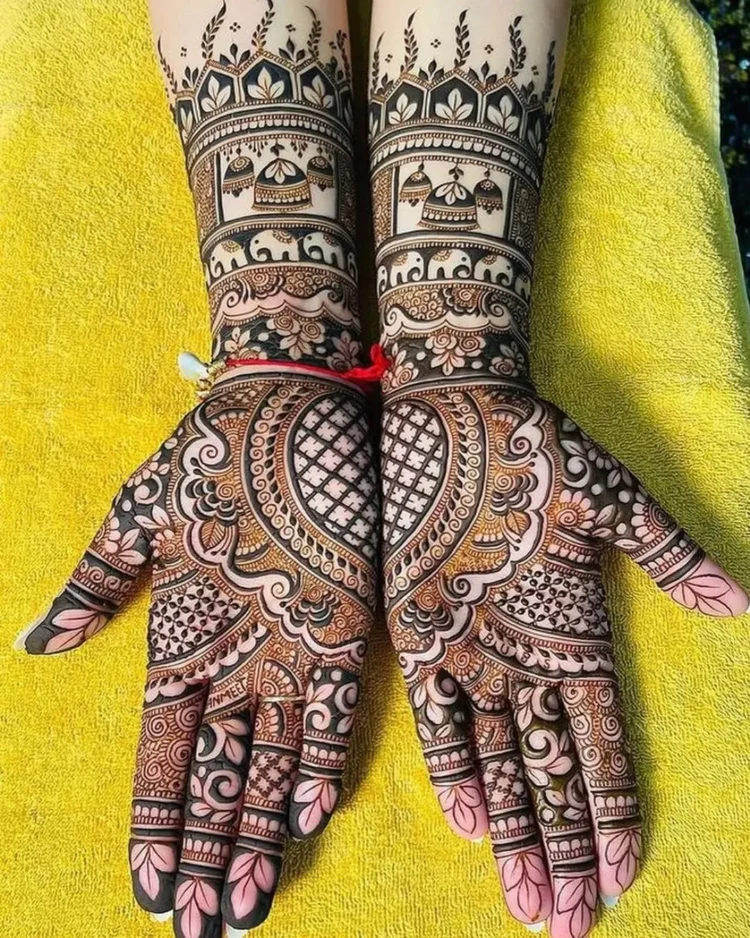
5. Elephant rows and domed canopy cuffs. Stacked cuffs on the forearms show a row of elephants and domed canopies hung with bells. On the palms, big paisleys are filled with net, and every fingertip ends in a bare-skin lotus petal.
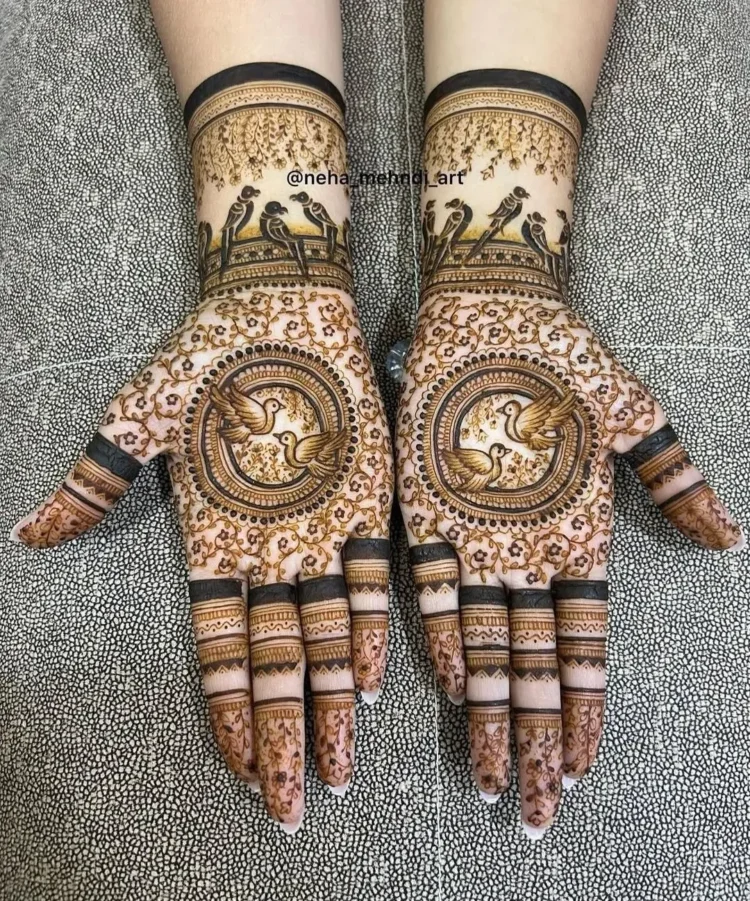
6. Birds on a rail with dove medallions. A row of birds sits on a rail under hanging vines at each wrist, and a round medallion in the palm holds a pair of doves. Fine vine fill covers the rest of the palm and the fingers carry banded sections, which makes this a slow, detailed bridal design.
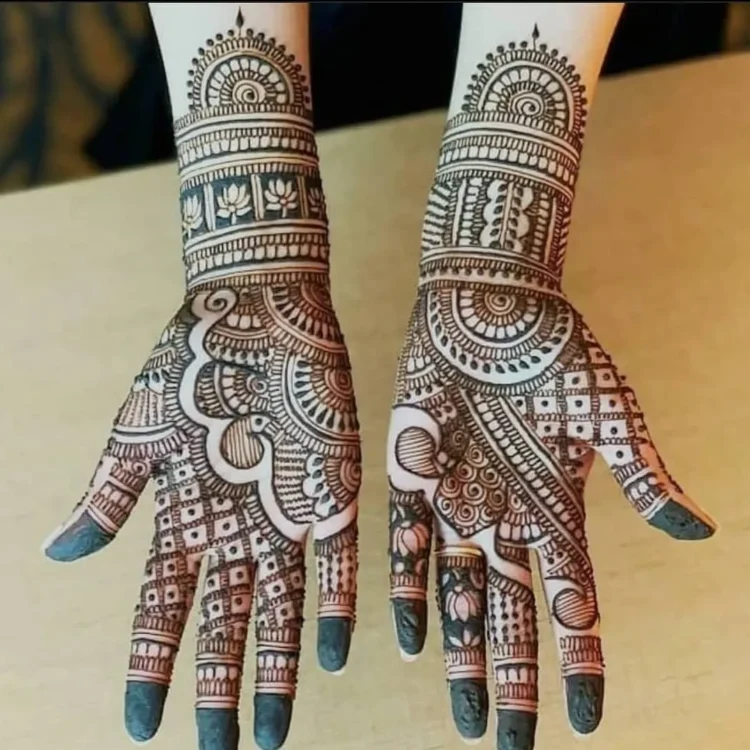
7. Lotus panels with an arched crest. Wide cuffs with lotus panels climb the forearm and end in a rounded crest shaped like an arch. On the palm, bare-skin swirls break up the checks and net, and the tips are dipped.
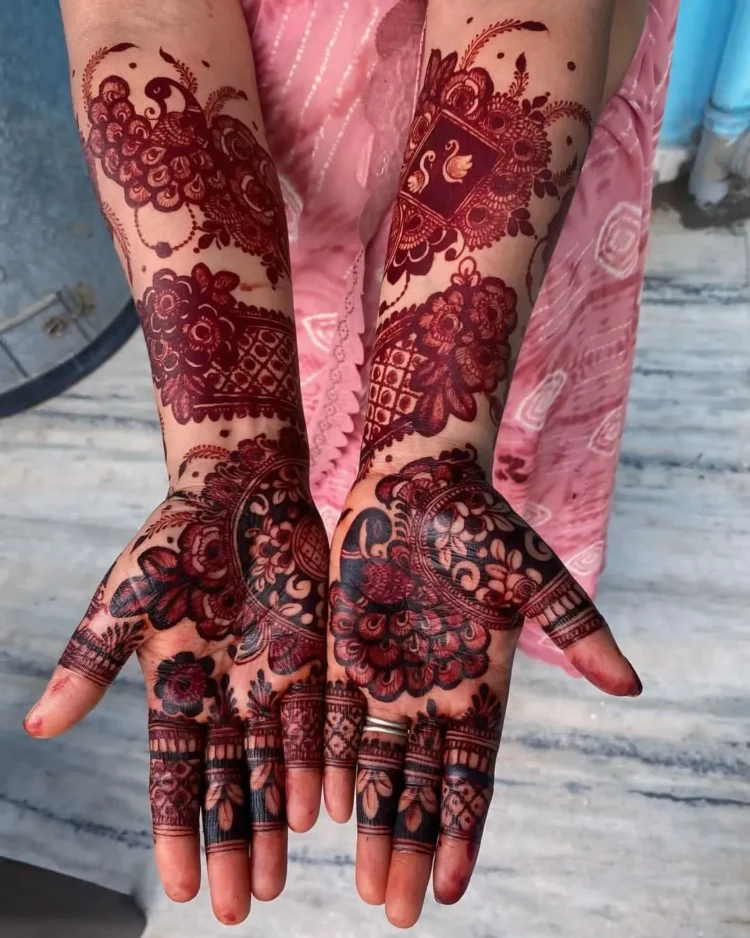
8. Peacocks and a framed swan. A deep maroon stain shows peacocks on the forearms, a swan inside a square frame and dense roses on both palms. Leaf bands decorate each finger.
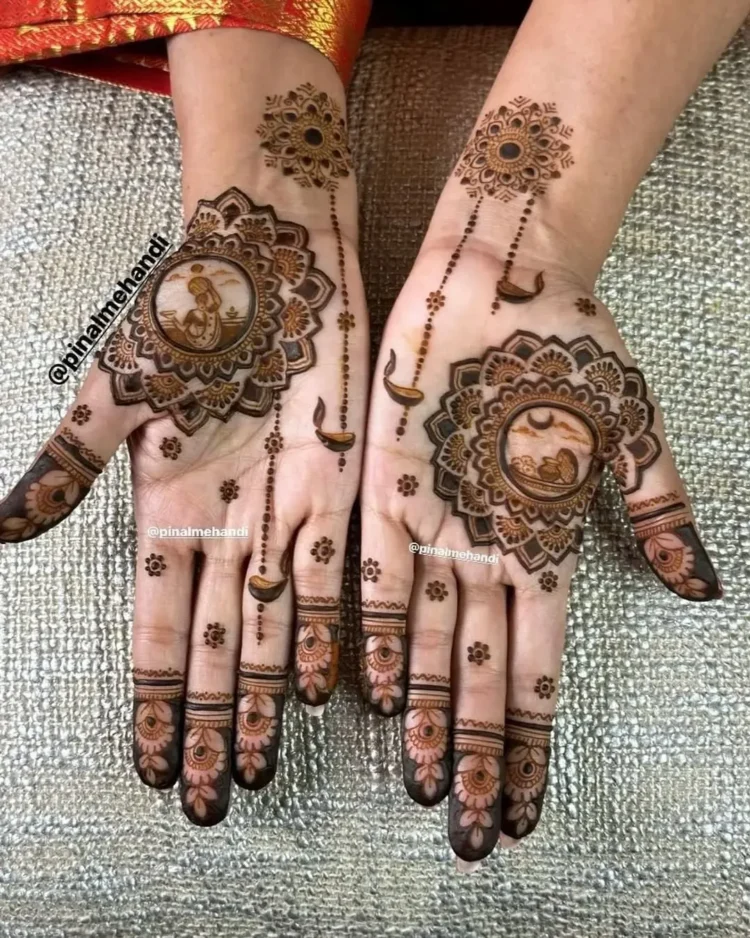
9. Diya chains and scene medallions. A large layered medallion on each palm frames a small drawn scene in its centre, and tiny diya lamps hang from dotted chains that run down from the wrist. Most of the palm stays open, so the medallions read clearly in photos.
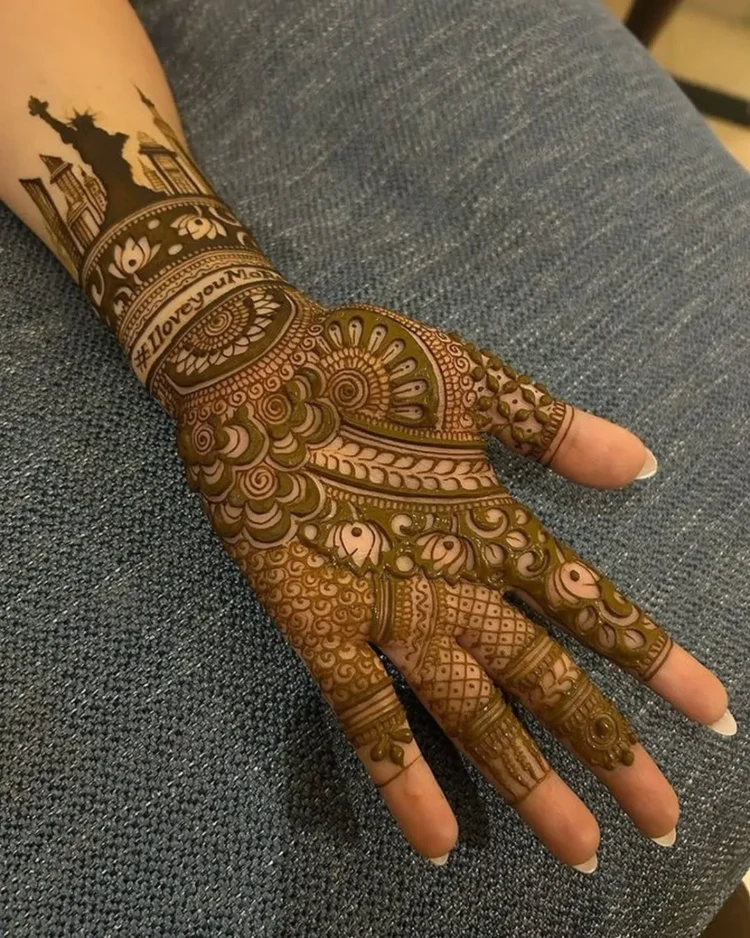
10. City skyline cuff. A modern take on architecture: a city skyline is drawn at the wrist above a band with a written love message, while scallops and net fill the hand below. Personal details like this are drawn on request.
Peacock and Bird Royal Mehndi Design for the Palm
The peacock (mor) is one of the motifs most often asked for on a bridal palm, and smaller birds give a lighter version of the same idea. In these designs the bird is the main motif, drawn large with a feathered body or set inside its own panel, while net, leaves and lotus fingertips fill the space around it.

11. Peacock head with a spiral shell. A large peacock head curves across the palm beside a spiral shell motif and lotus petals edged in bare skin. Quatrefoil net covers the thumb, check and dotted net fill the fingers, and the tips are dipped.
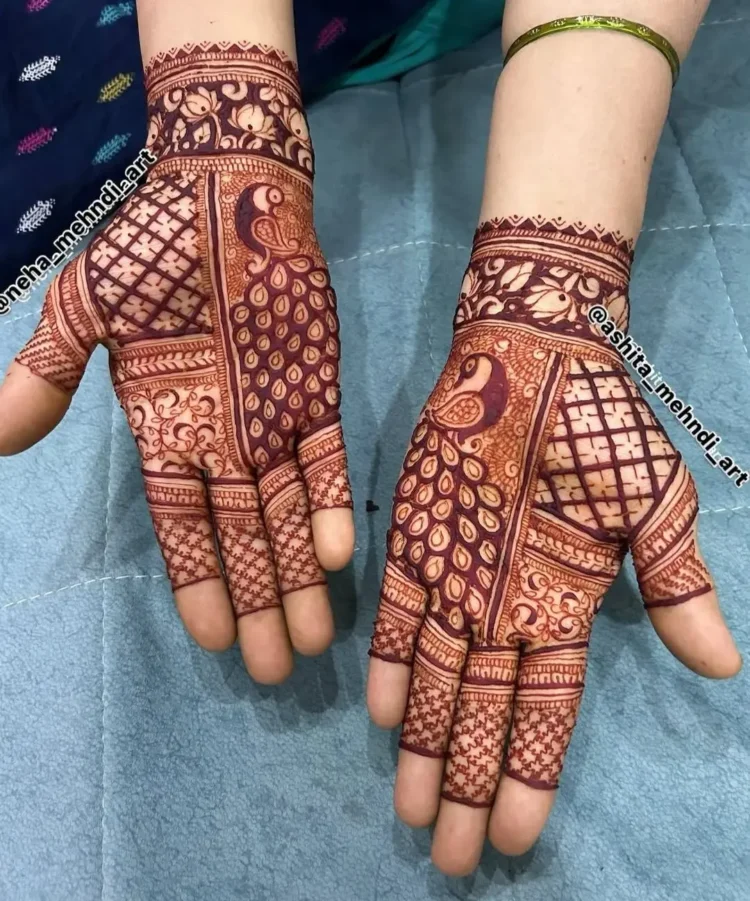
12. Peacock and check grid panels. Each palm is divided into vertical panels: a peacock with drop shaped feathers, a large check grid and floral fill. A row of lotus flowers forms the wrist cuff, and cross stitch net covers the fingers.
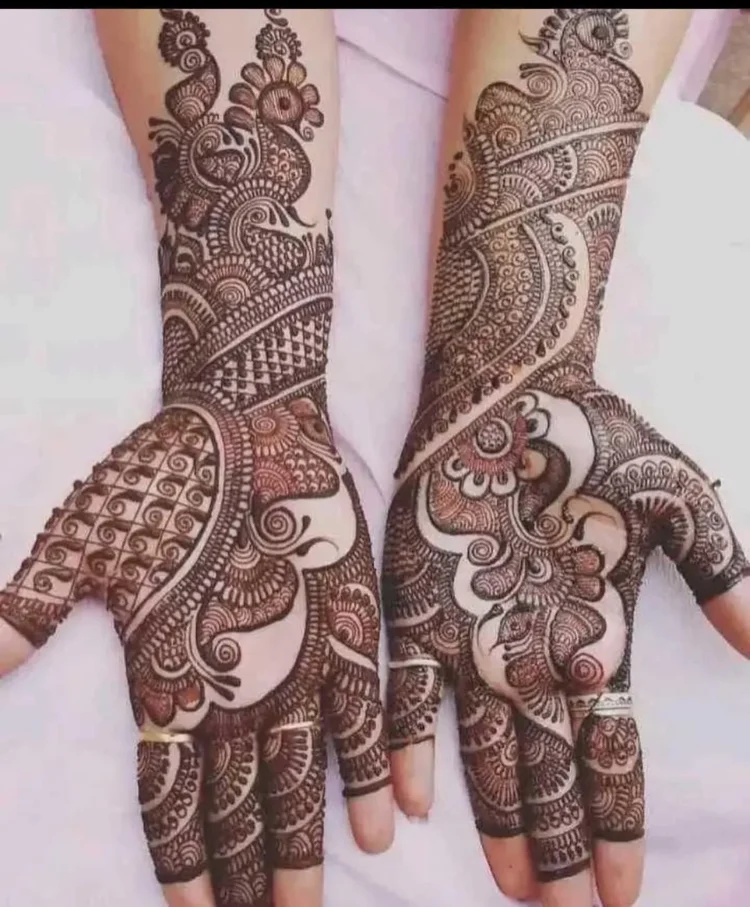
13. Peacock palms with diagonal net. Peacocks and paisleys sit between diagonal bands of net that run from the fingers up to the forearm. The two palms are not exact mirror images, but the bands line up when the hands are held together.
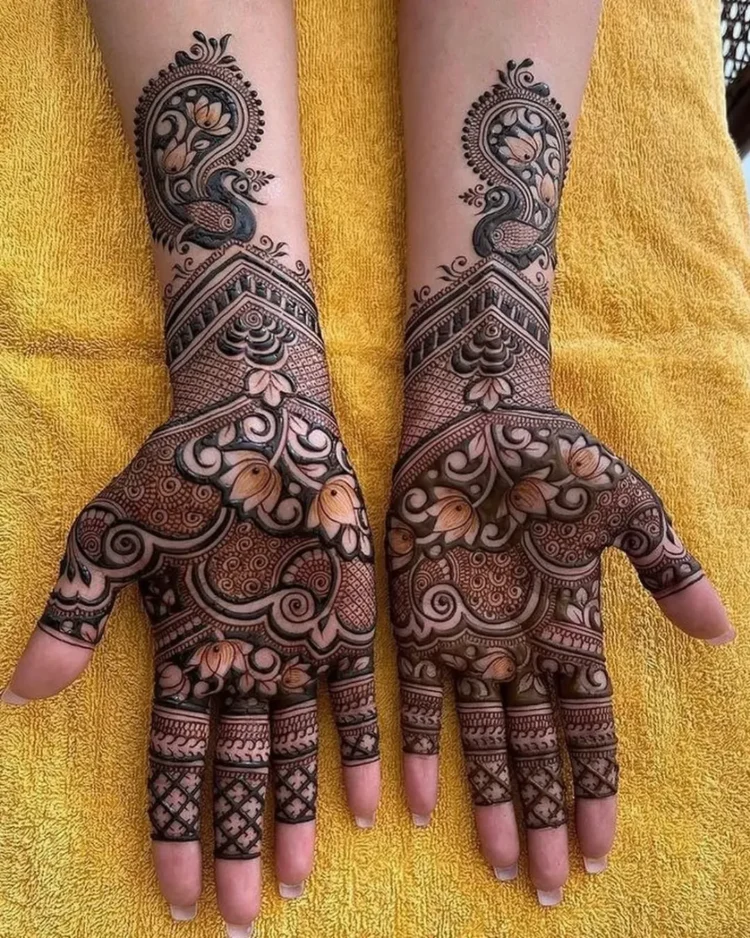
14. Lotus palms with peacock forearms. Lotus flowers with bare-skin petals fill both palms, a chevron band marks each wrist and a peacock rises up each forearm. The lower finger sections are filled with square net.
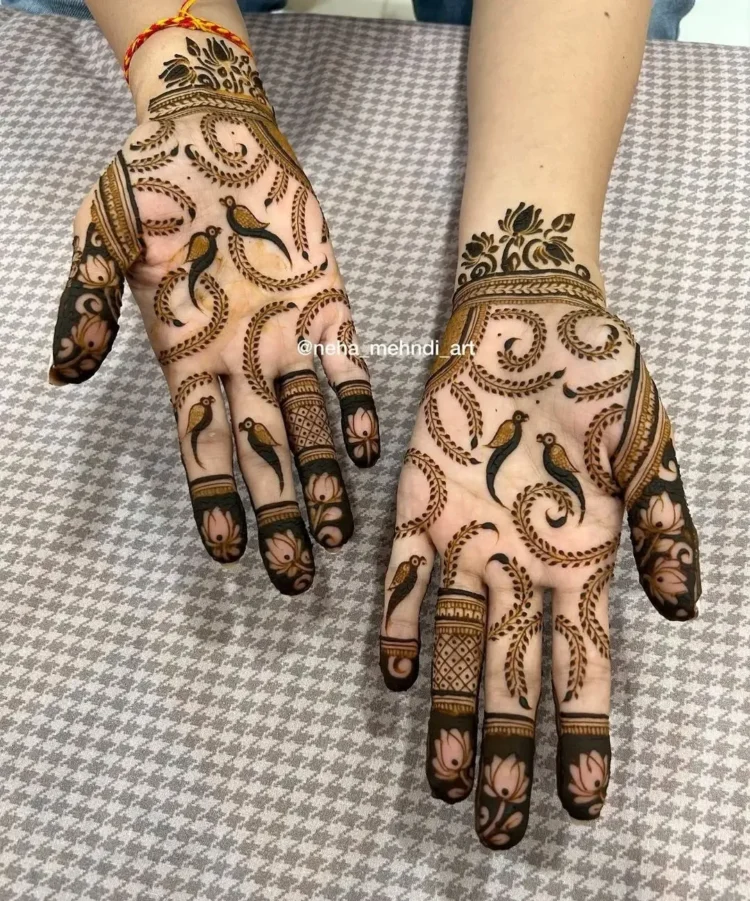
15. Small birds among leaf vines. Small birds sit between curling leaf vines spread across an otherwise open palm. Each fingertip holds a lotus bud and a lotus crest finishes the wrist, so it looks rich but is quicker than full net.
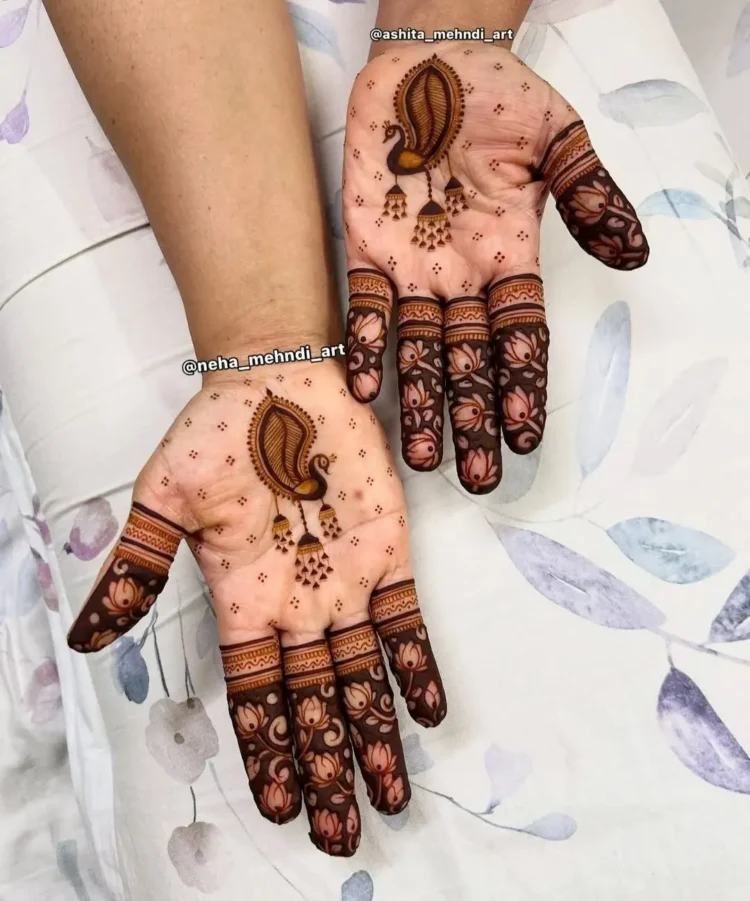
16. Peacock with hanging tassels. One peacock with a fanned tail and three hanging tassels sits in the middle of each palm, with tiny dot clusters scattered around it. The fingers are filled solid with lotus buds, which balances the open palm.
Royal Front Hand Mehndi Designs with a Centre Mandala
A large round motif in the middle of the palm is the simplest way to give a front hand design a royal anchor. The mandala is drawn first, and the net, bands and finger patterns are built outward from it, which keeps both hands balanced. If you like this round centre, our circle mehndi designs and lotus mehndi designs show many more variations.
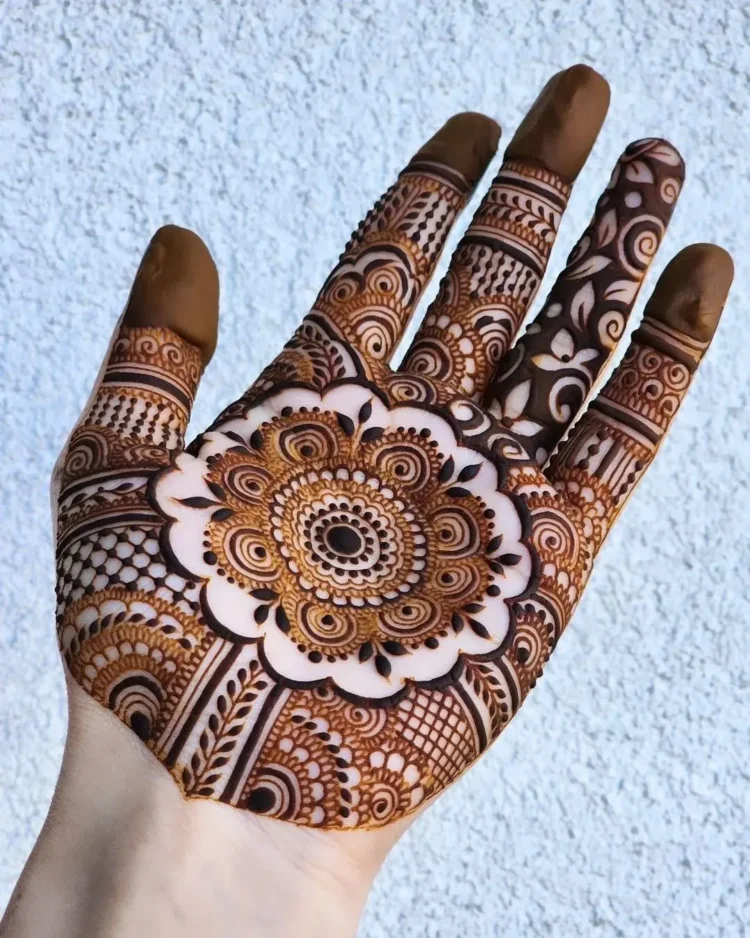
17. Mandala with a bare-skin flower edge. A large mandala fills the palm inside a wide flower shape left as bare skin, which makes the centre stand out sharply. Leaf stripes and fine bands fill the space below, and the tips are dipped.
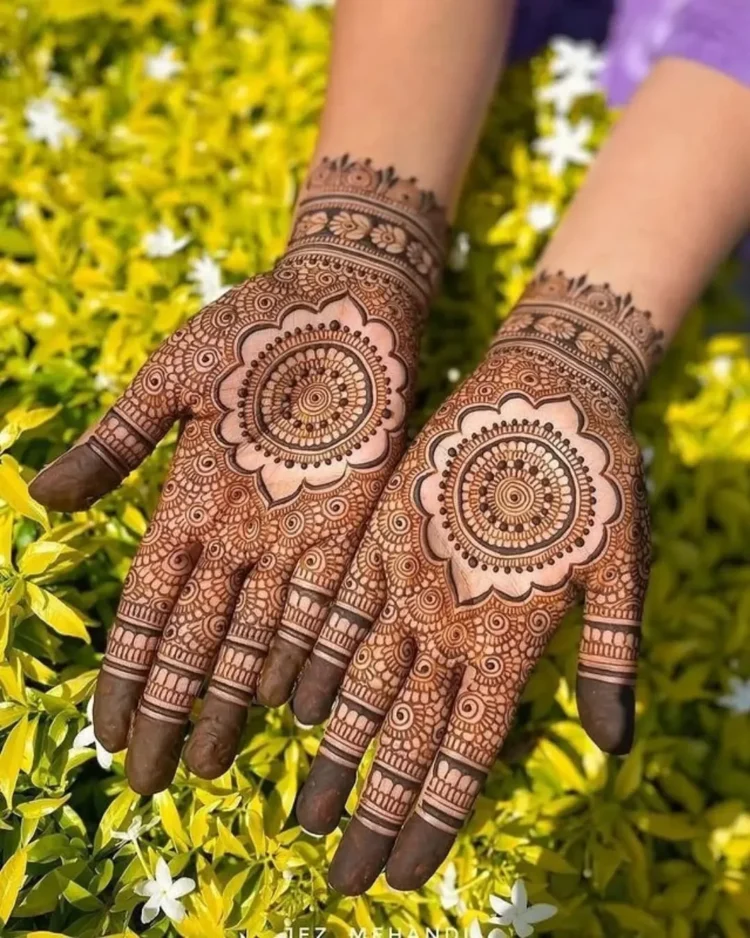
18. Flower outline mandalas with lace cuffs. A big round mandala sits inside a scalloped flower outline in the middle of each palm, surrounded by fine dotted fill. A layered cuff with a lace edge closes each wrist, and every finger ends in a dipped tip.
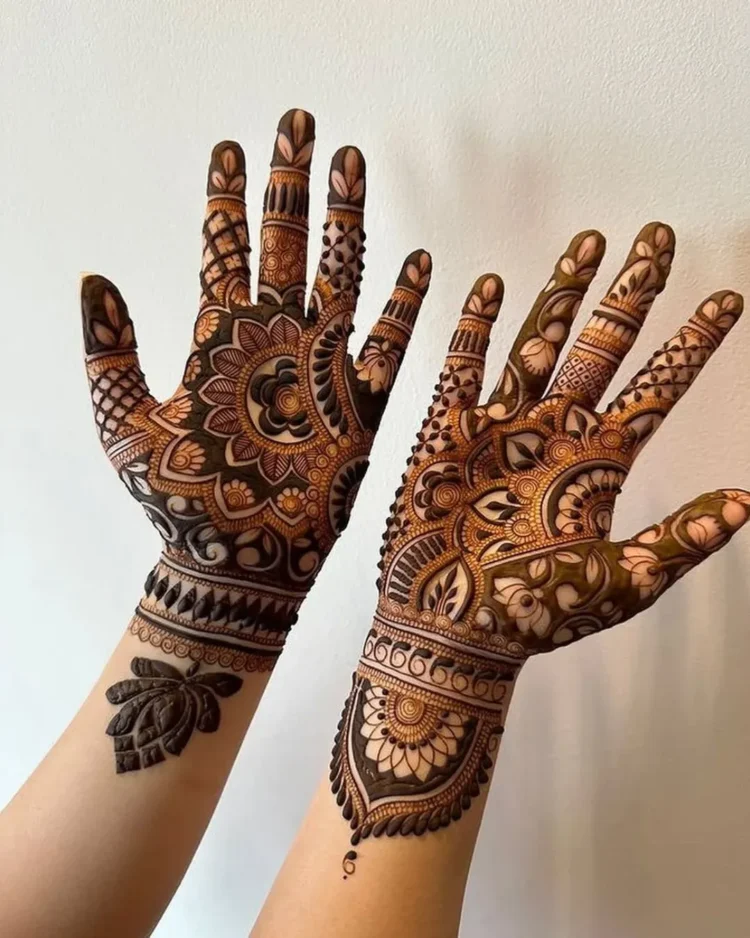
19. Mirrored mandalas with wrist drops. Both palms hold a layered mandala, and the fingers end in pointed leaf tips. A lotus hangs below one wrist cuff and a pointed drop below the other.
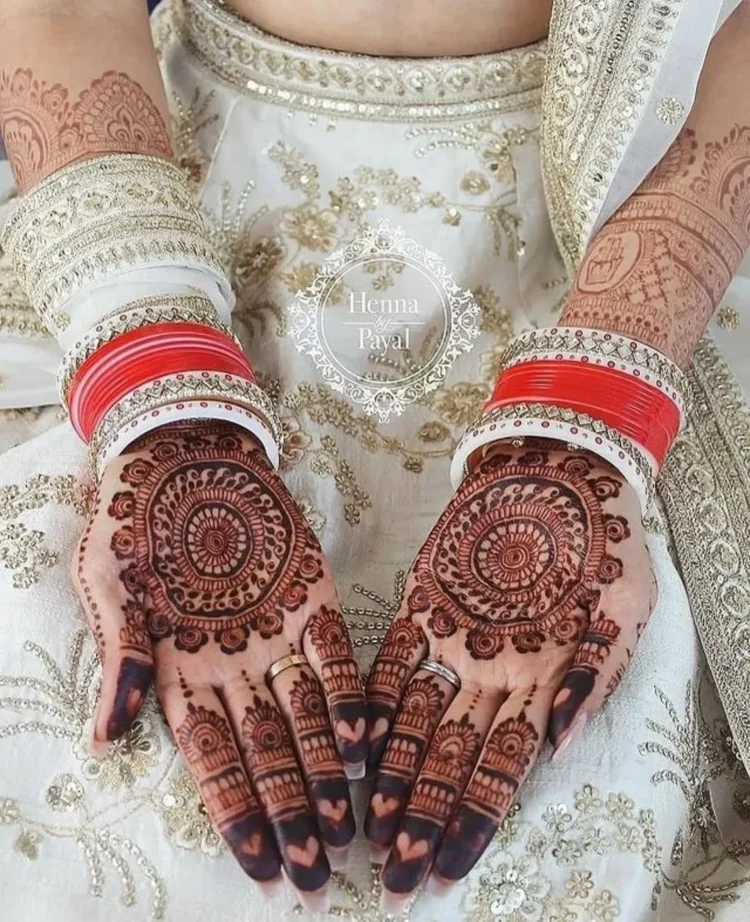
20. Round mandalas with heart tips. A round mandala built from rings of dots and petals fills the centre of each palm. The fingers carry small arches, and every dipped fingertip keeps a heart in bare skin, a sweet bridal detail.
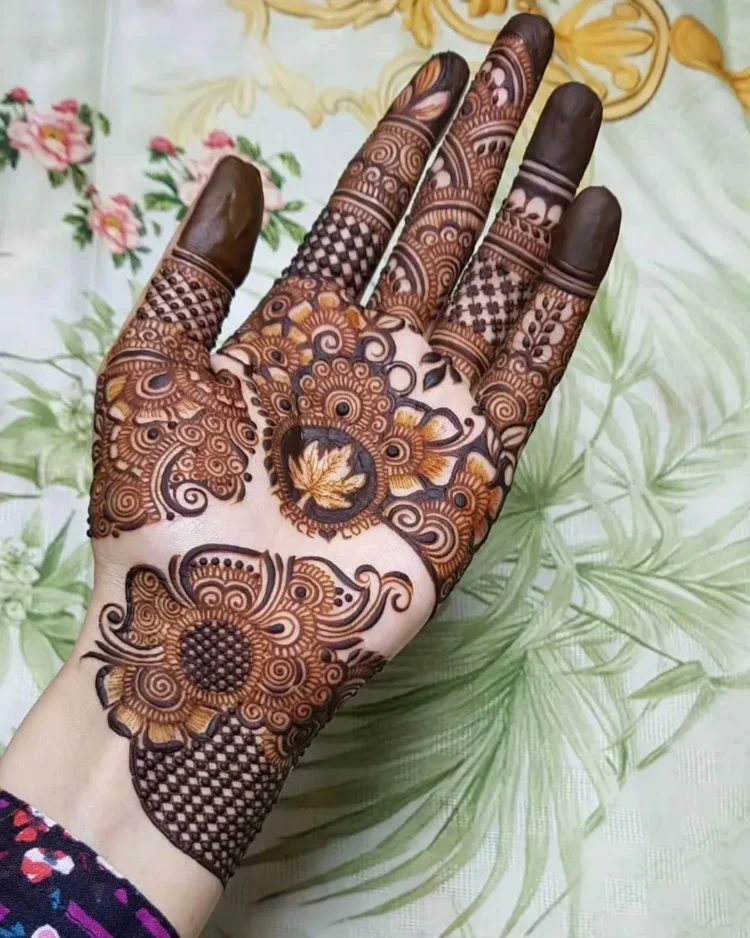
21. Maple leaf medallion and sunflower. A medallion with a maple leaf at its heart sits high on the palm, with a large sunflower below it. A block of net covers the wrist and the fingertips are dipped.
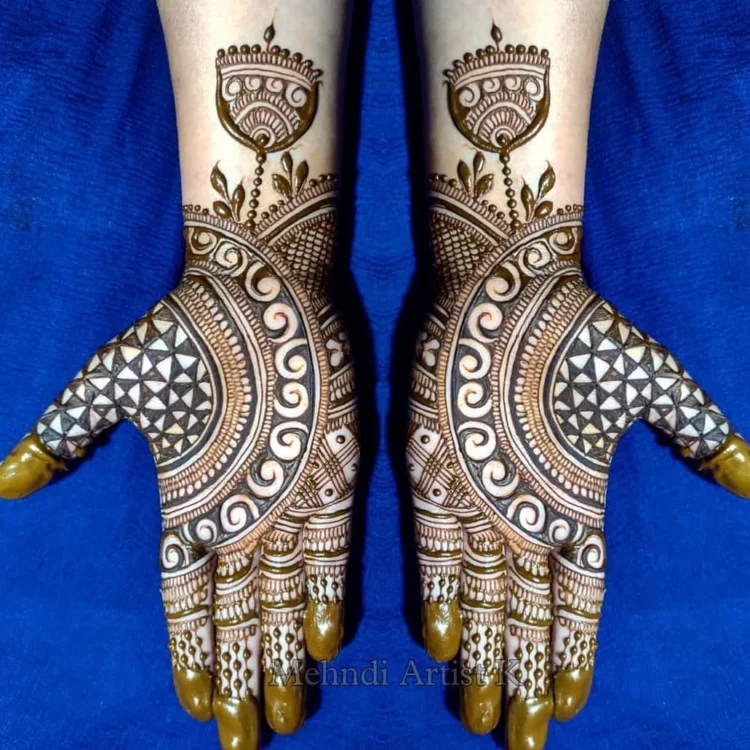
22. Crescent arcs with lantern crests. Wide crescent arcs filled with bare-skin swirls curve around the centre of both palms, and the thumbs are covered in triangle net. Above each wrist a lantern shaped motif hangs from dotted chains, and the tips are still in fresh paste.
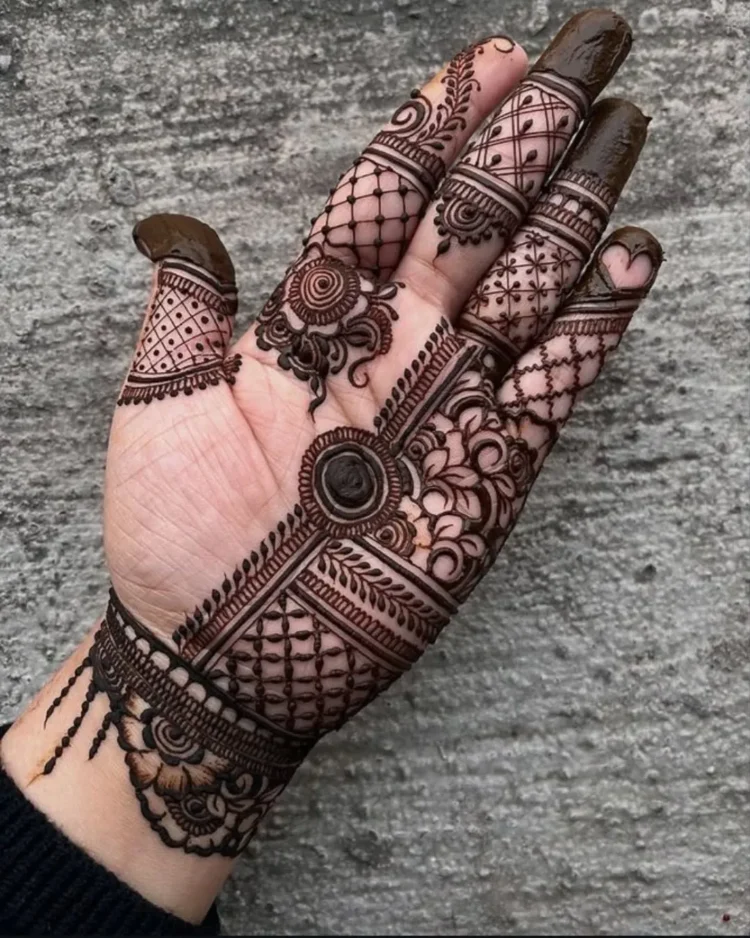
23. Round centre with a tassel cuff. A small solid circle marks the centre of the palm where a leaf band meets a net panel. The wrist cuff has hanging tassel drops like a bracelet, and one fingertip shows a bare heart.
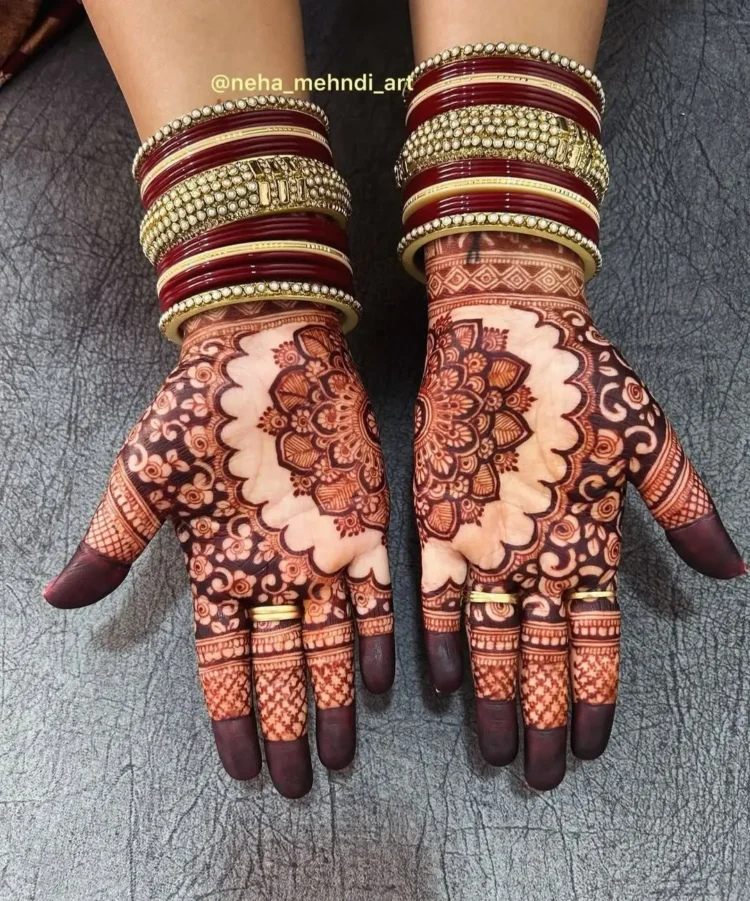
24. Scalloped half mandalas with rose swirls. Each palm holds half of a mandala inside a scalloped frame left as bare skin, so the two halves join when the hands are placed together. Rose swirls fill the rest, net covers the lower fingers and the tips are dipped, worn here with red and gold bridal bangles.
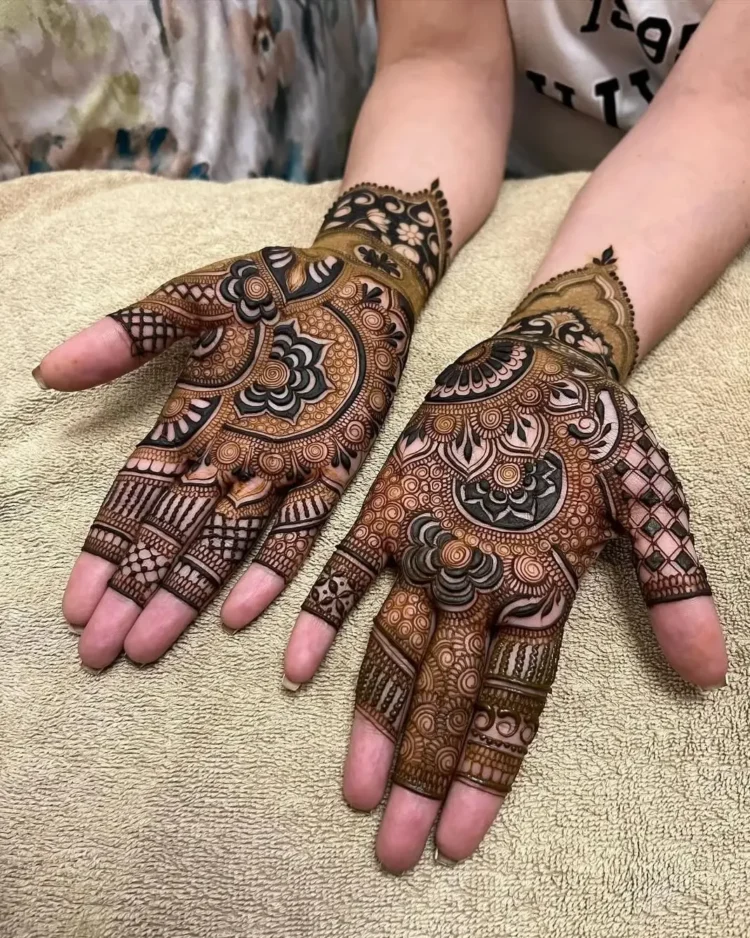
25. Dark lotus centres on both palms. Large lotus shapes shaded dark sit in the centre of each palm, with net on the thumbs and a pointed crest at each wrist. The fingertips are left bare for a cleaner finish.
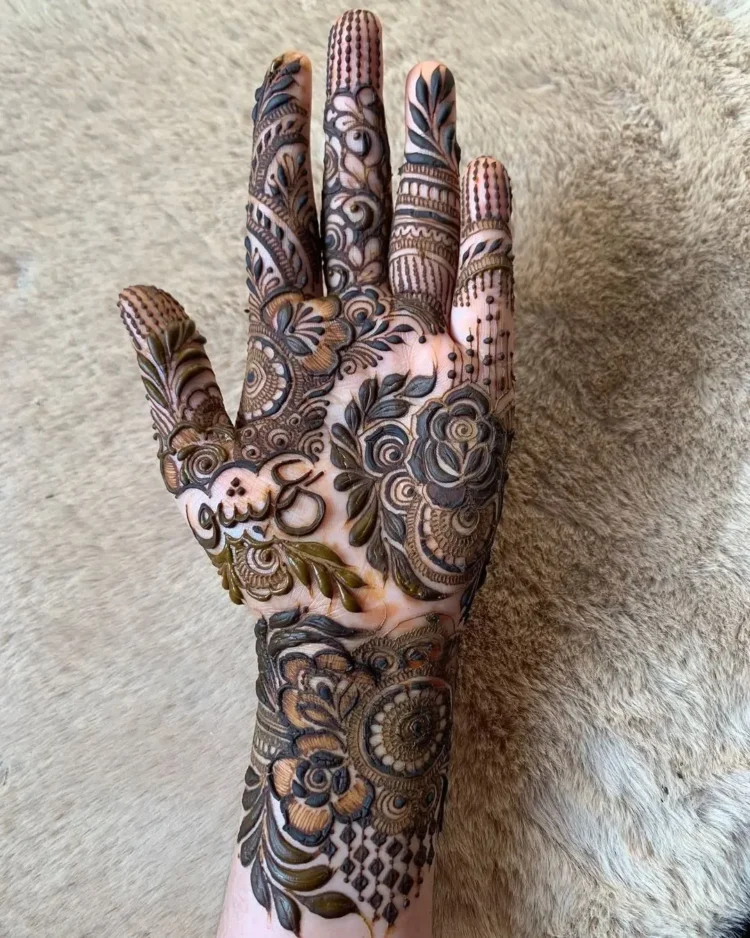
26. Ishq calligraphy with roses. The Urdu word ishq (love) is written across the palm in calligraphy, framed by bold roses and leaves. A round mandala and a net drop finish the wrist.
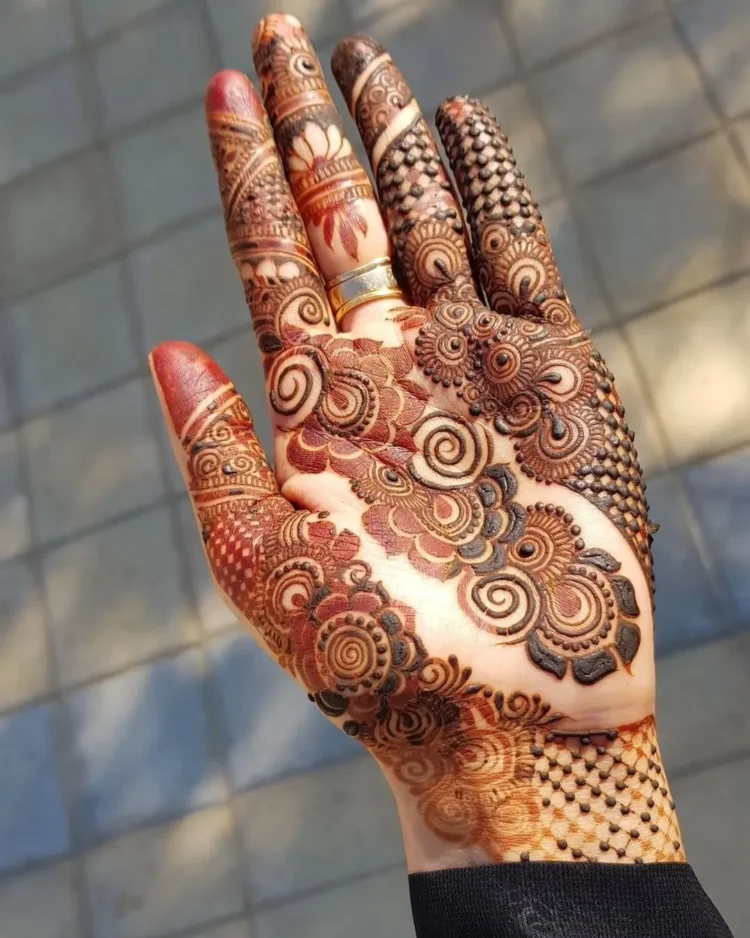
27. Spiral swirl palm. Spiral swirls ringed with dots run diagonally across the palm toward the index finger. Dotted net fills the base of the palm, and the fingers carry bands and checks.
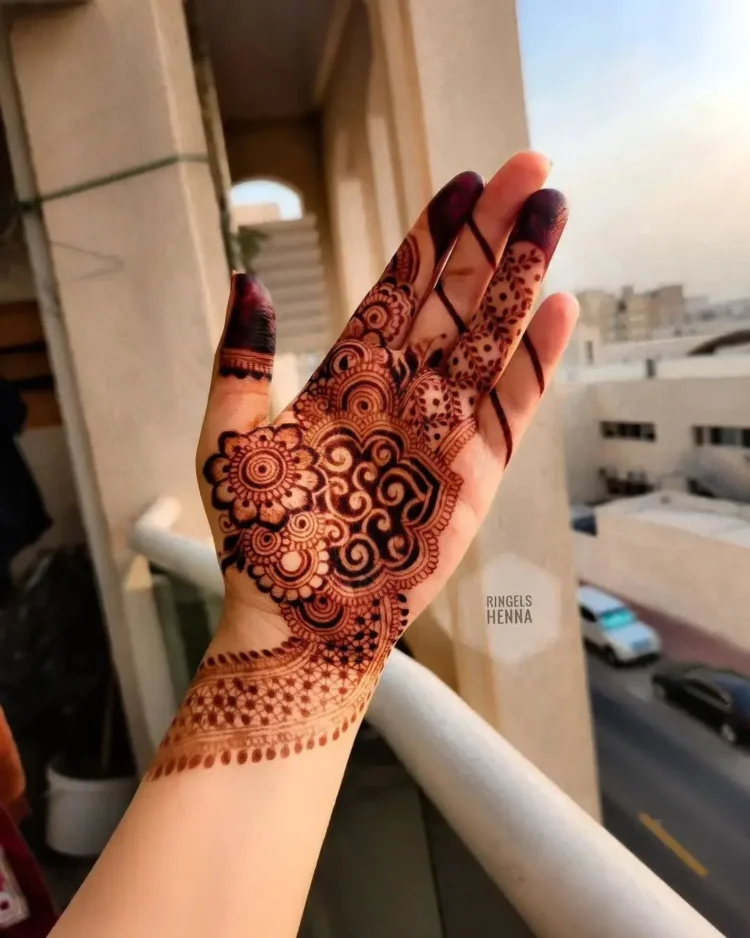
28. Swirl flower cluster with a lace wrist. A cluster of round flowers and bare-skin swirls covers one side of the palm, and a lace border of dots wraps the wrist. Diagonal bands cross the open fingers, leaving the other side of the palm bare.
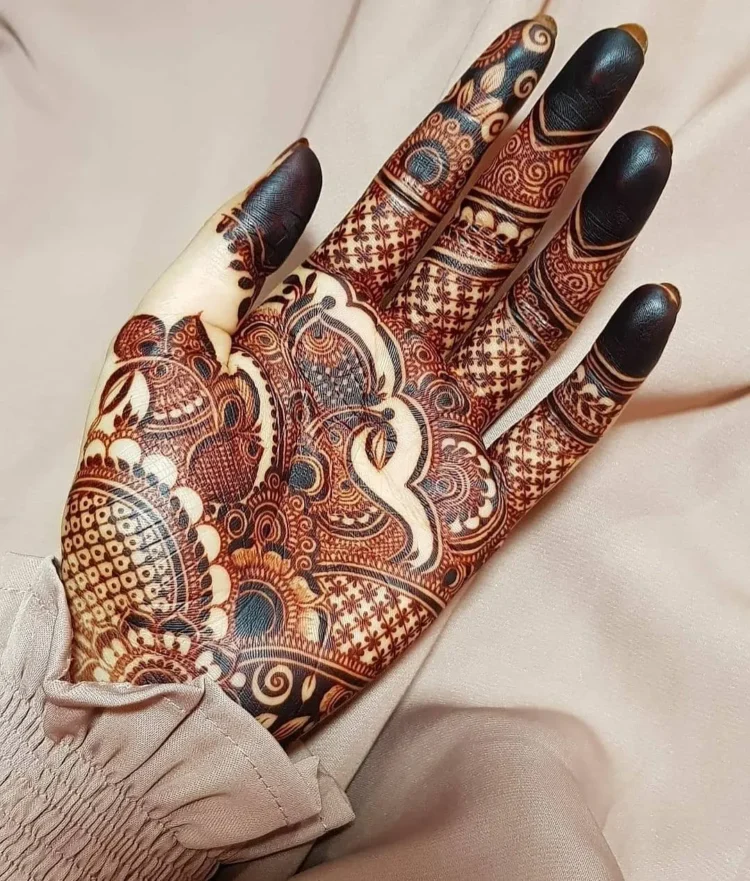
29. Paisleys and bare-skin swirls. Paisleys and bare-skin swirls sweep across a palm that is otherwise filled edge to edge with checks and fine lines. The dipped fingertips stain almost black against the red.
Jaal and Lace Front Hand Designs with Layered Wrist Cuffs
Jaal (net), checks and lace scallops are what make a palm look completely full. Each row is small and repetitive, so these designs take patience more than drawing talent, and the layered cuffs at the wrist act like bangles drawn in henna. Our bracelet mehndi designs focus on the cuff alone, and our full hand mehndi designs carry the same fill further up the arm.
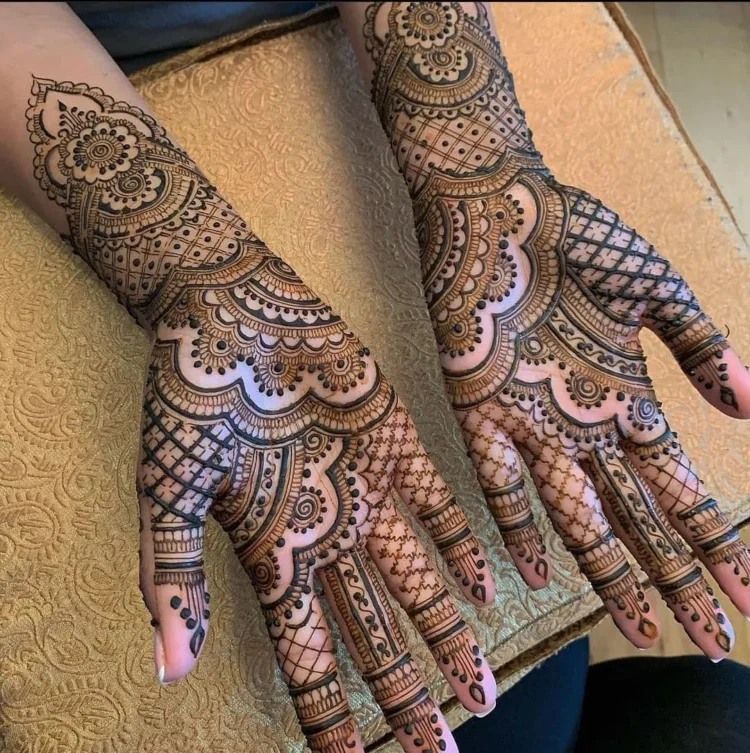
30. Lace arches on both palms. Rows of lace scallops arch across both palms above a band of diamond net. A small mandala sits on each wrist, and the fingers carry fine bands.
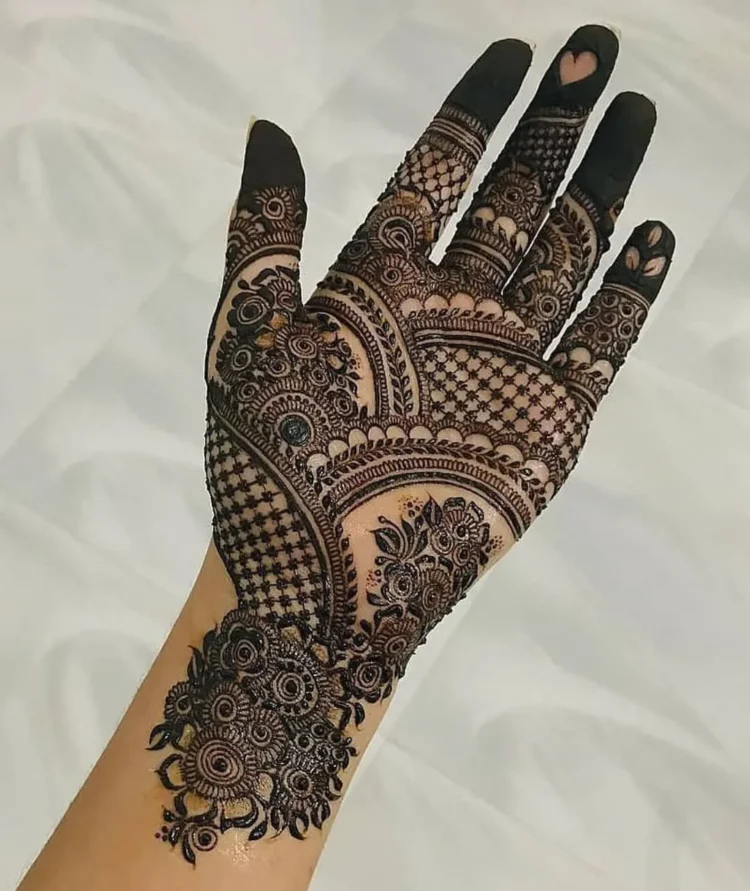
31. Net arch with a rose wrist. A net-filled arch curves from the thumb toward the little finger, and a cluster of roses spills over the wrist. One dipped fingertip keeps a small heart in bare skin.
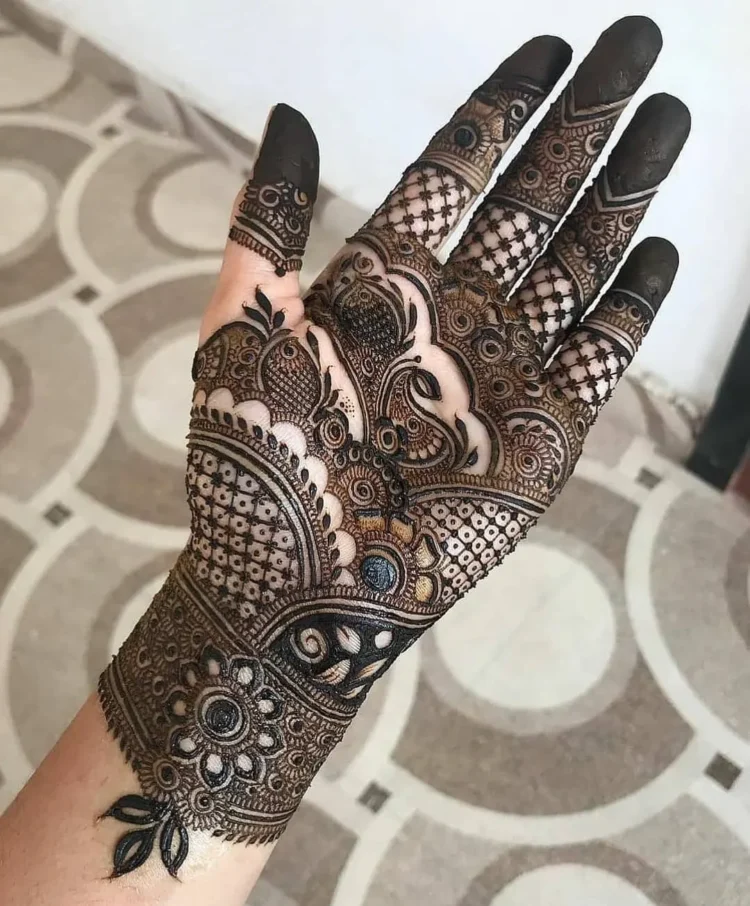
32. Scallops with a flower cuff. Scallops and net cover the palm, a wide cuff with a flower sits at the wrist and two leaves hang below it. Almost no skin is left bare, which gives a very even stain.
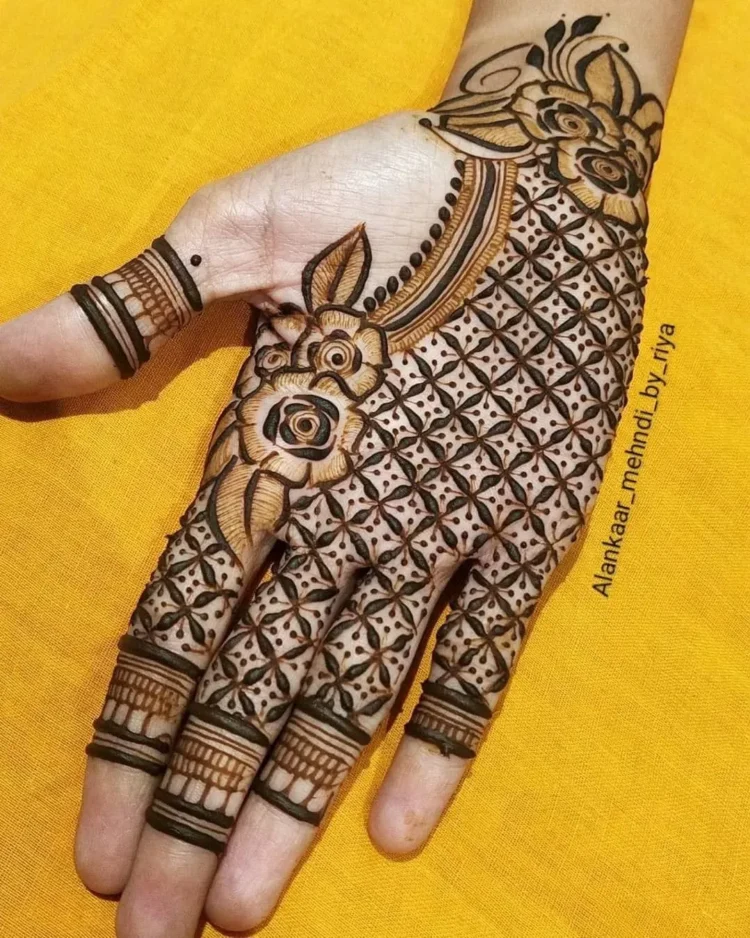
33. Quatrefoil net with a rose border. A net of small quatrefoils covers most of the palm in one even pattern, edged by a curved border with a rose and leaves. The fingers carry plain bands, so the net stays the focus.
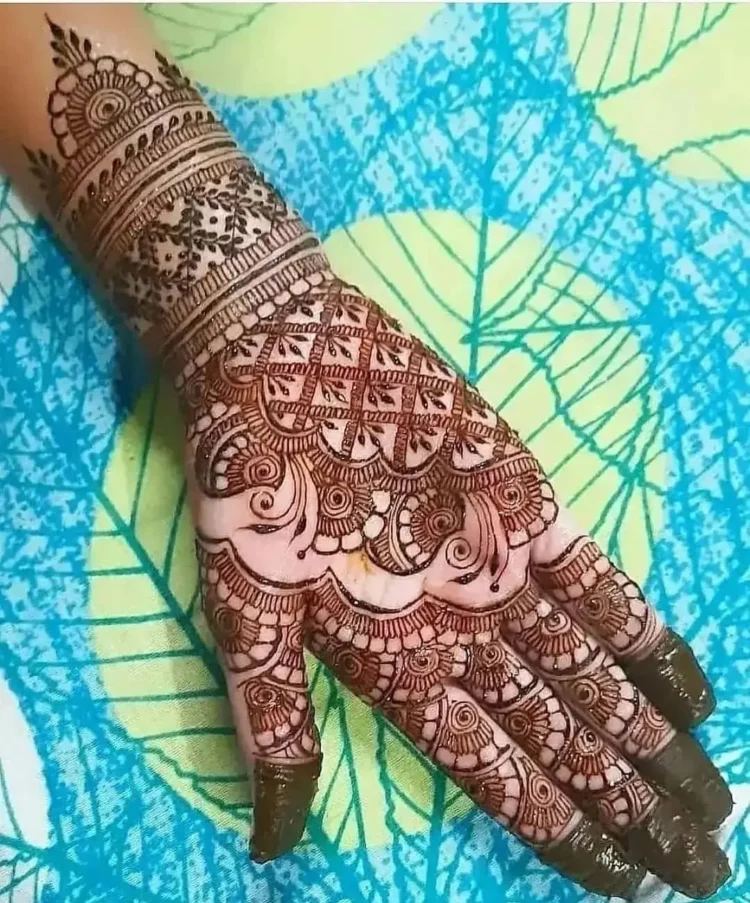
34. Diamond net with arched bands. Dotted diamonds inside a net pattern fill the lower palm, and arched bands lead to a tall layered cuff on the forearm. The fingertips are still covered in paste.
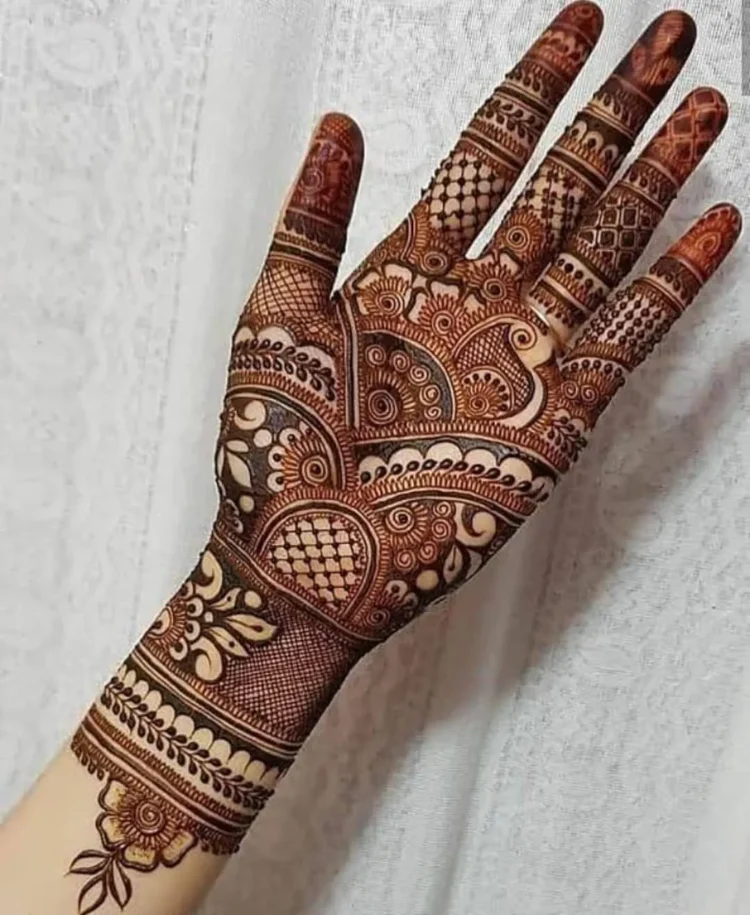
35. Stacked forearm cuffs. Net and scallop arches fill the palm, then several stacked cuffs carry the design halfway up the forearm. A small leaf drop closes the bottom edge.
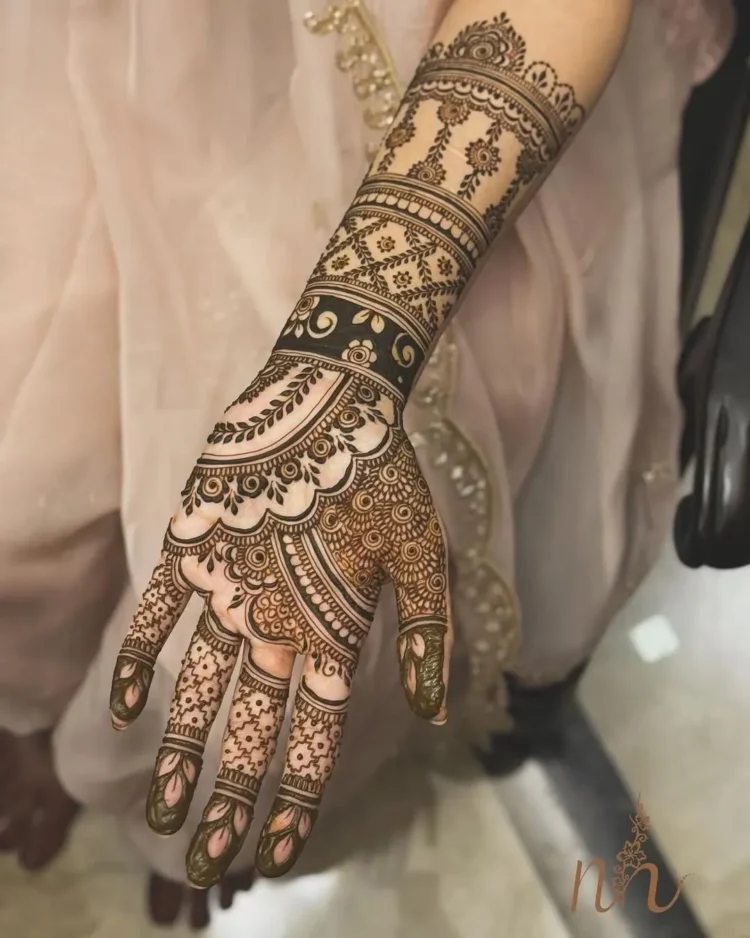
36. Scalloped arches with a long cuff. Scalloped arches and swirl fill cover the palm, the fingers carry flower net and each tip ends in a petal outline. Several cuffs of jaal, a dark band and leaves continue the design up the forearm.
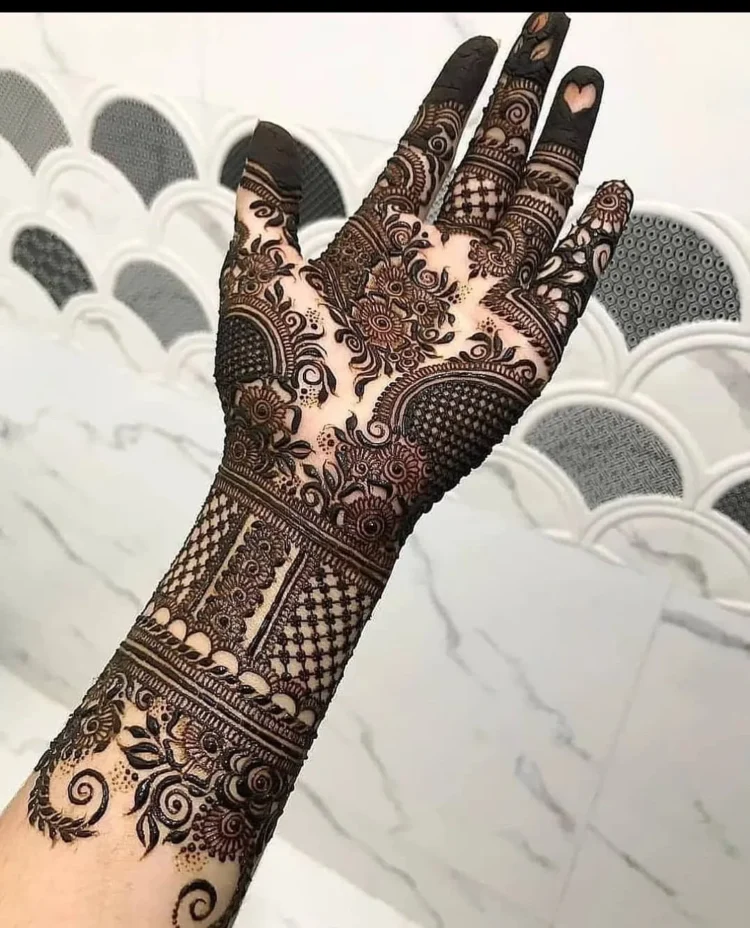
37. Long cuff with loose swirls. A royal stylish mehndi design that runs long: floral blocks and net lead from the fingers into a cuff of checks and bands, with loose swirls trailing down the forearm. A bare heart decorates one fingertip.
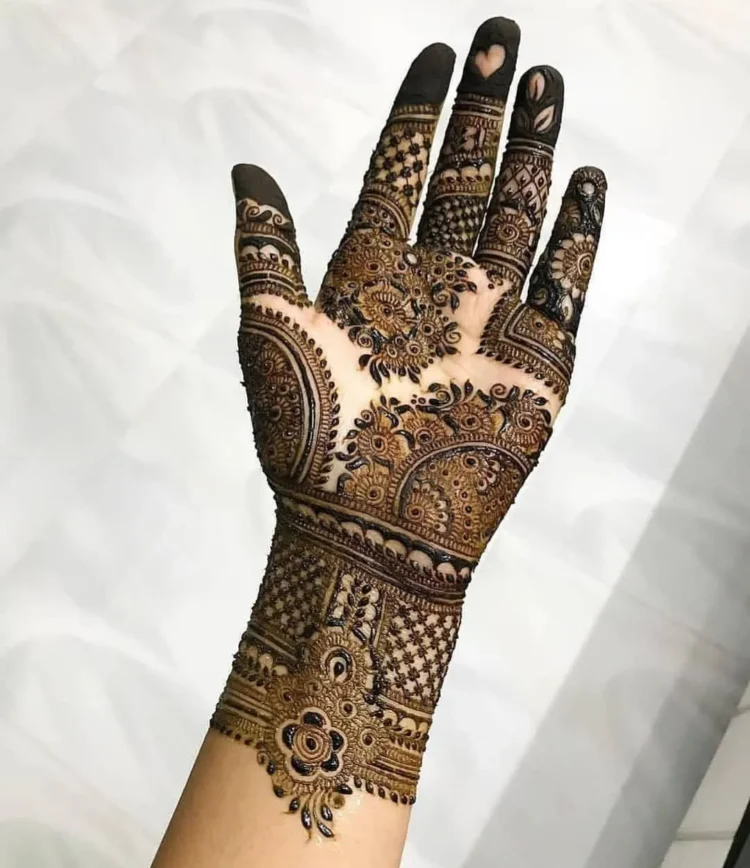
38. Check cuff with a flower pendant. Fine floral fill covers the palm, check bands form a cuff at the wrist and a single flower hangs below it like a pendant. Bare hearts and drops decorate the fingertips.
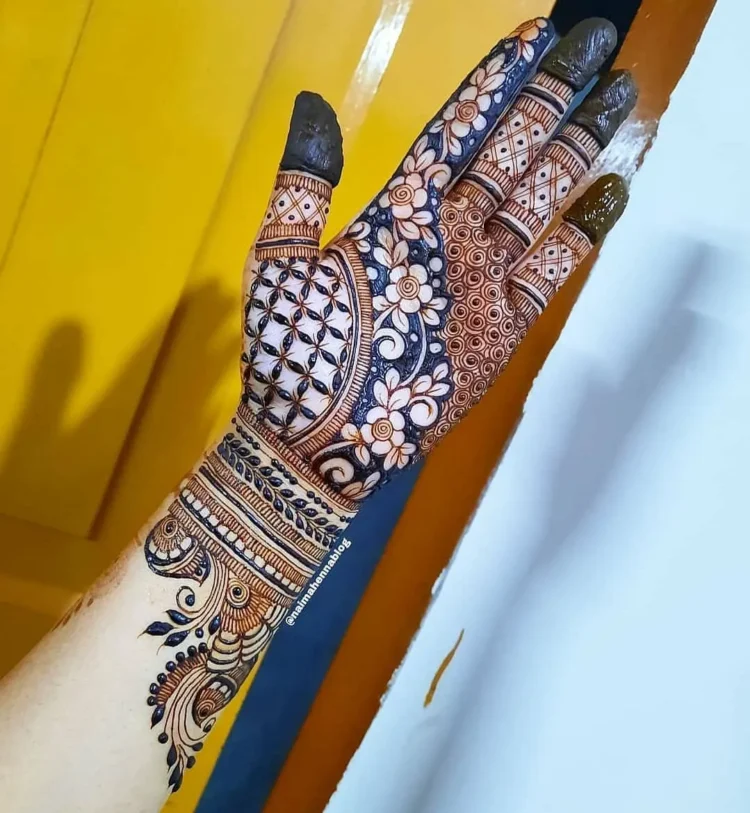
39. Star net with a trailing cuff. Star shaped net fills the thumb side of the palm next to a panel of flowers and a block of dotted circles. A layered cuff with a leaf band sits on the wrist and a vine trails down the forearm, with the paste still fresh on the tips.
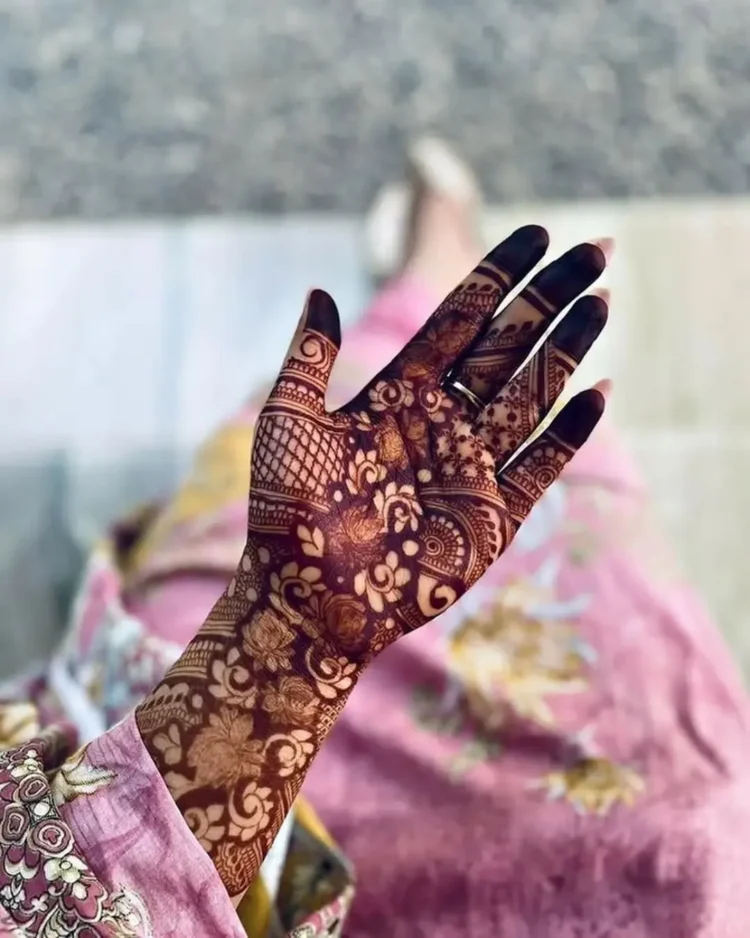
40. Maroon net and flower palm. Net covers the side of the palm and flowers fill the centre, continuing onto the forearm in a dark maroon stain. It shows how densely filled skin takes the strongest colour.
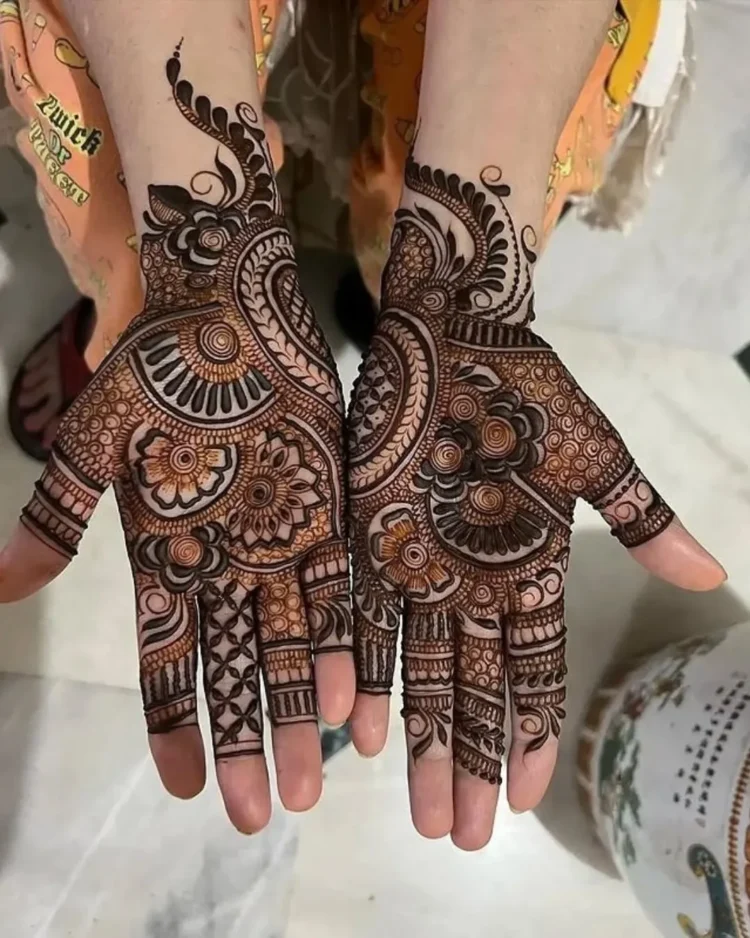
41. Paisley palms with crossed fingers. Large paisleys and half mandalas fill both palms, and the fingers alternate crossed lines, checks and bands. The design stops at the wrist, so it is a little quicker than a forearm cuff.
Geometric Royal Front Hand Mehndi Designs with Squares and Triangles
Some royal palms are built around a shape instead of a flower: a square frame, a triangle or a straight band that cuts across the palm. Straight edges give a sharp, modern look and are easier to keep even than a large mandala. Inside the shape the artist adds chevrons, net, a sun or a small figure.
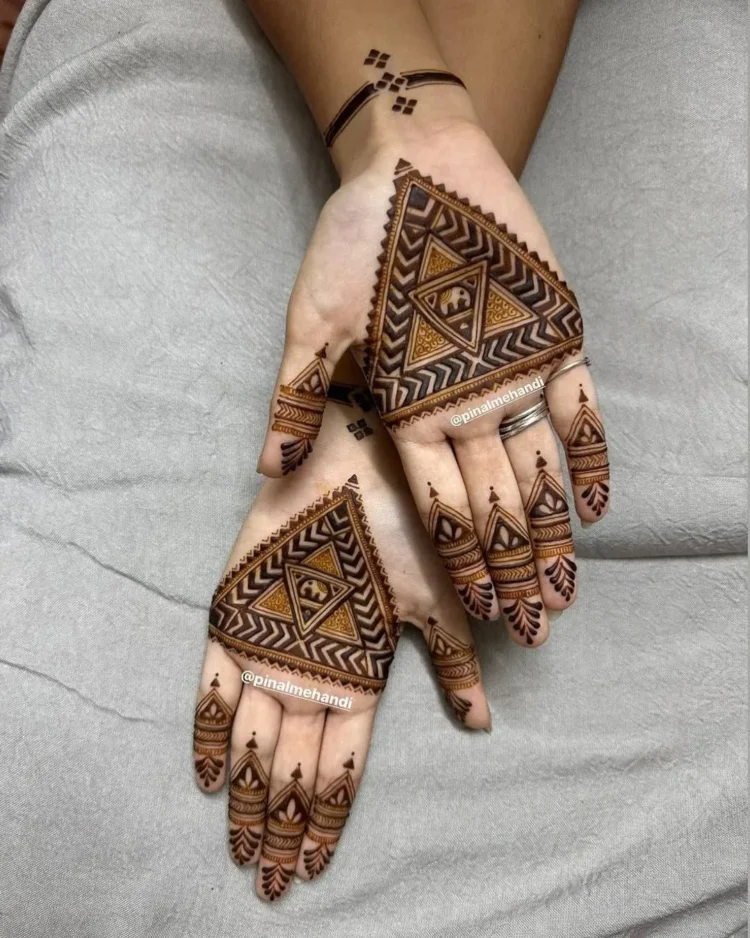
42. Triangle panels with an elephant. A large triangle filled with chevron rows covers the upper palm, with a small elephant inside the central triangle. Pointed motifs decorate the fingertips and a small diamond cluster sits on the wrist, leaving the lower palm open.
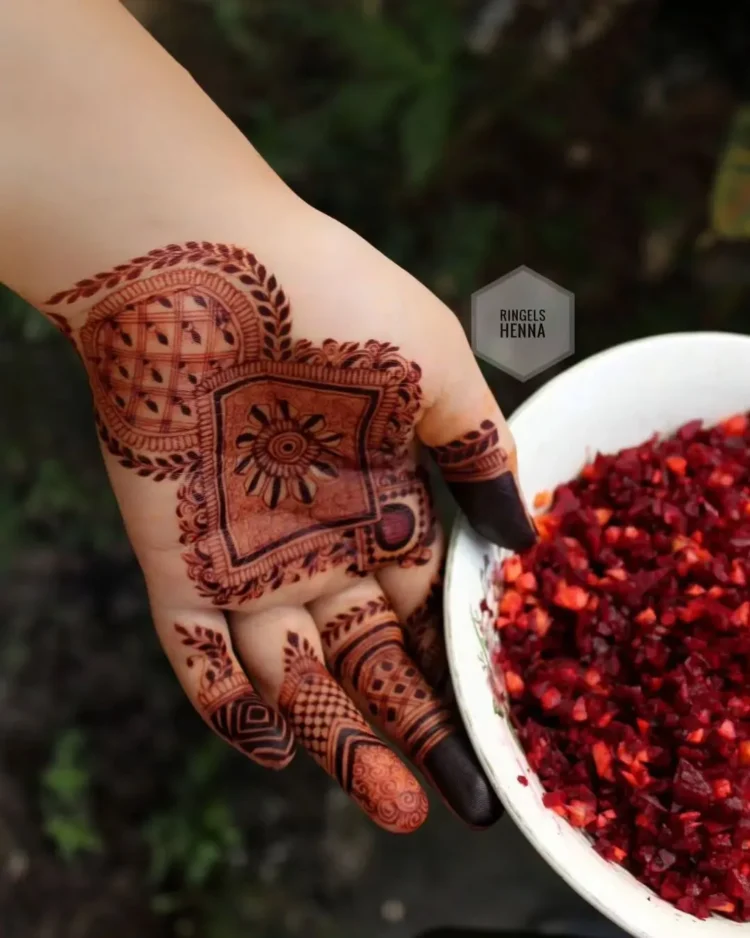
43. Square sun frame. A square frame with a sun at its centre sits in the middle of the palm, overlapping a round net shape ringed with leaves. Each finger gets a different geometric fill, from diamonds to checks.
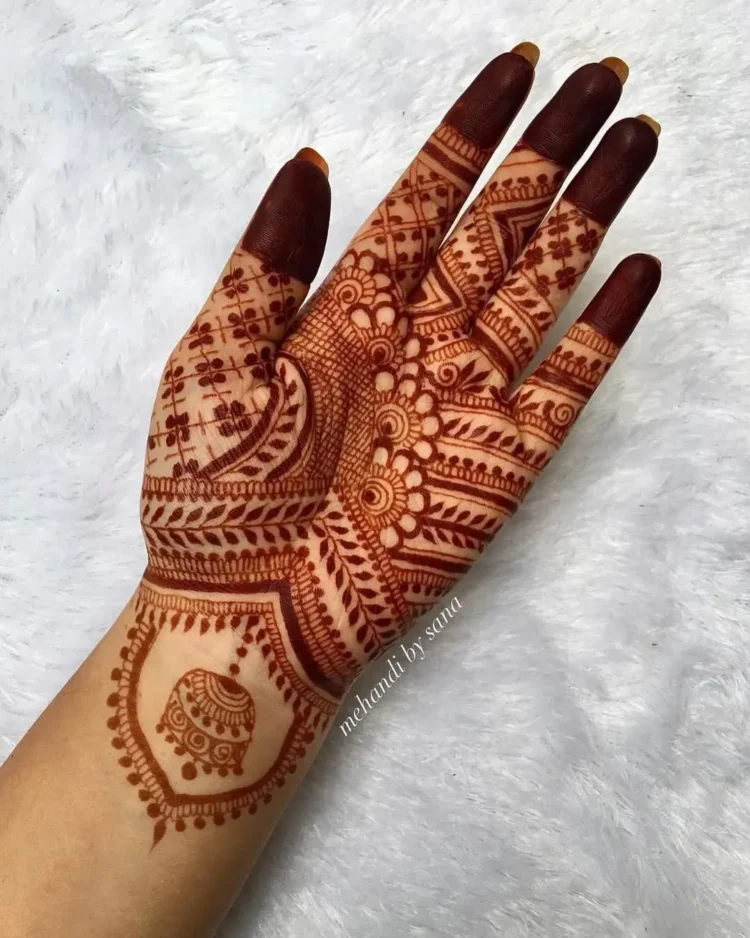
44. Sun band with a hanging bell. A wide diagonal band of leaf stripes and a half sun divides the palm, with flower net in the corner by the fingers. At the wrist a pointed frame holds a hanging bell, a motif borrowed from jhumka earrings.
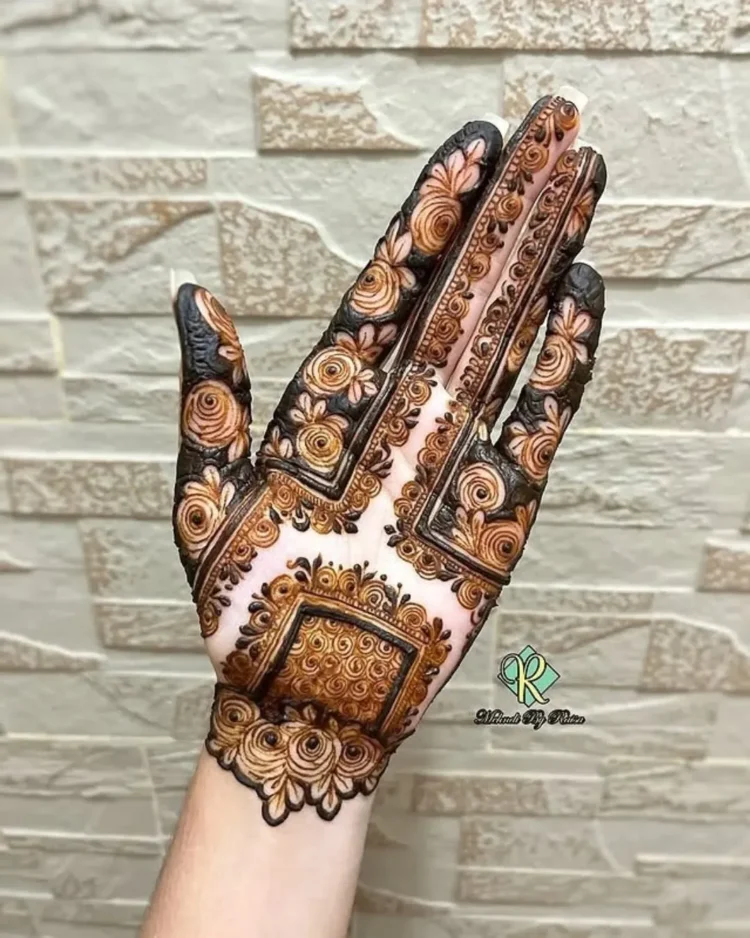
45. Swirl filled rectangle. A rectangle packed with small swirls sits on the lower palm, framed by a straight bare-skin border. Roses fill the fingers in long strips and a rose cluster closes the wrist.
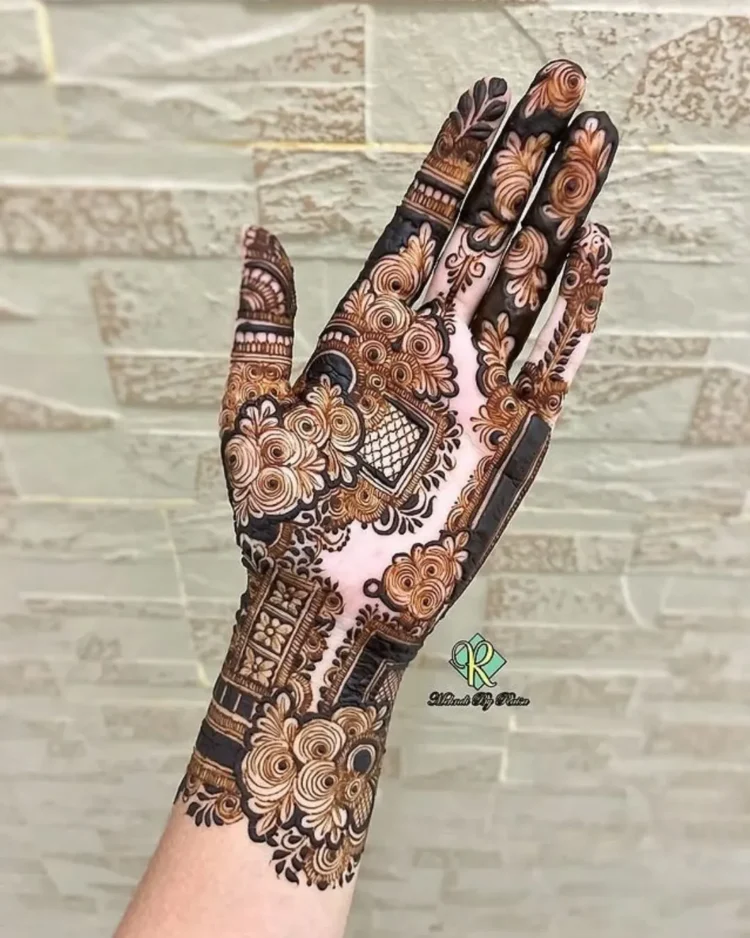
46. Net square beside rose swirls. A small net square sits among rose swirls on the palm, with solid dark bands outlining the thumb and fingers. The wrist carries a block cuff with patterned squares and a rose cluster that spills onto the forearm.
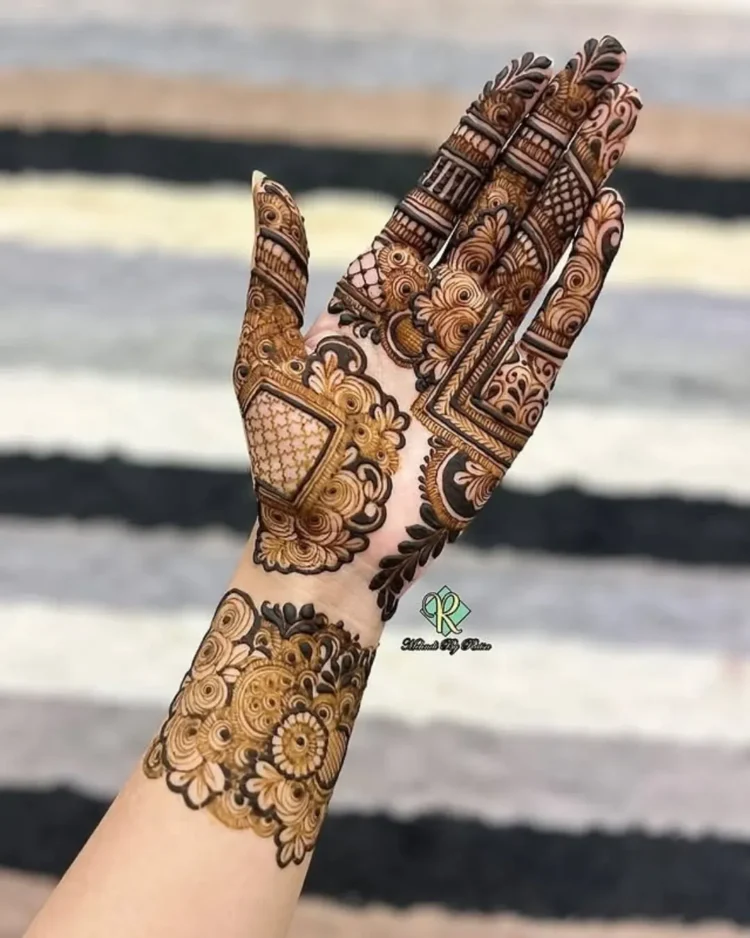
47. Net square on the thumb side. A square of fine net framed by roses sits near the thumb, and long V lines lead to fingers with bands, checks and leaves. A separate round rose cuff on the wrist completes the look.

48. Scalloped panels with dark leaves. Scalloped panels divide the palm into fine dotted fill and check net, with dark filled leaves edged in bare skin running down the middle. Banded fingers, dipped tips and a lace edge at the wrist finish it.
Floral Royal Mehndi Design for the Palm
Roses, open flowers and leaf sprigs are the base of most Indian and Pakistani palm designs. In a royal version the flowers are larger and shaded, and the gaps between them are filled with dotted net instead of being left open. A few designs here leave more skin bare, which suits sisters and cousins who want a rich look in less time. For more flower ideas, see our rose mehndi designs.
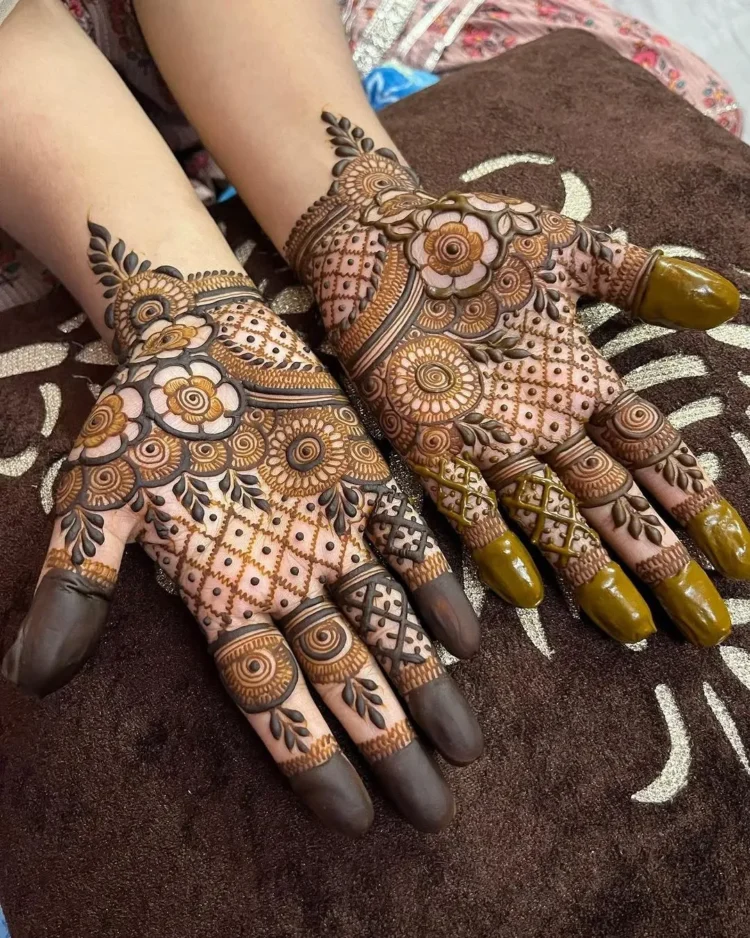
49. Spiral flowers over dotted net. Flowers with spiral centres sit over a background of dotted net, with leaf sprigs between them and crossed X shapes on the fingers. One hand still has fresh green paste on the tips.
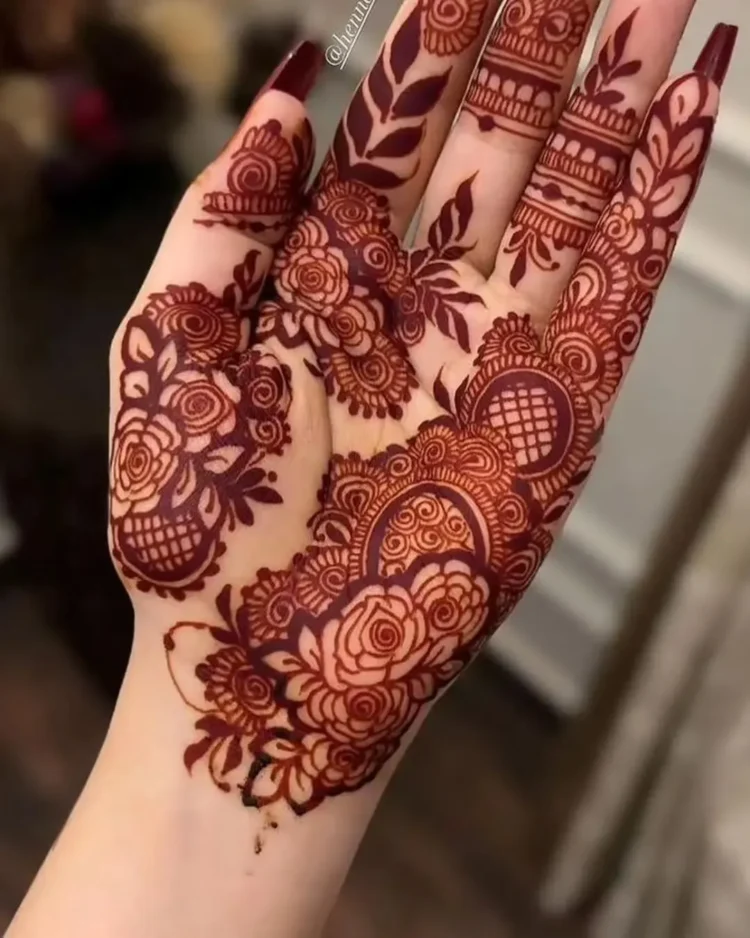
50. Maroon roses with a net circle. Large open roses fill the palm in a deep maroon stain, with a net filled circle tucked between them. The fingers alternate leaf sprays and bands rather than full net.
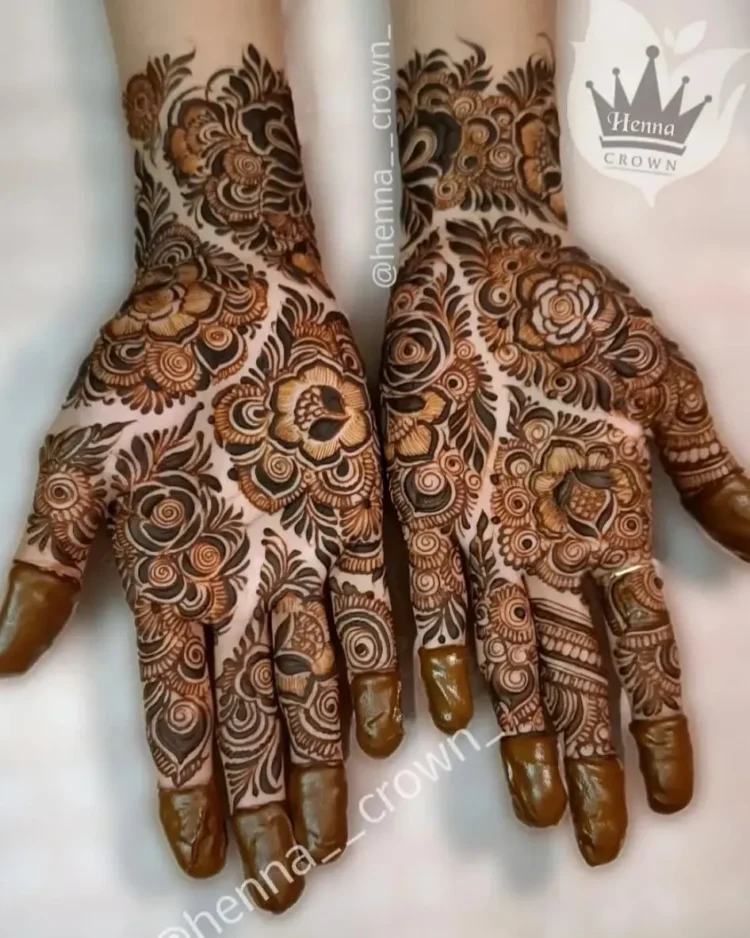
51. Roses split by bare-skin vines. Large roses and swirls cover both palms edge to edge, broken only by thin vines left as bare skin that branch across the hand. The fingertips are still covered in fresh paste.
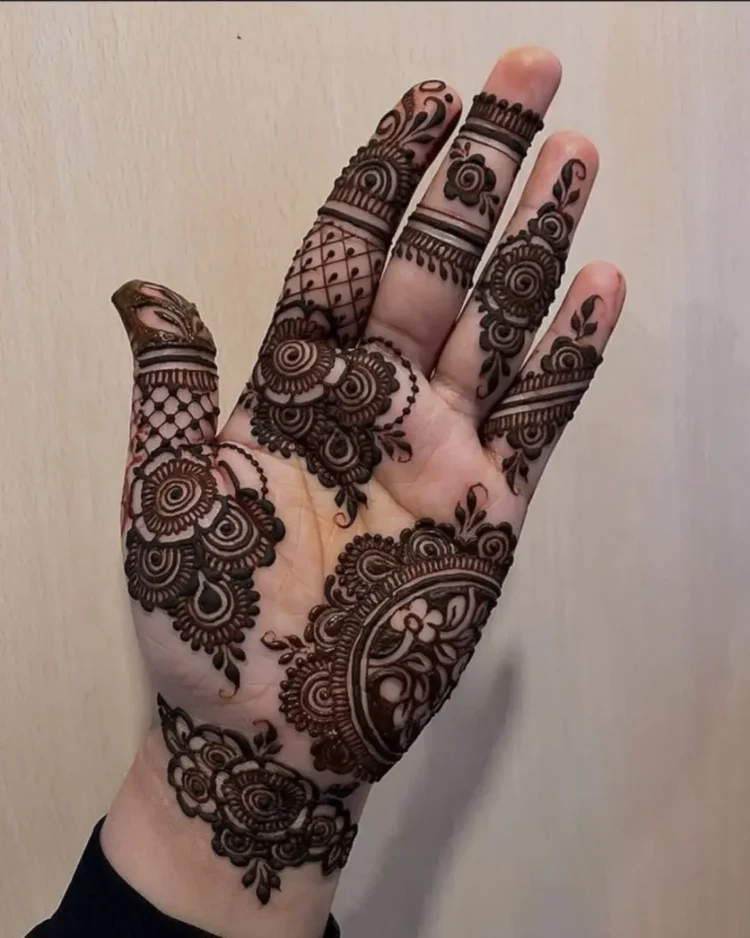
52. Spaced rose clusters. Rose clusters are spaced out across the palm with open skin between them, and the thumb is filled with net. It is lighter than most designs here and quicker to finish.
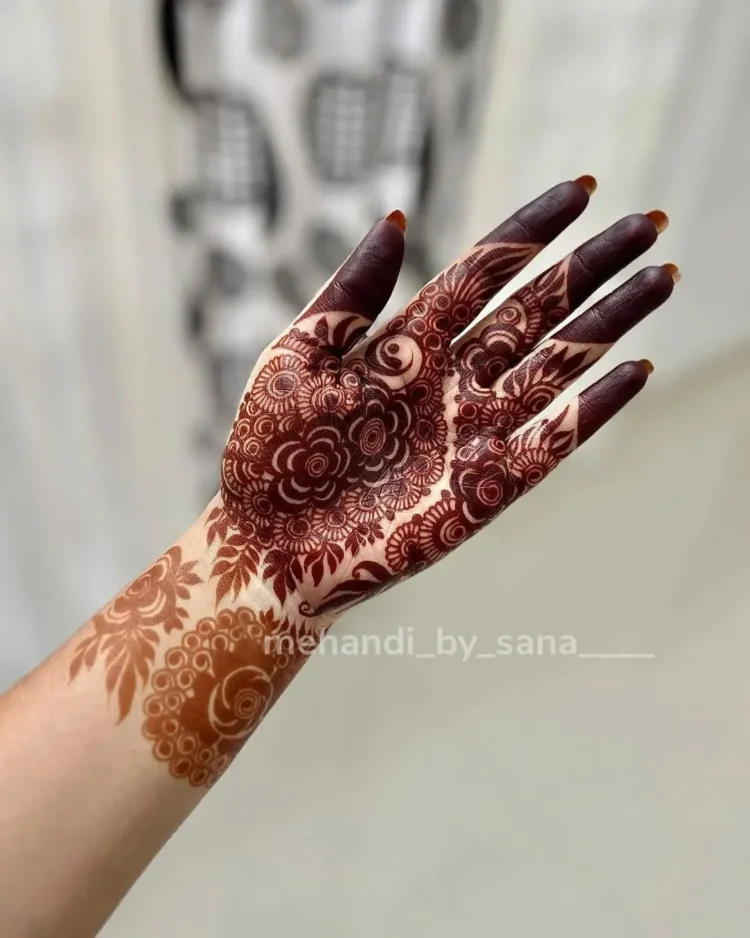
53. Shaded roses onto the forearm. Dense roses and swirls cover the palm and the dark dipped fingers, while a second cluster of roses on the forearm has taken a lighter stain. The contrast shows how the forearm usually colours less than the palm.
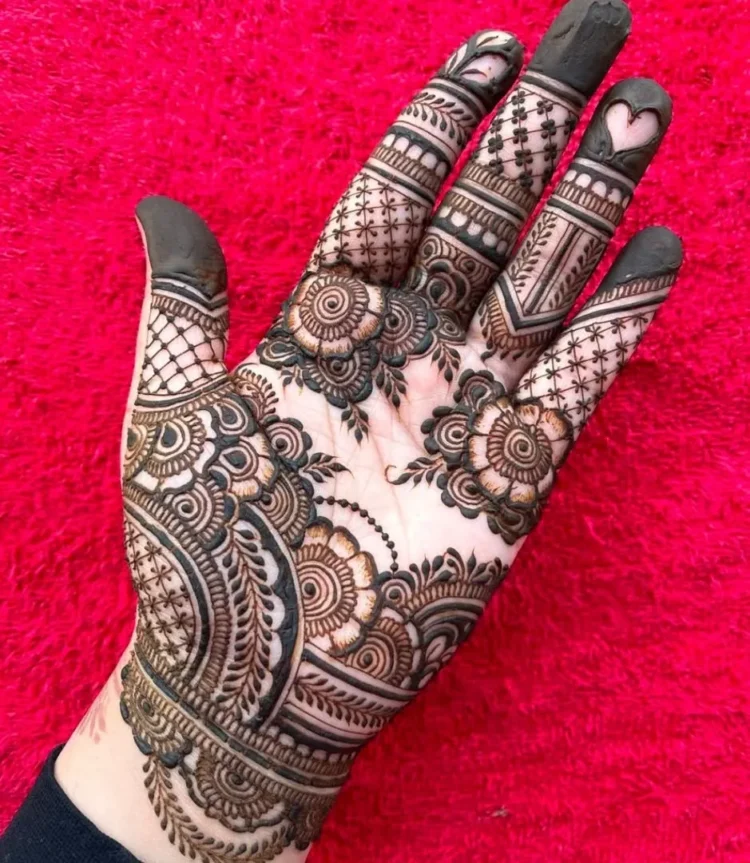
54. Roses with net and a heart tip. Round roses sit across the palm, a feather leaf runs along its side and the fingers mix net, crosses and V bands. A bare heart shows on one dipped tip.
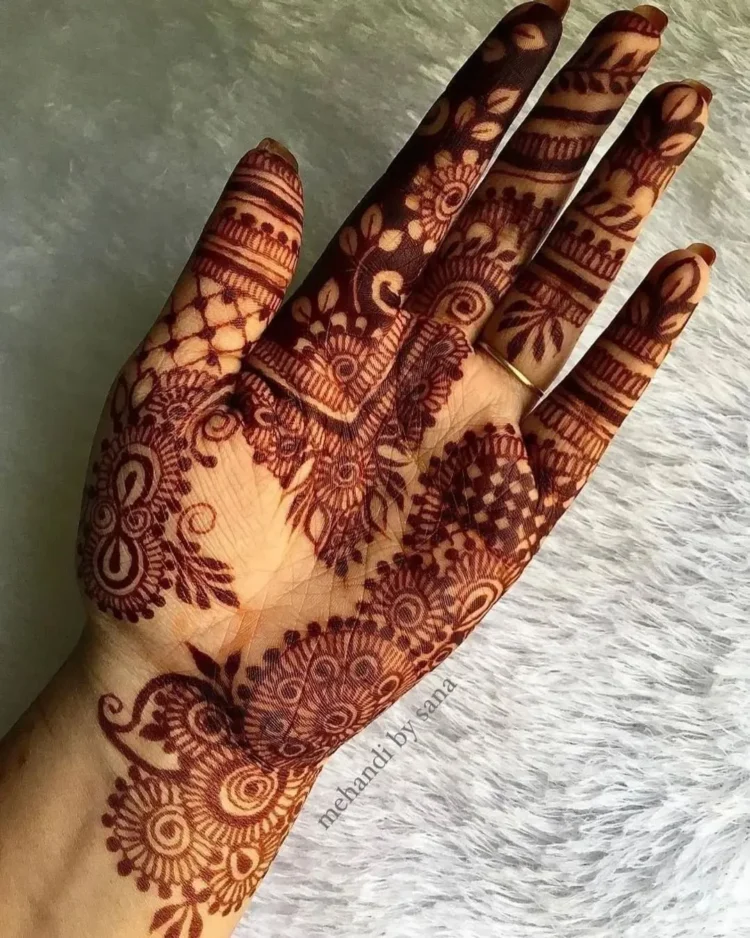
55. Feather fan with leaf fingers. A large feathered fan motif sits at the wrist, with round flowers, a check net patch and paisleys above it. Every finger is filled with leaves or bands in a strong maroon stain.
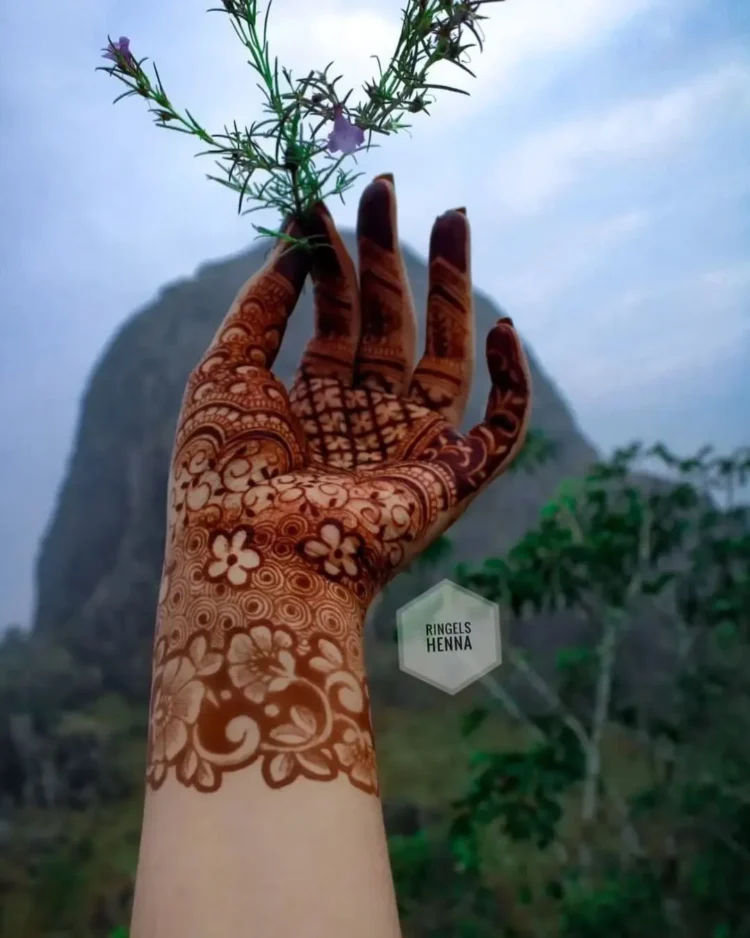
56. Flower cuff with net fingers. A wide cuff of open flowers over swirl fill wraps the wrist and lower palm, ending in a scalloped edge. Net and checks cover the fingers, and the tips are dipped dark.
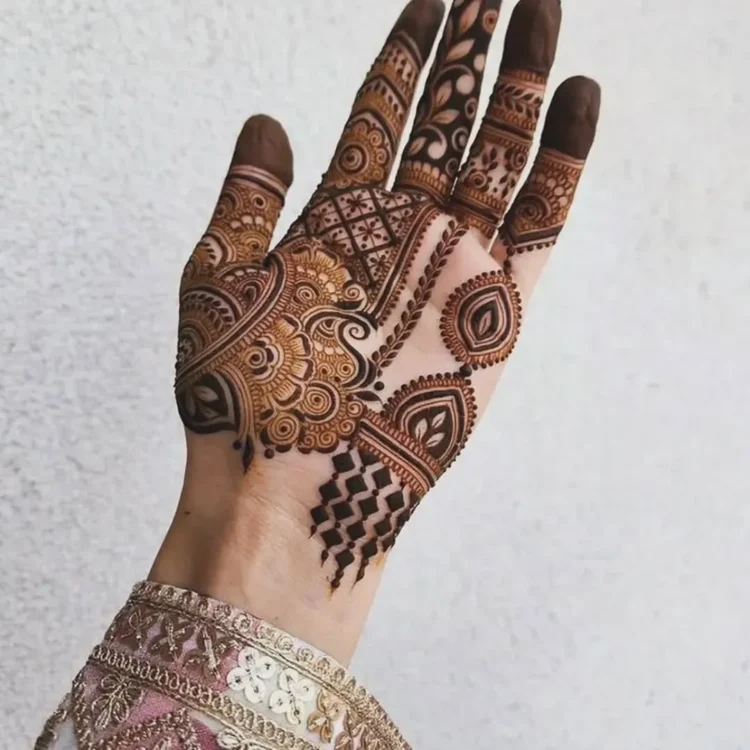
57. Flower cluster with a diamond wrist block. A flower cluster on one side of the palm balances two leaf drops on the other, and stacked diamonds sit at the wrist. An Indo-Arabic mix of filled and open areas.
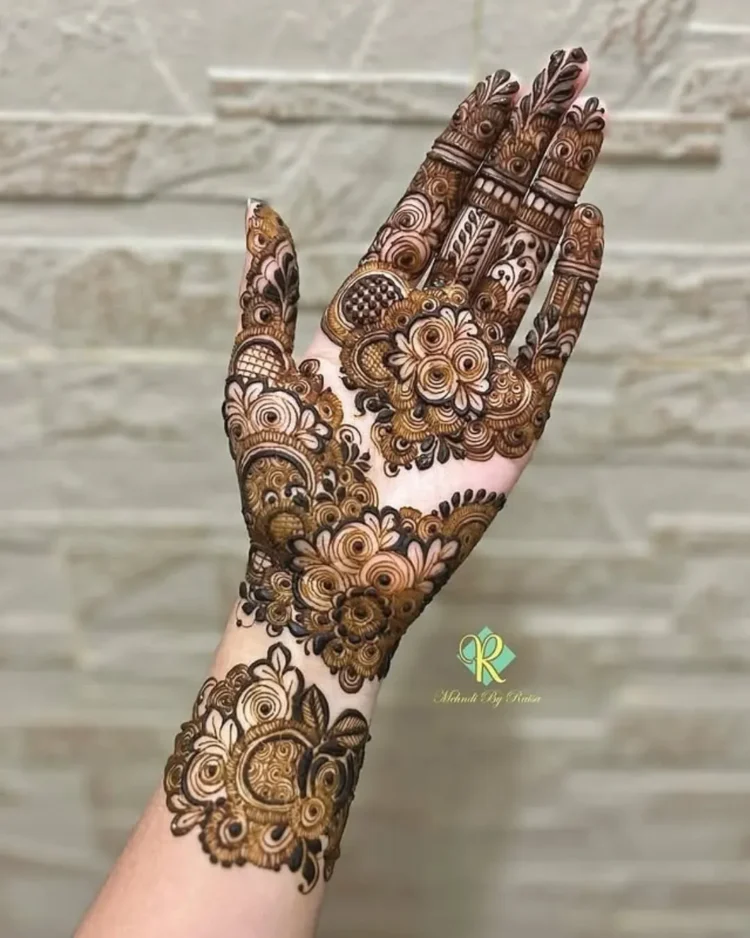
58. Large flower with a net circle. One large shaded flower sits in the middle of the palm next to a net filled circle, surrounded by smaller roses. A separate rounded cuff of roses sits on the wrist, with banded fingers above.
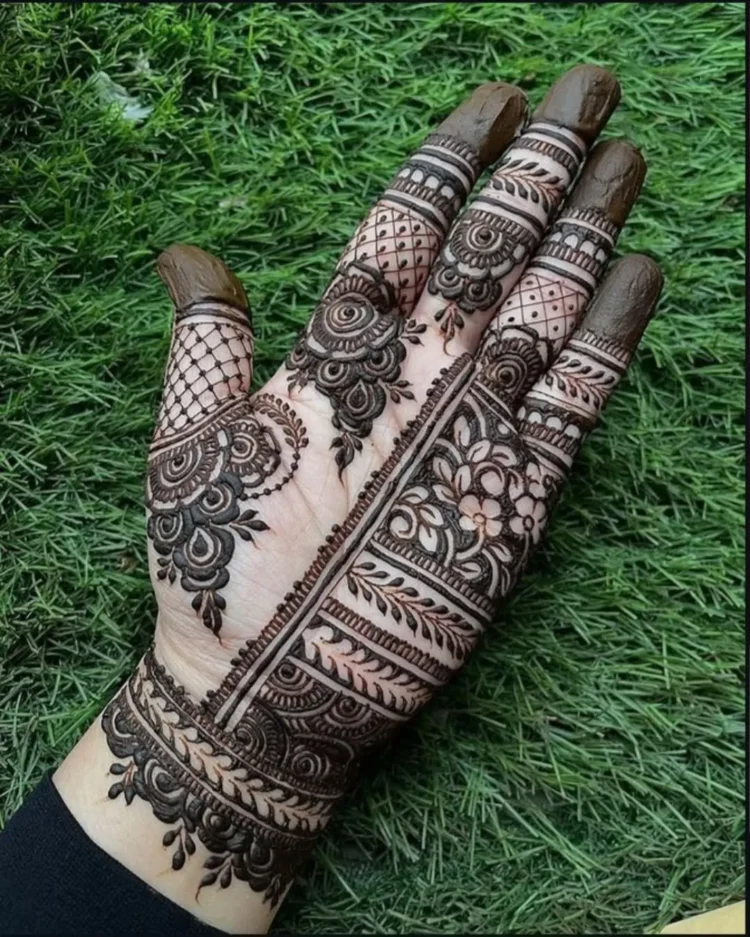
59. Diagonal leaf band. A wide diagonal band of leaf stripes and flowers splits the palm, with rose clusters on the open side. Small drops hang from the wrist band and the tips are covered in paste.
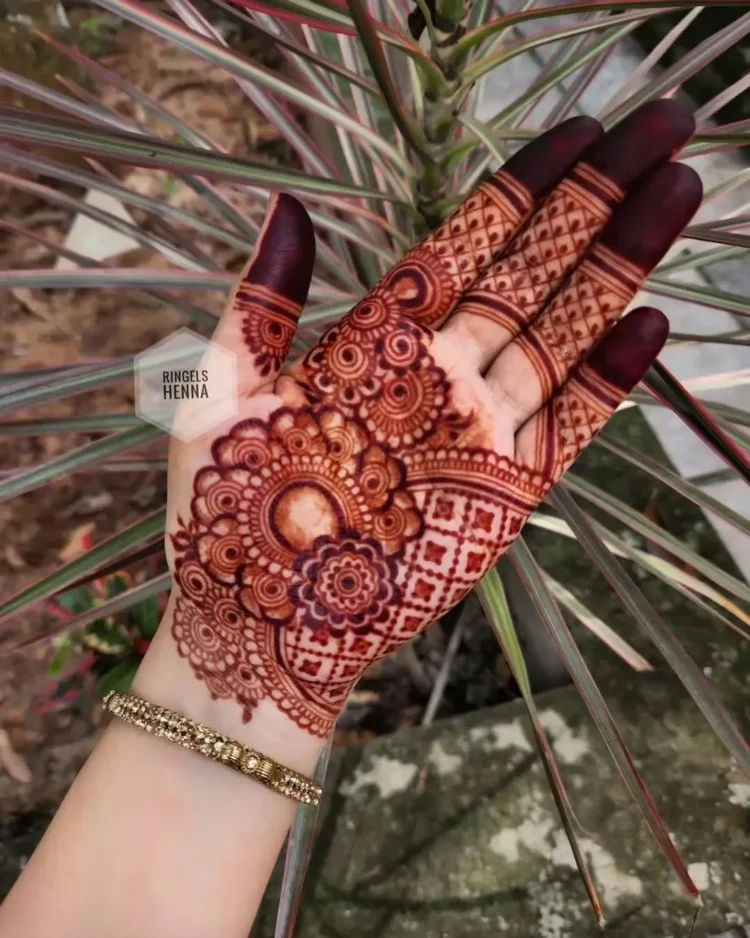
60. Flower cluster with a red net panel. A cluster of round flowers fills the thumb side of the palm and meets a panel of net with small crosses. The fingers carry bands and diamonds, and a gold bracelet sits at the wrist.
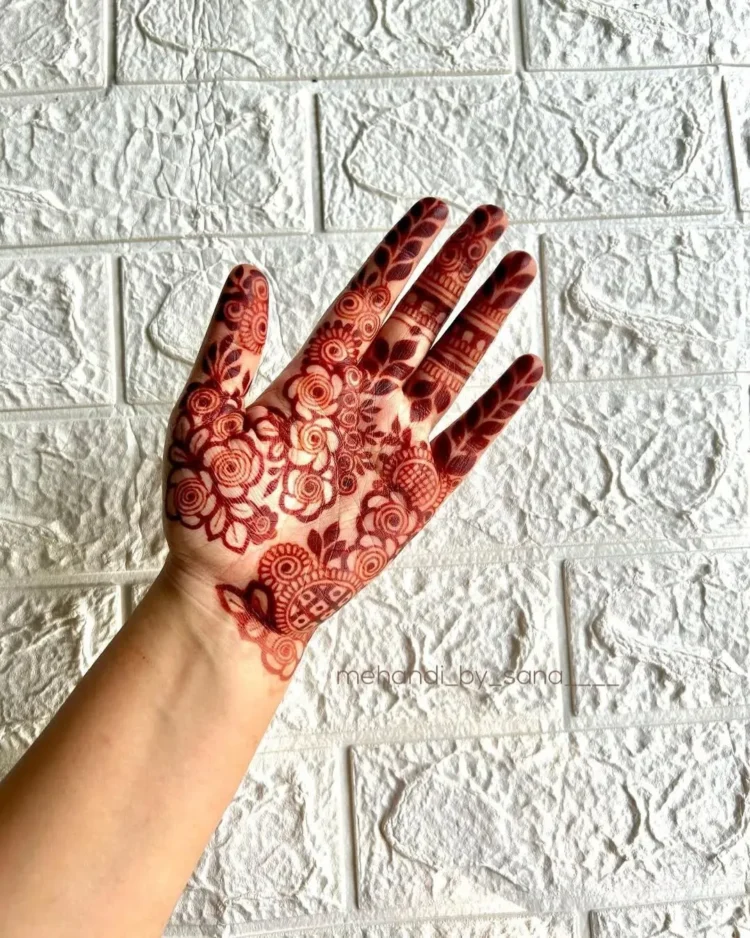
61. Rose trail with leaf fingers. A trail of red roses runs from the base of the fingers to a small net circle at the wrist. Leaf sprays and bands decorate the fingers, keeping it lighter than a full bridal palm.
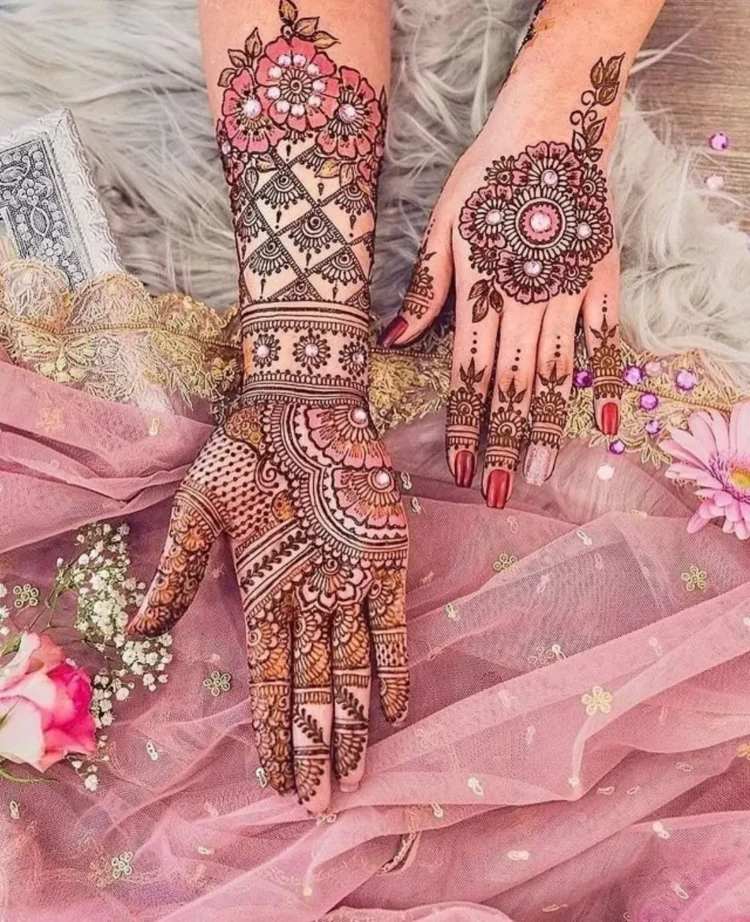
62. Embellished pink flowers. Flowers on the forearm and on the second hand are coloured pink and set with small stones, a decoration added for photos. Underneath, the palm is fully covered with net and bands.
Arabic Royal Front Hand Mehndi Design
Arabic mehndi, the style worn across the Gulf countries, uses bold outlines, shaded fill and a diagonal trail that leaves part of the palm bare. The royal version makes the trail longer, often down to the forearm, and adds more shading inside each petal. An Arabic palm takes roughly half the time of a full Indian bridal palm, so it is a good choice for wedding guests who still want a statement design.
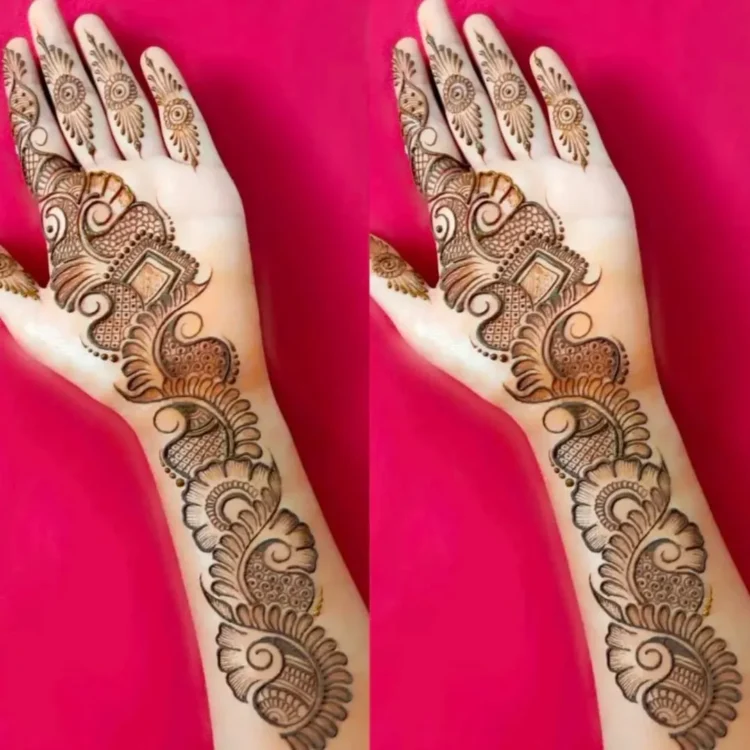
63. Feather trail to the forearm. Feathers, paisleys and a small square motif run from the index finger across the palm and down the forearm. The other fingers carry only single motifs, which keeps the open Arabic look; the photo repeats the same hand twice.
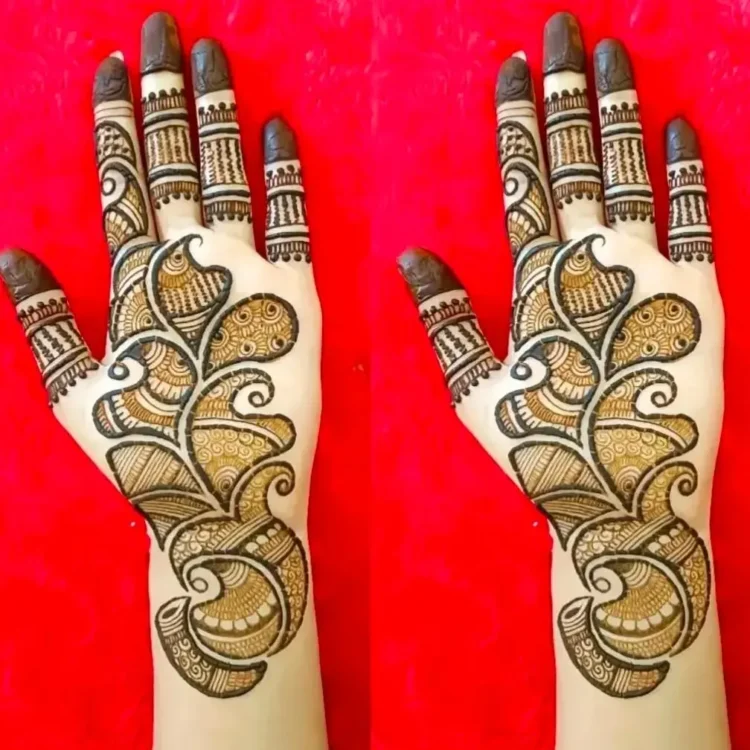
64. Large paisley trail. Large shaded paisleys curve from the fingers to the wrist, outlined in thick dark lines. Stacked bands and dipped tips finish the fingers, and the photo shows the same hand twice.
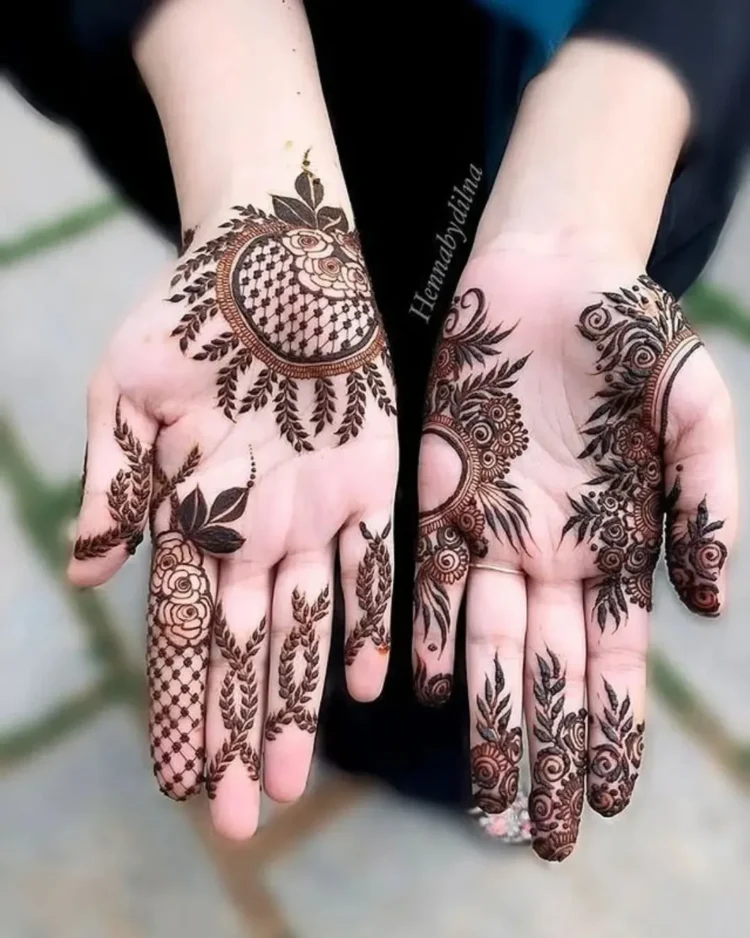
65. Net medallion with leaf rays. A round net medallion with leaves spreading out like rays sits high on one palm, and roses with leaf stems decorate the other. Most of each palm stays bare, so the dark leaves stand out.
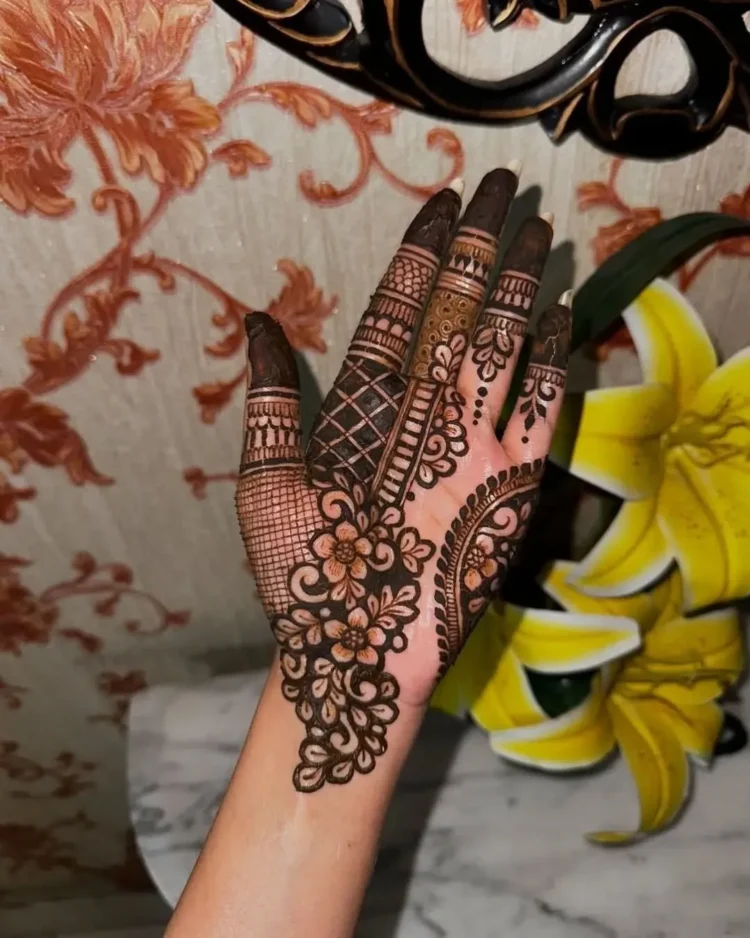
66. Floral trail with a half moon. A trail of flowers runs from the fingers to the wrist, the thumb is filled with net and a half-moon shape edges the side of the palm. Over half of the palm stays bare.
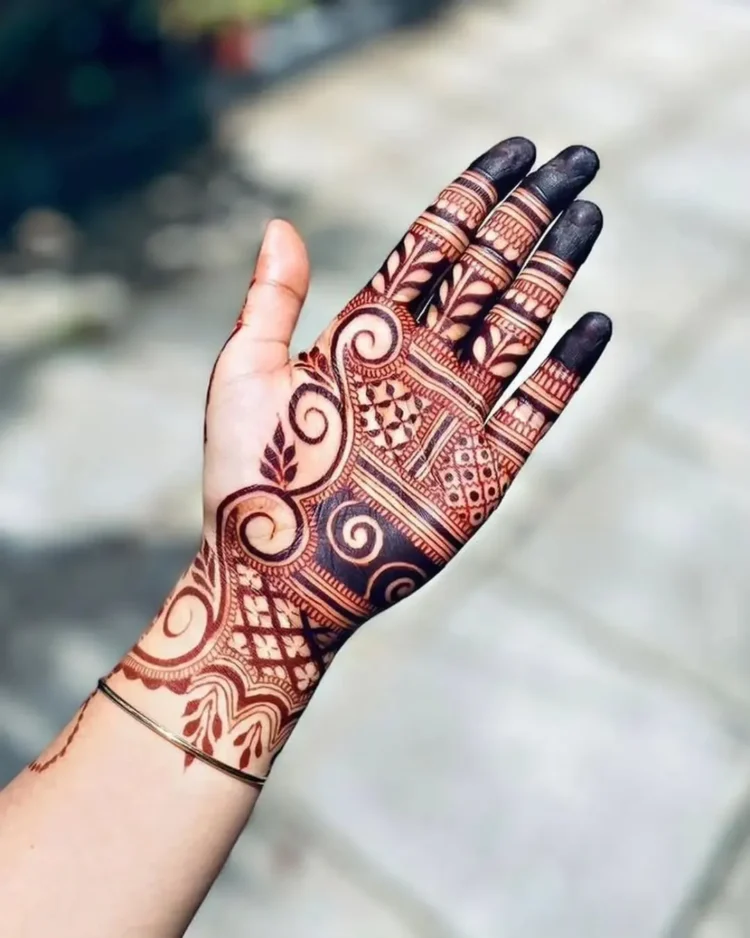
67. Bold swirls and square panels. Thick swirls frame a row of patterned squares across the palm, and a scalloped edge closes the design at the wrist. A thin gold bracelet completes the look.
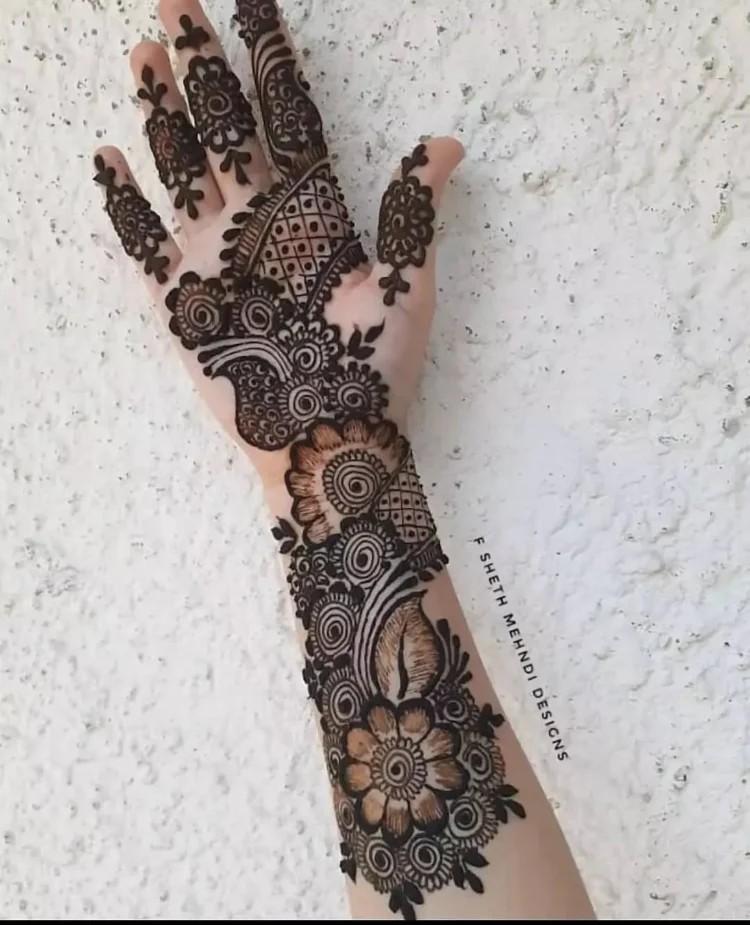
68. Long flower trail to the forearm. Large flowers, swirls and a net patch run in one long trail from the fingers down the forearm. Small flower motifs decorate the fingers, and the side of the palm stays bare.
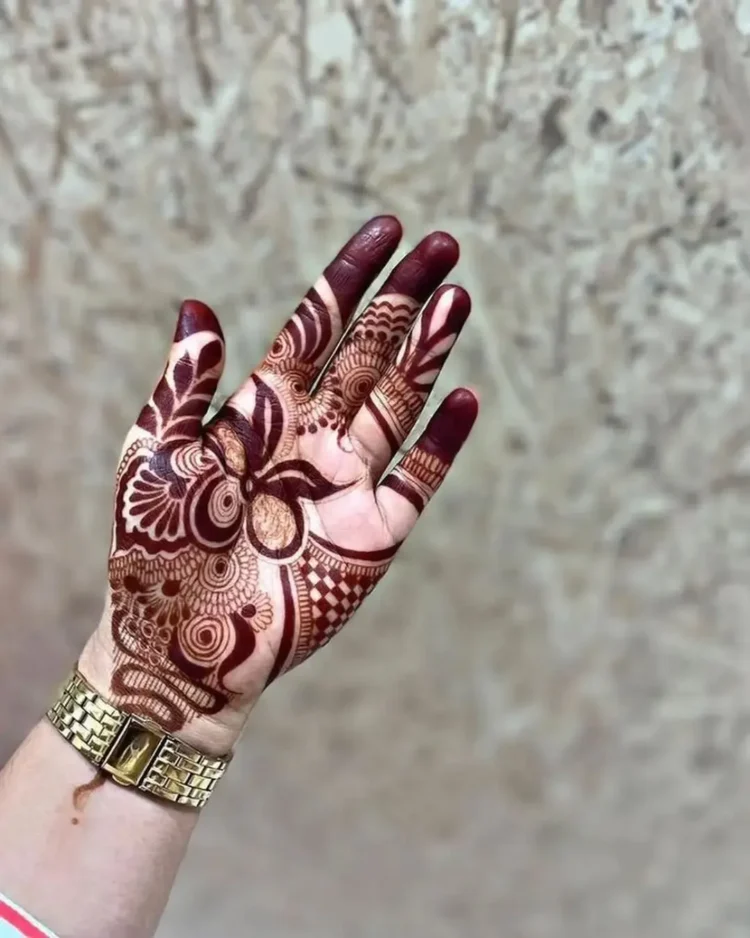
69. Checkered band with bold petals. Bold filled petals and swirls meet a checkered band across the palm, all in a deep maroon stain. Large solid shapes like these are quick to apply.

70. Fan motif with a banded cuff. A shaded fan motif rises from a banded cuff at the wrist, and a paisley trail climbs toward the index finger. The thumb and the side of the palm stay open.
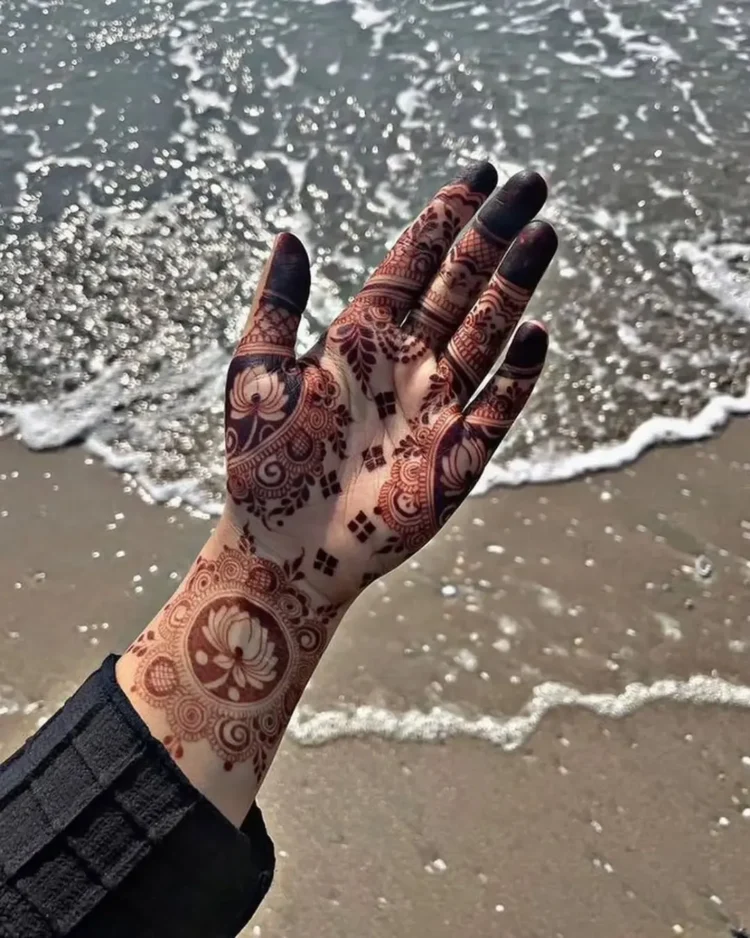
71. Lotus circle at the wrist. Flowers and small diamonds run diagonally from the fingers to a round lotus motif on the wrist. The rest of the palm is left open.
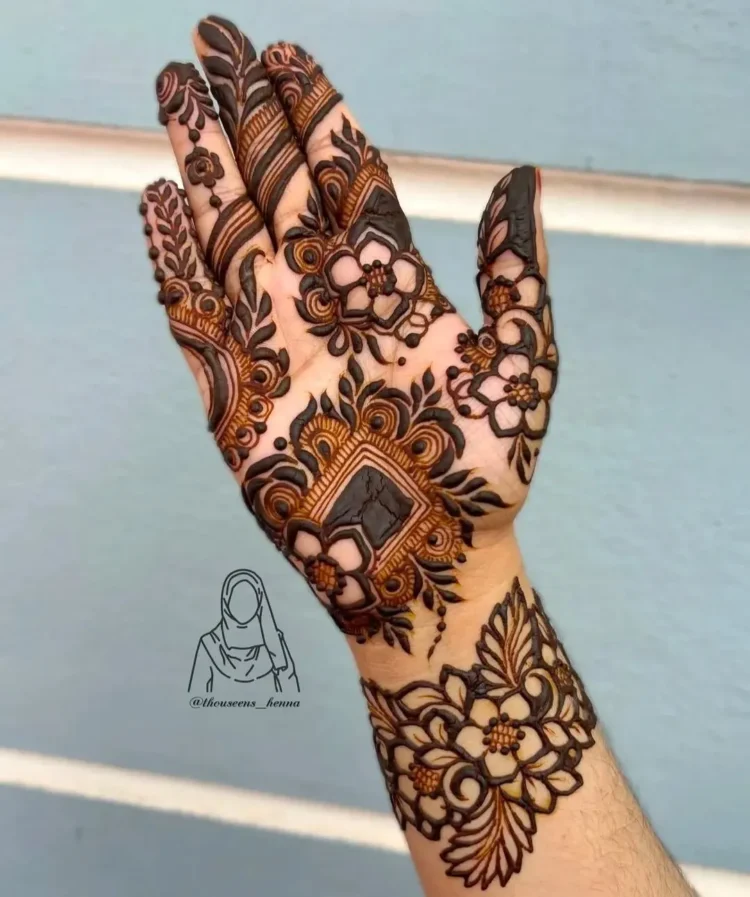
72. Bare petal flowers with a diamond centre. Flowers with petals left as bare skin surround a dark diamond motif in the palm, outlined in thick lines. A separate flower cuff with a leaf spray sits on the wrist.
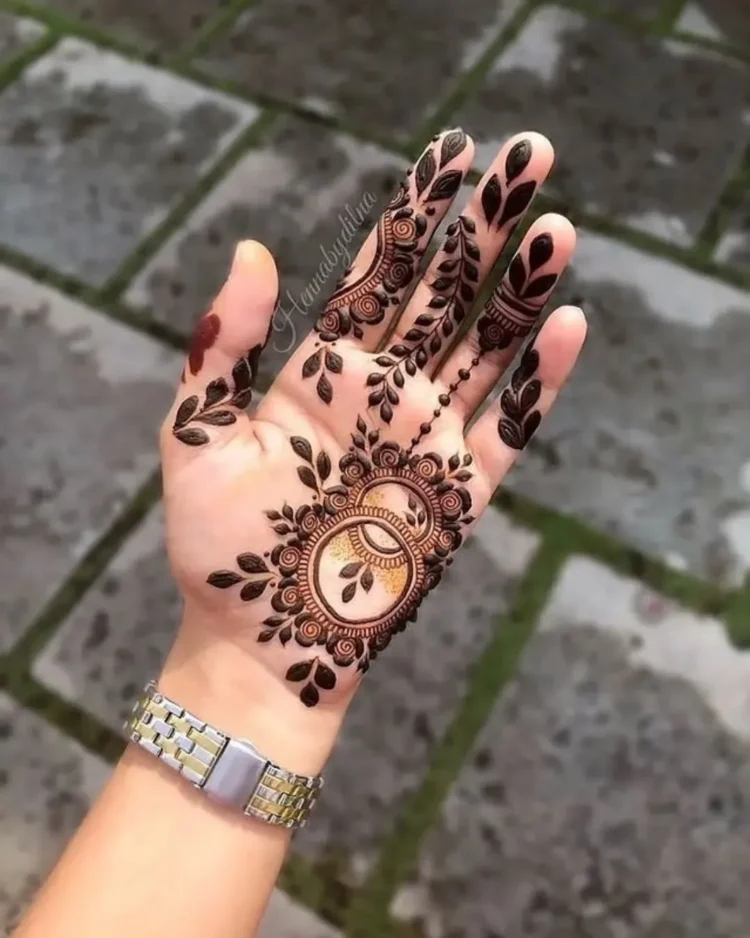
73. Crescent medallion with a dot chain. A round medallion with a crescent inside, ringed by leaves, sits in the lower palm, and a chain of dots runs up the middle finger. Leaf shapes decorate the other fingers, and it is quick enough for Eid.
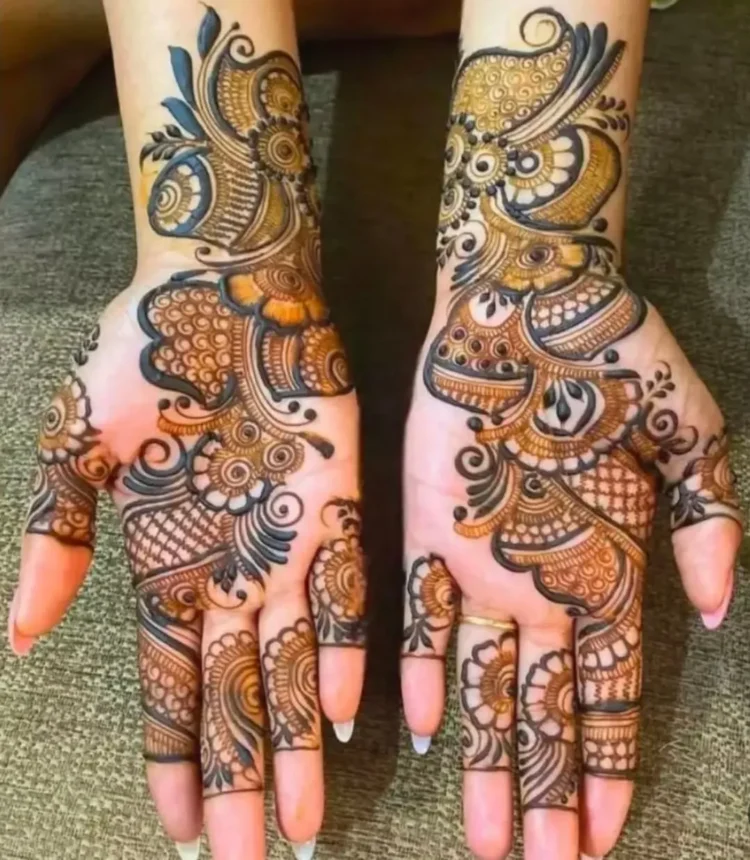
74. Bold outlined Arabic palms. Very dark outlines mark large flowers, net and swirls that run from the fingers onto both forearms. Only some fingers are decorated, a typical Arabic choice.
Simple Royal Front Hand Mehndi Design
Not everyone at a wedding has two hours to sit still. These lighter designs keep a royal detail, such as a repeated motif, a lace edge or a medallion, but leave more skin open, so they suit guests, Eid and a first attempt at home.
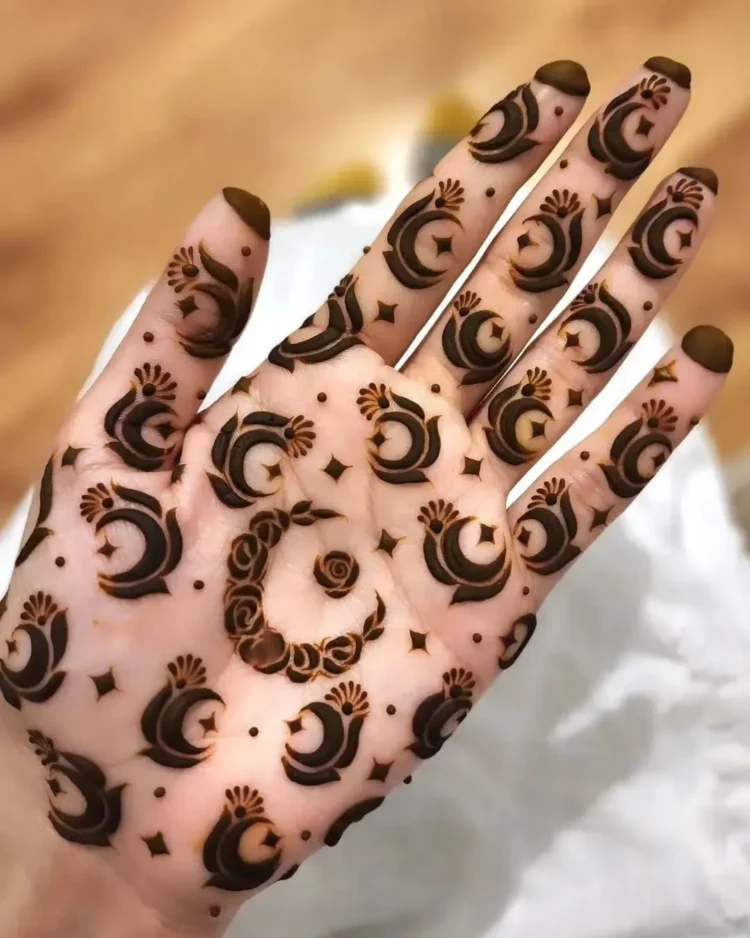
75. Crescent moons and stars. Small crescent moons with flower buds repeat across the palm and fingers, with tiny stars in between. The moon motif makes it a natural choice for Eid and Chand Raat.
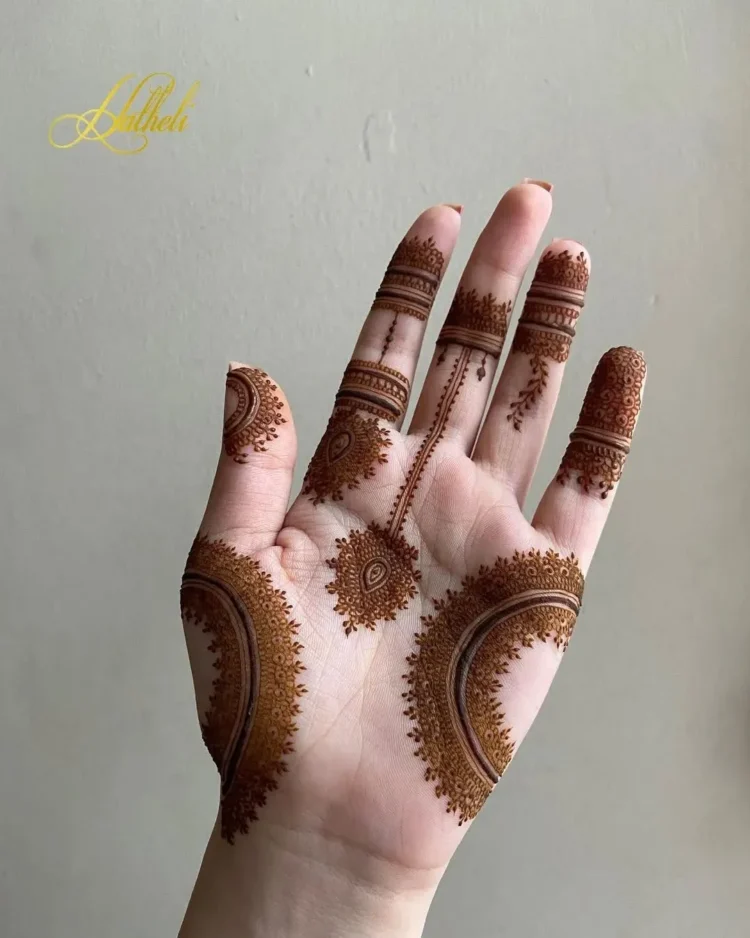
76. Lace half circles with a drop. Two half circles of fine lace frame the edges of the palm, with a small drop motif in the centre and a dotted line up the middle finger. Thin bands and a vine on the fingers keep it light and quick.
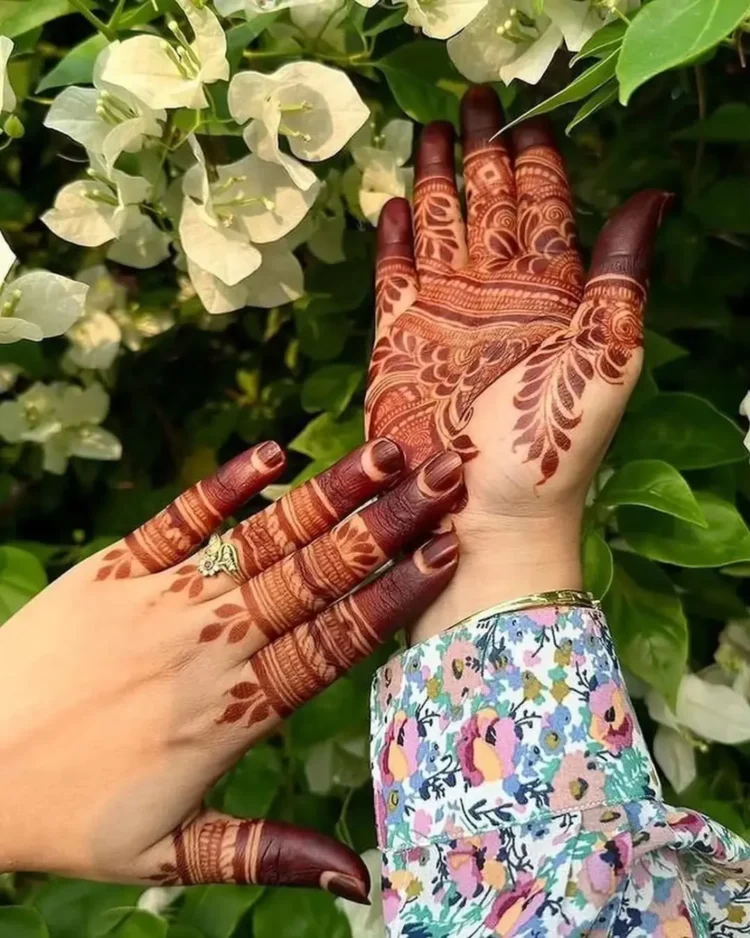
77. Red leaf sprays. Long leaf sprays cross the palm in a clear red stain, while the second hand shows matching finger bands. With so few lines, it dries in minutes.
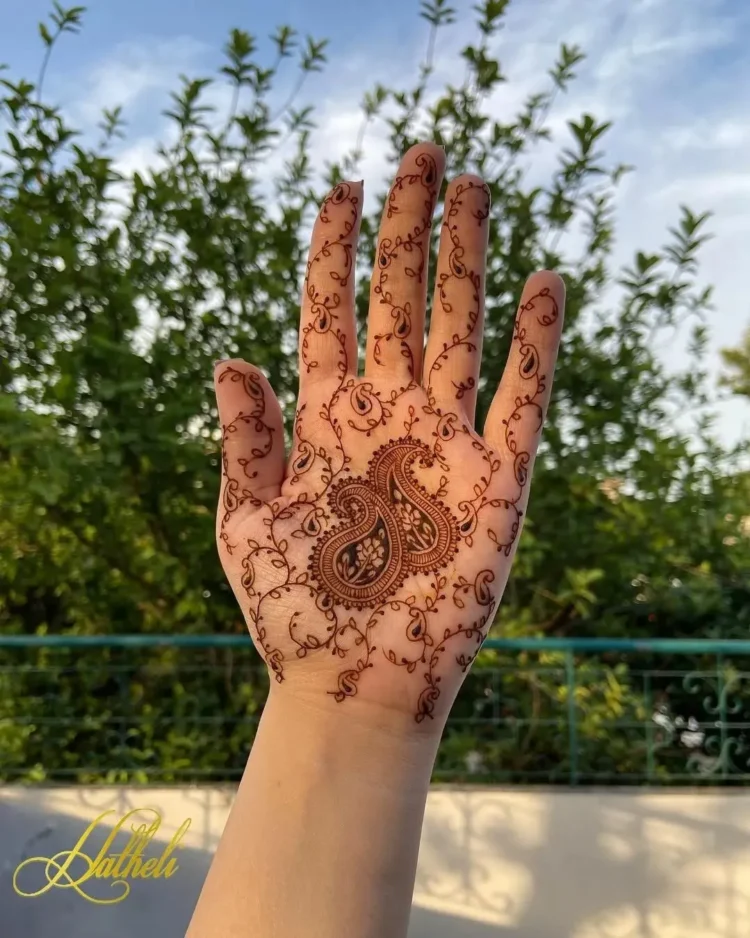
78. Paisley vines. One filled paisley sits in the middle of the palm, and thin vines with small paisleys spread over the rest of the hand and fingers. It uses only fine lines, so it suits a first try at home.
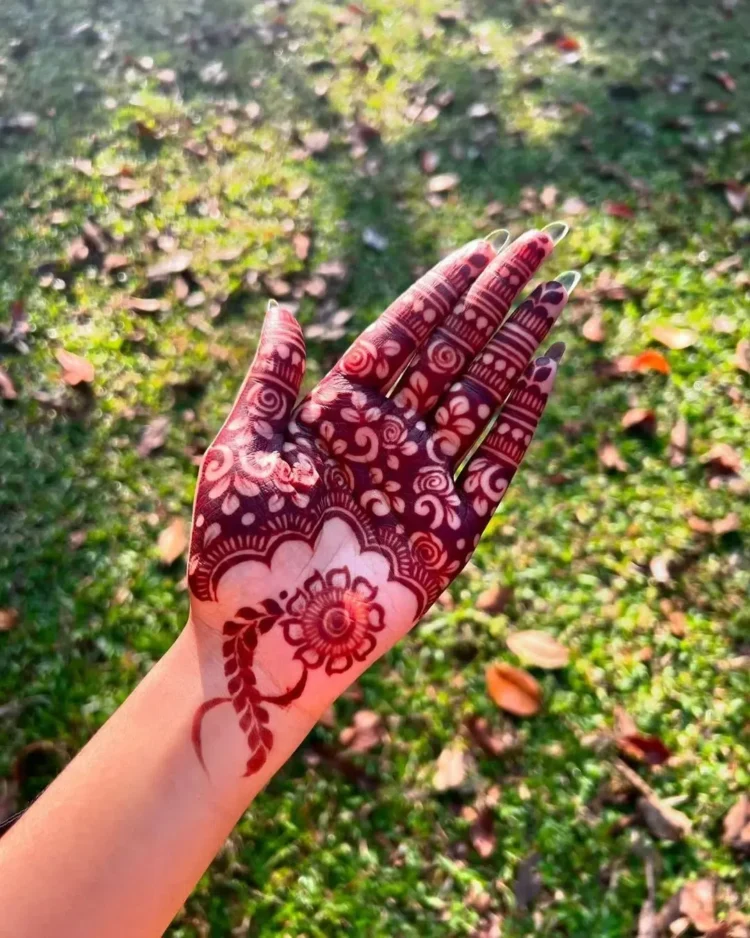
79. Filled top with an open lower palm. The upper palm and fingers are packed with small flowers, and a scalloped edge separates them from the open lower palm, which holds one flower and a vine to the wrist.
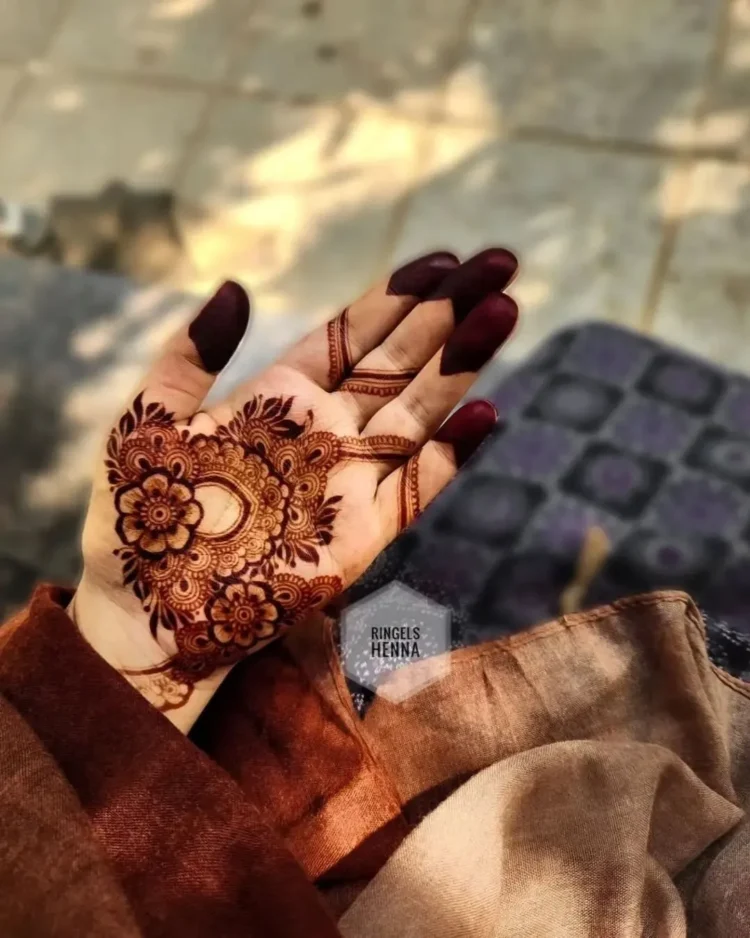
80. Flower cluster with a bare crescent. A small cluster of flowers curves around a crescent of bare skin on the side of the palm. A thin line wraps one finger and the tips are dipped in a deep maroon.
Matching Back Hand Mehndi Ideas for a Royal Palm
A filled royal palm is often paired with a lighter design on the back of the hand, which shows when the hands are turned for photos. These designs use trails, cuffs and finger patterns that match the palm without repeating it. For more, see our back hand mehndi designs and royal back hand mehndi designs.
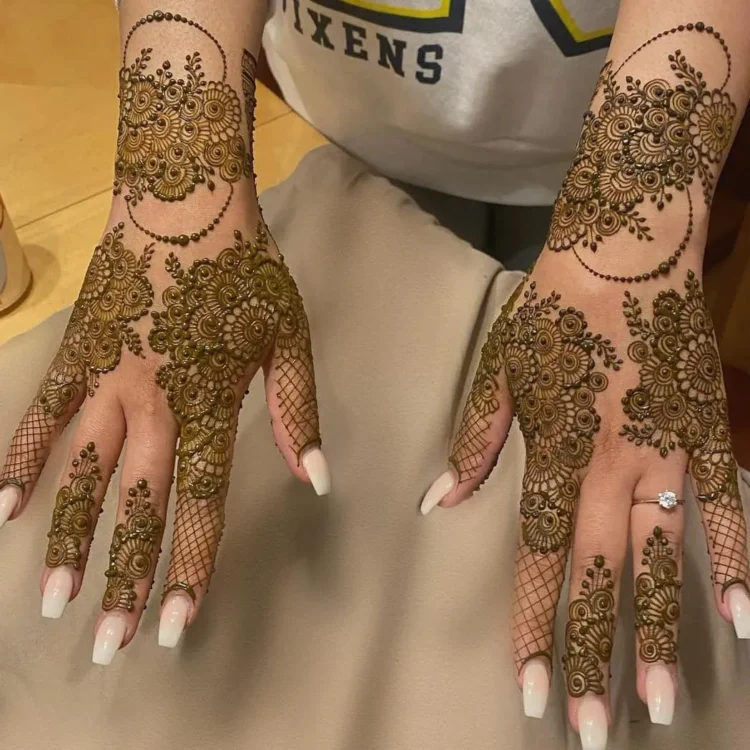
81. Back hand chains with net fingers. Shown on the back of both hands in fresh paste: flower clusters, looped chains of dots around the wrist and net on the fingers. It pairs well with a filled royal palm.
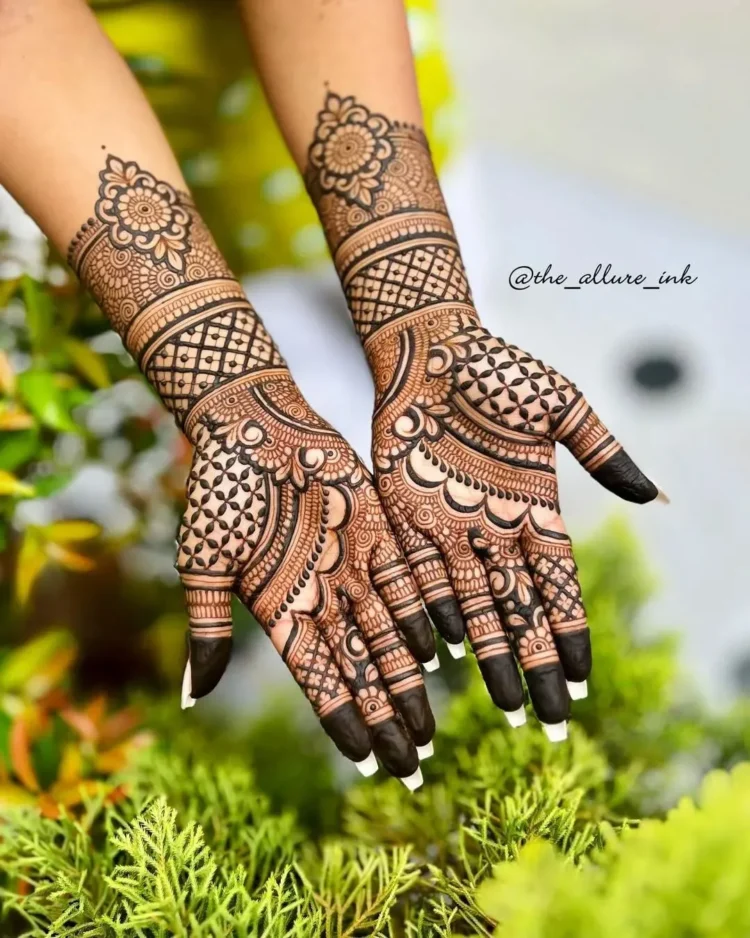
82. Mandala crests with net cuffs. A mandala crest sits on each forearm above stacked cuffs of diamond and star net. Scallops and dots fill the back of the hand, and the dark dipped tips match a filled palm.
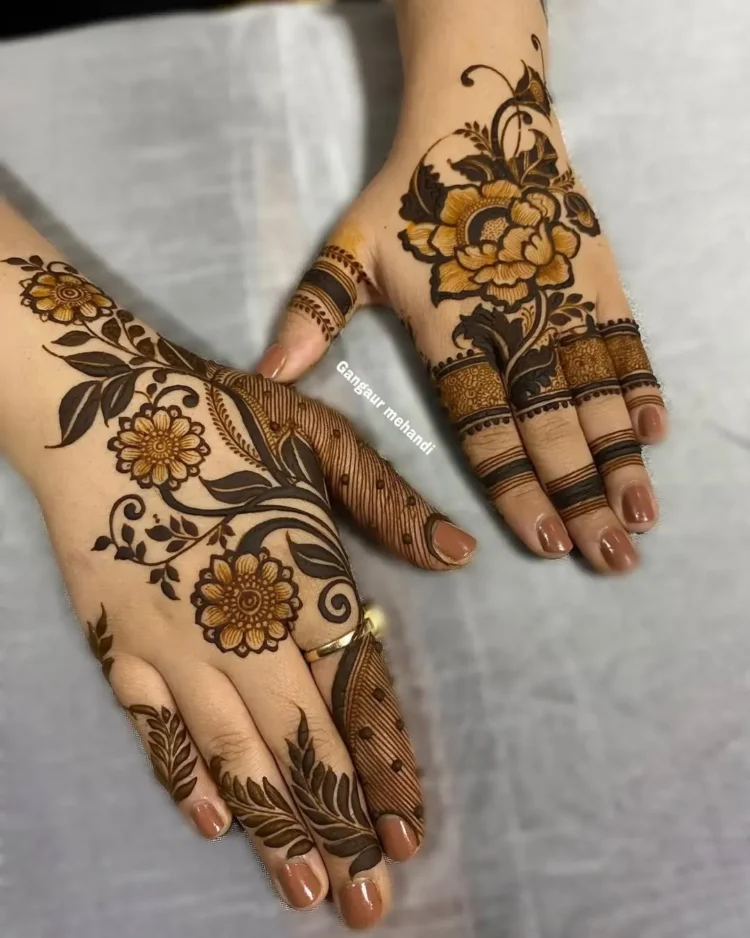
83. Shaded flower vines. Large shaded flowers on leafy vines cross the back of both hands, one running from the wrist to the fingers and one set near the wrist. Wide bands decorate the fingers, leaving most of the skin open.
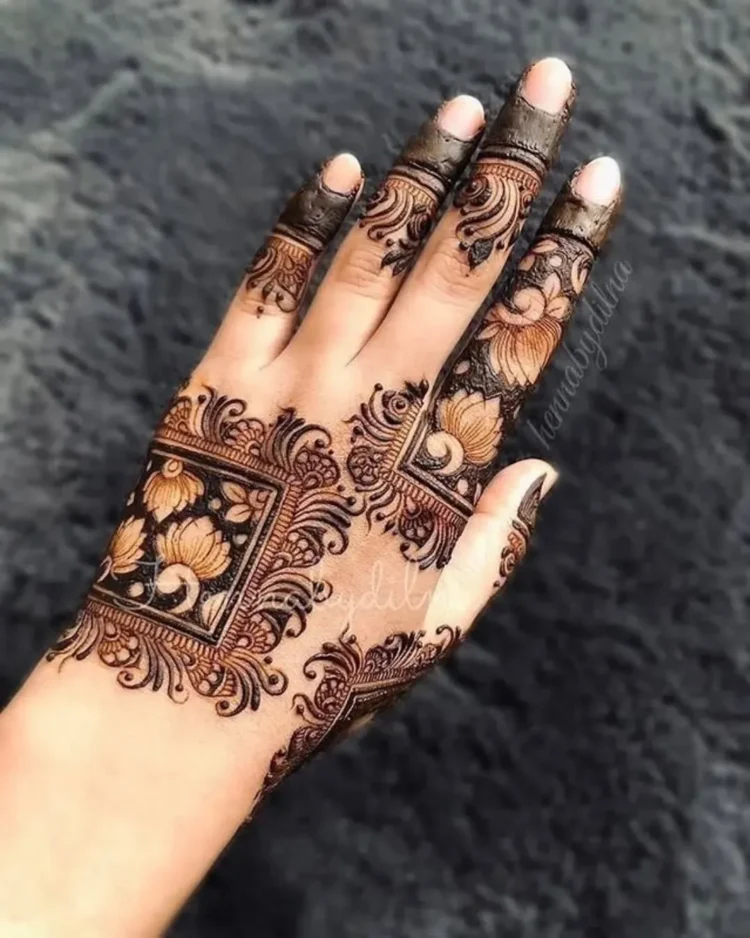
84. Square lotus frame. A square frame filled with lotus flowers sits on the back of the hand, edged with lace swirls on each corner. The fingers carry floral sections and dipped tips.
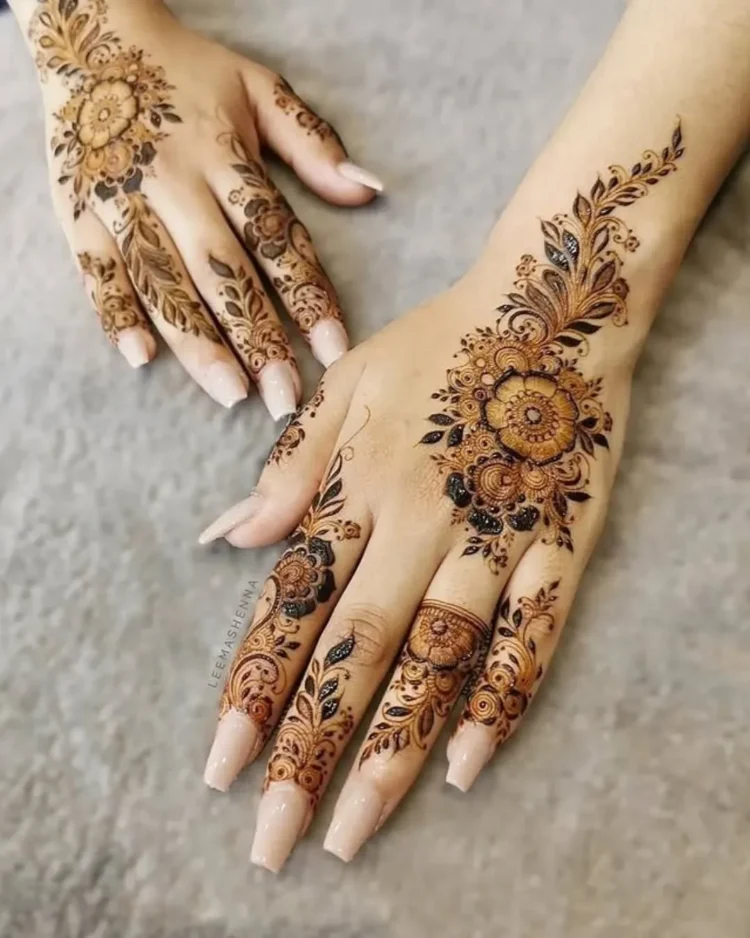
85. Khaleeji flower trails. Shaded flowers with leafy vines run in light diagonal trails across the back of both hands and onto the fingers. Most of the skin is left open, the signature of this Gulf style.
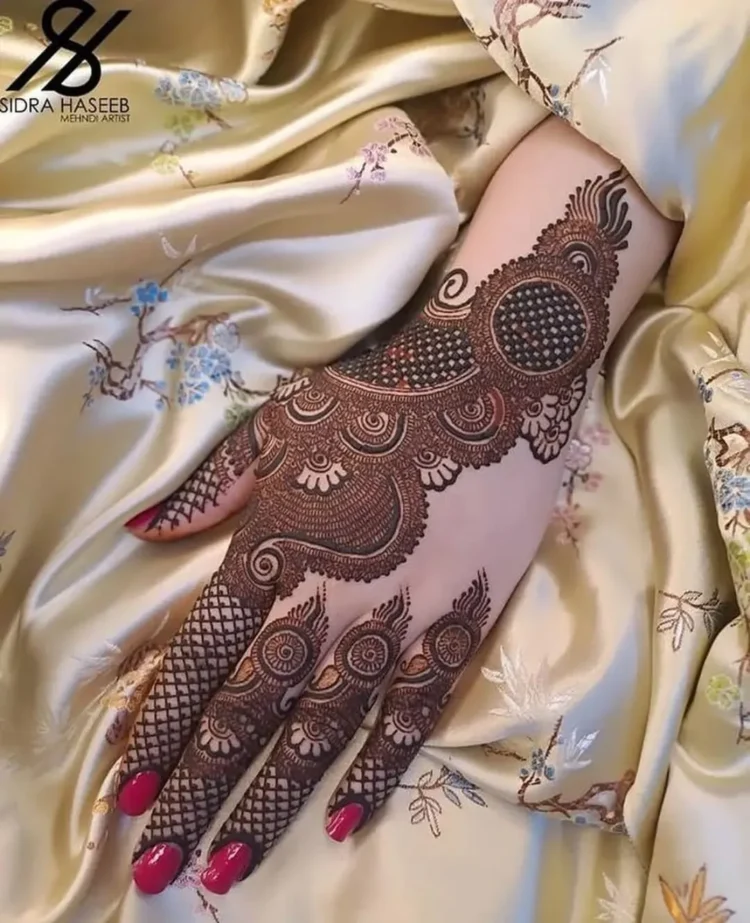
86. Scallop rows with a net circle. Rows of scallops and a net circle run diagonally from the fingers to a feathered crest at the wrist. Each finger holds a round flower or a section of net.
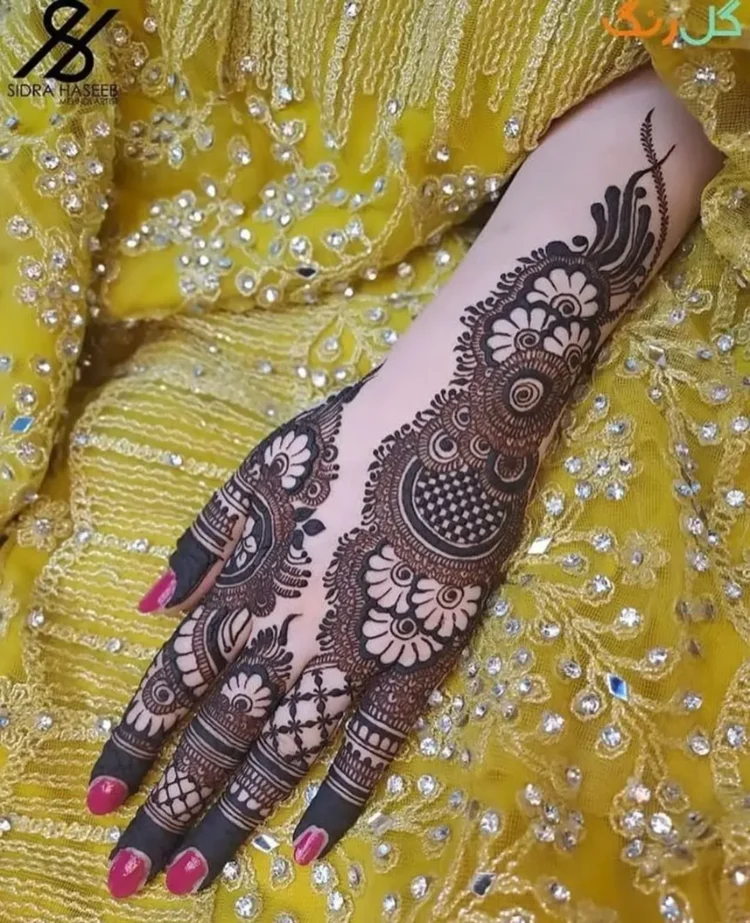
87. Flower trail with a feather crest. Bare-skin flowers and a net circle form a trail from the fingers to a feathered crest on the forearm. The fingers mix flowers, crosses and net, with dark dipped tips.
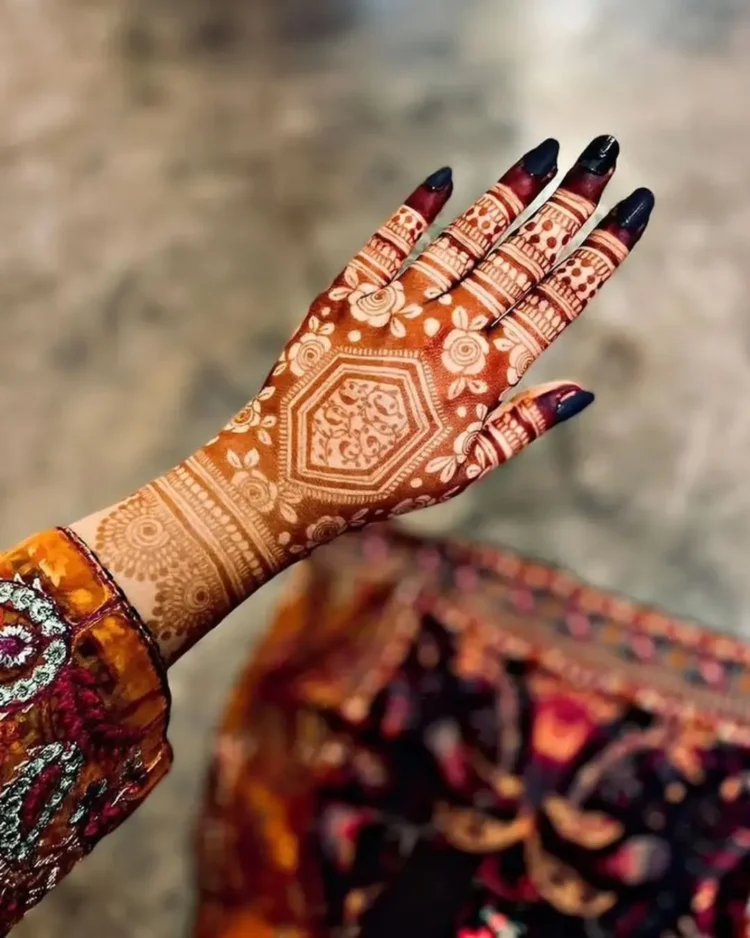
88. Hexagon medallion on the back hand. A hexagon medallion sits in the middle of the back of the hand, surrounded by roses, with bands running up the forearm. A geometric centre like this matches a palm with a mandala.
Time, Skill and Who Should Wear a Royal Palm
- The bride: the full version with figures, a centre medallion and cuffs to the elbow or forearm. Expect two to four hours for both palms from a professional artist, plus the same again if the back of the hands, the feet or the fingers are done. Our royal finger mehndi designs and foot mehndi designs cover those areas.
- Mother, sisters and close family: a mandala or floral royal palm that stops at the wrist, about 45 minutes to 1 hour per palm.
- Wedding guests: an Arabic trail or a lighter design from the simple section, about 15 to 30 minutes per hand.
- Doing it yourself: net, checks and scallops are repetitive, so an intermediate hand can manage a mandala palm. Figures and portraits are best left to a professional artist.
- Tools: a fresh henna cone with a fine tip for net and outlines, and a second cone with a wider opening for filling fingertips.
How to Plan a Royal Front Hand Design for the Wedding Day
Henna paste is made from the crushed leaves of the henna plant (Lawsonia inermis). Its dye, lawsone, stains the top layer of the skin orange at first, and the colour darkens to red-brown or maroon over the following 24 to 48 hours. That delay is why timing matters more for a bride than the design itself.
- Apply one or two days before the wedding. This is why the mehndi ceremony traditionally falls a day or two before the wedding: the stain then peaks on the day itself.
- Book the artist early. A detailed bridal palm can take a whole afternoon, so leave time for the paste to dry before the evening programme.
- Start with clean, dry skin. No lotion, oil or waxing on the hands that day, because they stop the dye from reaching the skin.
- Keep the paste on for 6 to 8 hours, or overnight. Dab a little lemon and sugar mix on the dry paste so it stays on the skin.
- Scrape, do not wash. Remove the dry paste with a blunt knife or a little oil and keep the palms away from water for 12 to 24 hours.
- Keep the hands warm. Warmth helps the stain darken, and the palm stays darker than the back of the hand.
A stain on the palm usually lasts one to three weeks. Natural henna never stains black: products sold as black henna may contain PPD (p-phenylenediamine), which can cause serious skin reactions, as the US Food and Drug Administration explains in its fact sheet on henna and black henna. For festival dates, our Eid mehndi designs and Holi mehndi designs have ideas that are quicker to apply.
Royal Front Hand Mehndi Design FAQs
What is a royal front hand mehndi design?
It is a palm design that covers the whole front of the hand with dense, symmetrical patterns around one strong centre motif. Most versions add layered cuffs at the wrist and fully decorated fingers, and bridal versions often include peacocks, elephants or bride and groom figures.
How is a royal front hand design different from a simple one?
A simple front hand design covers part of the palm and leaves open skin, and takes 10 to 20 minutes. A royal design fills the palm to the wrist, has a clear centre motif and cuffs, and takes 45 minutes to 2 hours per palm.
How long does a royal bridal palm take to apply?
A professional artist usually needs two to four hours for both palms with figures or detailed net. Add drying time of 20 to 30 minutes before the bride can move her hands carefully.
When should a bride apply a royal front hand mehndi design?
One or two days before the wedding. Henna keeps darkening for 24 to 48 hours after the paste comes off, so this timing lets the stain peak on the wedding day.
Is an Arabic royal front hand design easier?
Yes. Arabic designs use bold lines and a diagonal trail that leaves part of the palm bare, so they need fewer details and roughly half the time. They suit wedding guests and Eid well.
Why does henna look darker on the palm?
The skin of the palm is thicker than on the back of the hand, so it holds more dye. A dense royal design also keeps more paste on the skin, which adds to the depth of colour.