

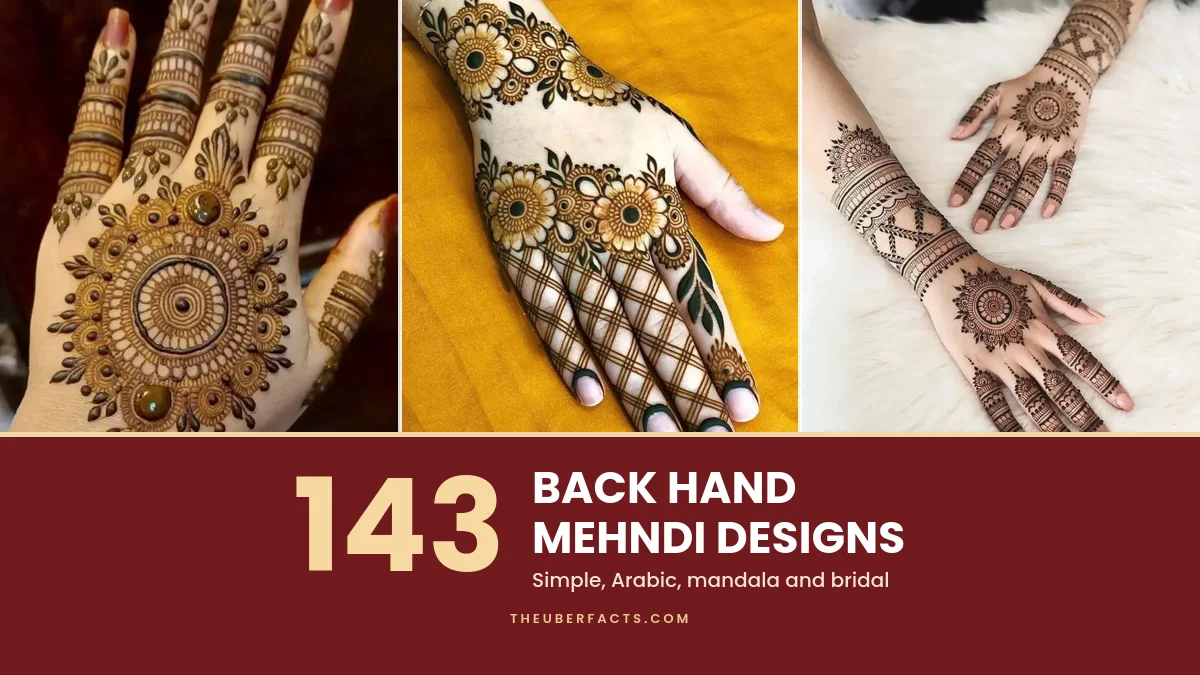
A back hand mehndi design is henna applied to the outer side of the hand, from the wrist over the knuckles to the fingertips. It is the side people see first: when you hold a cup, shake hands, wear rings or pose for a photo, the back of the hand faces outward while the palm stays closed. That is why most brides, wedding guests and Eid shoppers choose this placement when they want their mehndi noticed.
This page collects 143 back hand mehndi designs, each with a photo and a short note on its motifs, coverage and difficulty. They are grouped by style: simple and easy patterns, Arabic diagonal designs, trails that run up the forearm, shaded floral work, mandalas, jewellery styles, geometric jaal and full bridal hands. Below the gallery you will find how to choose a layout for your hand shape and why the back of the hand stains lighter than the palm.
Back Hand Mehndi Design at a Glance
- Placement: back of the hand from the wrist to the fingertips, often with a band or trail onto the forearm.
- Style families: Arabic and Khaleeji (Gulf) with bold lines and open skin, Indian and Pakistani with dense fill, Indo-Arabic mixes, and modern geometric work.
- Common motifs: bel (vine), mandala, rose, lotus, paisley (kairi), jaal (net), lattice, haath phool chains, finger bands and dipped fingertips.
- Skill level: beginner for scattered booti, intermediate for an Arabic bel or a mandala, advanced for a full bridal hand.
- Time per hand: about 5 to 10 minutes for a simple design, 15 to 30 minutes for Arabic or mandala work, 45 minutes or more for full bridal coverage.
- Stain colour: orange when the paste comes off, deepening to red-brown over 24 to 48 hours, usually a shade lighter than on the palm.
- How long it lasts: about 1 to 2 weeks on the back of the hand, less with frequent washing.
- Occasions: weddings and mehndi night, Eid and Chand Raat, Karwa Chauth, Teej, Diwali and parties.
Simple Back Hand Mehndi Designs for Beginners
A simple back hand mehndi design uses small repeated shapes or a single trail, so most of the skin stays bare. These easy patterns are the best place to start with a henna cone, because a small wobble does not spoil the look. An easy back hand mehndi design also dries in minutes, which suits children, office wear and a quick Chand Raat session.
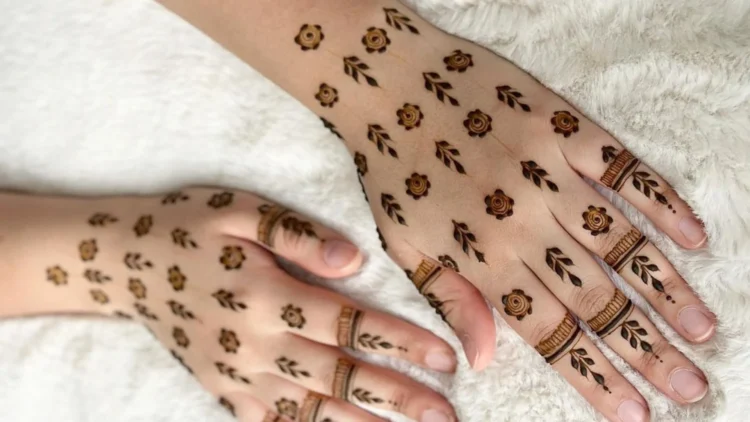
1. Scattered roses and leaf sprigs. Tiny roses and leaf sprigs are dotted in rows over both hands, with a thin ring on some fingers. Each motif takes seconds, so a beginner can cover a hand in about five minutes.
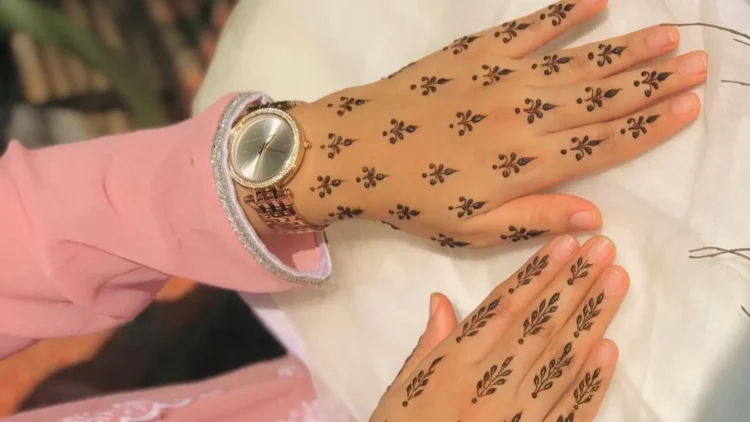
2. Fleur booti all over the hand. One small three-dot fleur motif is repeated in even rows from the wrist to the knuckles. It works with a watch or bracelet and looks neat at work.
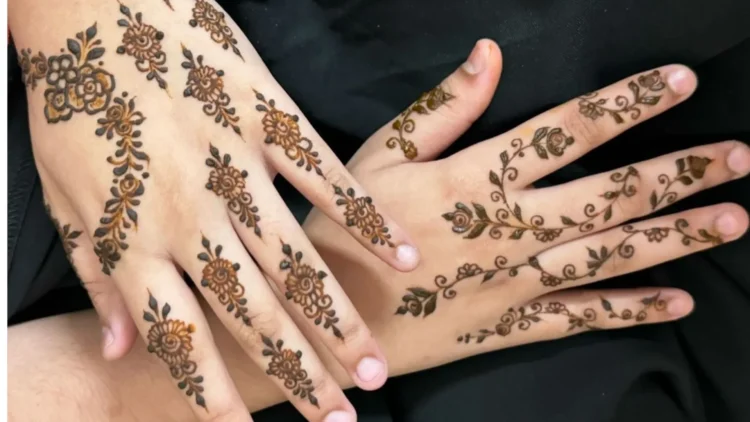
3. Thin floral trails on both hands. Thin vines with small flowers run along each finger instead of across the hand. The light coverage keeps the design delicate, and it suits young girls.
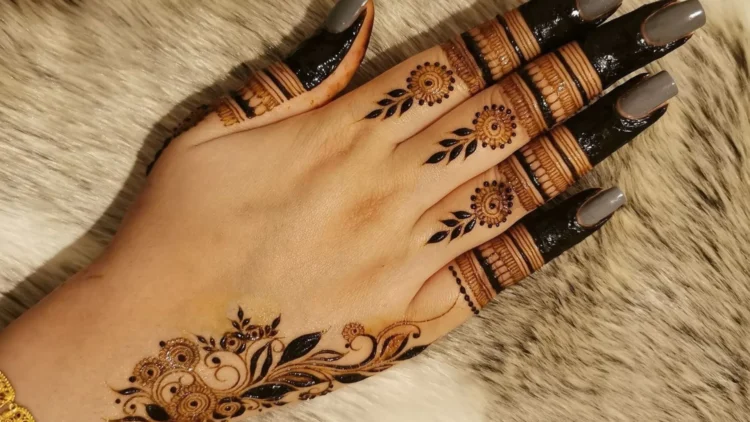
4. Wrist spray with banded fingers. A shaded floral spray sits at the wrist, three small flowers mark the knuckles and the fingers carry thick bands with fully dipped tips. Most of the hand is bare skin.
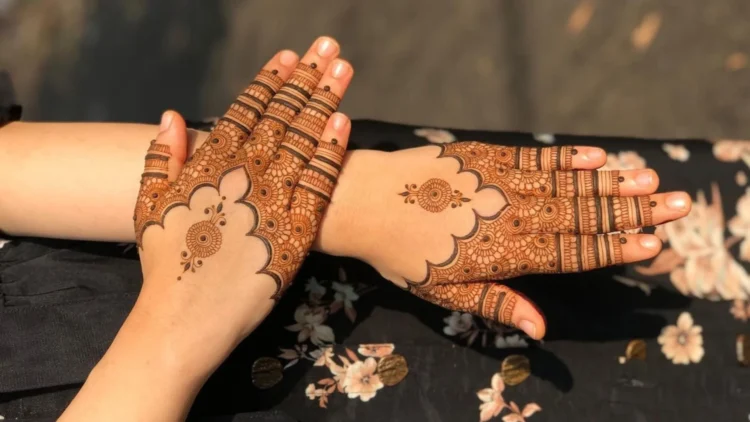
5. Scalloped edge with a small mandala. A scalloped lace edge curves across the hand above a small mandala, and every finger is banded. The orange colour shows a fresh stain that will darken over two days.

6. Square block with a wrist arch. A single square block filled with fine geometric lines sits in the middle of the hand, framed by a thin arch at the wrist. Small motifs on three fingers finish it.
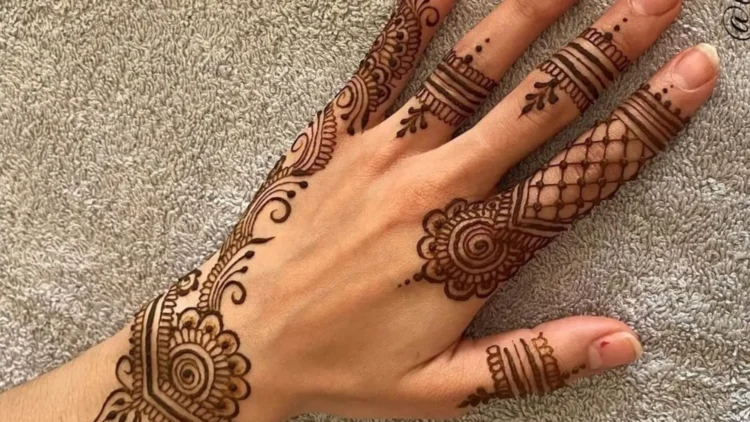
7. Paisley wrist curl with a lattice finger. A paisley curl climbs from the wrist along the thumb side, one flower sits at the knuckle and a single finger carries lattice. The other fingers get thin bands, so most of the hand stays bare.
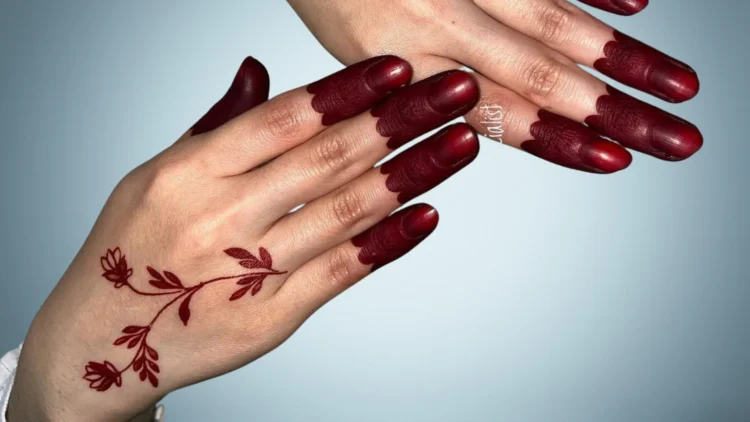
8. Single red rose stem. One thin stem with two small roses and a few leaves runs across the back of the hand, and the fingertips are filled up to a scalloped edge. It takes a few minutes and suits a first try with the cone.
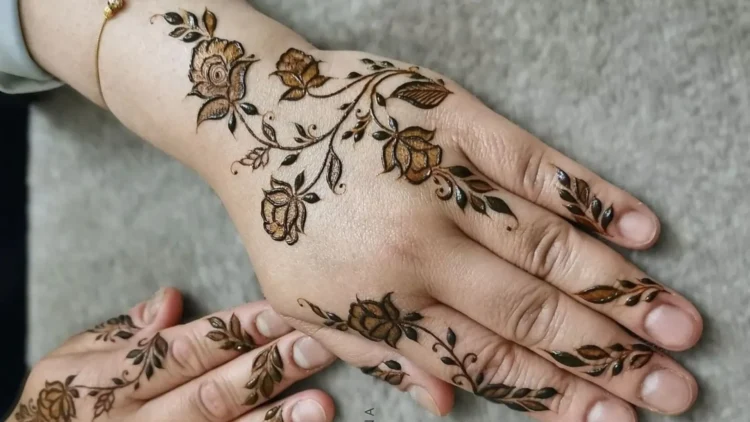
9. Rose vine from wrist to knuckles. Four shaded roses sit on one thin curving vine from the wrist to the knuckles, and each finger carries a short leaf sprig. The second hand repeats the vine on a smaller scale.
Arabic Back Hand Mehndi Designs with a Diagonal Bel
Arabic mehndi runs a bel (vine) diagonally from the wrist toward one or two fingers and leaves the rest of the hand open. The diagonal line makes the hand look longer and slimmer, which is why this is the most requested stylish back hand mehndi design for parties and weddings. Bold outlines and shaded leaves also hold their colour well on the back of the hand.
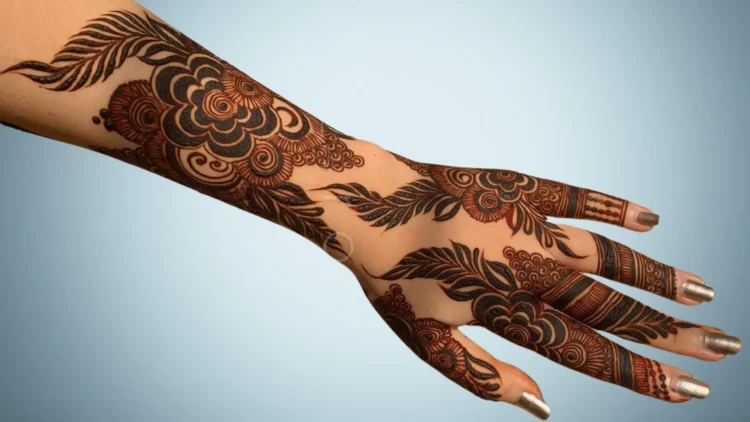
10. Bold flower with feather leaves. A large layered flower sits on the wrist, and feather-shaped leaves carry the design diagonally to the middle and ring fingers. Thick lines like these give a very dark stain.
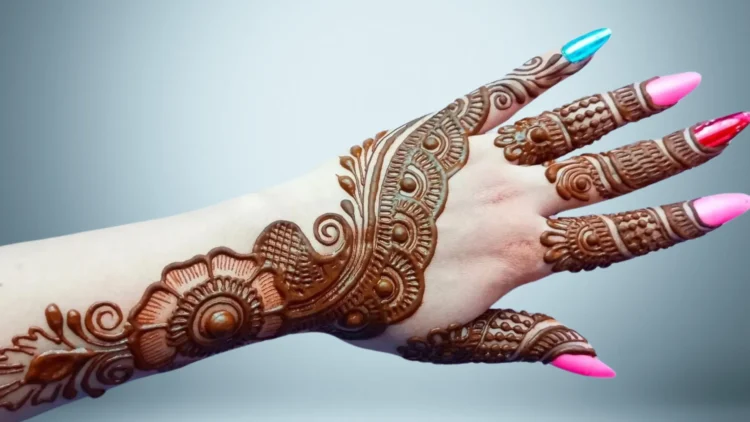
11. Paisley bel along the outer edge. One long paisley bel follows the outer edge of the hand from the forearm, leaving the centre of the hand bare. The fingertips carry patterned caps.
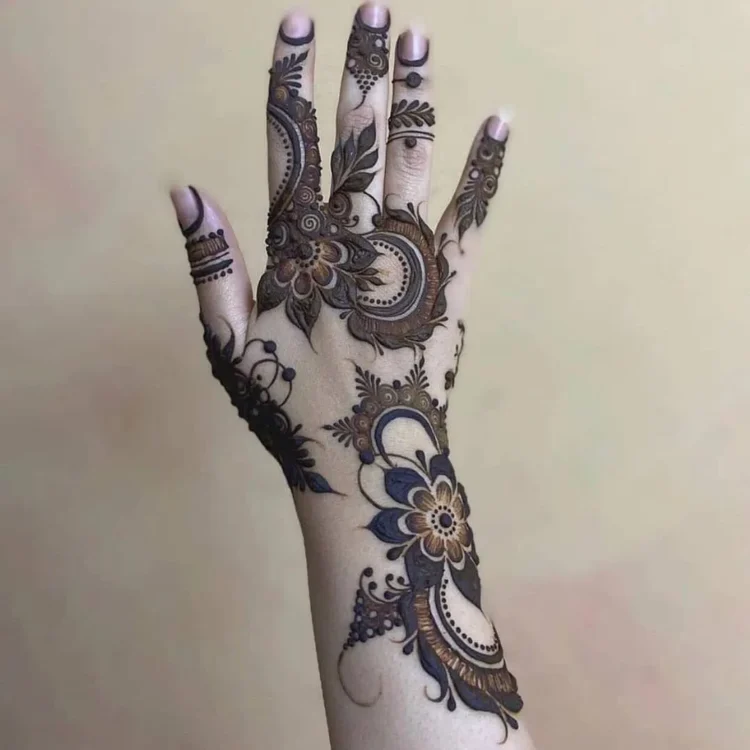
12. Crescent moons and shaded flowers. Crescent moons and shaded flowers climb from the fingers to the wrist in a curving line. The very dark lines and filled leaves are typical of Gulf-style work.

13. Floral mandala trail with glass bangles. A trail of floral mandalas runs from the wrist to the index finger, and the other fingers get neat bands. Shown with glass bangles, it suits a festival look.
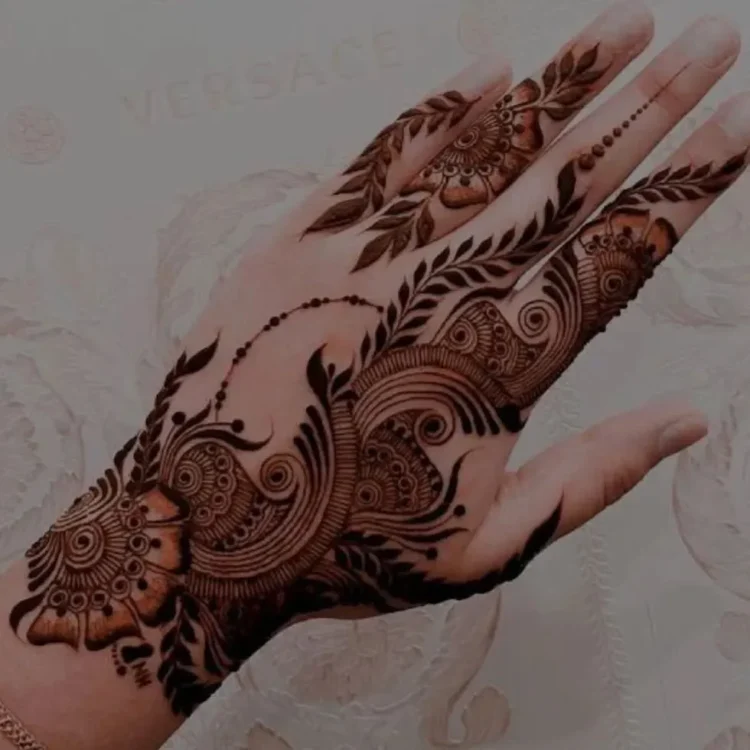
14. Leafy bel with a bead line. Leafy branches and shaded petals sweep across the hand, and a single line of beads crosses from the side toward the fingers.

15. Wrist florals with a bead chain finger. Flower clusters sit low on the wrist and rise in a diagonal to the knuckles. One finger carries a hanging bead chain, a small detail that adds movement.
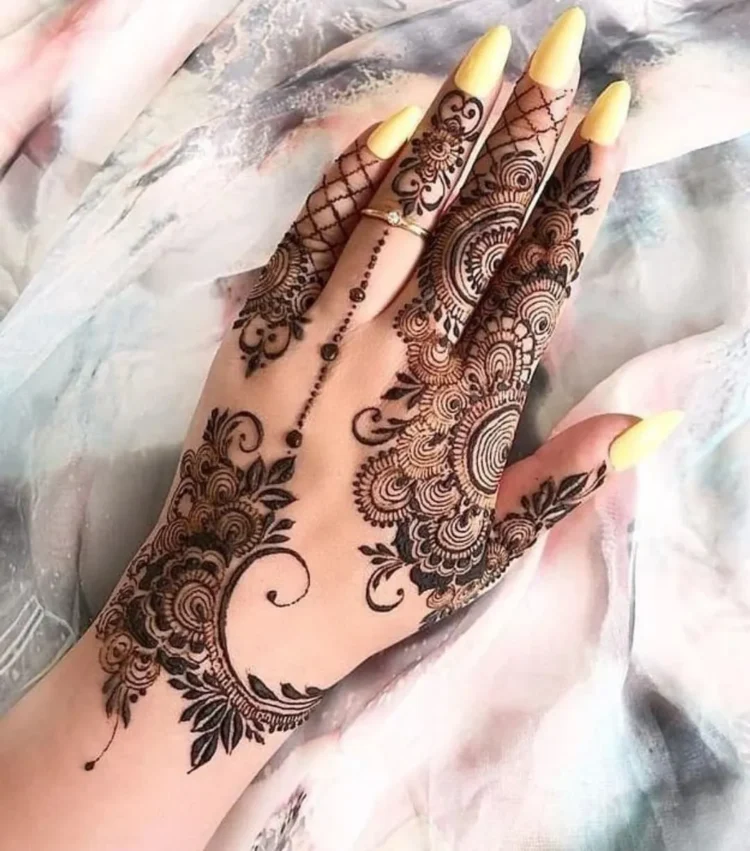
16. Paisley curl with a mandala. A bold paisley curls around the wrist, a half mandala fills the side of the hand and two fingers carry fine net. A dotted line runs down the middle finger.
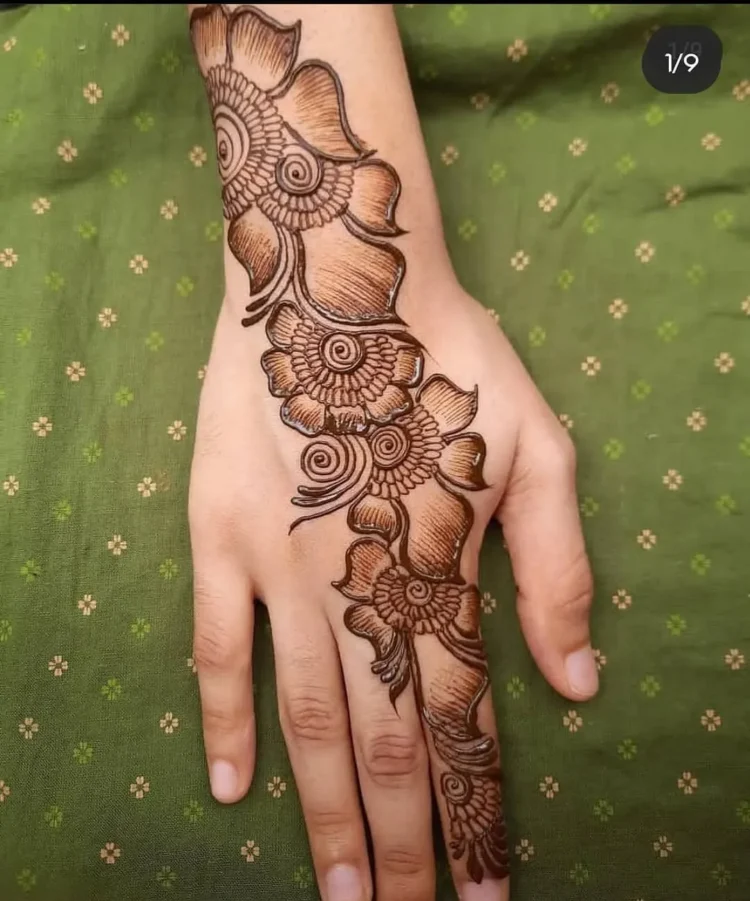
17. Open shaded flowers on one side. Large open flowers with spiral centres run in a single column from the wrist to the middle finger. Only one strip of the hand is covered, so it is quick to apply.
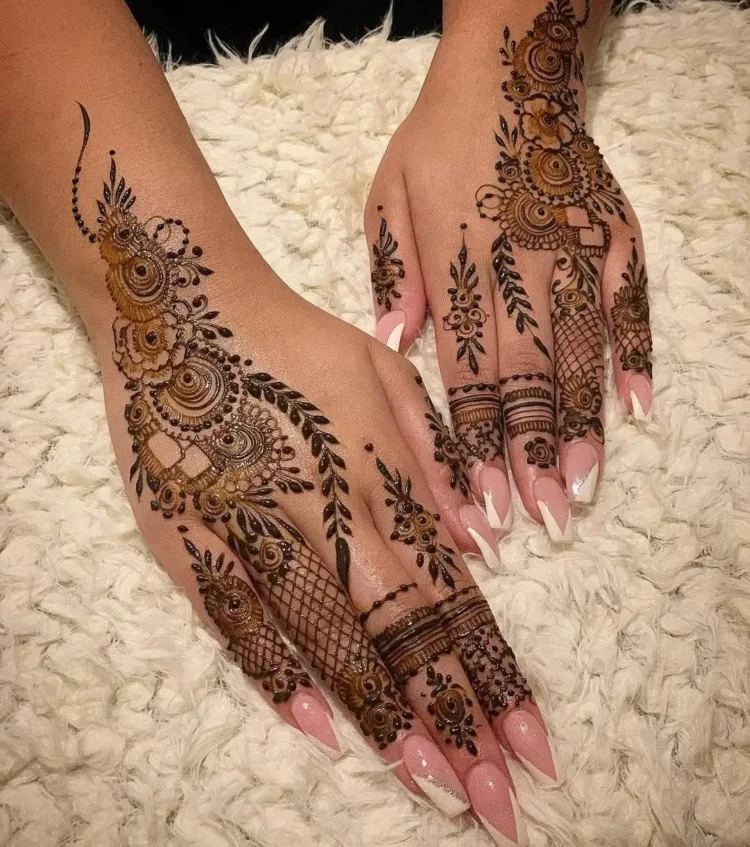
18. Fresh paste bel with net fingers. Shown with the paste still glossy: a floral bel with leaf sprigs crosses each hand diagonally, and some fingers are filled with net and bands.
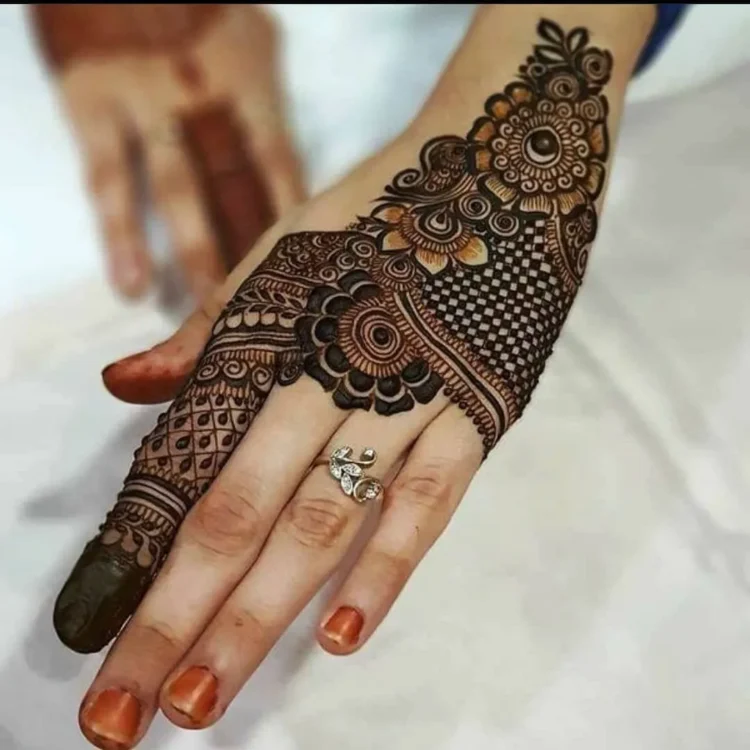
19. Half hand with a checkered block. The design covers only the side of the hand next to the thumb: a checkered block, bold flowers and net down to a dipped index finger.
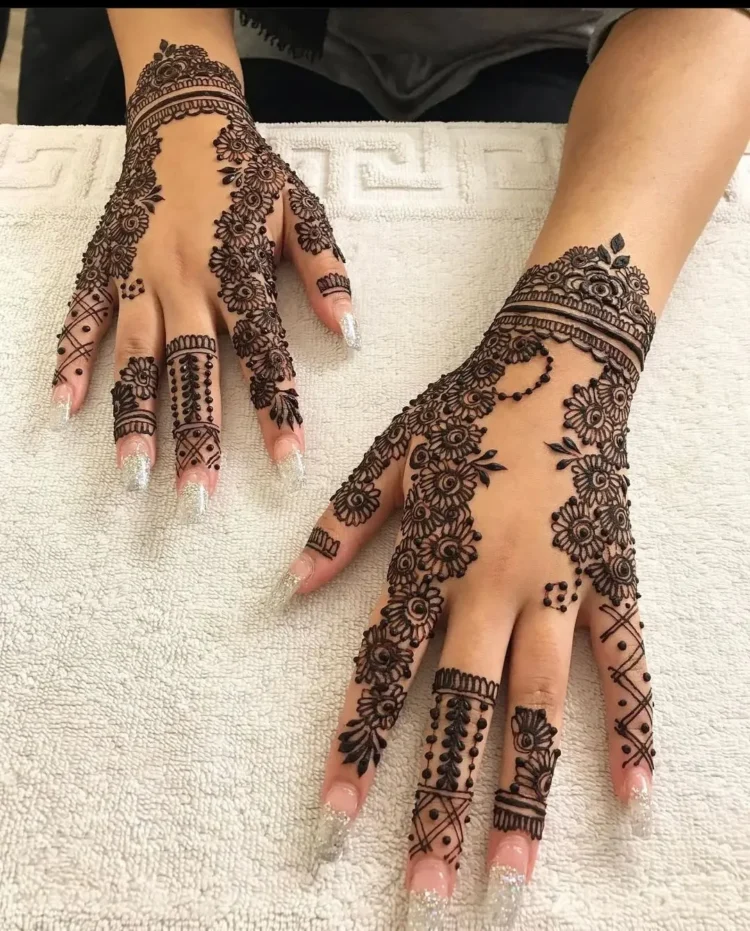
20. Vertical floral trails. Floral trails run straight up from the knuckles to a wrist band, while the fingers carry small geometric blocks and dots.
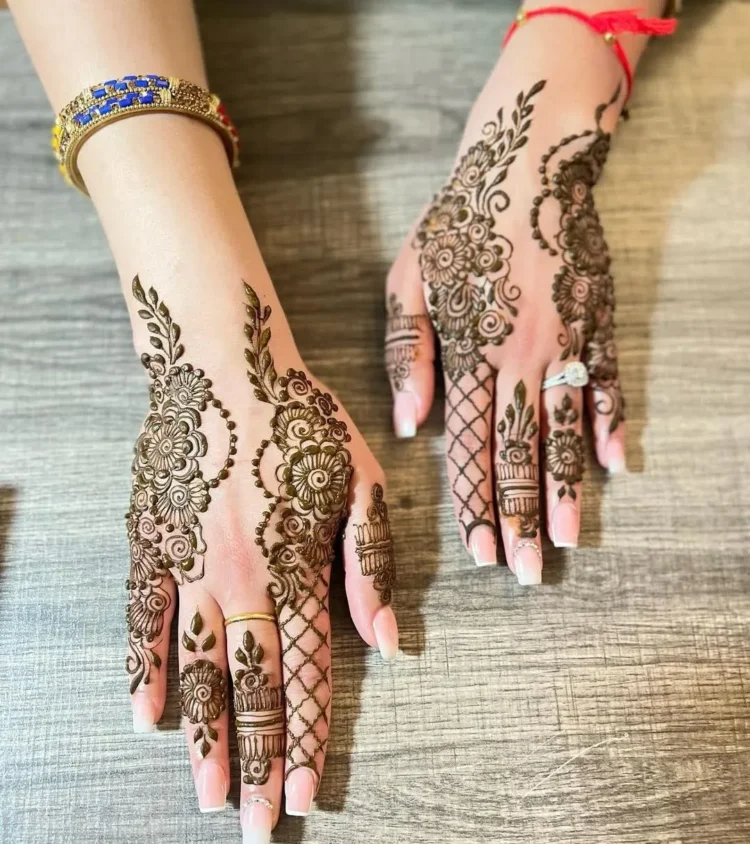
21. Twin floral columns. Two columns of flowers rise side by side from the fingers to the wrist on one hand, and the other hand repeats them with a criss-cross net on one finger.
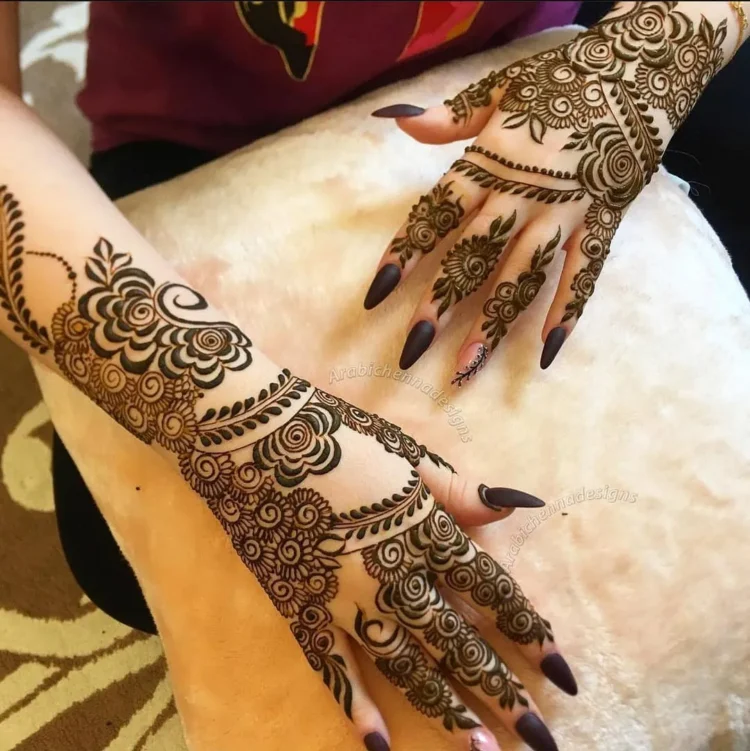
22. Rose rows with dotted lines. Rows of roses and leafy bands cross the hand diagonally, with lines of dots separating them. The second hand carries a lighter version with small roses on the fingers.
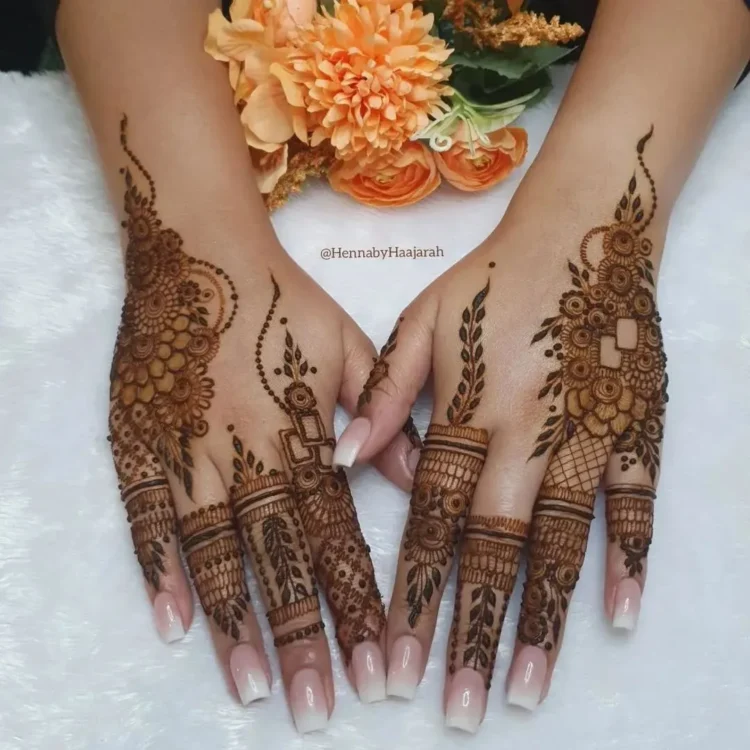
23. Edge florals with square motifs. Flower clusters run up the outer edge of each hand toward the wrist, with small square outlines set between them. The fingers mix leafy trails, net and bands, and the middle of the hand stays bare.
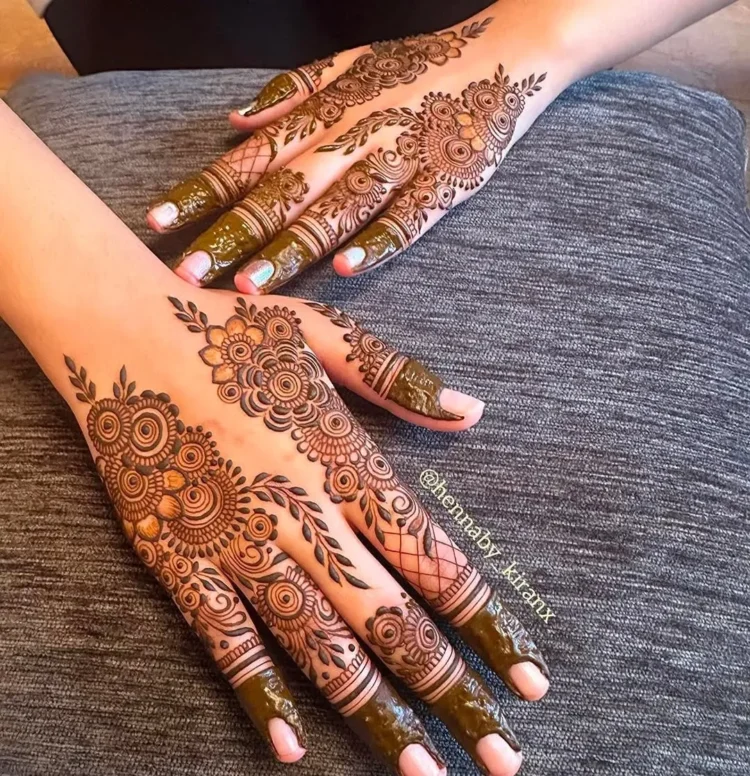
24. Spiral flower diagonal. Clusters of spiral centred flowers and leaves cross from the wrist to the knuckles in a diagonal, and the fingers carry net, bands and filled tips. The second hand mirrors the flow.
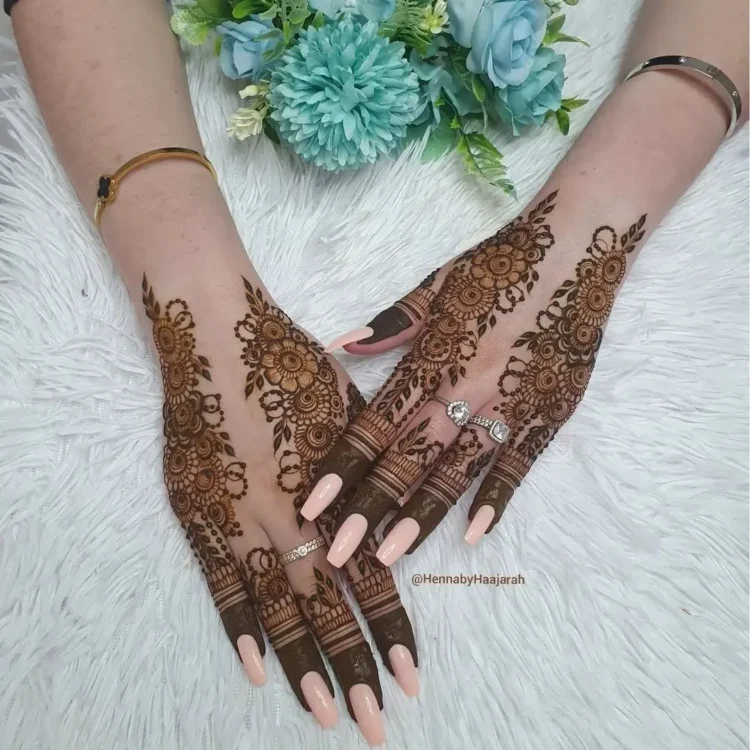
25. Matching floral edges on two hands. Each hand has a column of flowers and leaves along its outer edge, mirrored so the two hands frame each other. Bands and dipped tips finish the fingers.
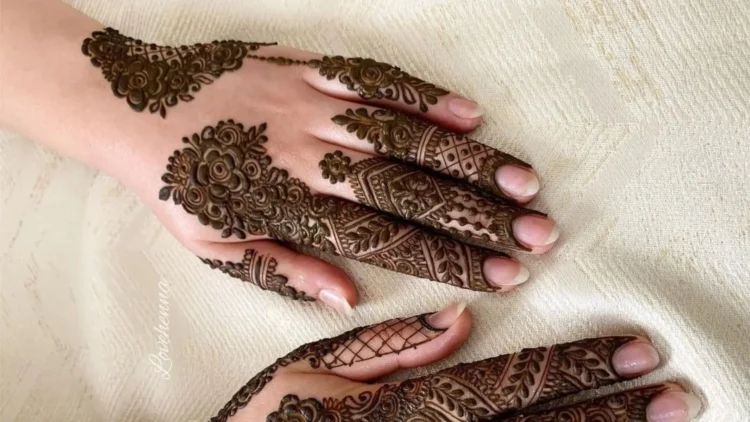
26. Rose clusters with leaf panel fingers. One rose cluster sits on the wrist and a larger one at the base of the index finger, joined by a dotted line. The fingers are filled with leaf panels and small geometric bands, a balance of bold and fine work.
Back Hand Mehndi Designs That Run Up the Forearm
Many back hand designs do not stop at the wrist. A trail of flowers, a peacock or a large round motif carries on up the forearm, which makes the arm look longer in photos and fills the space between the sleeve and the hand. These designs take longer than a hand only pattern, but they leave more bare skin than a bridal sleeve.
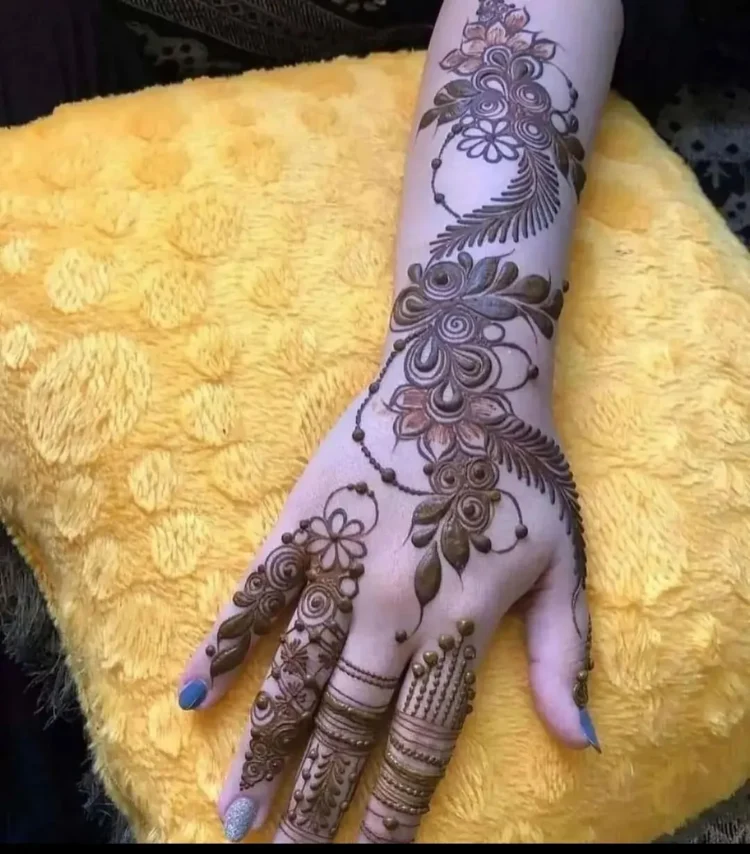
27. Long bel up the forearm. Roses and feather leaves rise from the knuckles to the middle of the forearm, joined by a thin dotted line. Two fingers carry tall stacked bands.
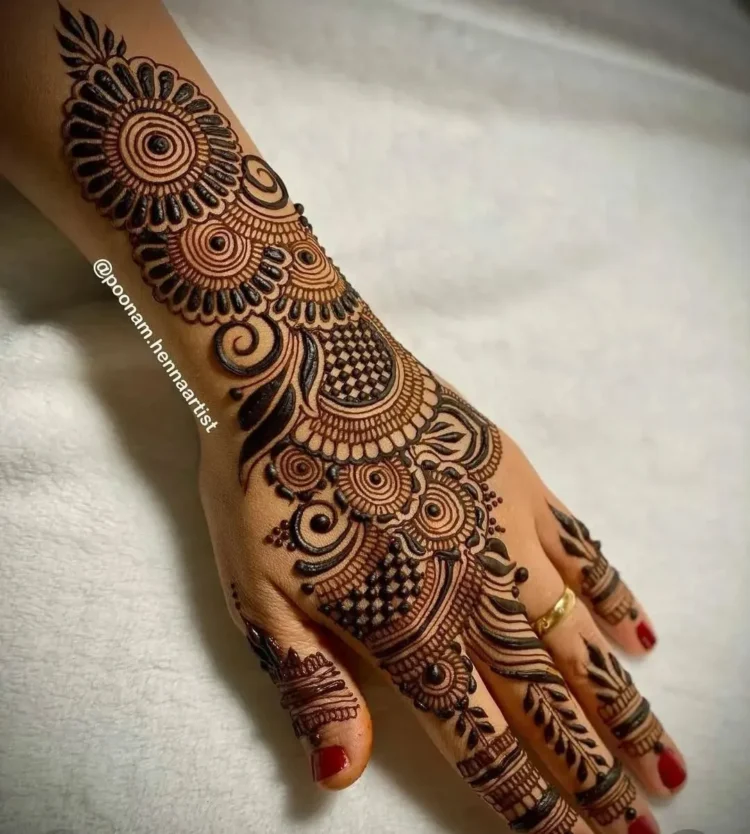
28. Sunflower forearm with checkered blocks. A sunflower mandala on the forearm leads into swirls and two checkered domes on the hand, and leafy bands cover the fingers. The dark outlines and filled petals give strong contrast.
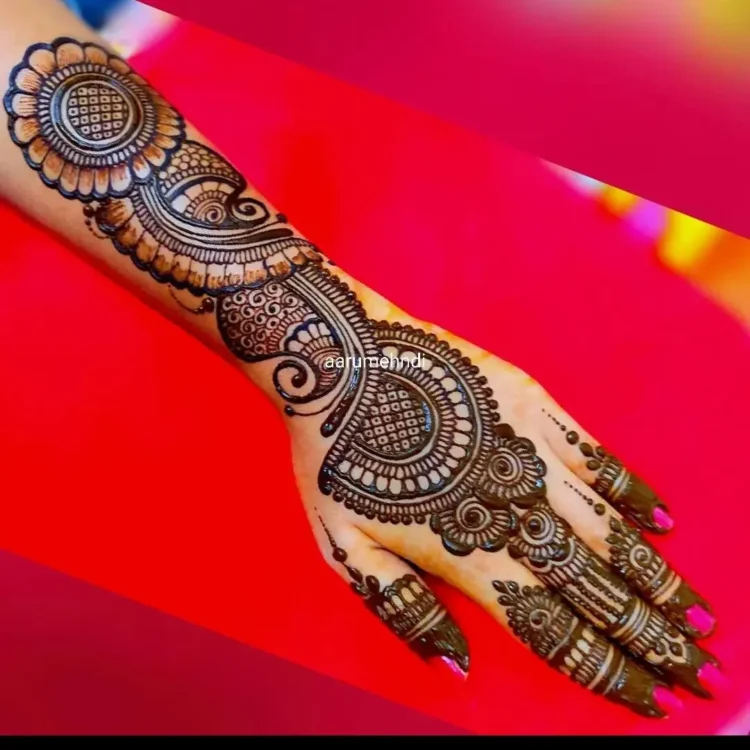
29. Lattice S curve to the fingers. A large flower medallion on the forearm turns into an S shaped curve filled with lattice and dots, ending in small mandalas at the knuckles. The fingers carry bands down to the nails.
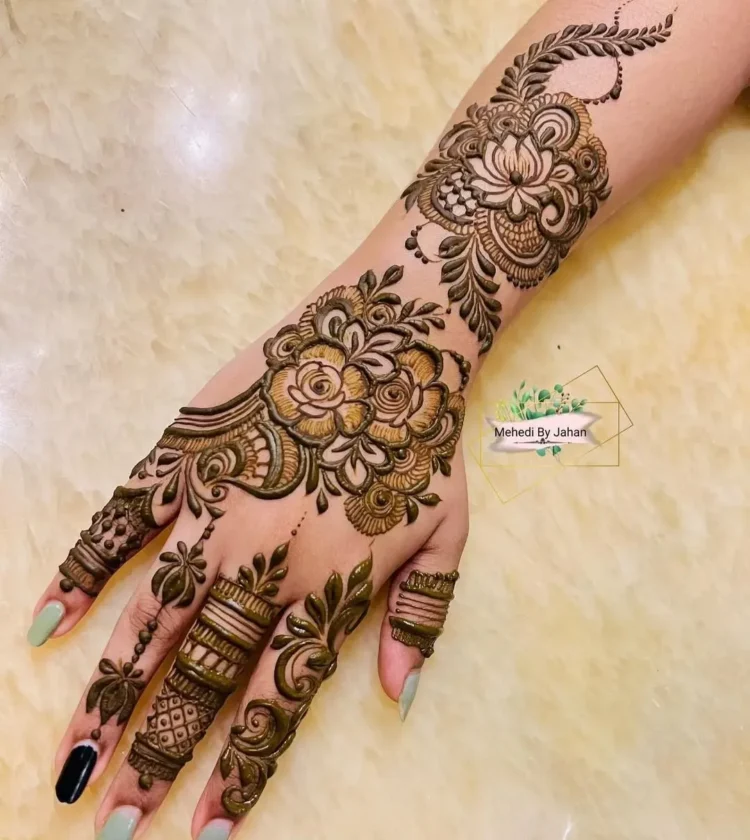
30. Shaded roses from forearm to hand. A lotus and leaf spray on the forearm leads to a large shaded rose on the hand, followed by leaf fingers and one lattice finger. The petals are shaded inside, which makes the roses look raised.
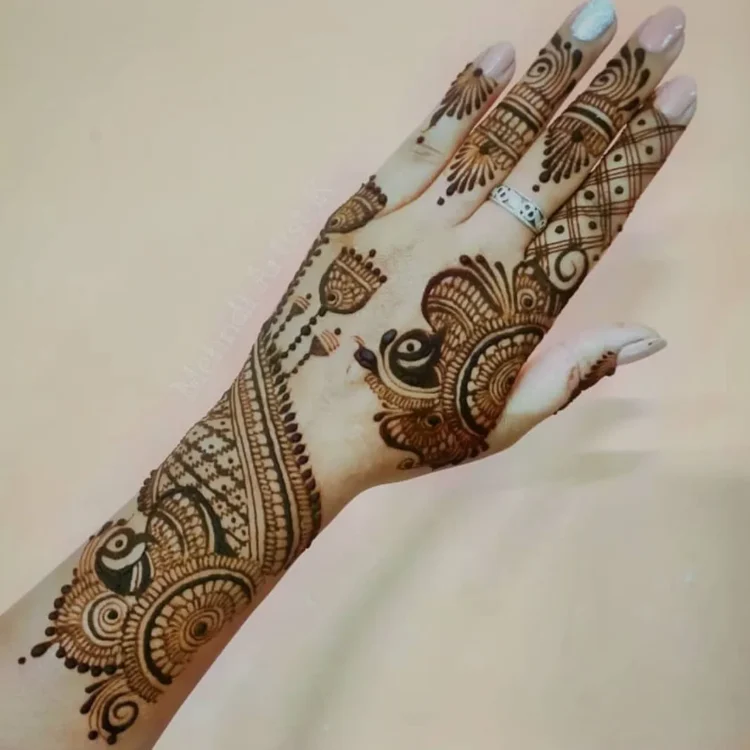
31. Peacock with a checkered forearm. A peacock with a curled neck sits by the knuckles, a band of checks and lines runs up the forearm to a second peacock, and hanging bead motifs fill the gap. Two fingers carry lattice.
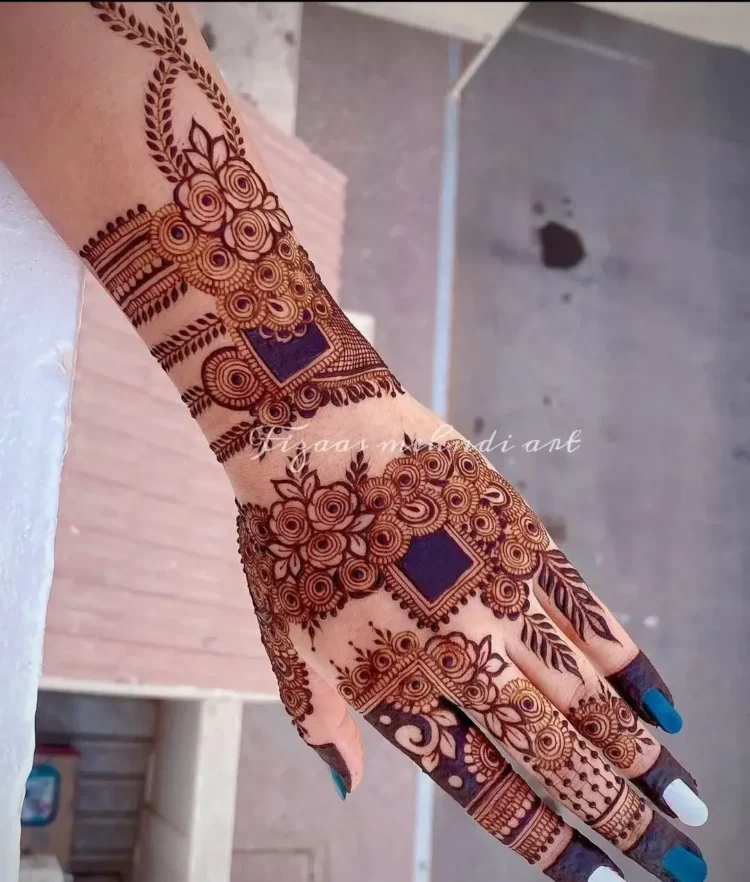
32. Dark squares with rose clusters. Rose clusters surround two solid dark squares, one on the hand and one at the wrist, and a leaf trail continues up the forearm. The bold squares make the design easy to read from a distance.
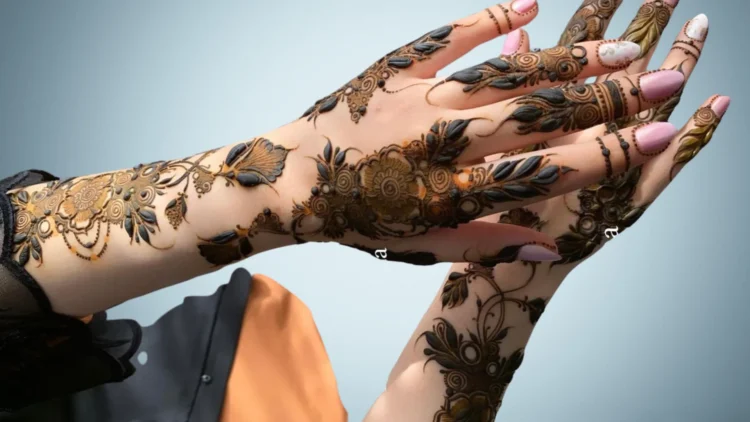
33. Black leaves with bead chains. Bold black leaves and large shaded flowers spread from the forearm to the hand, with short bead chains hanging between them. The fingers carry slim bands and single leaves.
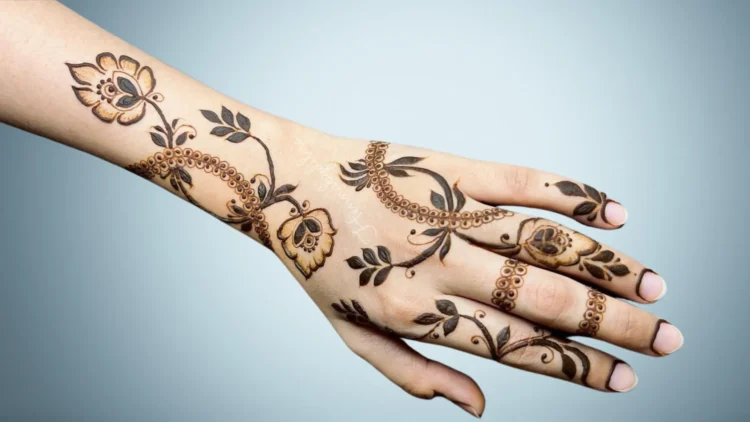
34. Bead chain vine with lotus buds. A thin vine with lotus buds and leaf pairs runs from the forearm to the fingers, threaded with chains of small beads. Two fingers wear matching bead rings.
Bold Floral and Khaleeji Style Back Hand Designs
Khaleeji mehndi, the style worn in the Gulf countries, uses large roses and leaves with thick outlines and shading inside the petals. On the back of the hand the flowers are usually placed in a diagonal cluster, with bold leaves on the fingers. For more rose ideas see our rose mehndi designs, and for flower centres built around a lotus see our lotus mehndi designs.
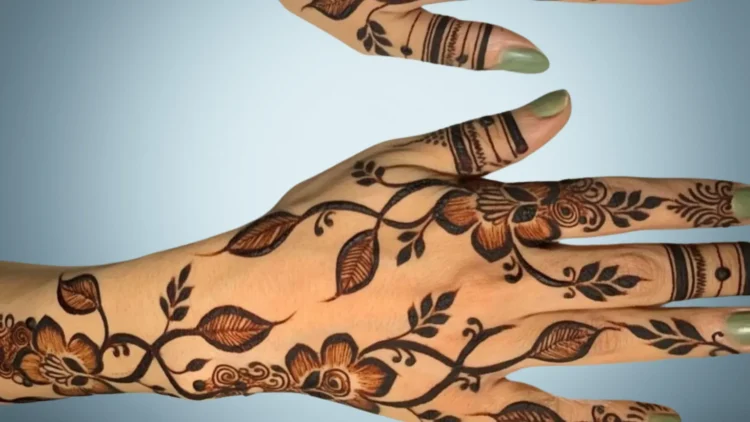
35. Leafy vine with shaded flowers. A thick vine twists from the forearm across the hand with filled leaves and shaded flowers, and the fingers carry simple bands. A clear example of Khaleeji leafwork.
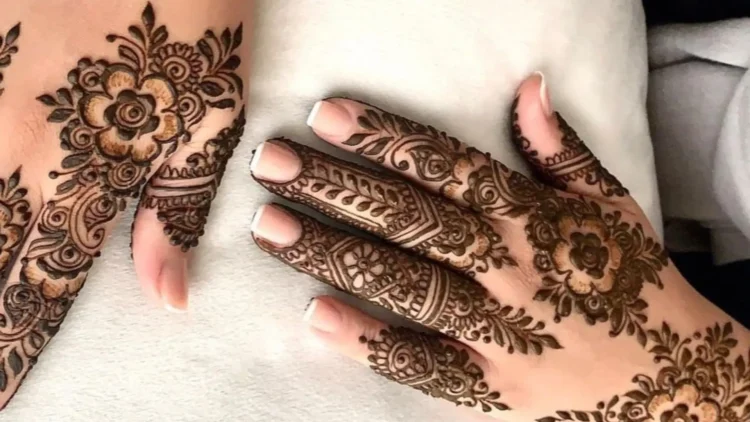
36. Rose clusters with patterned fingers. Shaded rose clusters sit at the wrist and knuckles, and each finger is filled with a different small panel pattern.
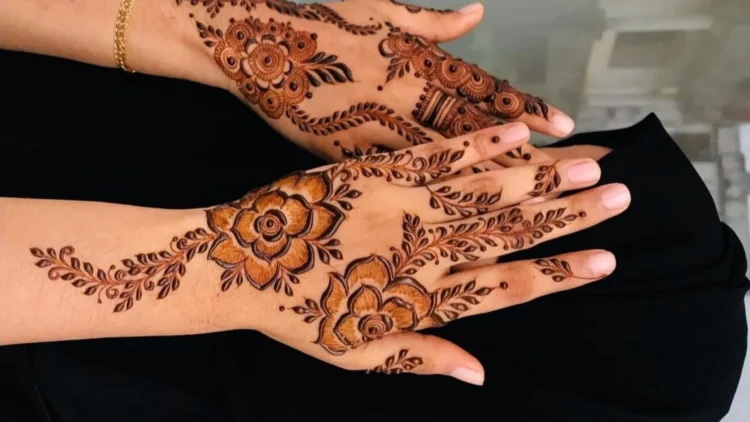
37. Shaded roses on a leafy trail. Large roses with shaded petals sit on a trail of small leaves that runs from the wrist across the hand. The light orange fill inside the petals gives a two-tone look.
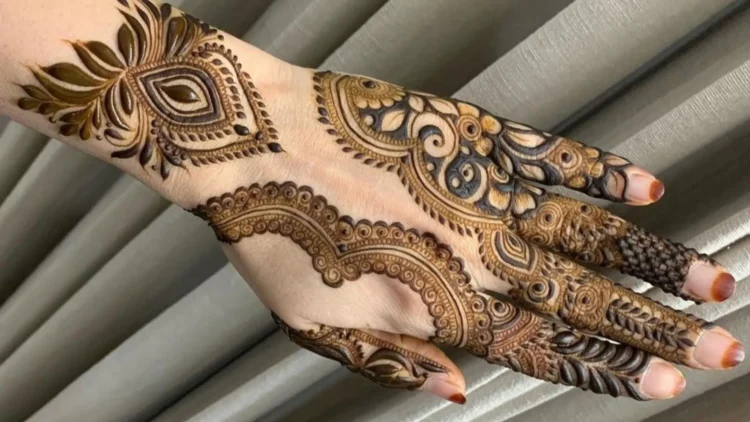
38. Leaf crown with shaded swirls. A crown of leaves and a teardrop sit at the wrist, a scalloped curve crosses the hand, and the fingers carry shaded swirls and a net tip.
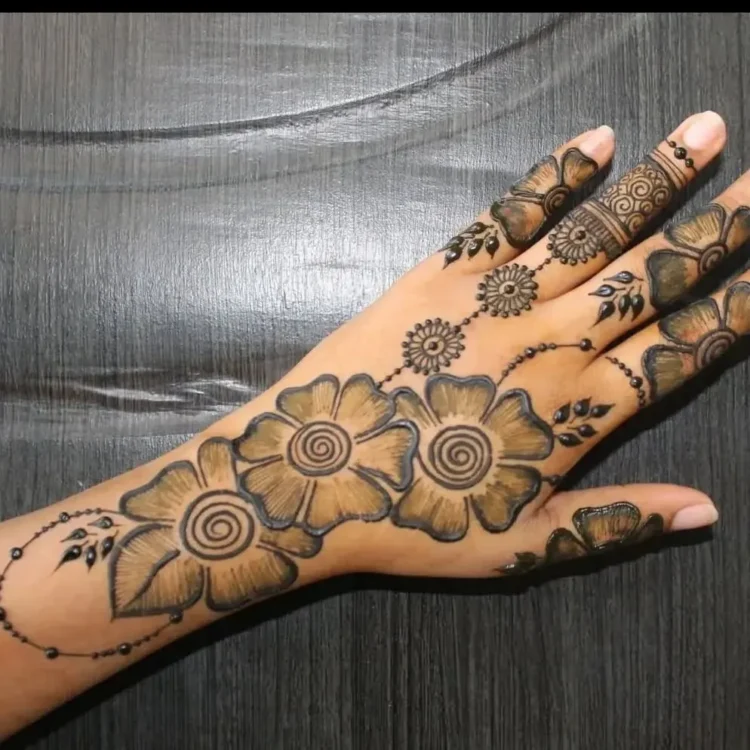
39. Spiral flowers with a bead bracelet. Three large flowers with spiral centres sit in a row across the hand, a bead chain wraps the wrist and tiny mandalas dot the fingers. Big shapes make it fast to fill.
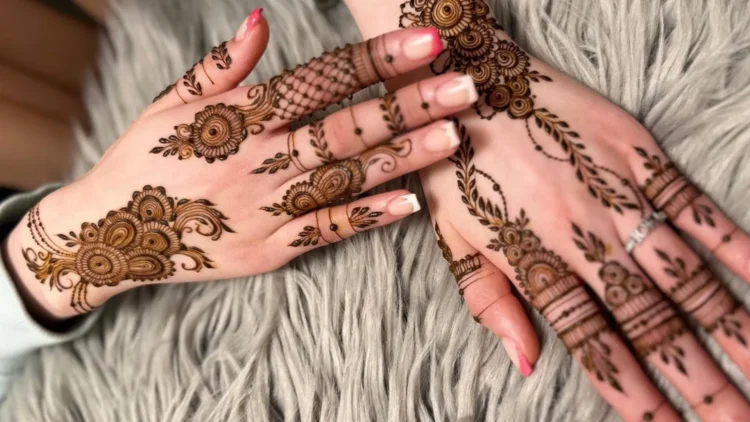
40. Floral mandalas with a chain bel. Floral clusters on one hand are answered by a leafy chain bel on the other, with net on one finger and thin rings on the rest.
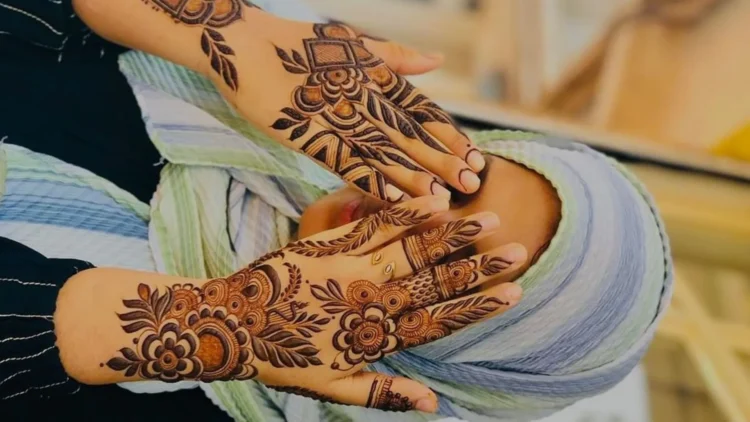
41. Shaded flowers with a diamond motif. Shaded flowers and bold leaves cover the hands, and a small diamond motif sits between the knuckles. The orange-brown fill shows a stain still darkening.
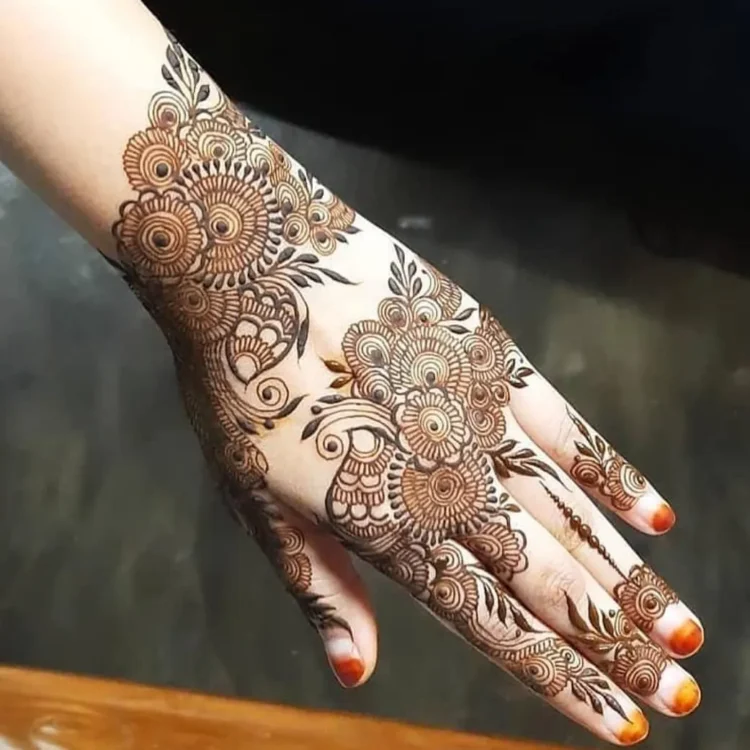
42. Dense flower clusters. Flower clusters and paisleys fill the space from the wrist to the knuckles in two diagonal groups, with small flowers on the fingers.
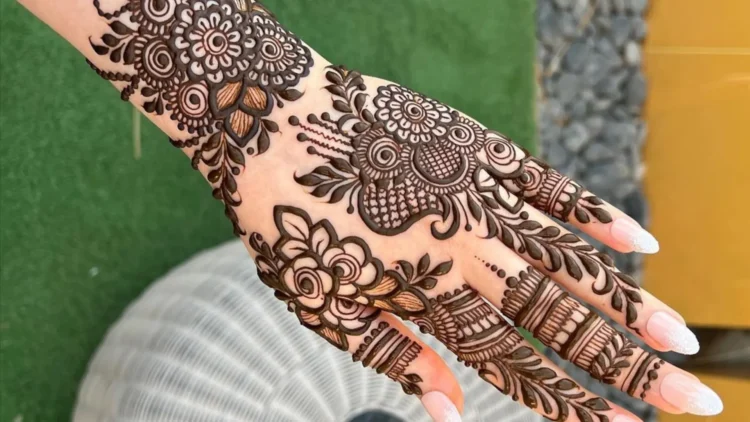
43. Wrist florals with leaf columns. Big round flowers fill the wrist, a rose cluster sits on the hand and columns of leaves run up two fingers. The other fingers carry wide bands.
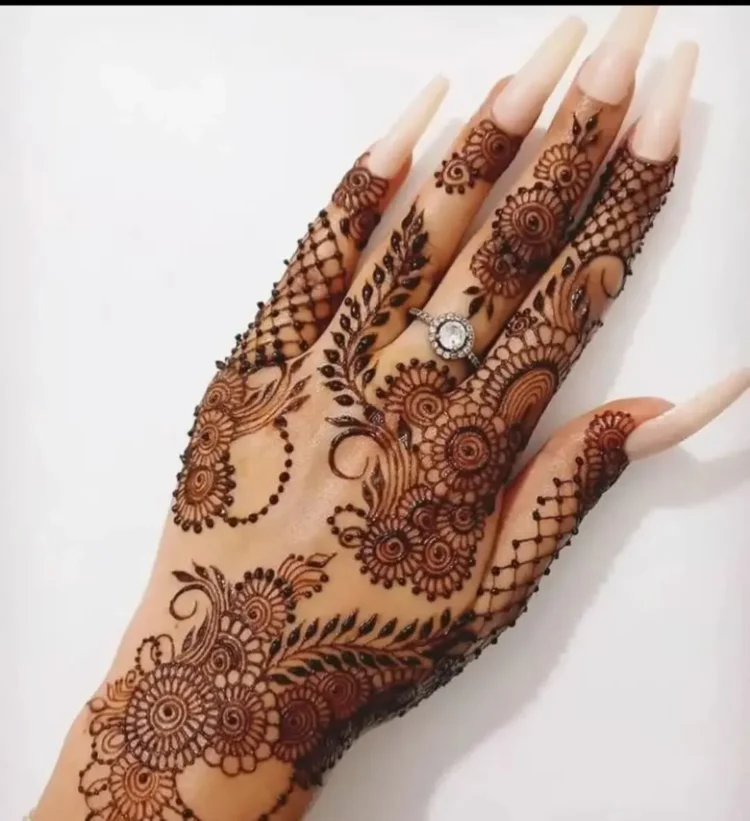
44. Roses edged with dotted net. Rose clusters cover the centre, and fine dotted net runs along both edges of the hand and up one finger, like a lace border.

45. Rose cluster with lattice fingers. A thick cluster of roses crosses the hand diagonally, the fingers mix lattice and leaves, and a leafy trail continues down the wrist.
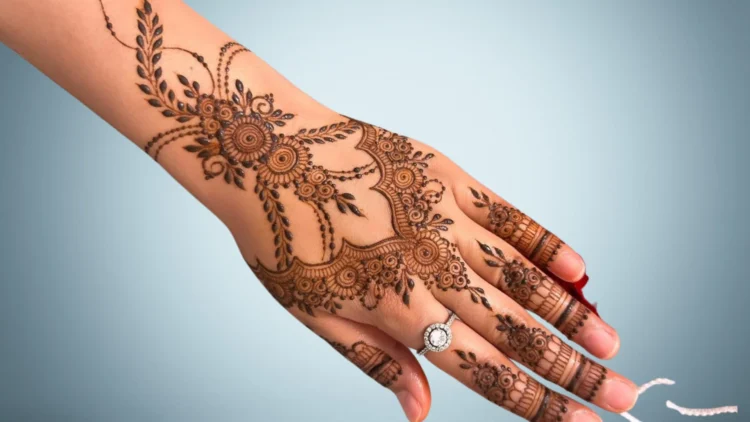
46. Fine floral with hanging chains. A fine floral centre spreads leafy sprays toward the wrist, with short chains hanging from the scalloped edge. The thin lines need a cone with a fine tip.
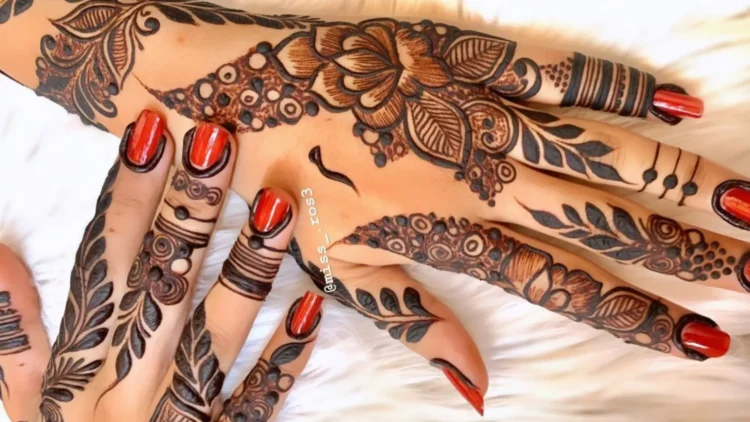
47. Bold lotus with dot clusters. A large lotus with filled leaves sits on the hand, framed by clusters of dots and bold leaf strokes. Thick bands and short lines mark the fingers.
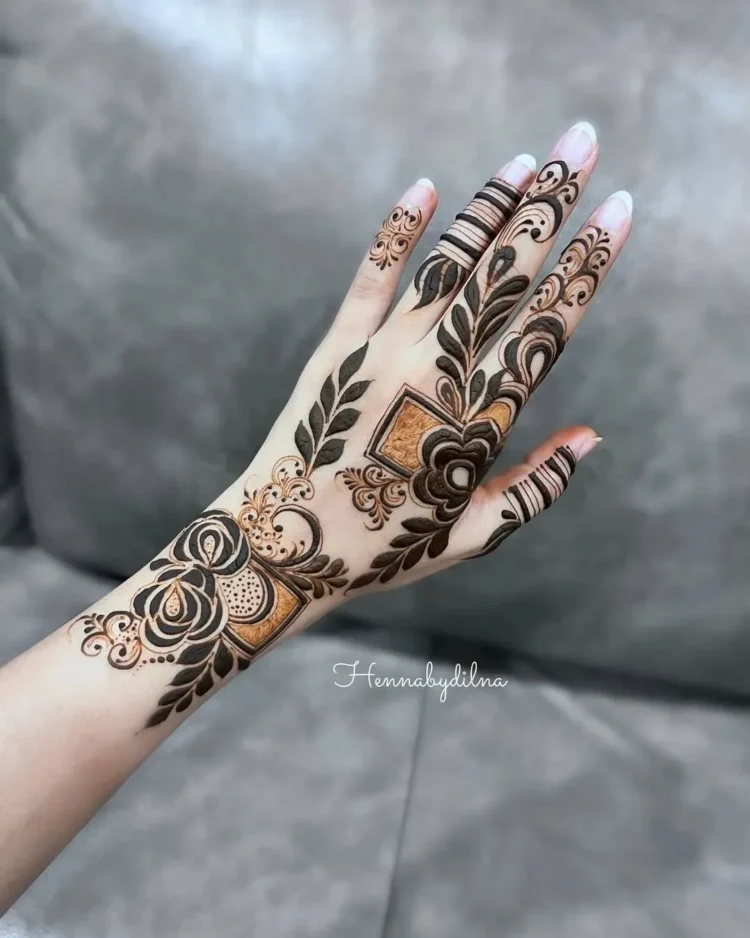
48. Black roses with gold squares. Black roses and leaf sprays run from the wrist toward the ring finger, with two square blocks filled in a lighter gold tone. Thick lines with open skin around them are typical of Gulf style work.
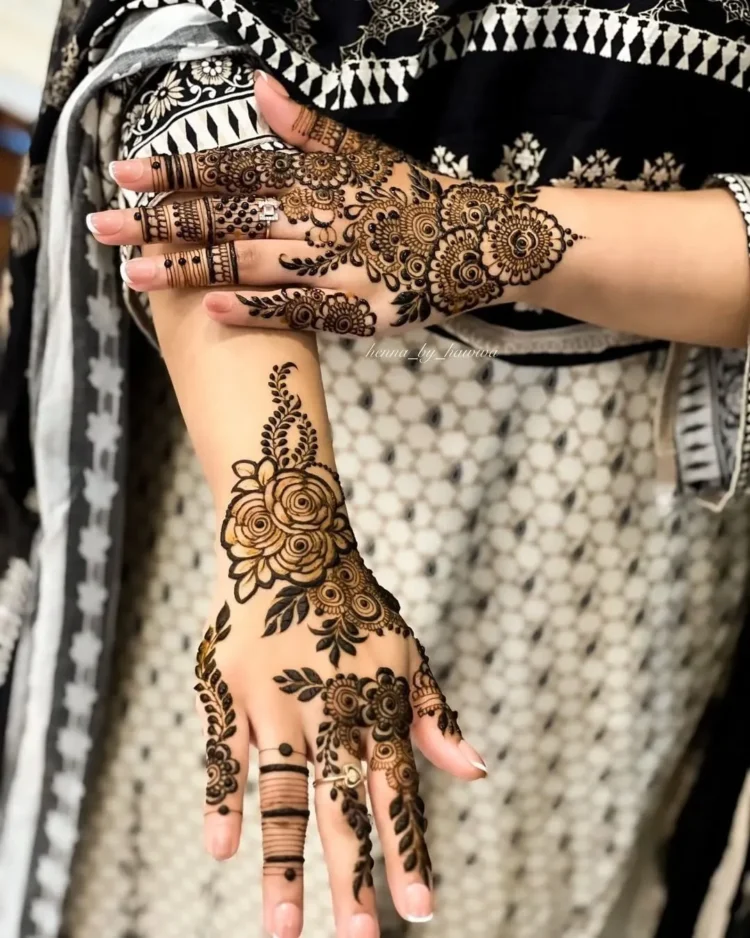
49. Rose clusters on crossed hands. Rose clusters with dark leaves cover the wrist of one hand and climb to the knuckles of the other, and small flowers fill the fingers. Thin bands sit between the flowers.
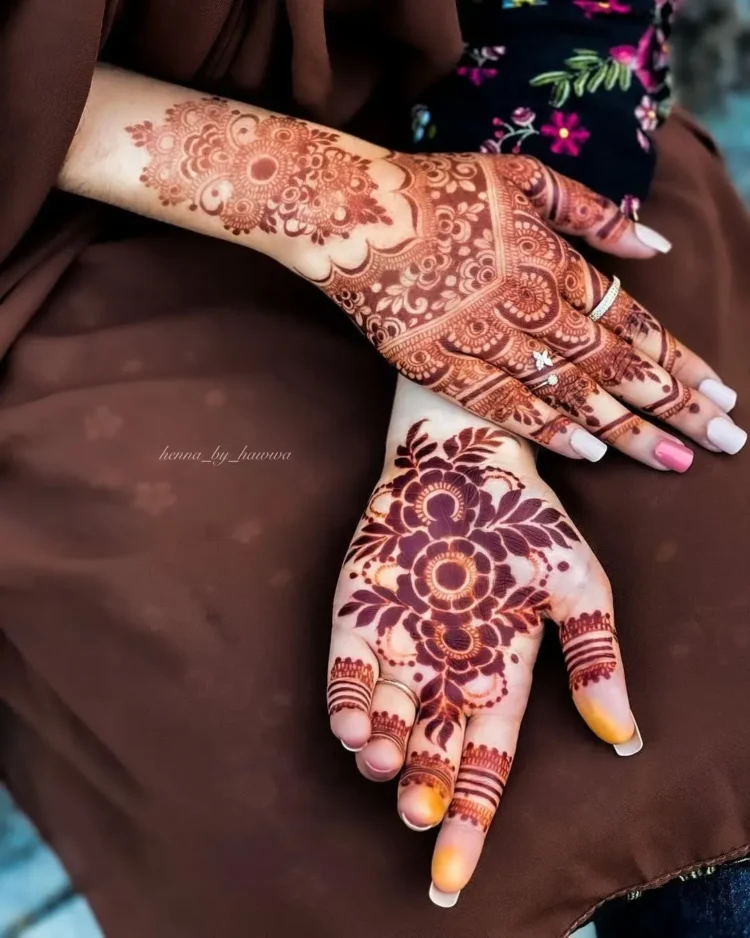
50. Maroon flower with a lace dome. One hand carries a single large flower with leaves in a deep maroon, and the other a lace dome with floral fill in a lighter red brown. The two hands show two different shades side by side.
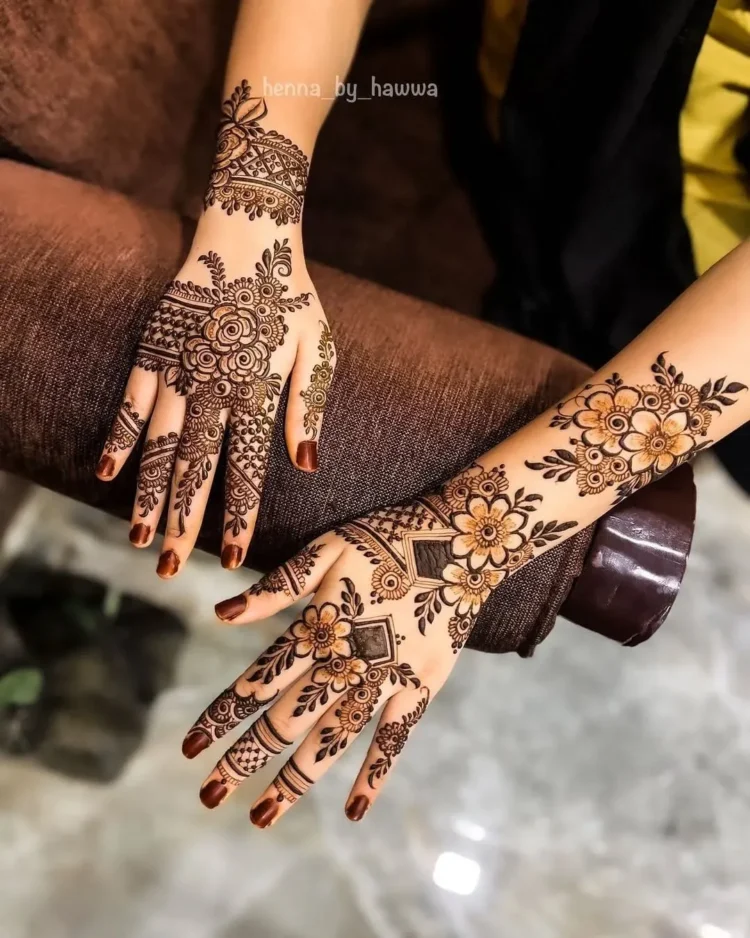
51. Orange flowers with diamond motifs. Flowers with orange filled petals run diagonally across one hand with small diamonds between them, while the other hand carries a rose and checkered wrist bands.

52. Rose clusters in red brown. Clusters of roses spread from the wrist to the knuckles, and the fingers mix lattice, leaves and bands. The second hand carries a lighter floral patch on the side.
Mandala and Round Centre Back Hand Mehndi Designs
A mandala placed in the middle of the back of the hand is the easiest way to look balanced, because everything grows out from one point. Fingers are then finished with bands, small motifs or dipped tips. A plain round tikki is also popular here; our circle mehndi designs show many more round ideas.
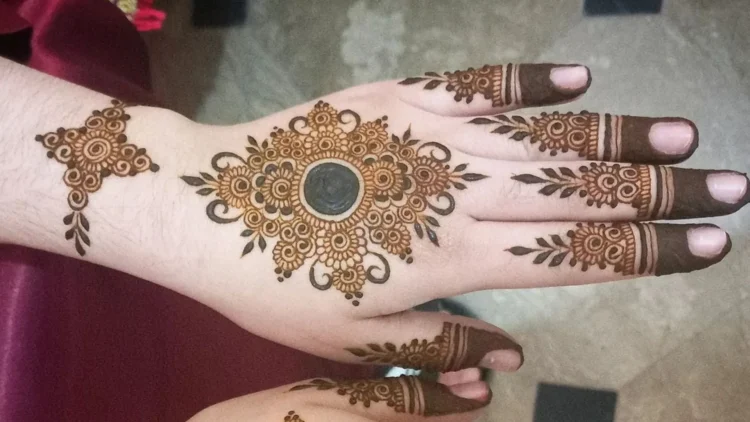
53. Mandala with an open dark centre. A wide mandala of small flowers surrounds a solid dark disc, a small star motif sits on the wrist and the fingers carry bands and dark tips.
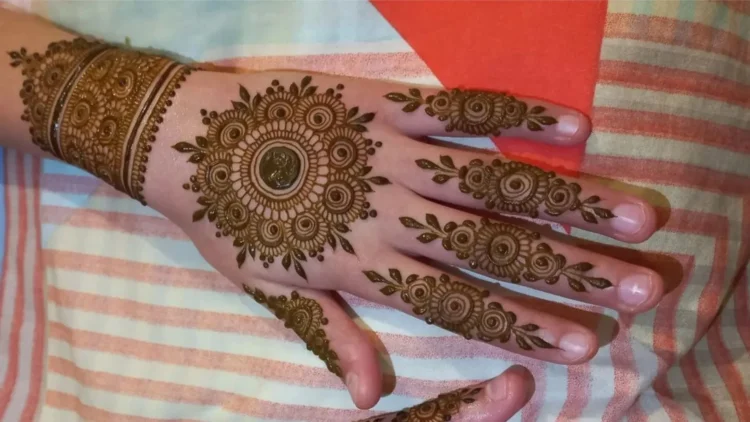
54. Mandala with a wide wrist cuff. A dense mandala is paired with a wide bracelet cuff at the wrist, and each finger carries two small round motifs with leaves.
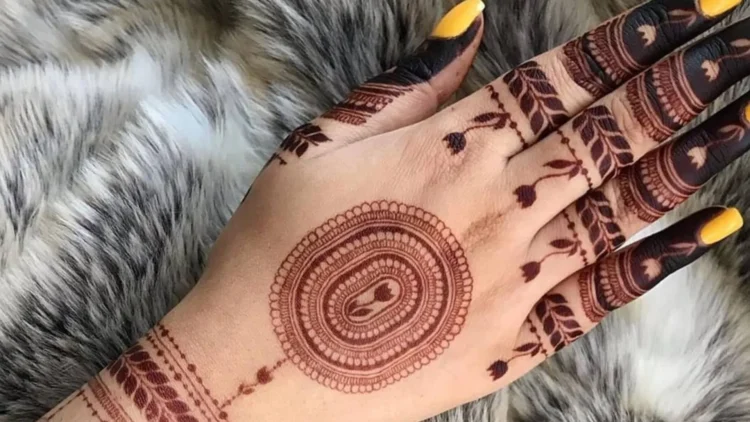
55. Oval medallion with leaf bands. An oval medallion with a tulip in the middle sits low on the hand, a chain bracelet hangs from the wrist and the fingers carry leaf bands with dipped tips.

56. Crossed hands with mandalas. Each hand has a mandala with an open centre, one wrist carries a wide band of leaves and lines, and all fingers are banded down to the tips.

57. Mandala with glossy accents. Rings of small circles and leaves surround a target centre, with a few large glossy dots set into the pattern. The fingers repeat bands and leaf tips.

58. Flower medallion with a scale cuff. The mandala is shaped like a big flower with a round centre, and a cuff of scale shapes covers the wrist. A neat choice for Eid.

59. Mandala with a leaf trail. A dotted mandala around a glossy round centre ends in a leaf trail toward the wrist. The fingers carry thick bands and one leaf spray.
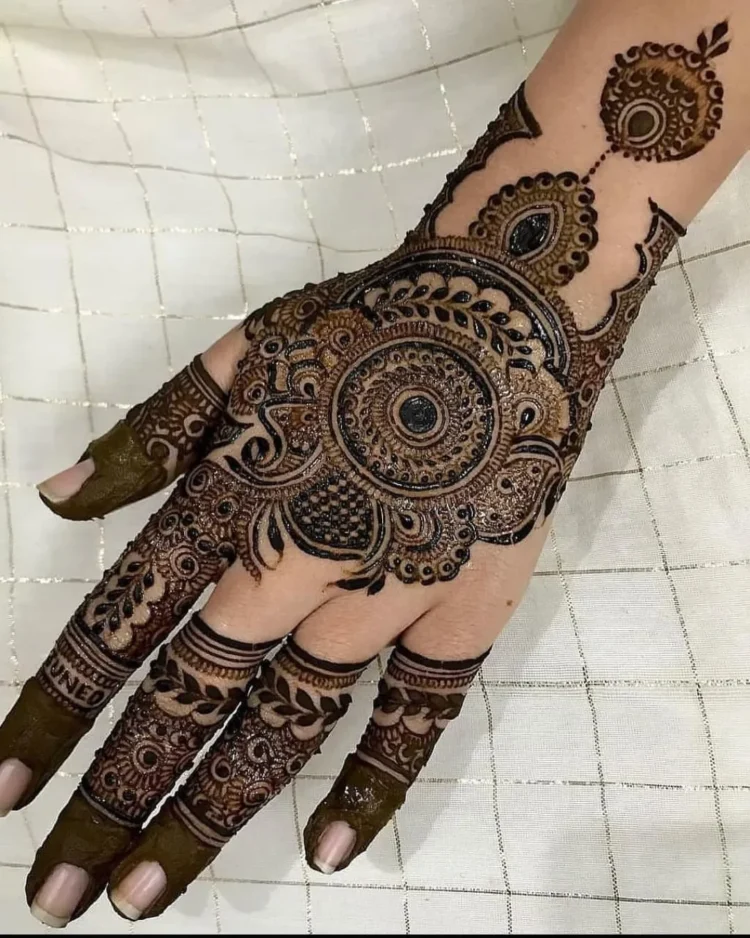
60. Bold dark mandala with a wrist drop. A very dark mandala with a ring of leaves fills the hand, a drop motif sits at the wrist and the fingers are banded with dipped tips. The paste is still on in this photo.
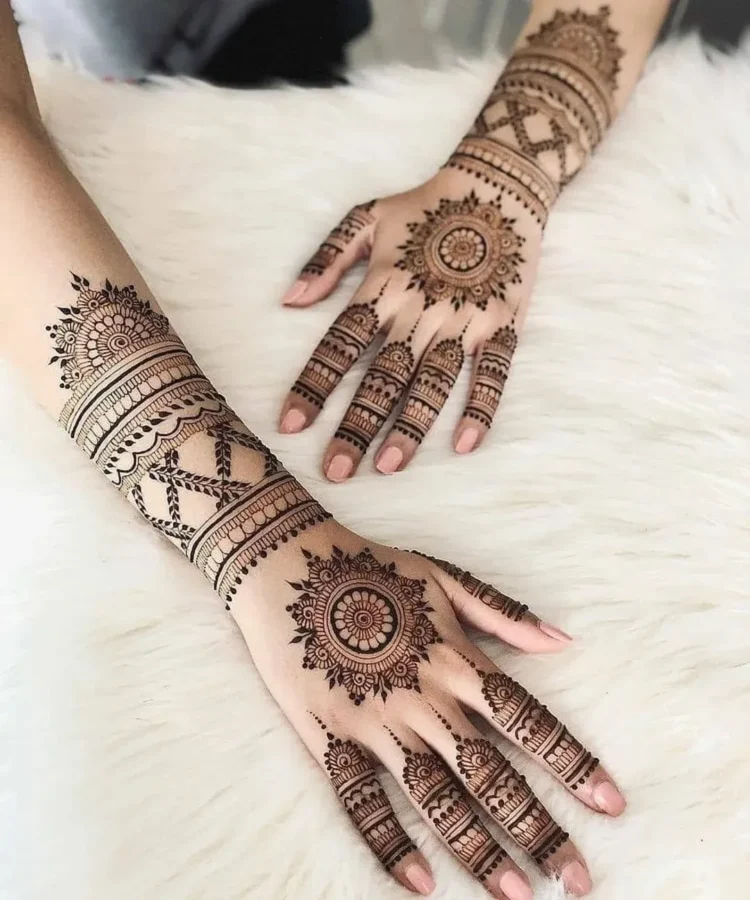
61. Mandala with a geometric forearm cuff. A sun-like mandala sits on each hand, and one forearm carries a wide cuff of crossed bands and lace. The fingers are filled with fine bands.
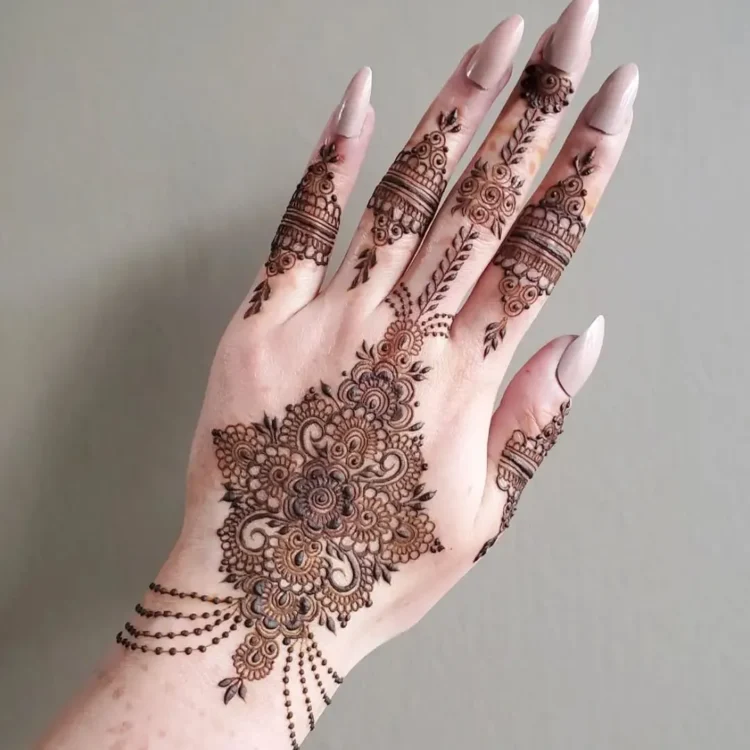
62. Floral medallion with bead strings. A floral medallion sits in the middle of the hand with strings of beads hanging from it toward the wrist. The fingers carry slim bands and leaf sprigs.

63. Maroon mandalas with a half circle. Round mandalas sit on the hand and wrist, a half circle frames the outer edge and one finger carries net. The deep maroon shows a well developed stain.

64. Checkered disc and diamond. A checkered disc sits at the wrist, a diamond motif on the hand and a large curved motif on the side, with patterned bands on every finger.

65. Flower mandalas with bead chains. Flower mandalas with a square centre sit on both hands, and bead chains loop toward the wrist. The fingers carry bands in a warm orange stain.
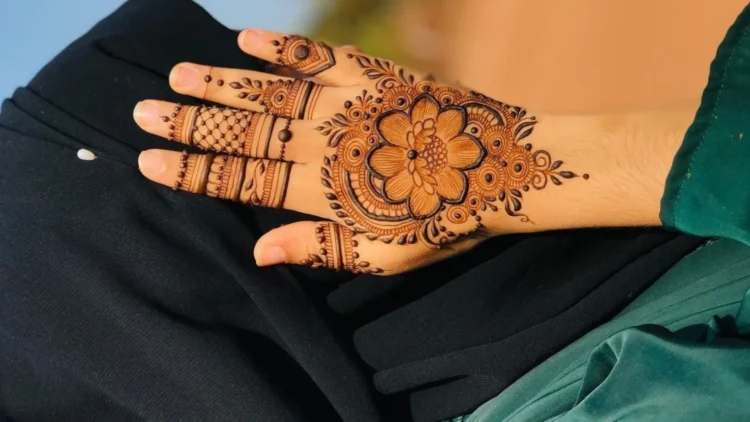
66. Lotus flower medallion. A large lotus with layered petals sits inside a scalloped round frame near the wrist, and the fingers carry a mix of net and bands.
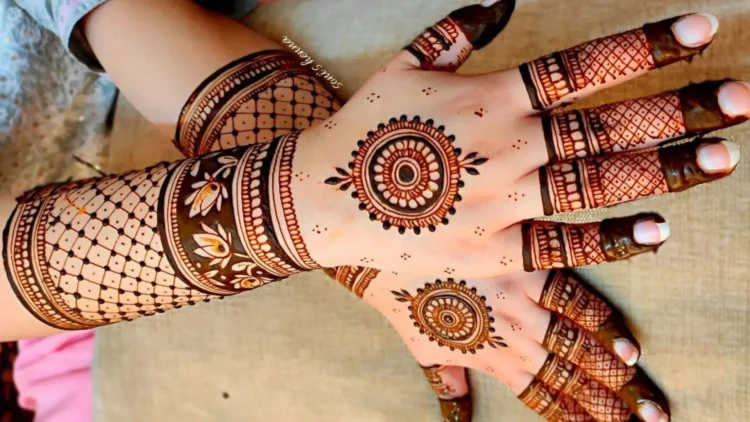
67. Small mandala with a lattice cuff. A small mandala sits alone in the middle of the hand, while a wide cuff of lattice and lotus bands covers the wrist. The fingers carry net and dark tips, so the bare skin around the mandala stands out.
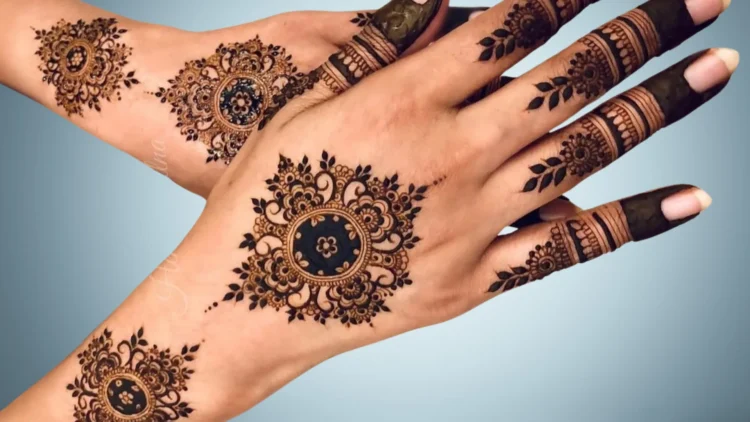
68. Dark centre mandalas in a trail. Floral mandalas with solid dark centres sit on the hand and wrist of both hands, and the fingers carry leaf sprigs, bands and dark tips.
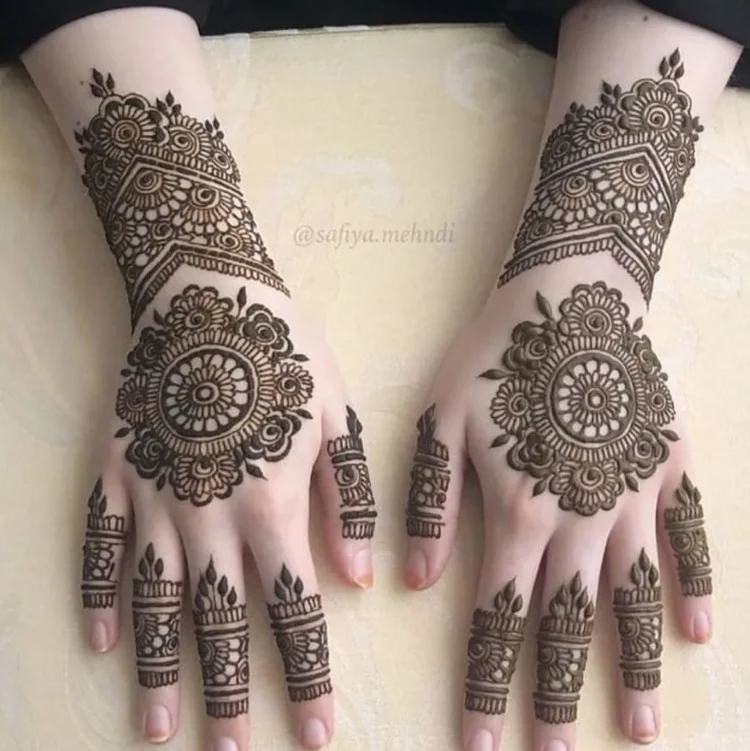
69. Matching mandalas with a chevron cuff. Both hands carry the same mandala with a flower centre, under a chevron cuff of flowers on the wrist. The fingers have stacked bands topped with small leaf points.
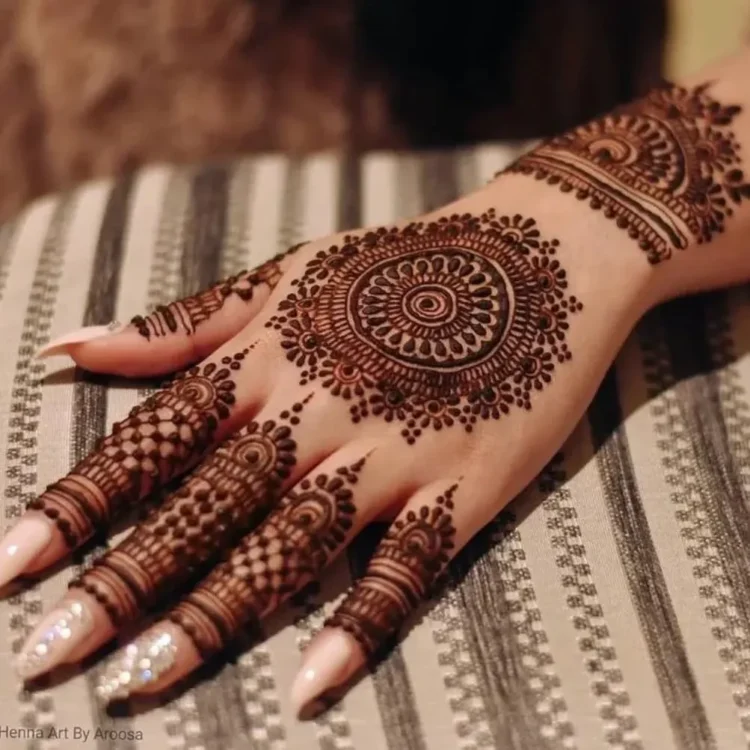
70. Mandala with checkered fingers. A large mandala with rings of dots fills the middle of the hand, a half circle and bands sit on the wrist and several fingers are filled with checks.
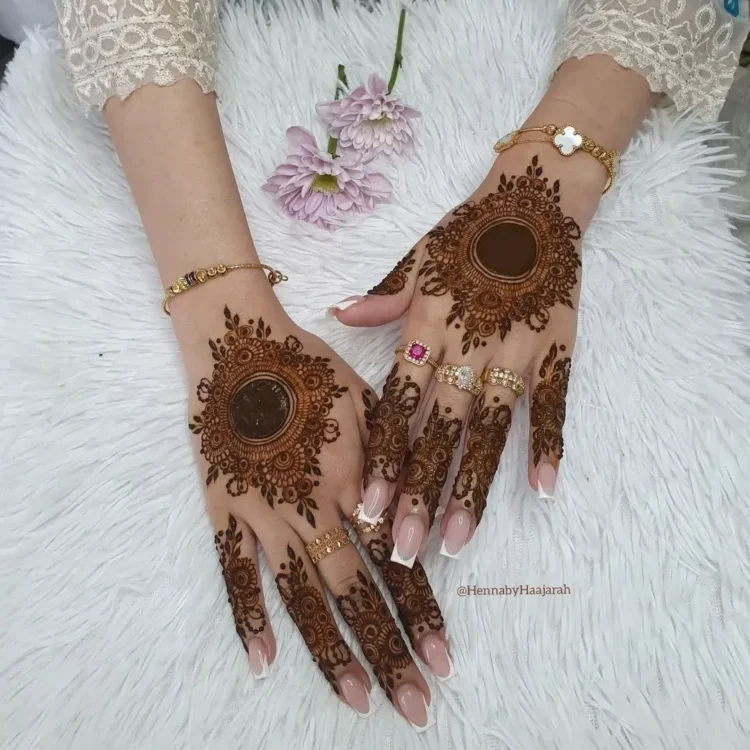
71. Solid disc mandalas. Each hand has a solid filled disc ringed by small flowers and leaves, and the fingers carry floral bands. The dark disc needs an even, thick layer of paste.
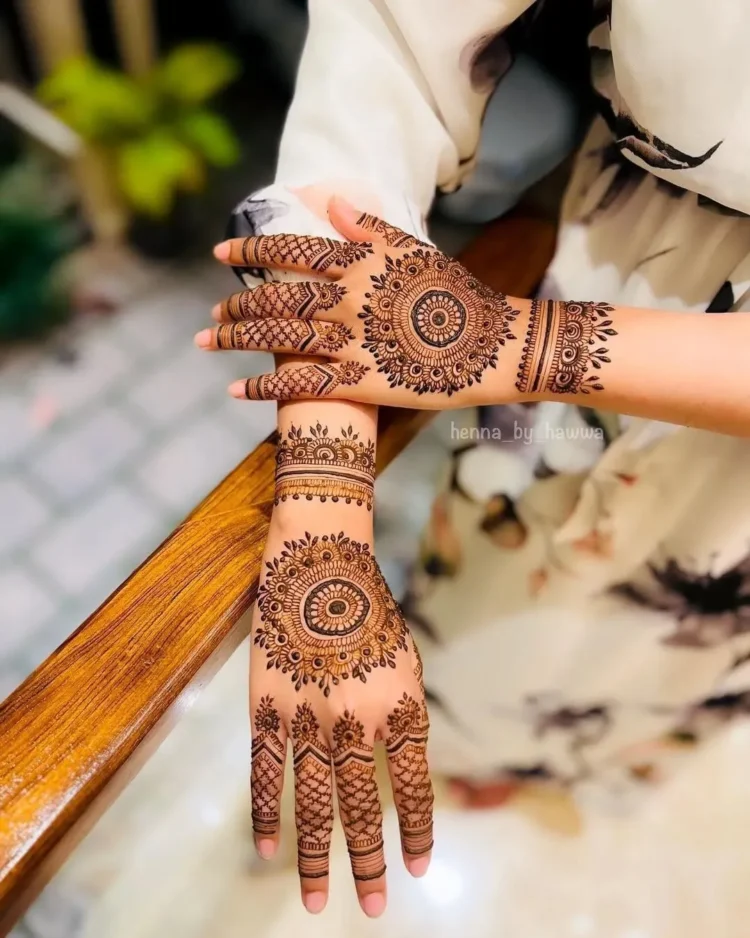
72. Twin mandalas with net fingers. A mandala with many rings sits on each hand, the wrists carry bands and the fingers are filled with net and zigzag lines. Both hands match.
Jewellery Style Mehndi Back Hand Designs
These designs copy jewellery: a haath phool (hand chain) linking a ring to a bracelet, dangling beads, or lace that hangs like a pendant. They look best with long, slim fingers and leave plenty of bare skin, so they read clearly in photos. Pair them with a wrist band from our bracelet mehndi designs.
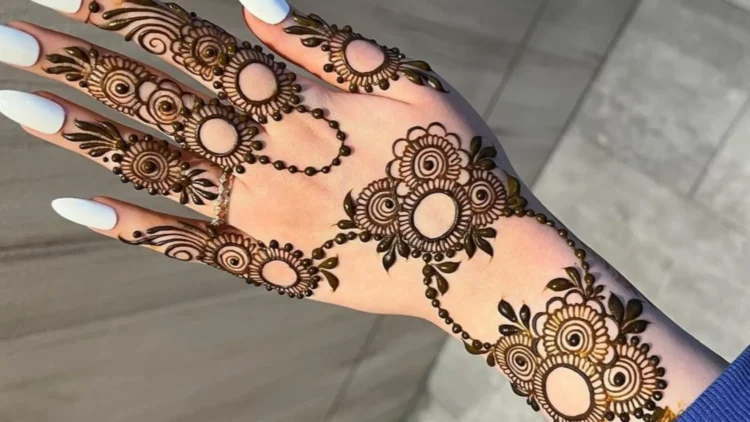
73. Linked open mandalas. Several mandalas with bare centres are joined by bead chains from the wrist to the fingers, like a haath phool. Rings of the same motif sit on the fingers.
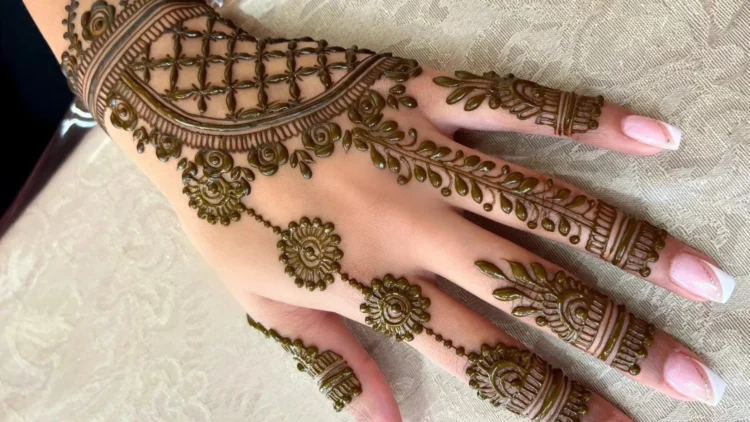
74. Lattice dome with a mandala chain. A half dome filled with lattice sits on the wrist, and a chain of three small mandalas drops toward the ring finger. A leafy bel runs along the index finger.
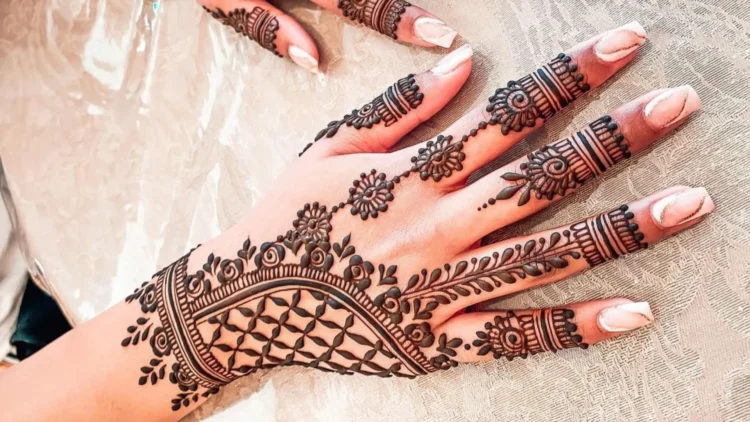
75. Lattice arch with flower links. A wide arch of lattice sits on the side of the wrist, and small flowers linked by dots climb the middle finger. The other fingers carry banded caps.
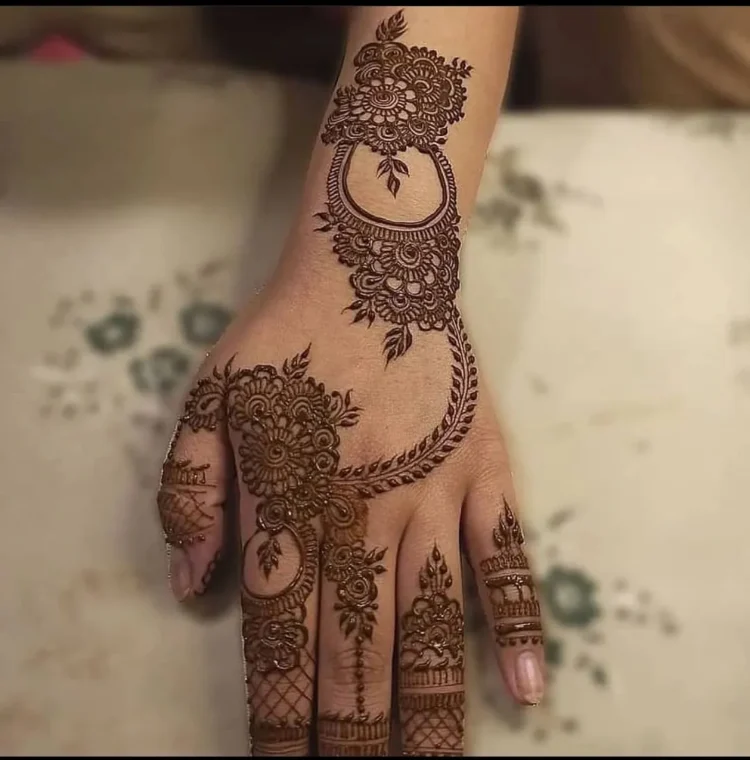
76. Crescent pendant with a curling chain. A crescent hangs below a floral cluster on the wrist, and a curling chain leads down to a floral patch on the fingers. Net fills one fingertip.
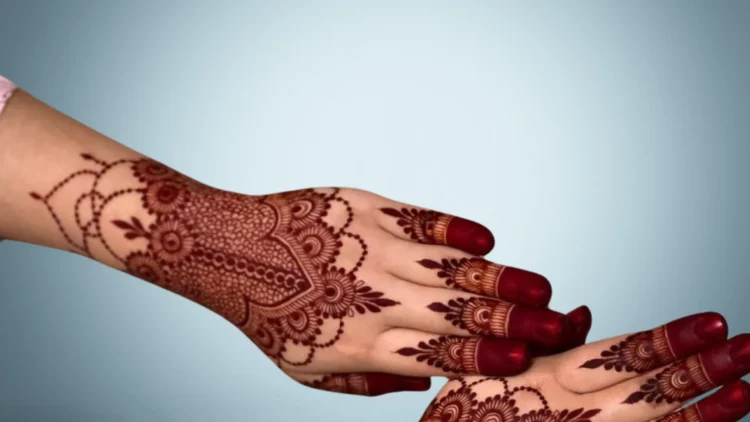
77. Lace pendant with dotted loops. A lace pendant hangs from the wrist toward the knuckles, edged with loops of dots, and the fingers end in dark dipped tips. The deep red-brown stain makes the lace stand out.
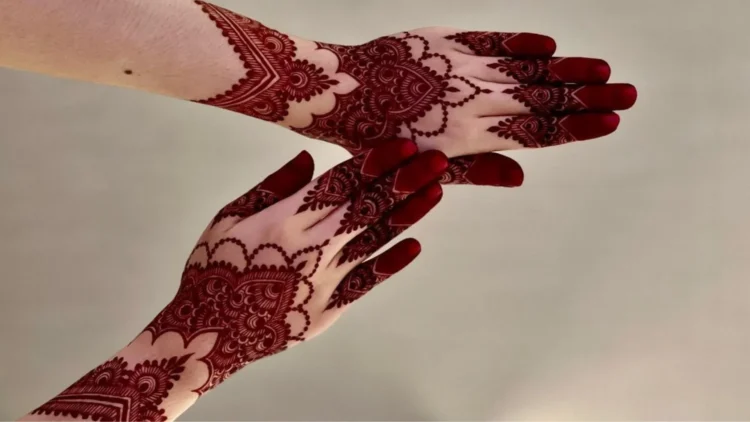
78. V lace with dipped tips. A V-shaped lace band frames each wrist, a small lace drop sits on the hand and the fingertips are dipped in a deep maroon stain.
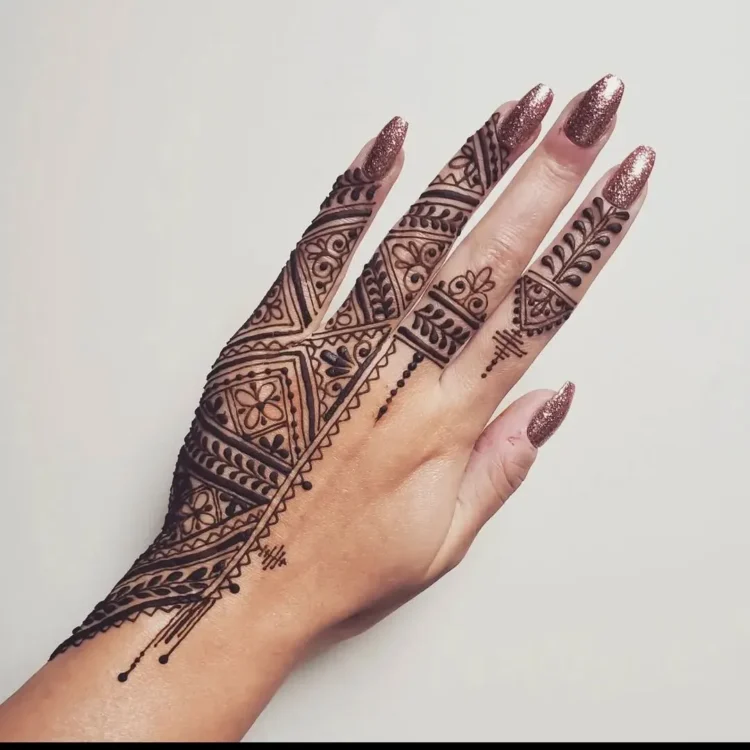
79. Geometric blocks with dangling beads. Triangles and diamonds filled with leaves run along the outer edge, and short bead strings dangle at the wrist. A clean, modern look with lots of bare skin.
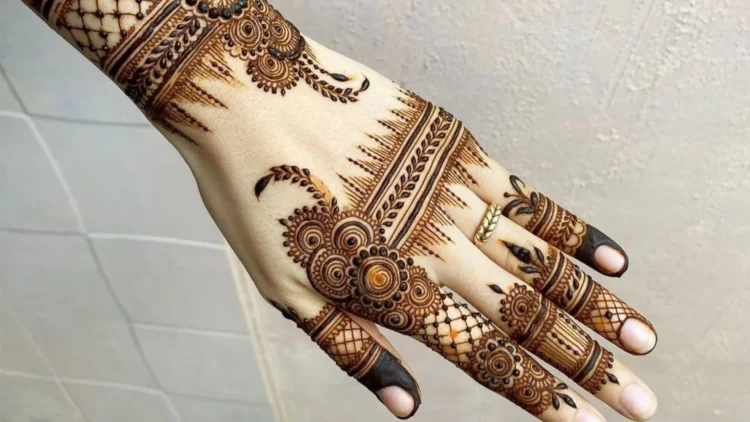
80. Fringe bands with a mandala. Bands with a fringe edge cross the hand like a bracelet, a small mandala sits by the knuckle and the fingers carry net and dark tips.
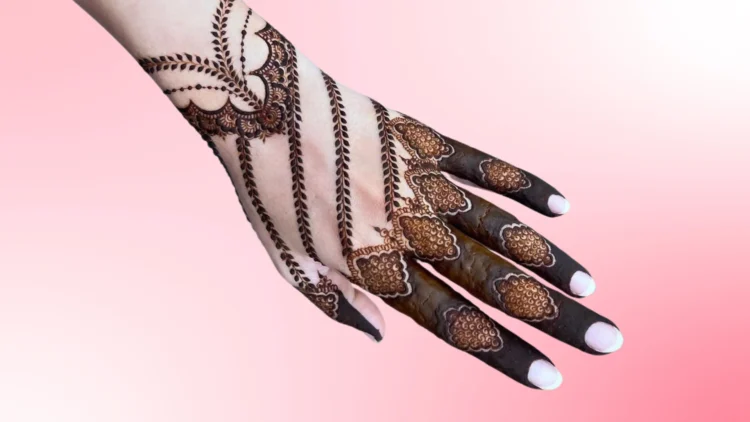
81. Diagonal bead strings. Lines of beads run diagonally from a lace edge at the wrist to the fingers, which are filled with small lace motifs and dark tips.
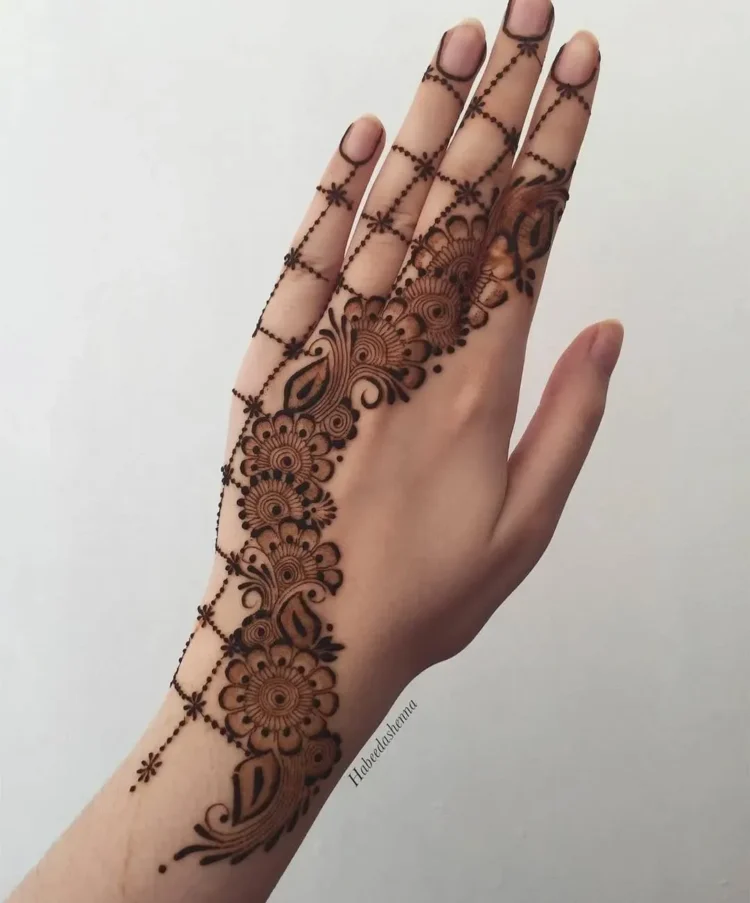
82. Bead grid haath phool. Chains of beads form a grid over the fingers, linked to a column of flowers and paisleys along the outer edge of the hand. A bead line drops below the wrist.
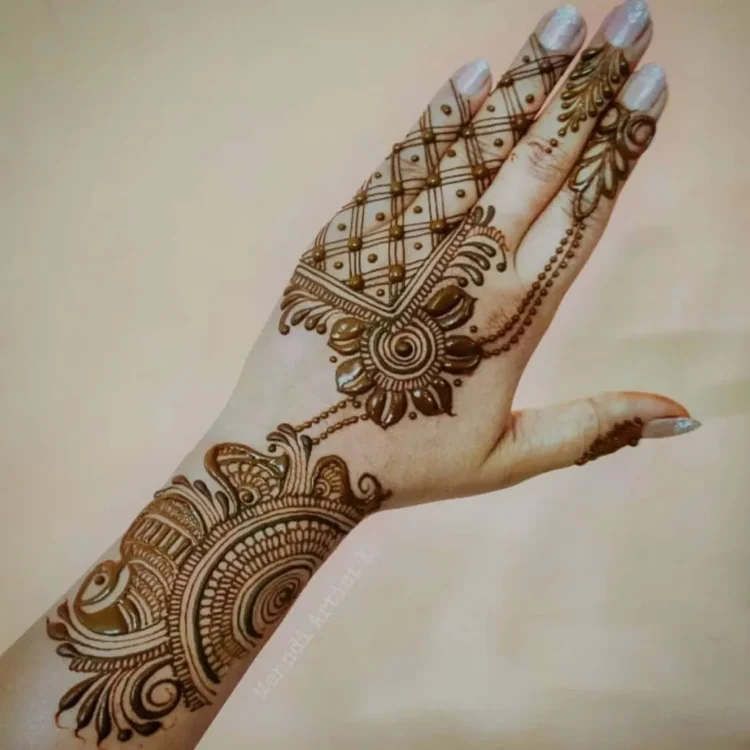
83. Lattice finger panel with a bead chain. A lattice panel covers two fingers and ends in a V above a round flower, and a bead chain links it to a paisley at the wrist. The rest of the hand is bare.

84. Cage lines with a wrist mandala. Straight lines form an open cage over the hand like a hand chain, lace covers the finger joints and a small mandala sits on the wrist.

85. Arch jaal with a finger chain. An arch shaped panel of fine jaal sits above a band on each wrist, and a dotted chain with small motifs runs up the middle finger to a ring.
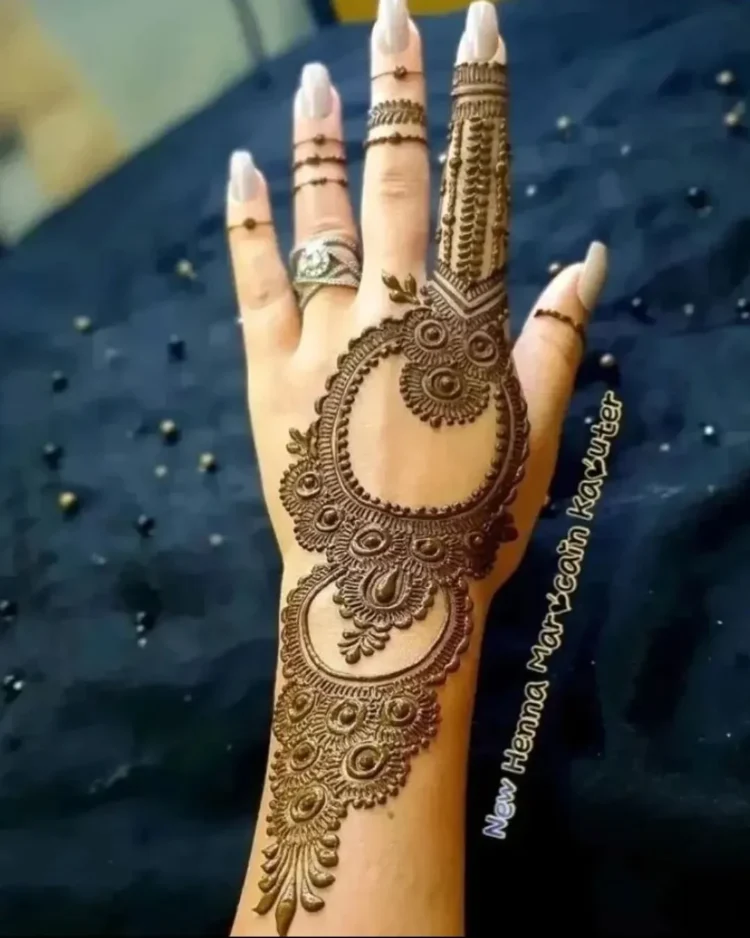
86. Crescent loop with paisley drops. A large crescent curve sits on the hand with paisley drops hanging in a column to the wrist, like a pendant. Fine bands mark the fingers and one finger is filled along its length.
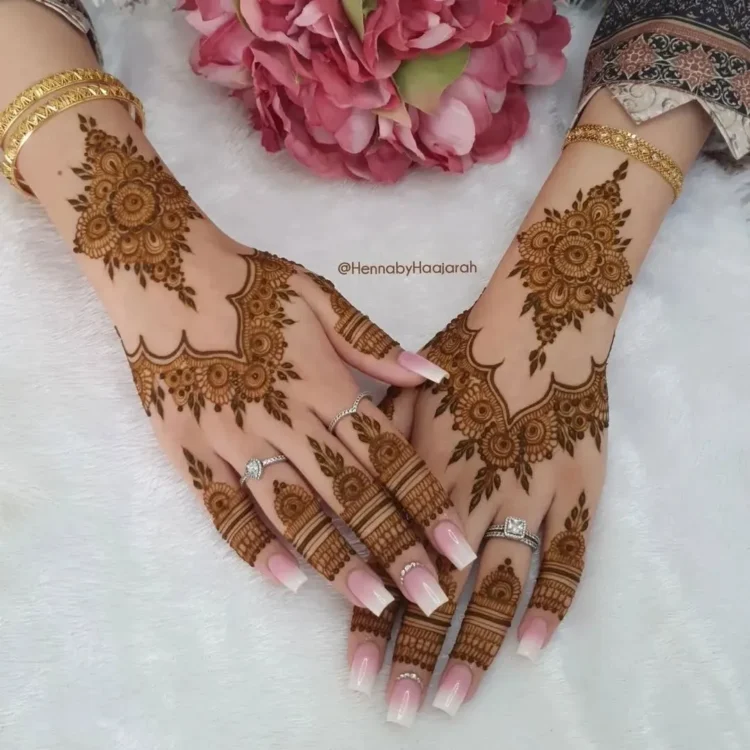
87. Scalloped lace with wrist medallions. A floral medallion sits on each wrist and a scalloped lace edge hangs below it across the hand. The fingers carry bands with small floral caps, leaving a clear gap of skin in the middle.
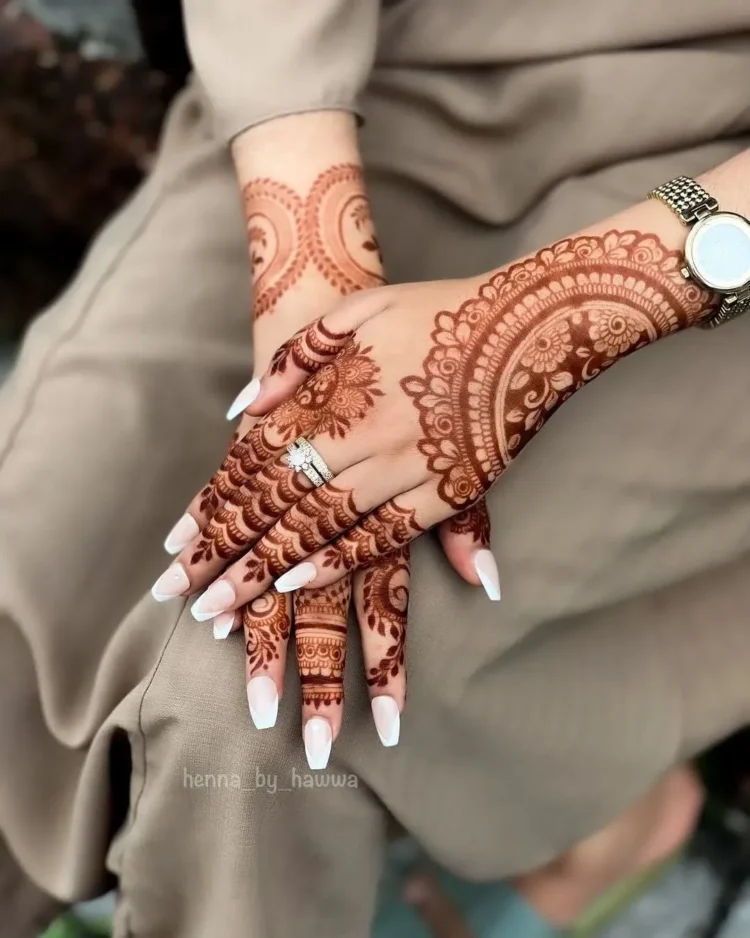
88. Half circle lace at the wrist. A half circle of lace and flowers sits on the outer wrist like a cuff, a small flower marks the knuckle and the fingers carry layered scallops. The red brown stain shows the fine lines clearly.
Geometric and Jaal Back Hand Mehndi Designs
Geometric back hand mehndi uses straight lines: chevrons, diamonds, lattice and jaal (a net of crossing lines). This is the modern back hand mehndi design style most often seen on Instagram, and it hides small mistakes because the eye reads the grid, not each line. A good test of a steady hand before you try bridal work.
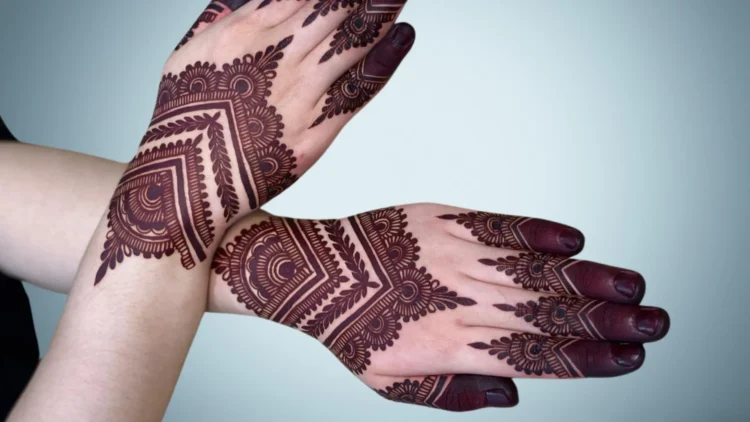
89. Chevron triangle with dipped fingers. Layered chevrons point from the wrist to the knuckles inside a triangle with a lace edge, and the fingertips are dipped dark. Both hands match.
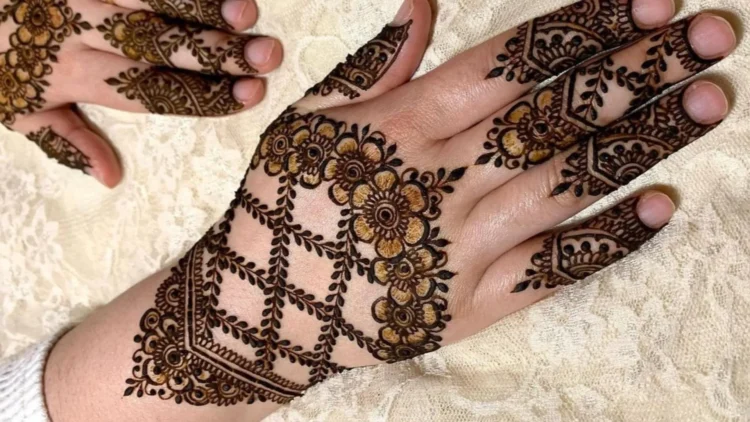
90. Leafy lattice with flowers. Diagonal lines of tiny leaves form a lattice across the hand, framed by a border of round flowers on one side.
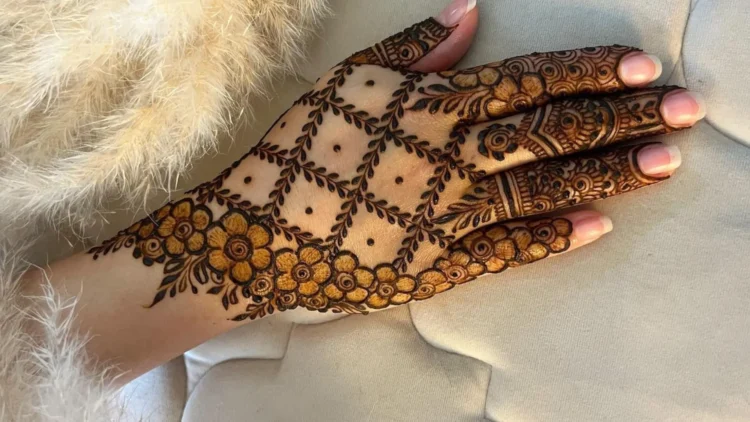
91. Dotted lattice with a flower border. Each square of a leafy lattice holds a single dot, and a row of shaded flowers lines the wrist. The fingers are filled with small mandalas.
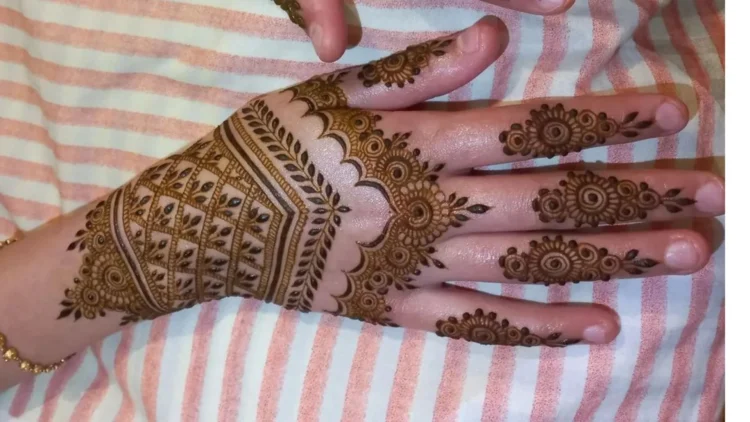
92. Leaf chevron cuff. A chevron cuff filled with small leaves covers the wrist and ends in a scalloped point. Round motifs with leaves sit on each finger.
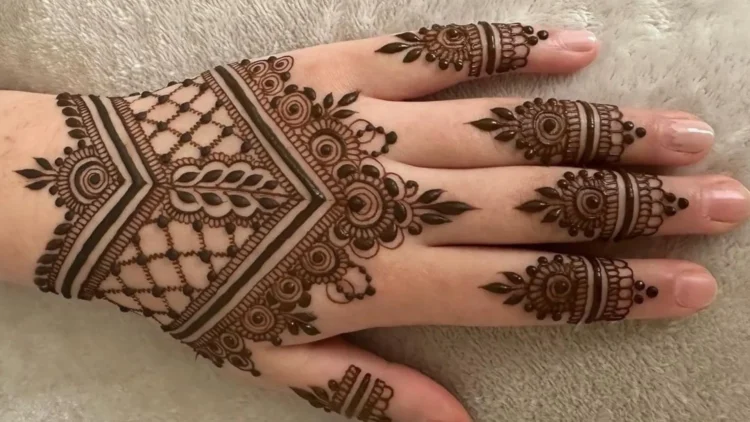
93. V net cuff with a leaf. A V-shaped cuff of net holds one leaf in the middle, and the fingers carry round motifs with bands. Similar to the leaf chevron but with open net.
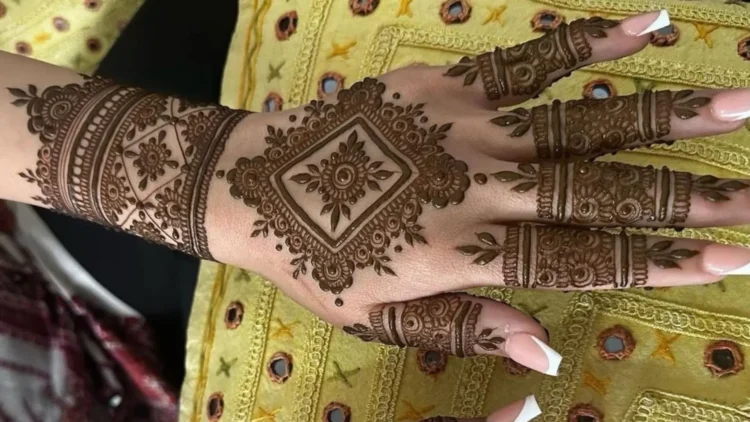
94. Diamond centre with a wrist cuff. A large diamond with a flower inside sits in the middle of the hand, a patterned cuff covers the wrist and the fingers carry wide bands.
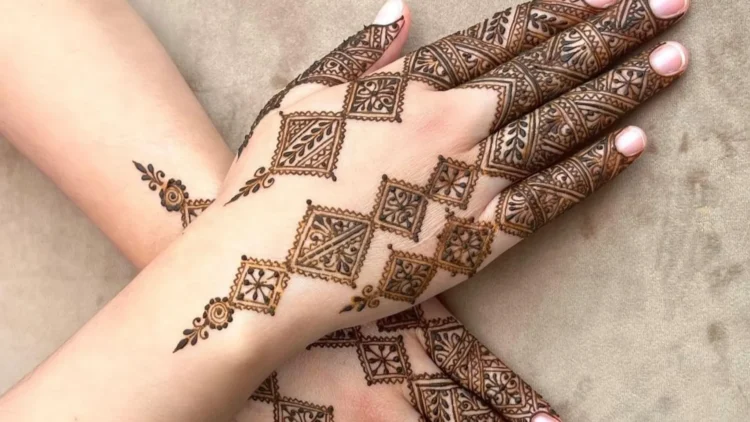
95. Diamond chain across the hand. A row of diamonds, each with a different fill, crosses the hand diagonally. The fingers are covered in fine geometric bands.
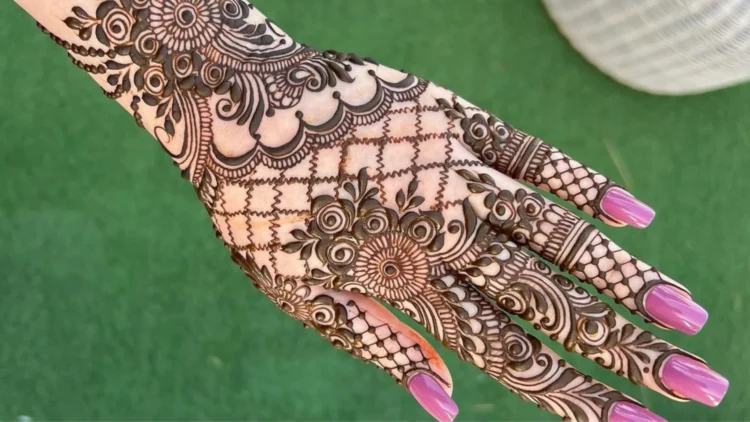
96. Jaal with a lace arch. Diamond jaal fills the hand under a scalloped lace arch, with a flower in the middle and net on several fingers.
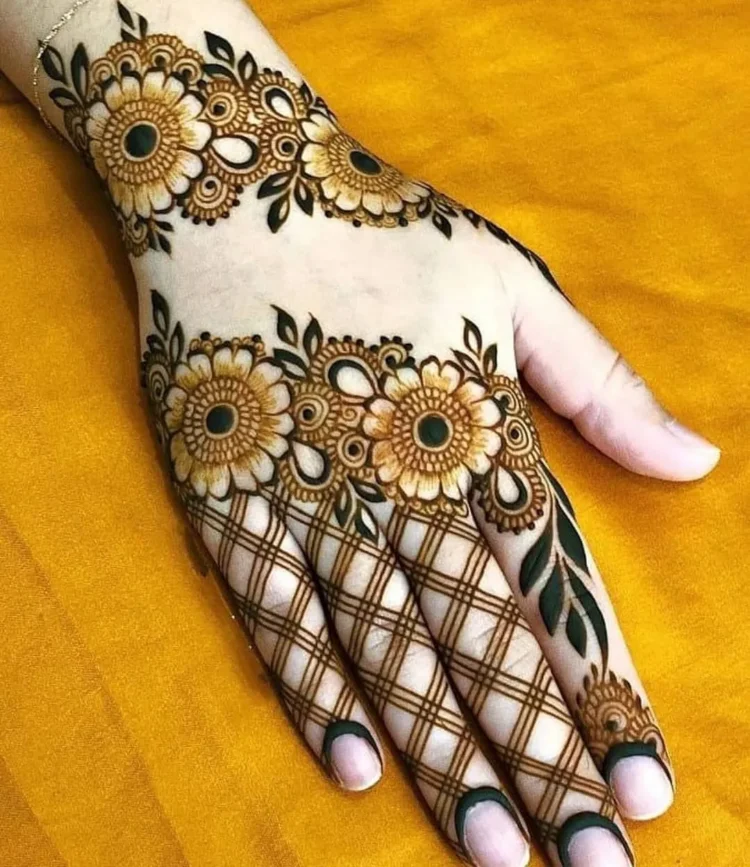
97. Sunflowers with criss-cross fingers. A row of sunflowers with dark centres crosses the hand, the fingers are covered in criss-cross lattice and each nail is outlined by a crescent.
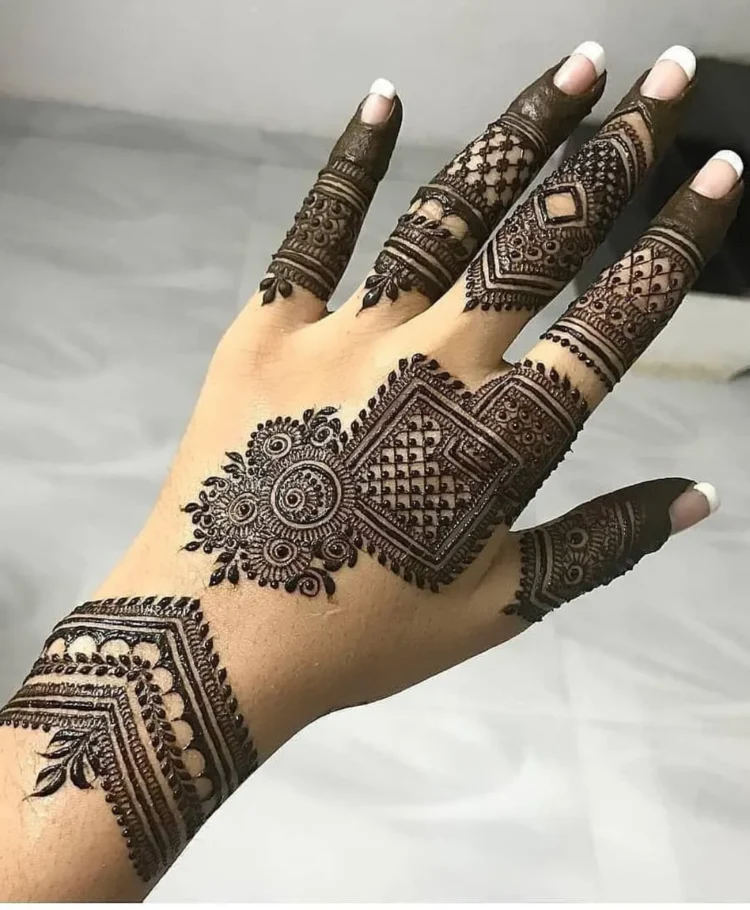
98. Mandala beside a diamond grid. A mandala is joined to a block of diamond grid, a chevron cuff sits at the wrist and each finger has a different geometric fill.

99. Layered chevron with roses. Layered chevrons point toward the fingers above a band of roses on the wrist. Scalloped bands on the fingers end in dipped tips.
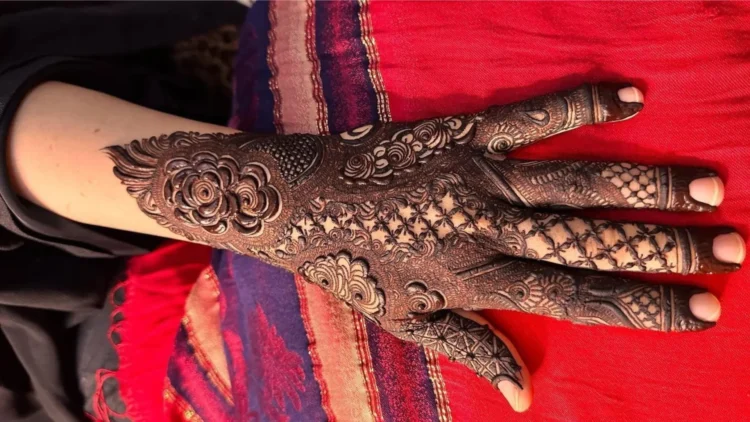
100. Roses and jaal on a full hand. Roses fill the wrist, a jaal of crosses covers the hand and the fingers carry net, in a dark stain that covers the whole back hand.
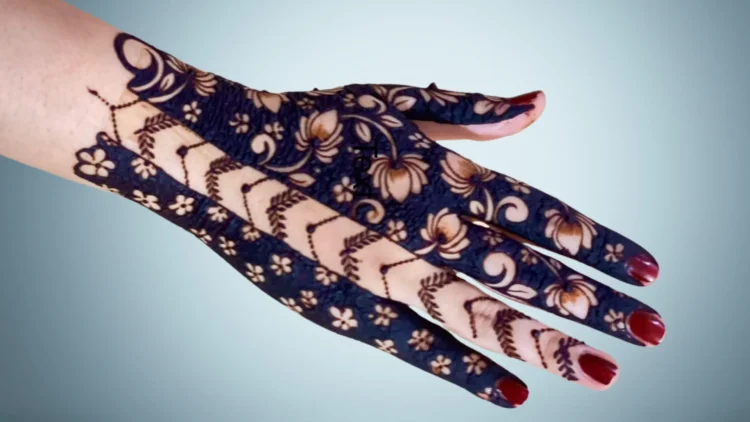
101. Floral stripes. Filled stripes with bare-skin flowers alternate with open stripes of leaf chevrons. The very dark colour in this photo makes the negative-space flowers stand out.
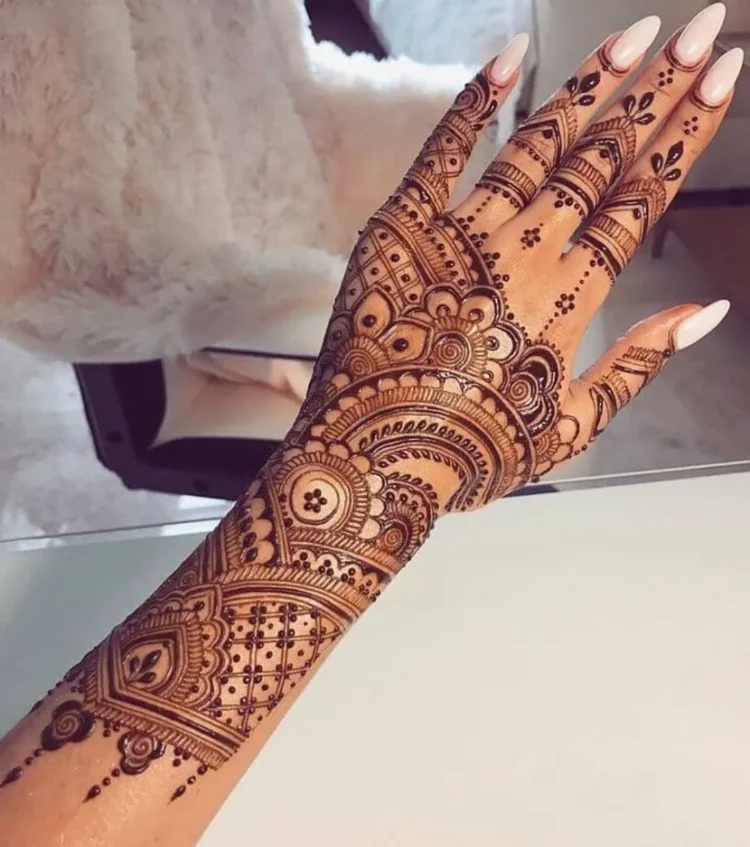
102. Lace arcs from forearm to fingers. Rows of fine lace arcs with dotted fill rise from the forearm to the knuckles, and the fingers carry matching small arches.
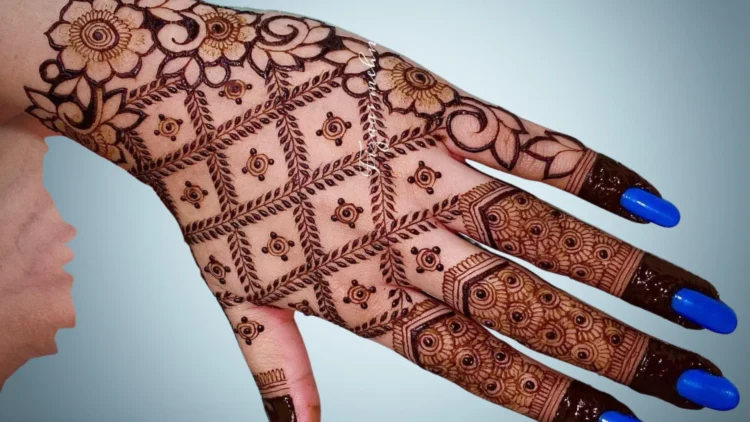
103. Leafy grid with dot motifs. A grid of leafy lines holds a small dot motif in every square, with a border of flowers along the edge and circle patterns filling the fingers to dipped tips.
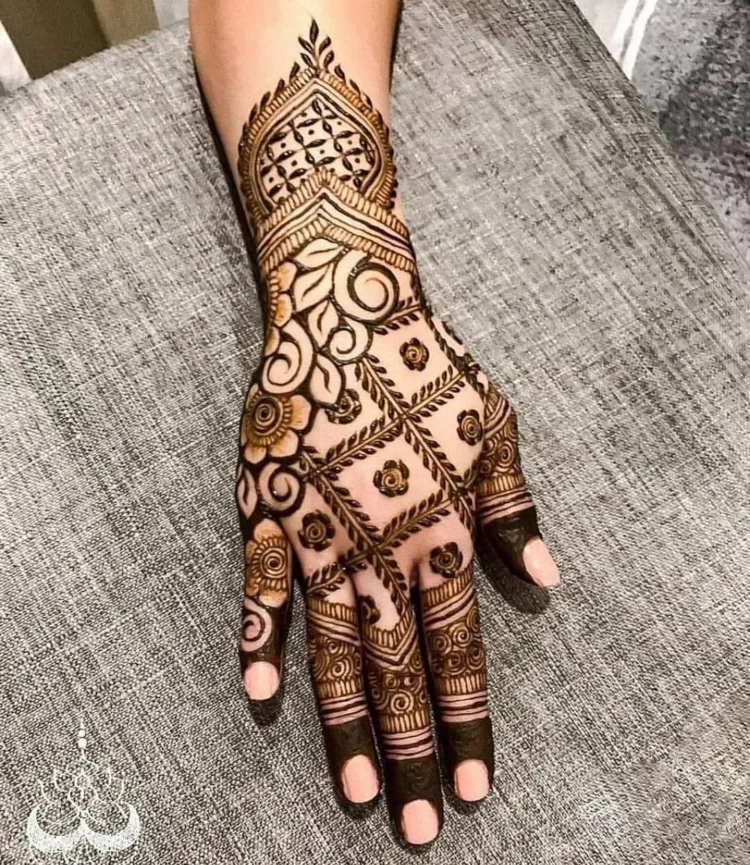
104. Rose lattice with a pointed crown. A leafy lattice holds small roses in its squares, a pointed lattice crown rises up the wrist and the fingertips are dipped.
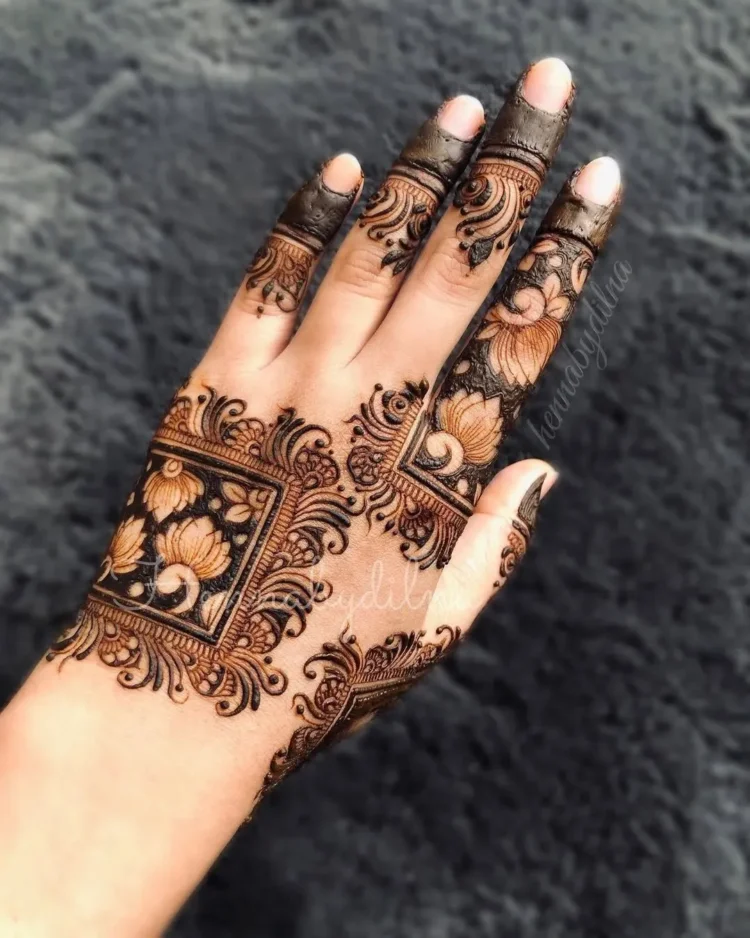
105. Square frame with lotus. A square frame filled with shaded lotus flowers sits at the base of the hand, with a second smaller frame beside it. The fingers carry lotus motifs and dipped tips.
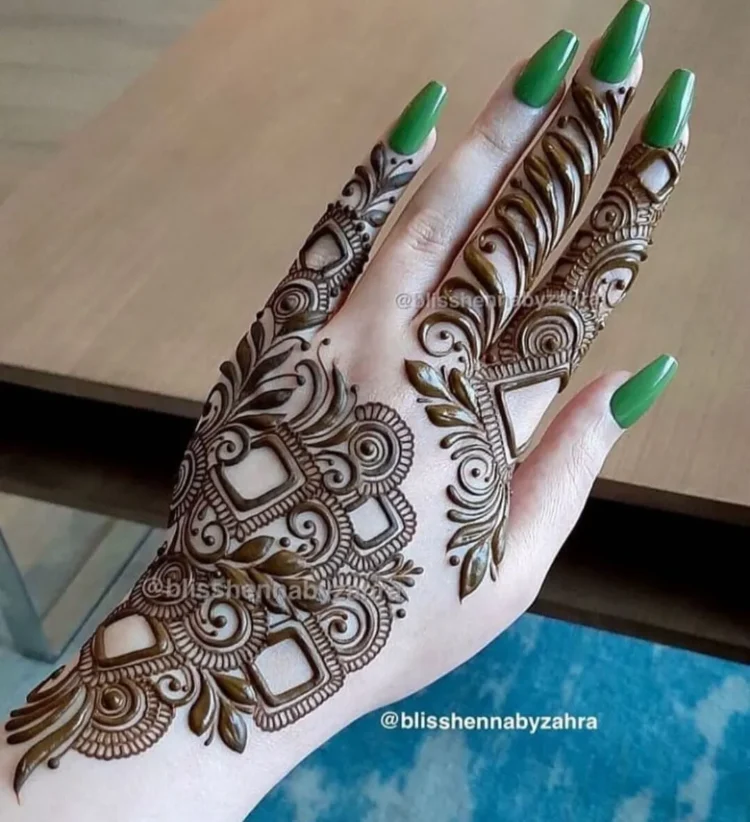
106. Bare squares with swirls. Square and triangle shapes are left as bare skin and framed with swirls and bold leaves along the side of the hand. The open shapes give a modern look.
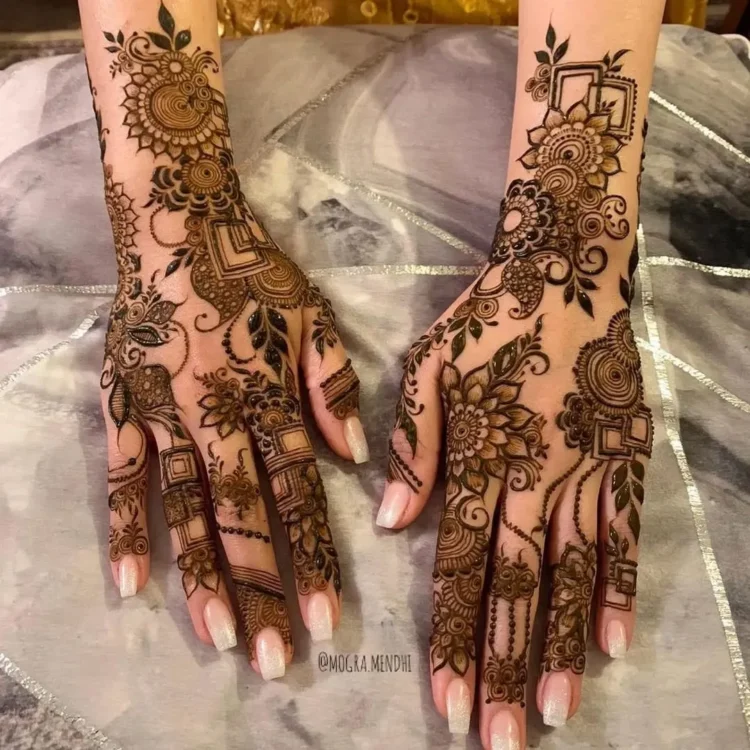
107. Florals with square outlines. Round flowers and leaves are set between outlined squares that repeat on the hand and fingers of both hands. The straight frames break up the curved florals.
Back Full Hand Bridal Mehndi Designs
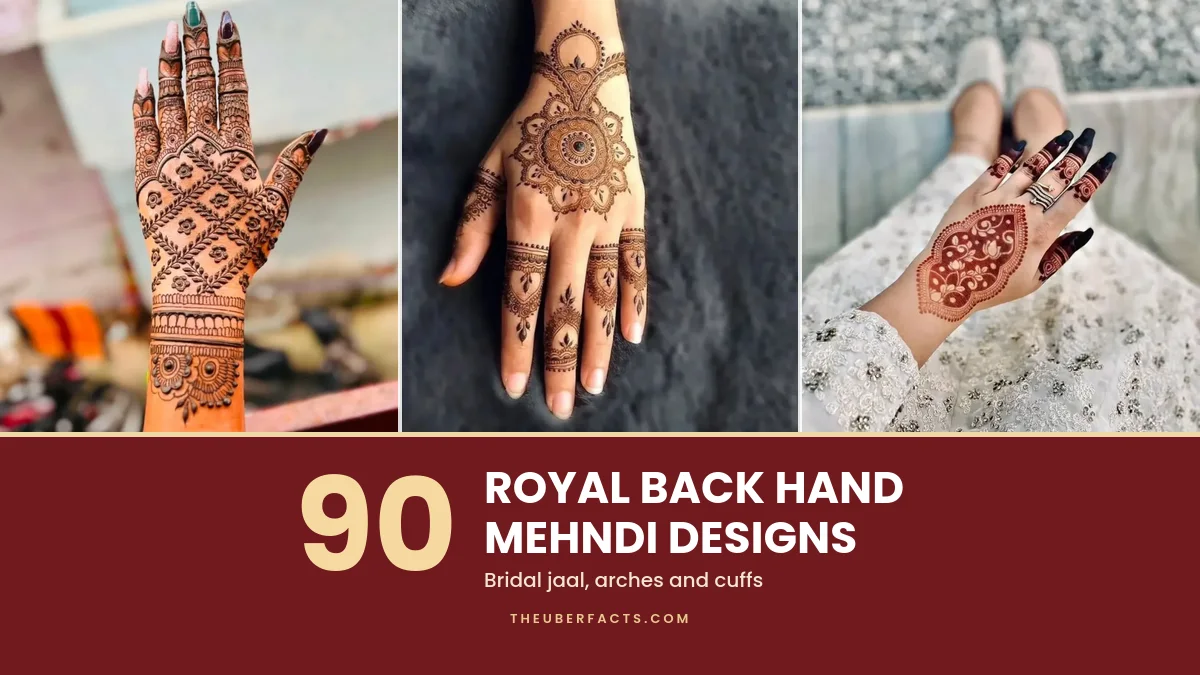
For a bride the back of the hand is covered from the fingertips to the forearm or elbow, with almost no bare skin. A back full hand bridal mehndi design for both hands takes several hours and is usually applied one or two days before the wedding, so that the stain is at its darkest on the day. See our full hand mehndi designs for the palm side, and royal back hand mehndi designs for heavier traditional work.
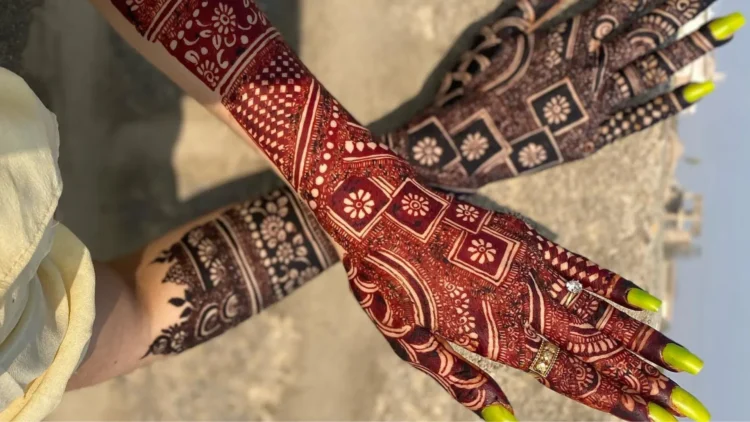
108. Red geometric squares to the forearm. Squares with flowers and stripes cover the hand and forearm in a bright red stain, set against a darker second hand. Bold blocks read well from a distance.
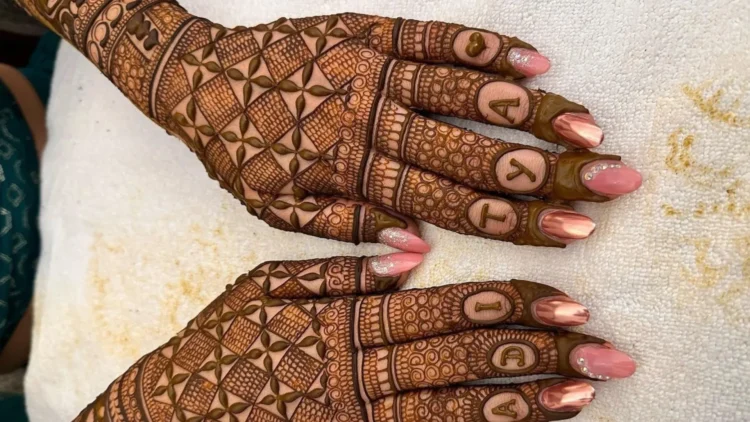
109. Initials on the fingertips. Both hands are filled with geometric panels, and the fingertips carry letters in small circles. Initials hidden in this way are a popular bridal detail.
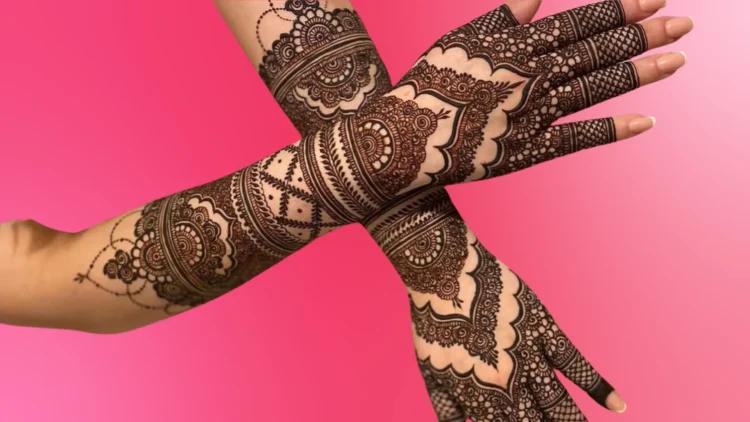
110. Crossed hands with lace and net. Lace scallops, mandalas and bands cover both hands and forearms, and the fingers are filled with fine net. Shown crossed, as brides often pose.
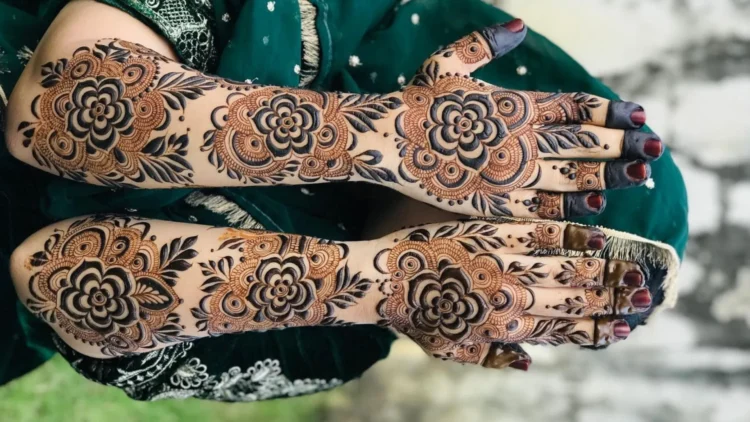
111. Large roses to the elbow. Large open roses are repeated from the knuckles to the elbow on both arms, with leaves filling the gaps. The repeat keeps a long design even.
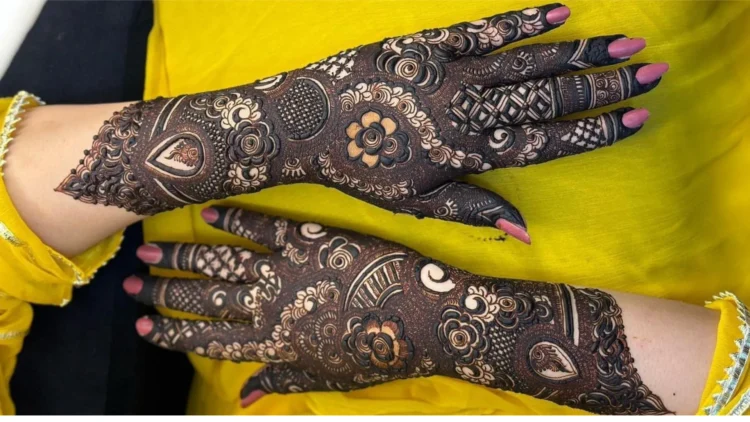
112. Dark mixed panels. Flowers, checkered blocks and paisleys are packed into panels on both hands. The stain is a very dark brown with hardly any skin left showing.
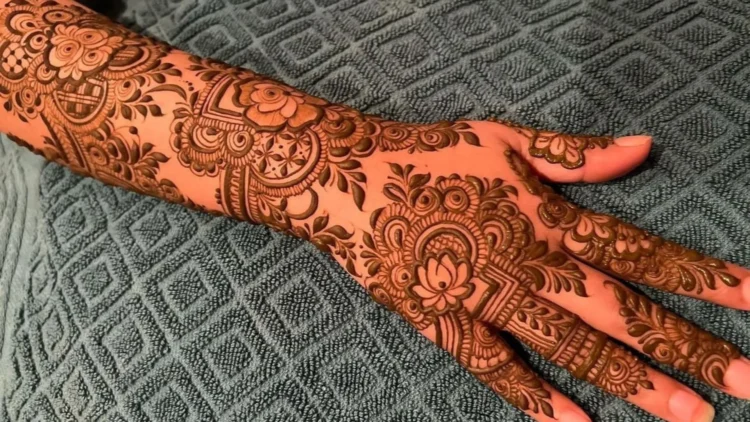
113. Orange lotus forearm. A lotus, roses and leaves cover the hand and continue up the forearm. The bright orange shows a fresh stain that will turn red-brown over two days.

114. Net sleeve with florals. Flowers cover the back of the hand and a sleeve of net with flowers climbs the forearm. The second hand shows the same fill on the fingers.

115. Red bridal pair with dipped tips. Both hands are filled with dense patterns in a bright red stain, and the fingertips are dipped dark. Photographed outdoors, the colour looks almost orange-red.
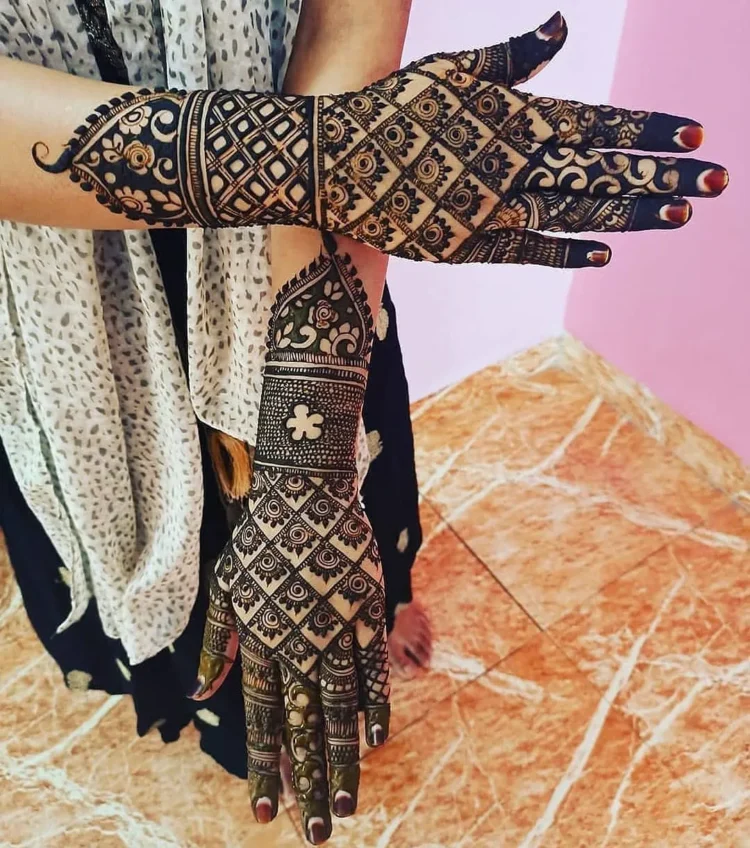
116. Dark diamond grid on both hands. A diamond grid fills both hands and forearms, broken by floral panels at the wrist. A near-black stain like this usually needs a long paste time.
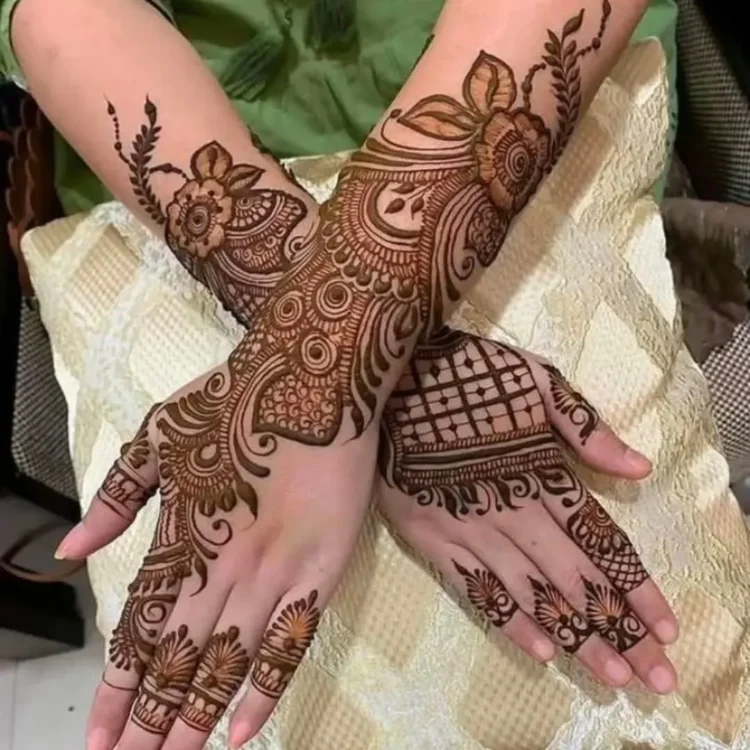
117. Rose at the wrist with lattice. A large rose opens at the wrist, a paisley column runs down one hand and the other hand carries lattice with leaf sprays.

118. Geometric bridal sleeve. Fine geometric grids and checks cover the hand and forearm, with a pointed crown of leaves at the top. Very detailed work for an experienced artist.

119. Red flower medallions. Each hand carries a large flower medallion with fine fill around it, and the design continues down the forearm. Dark fingertips finish the look.

120. Red diamond lattice. A diamond lattice with small motifs in each square covers both hands, ending in a row of roses at the wrist. Dipped fingertips are a deep maroon.

121. Dense geometric bands. Bands of triangles, diamonds and dots cover both hands to the fingertips, leaving almost no gap. The pattern is neat even when the hands rest in the lap.
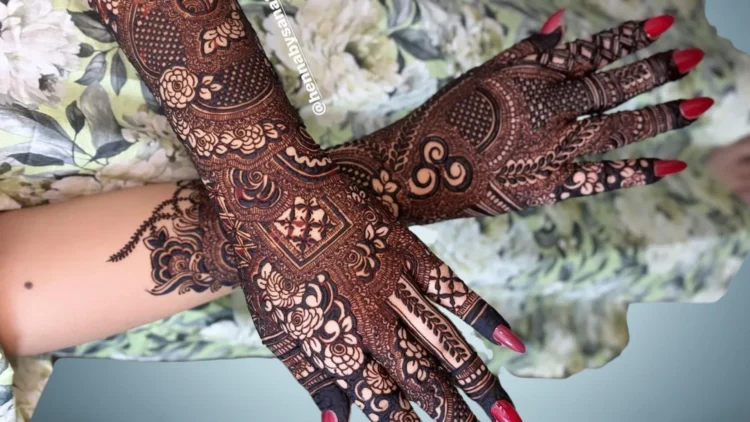
122. Bare skin roses on a dark sleeve. A dark fill covers the hand and forearm with roses left as bare skin, a diamond at the wrist and checks on the hand. The second hand is filled to the fingertips.
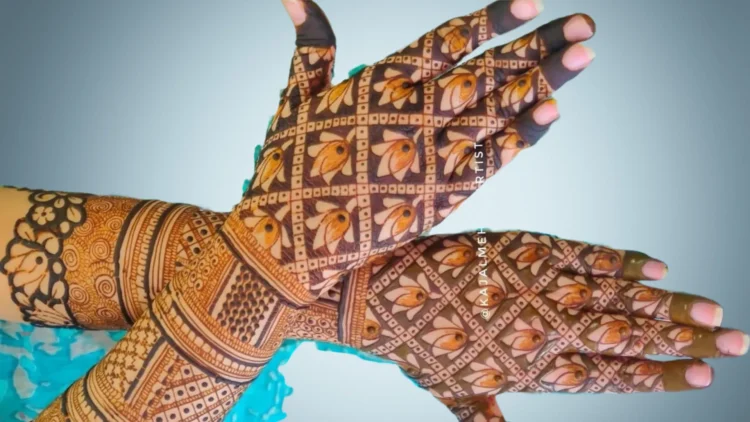
123. Bud diamonds on both arms. A diamond grid with a bud in every square covers both hands, and wide bands of fine fill continue up the forearms. The fingertips are dipped.

124. Sunflowers with leafy forearm panels. Large sunflowers sit on both hands, and the forearms are divided into panels of leaf lattice, flowers and bands. Fine lines fill the fingers.

125. Red lace triangle. A lace triangle points up from the wrist, a scalloped arch frames the hand and fine patterns fill every finger, all in a bright red stain.
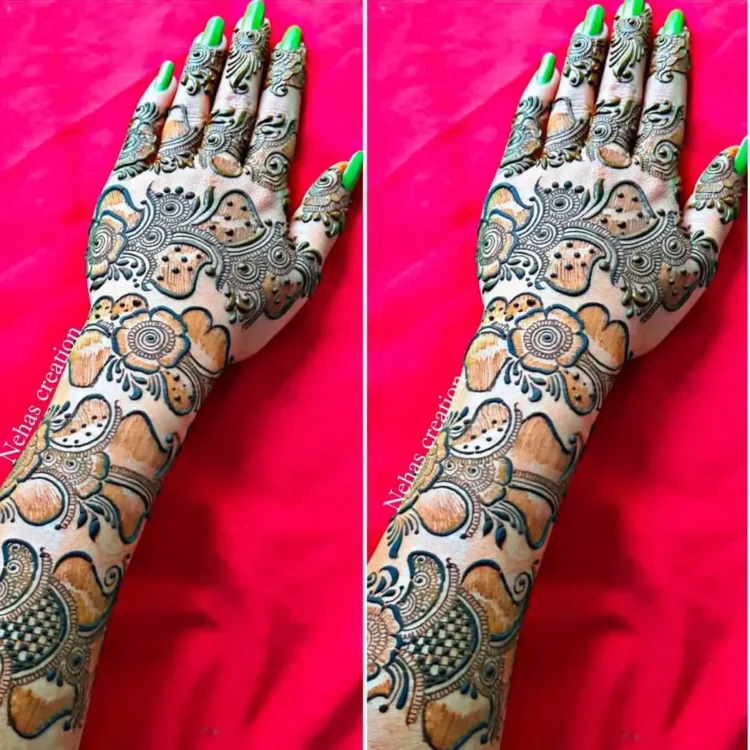
126. Full arm in two views. Two views of one arm covered from the fingers to the forearm with paisleys, roses and checks. Light shading inside the dark outlines gives each motif depth.
Indian and Pakistani Full Back Hand Mehndi Designs
Traditional Indian and Pakistani mehndi fills the whole back of the hand with paisleys, flowers, lace and fine fill lines, but stops at or just above the wrist. These designs suit a sister of the bride, mehndi night or Eid, when you want full coverage without a bridal sleeve. For the fingers alone, see our royal finger mehndi designs.
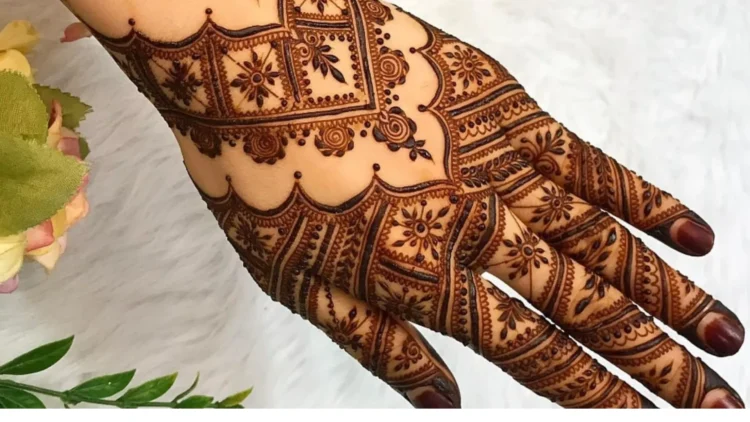
127. Lace crown with striped fingers. A scalloped lace crown with a diamond holds the wrist, and the fingers are filled with diagonal stripes and small flowers down to dark tips.
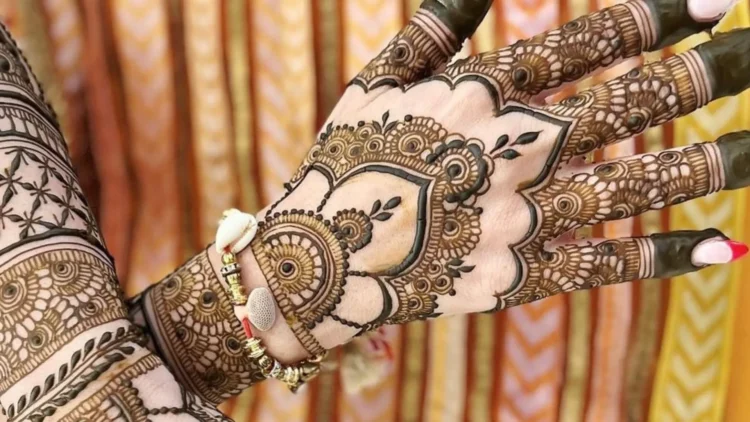
128. Dome arch with a paisley drop. An outlined dome arch frames a paisley drop and a mandala at the wrist. Fine circles fill the fingers, which end in dipped tips.
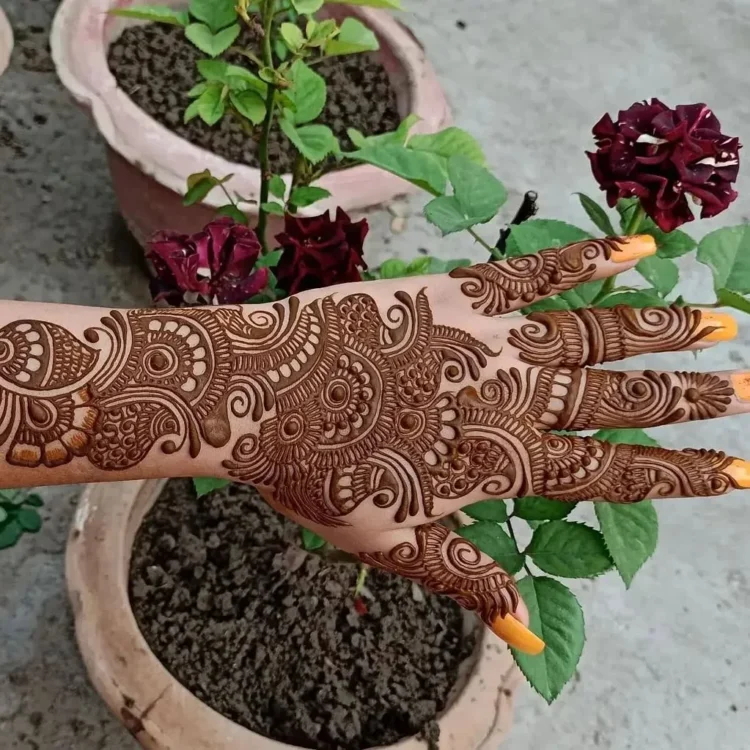
129. Dense paisley hand. Paisleys, flowers and fine fill lines cover the whole back of the hand in the traditional Indian manner. The red-brown stain is even across the dense work.
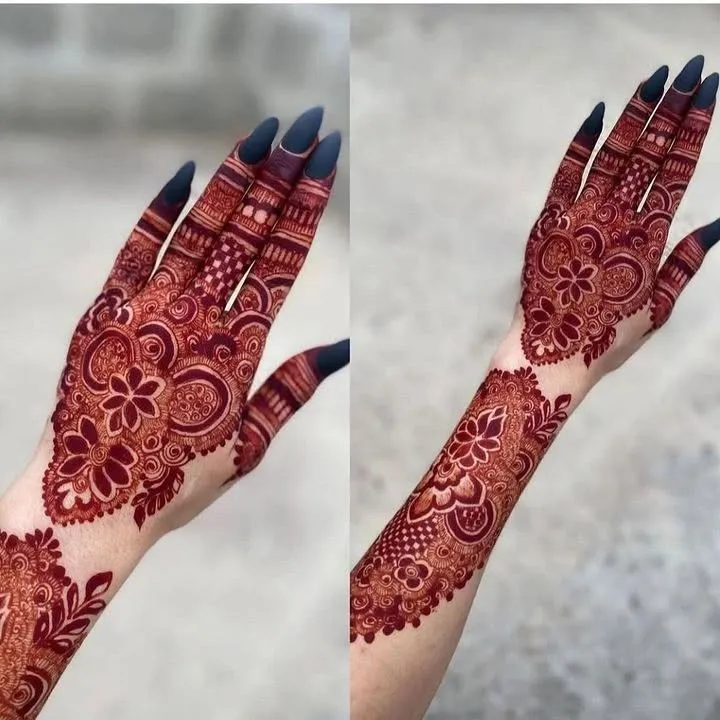
130. Red floral hand in two views. Two views of the same design: a floral centre with paisleys and checks, ending in dark dipped fingertips. A bright red like this is typical of the first day after the paste comes off.
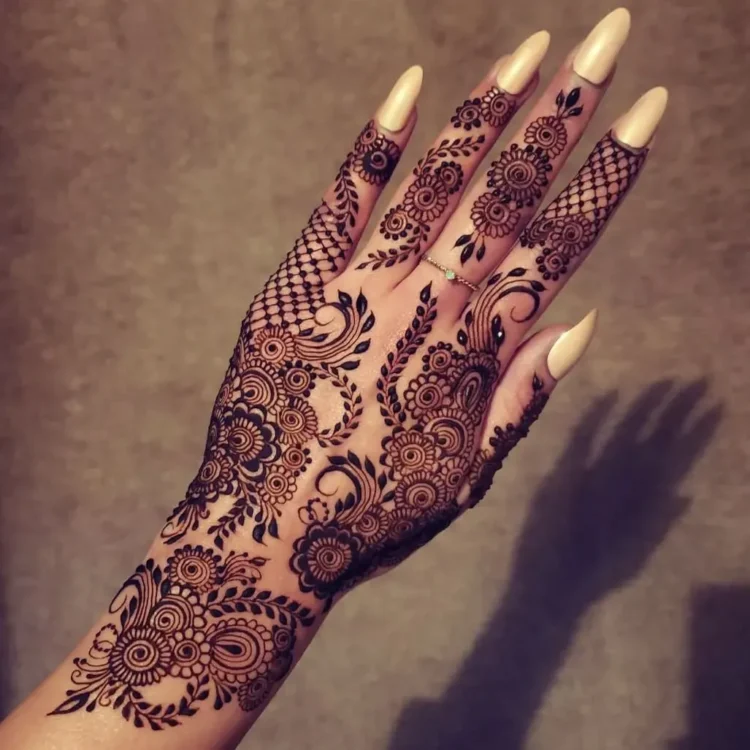
131. Peacock paisleys with net fingers. Paisleys with curled peacock-like necks spread from the wrist, flowers fill the hand and net covers several fingers.
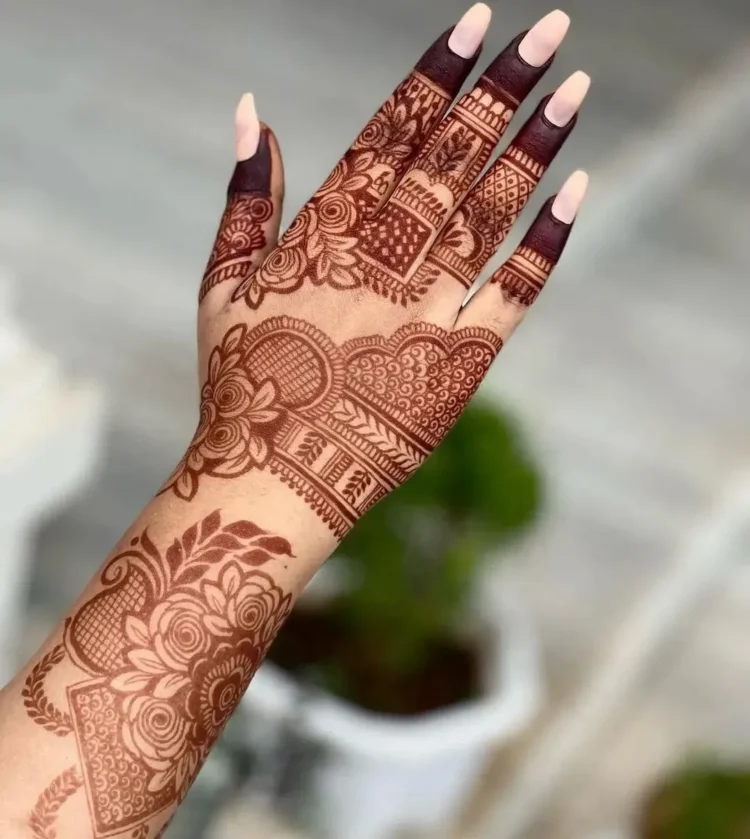
132. Lace band across the hand. A wide lace band crosses the hand below a floral panel on the fingers, and roses continue onto the forearm. The fingertips are dipped dark.
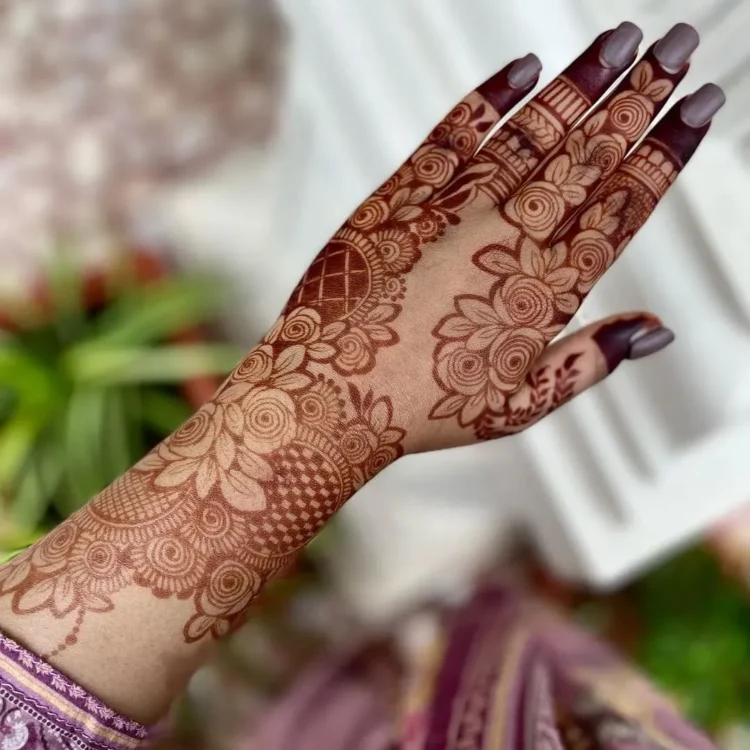
133. Roses with a checkered patch. Open roses fill the back of the hand and wrist, a checkered patch sits near the thumb, and the fingertips are fully dipped.
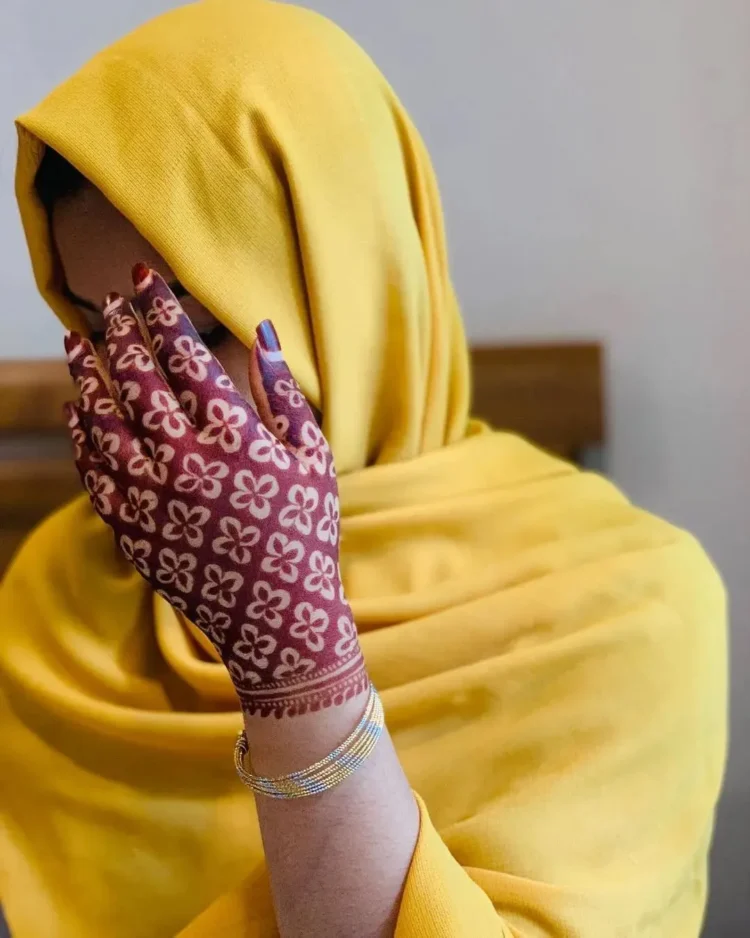
134. Negative space flowers. The whole hand is filled with paste, and small four-petal flowers are left as bare skin. A striking idea that takes patience but no fine detail.
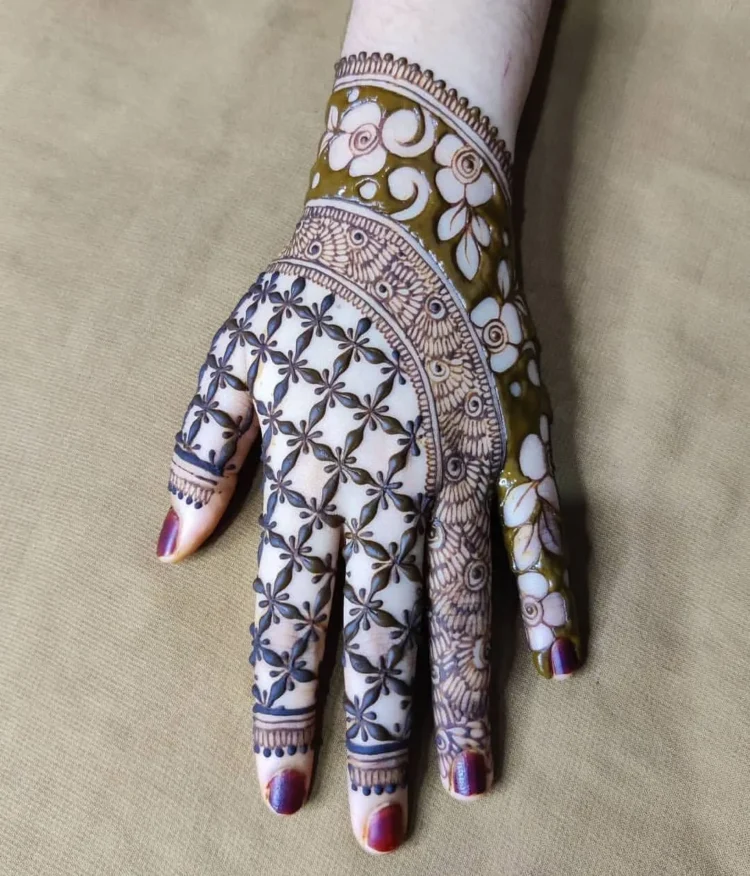
135. Star flower lattice in fresh paste. Shown before the paste is removed: a lattice of star flowers covers the hand and fingers, with a paisley border on the side and a band at the wrist.
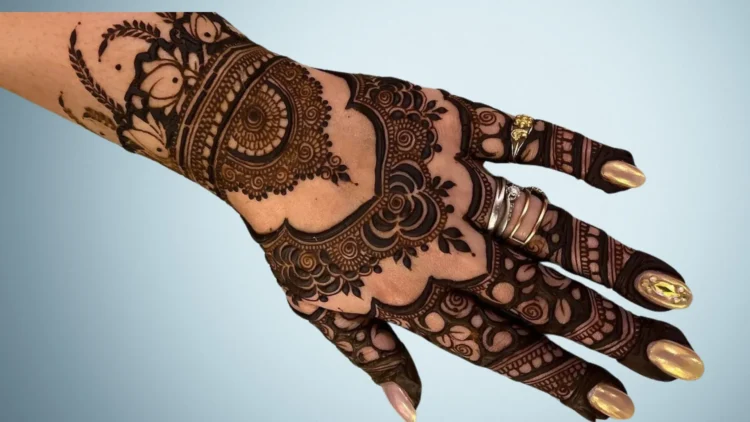
136. Bold arch with filled fingers. A dark arch frames the wrist, roses fill the hand, and the fingers are covered in bold patterns with almost no bare skin.
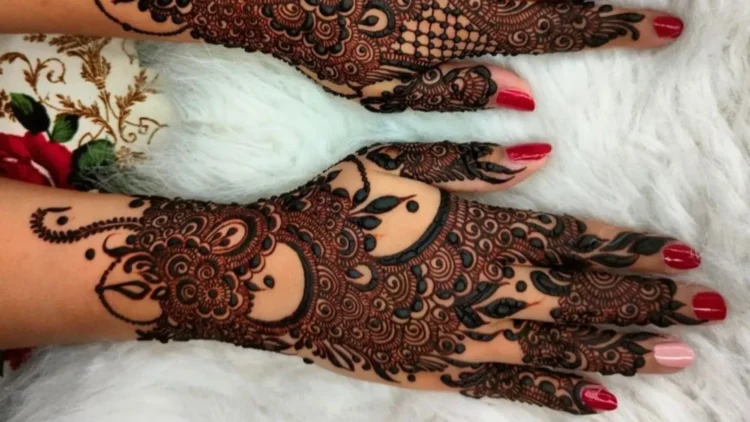
137. Dark florals on two hands. Dense florals with bold black leaves and a net section cover both hands. Thick outlines like these are popular in Pakistani mehndi.
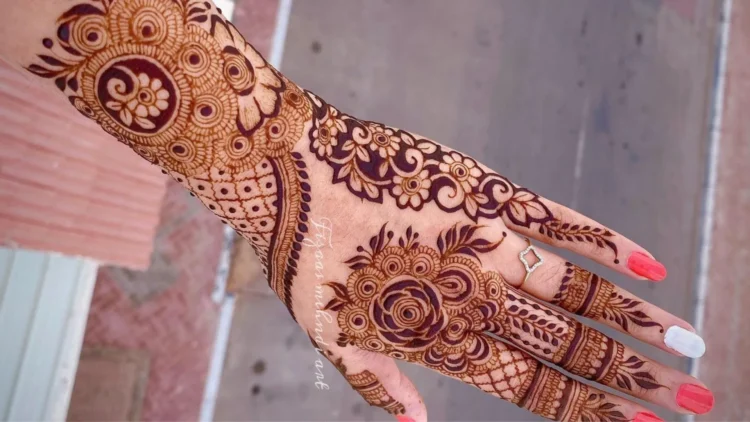
138. Rose and paisley with a net wrist. A large rose with a paisley fills the side of the hand, a mandala and net sit on the wrist and a leaf trail and lattice fill the fingers.
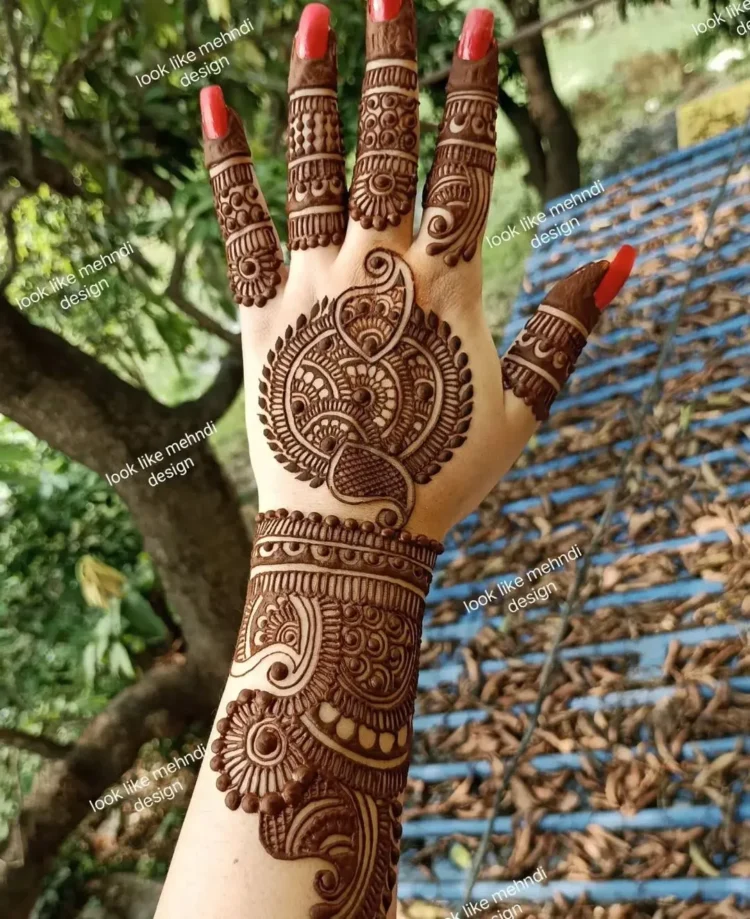
139. Paisley medallion with a forearm cuff. A round medallion built from two paisleys sits in the middle of the hand, a wide cuff of paisleys covers the wrist and the fingers are patterned to the nails.
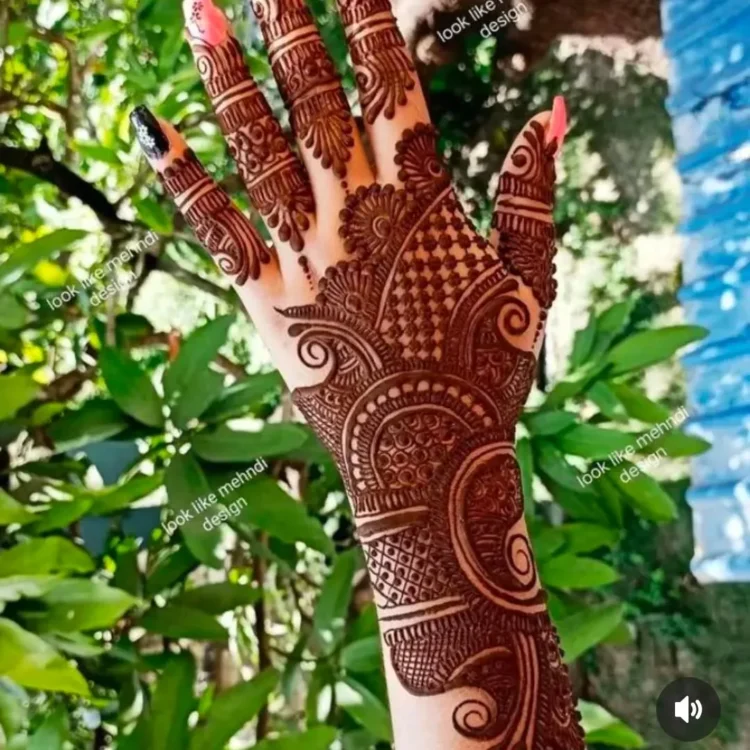
140. Checks and arches to the forearm. A checkered block, layered arches and swirls cover the hand and continue onto the forearm, with every finger fully patterned. Very little skin is left bare.
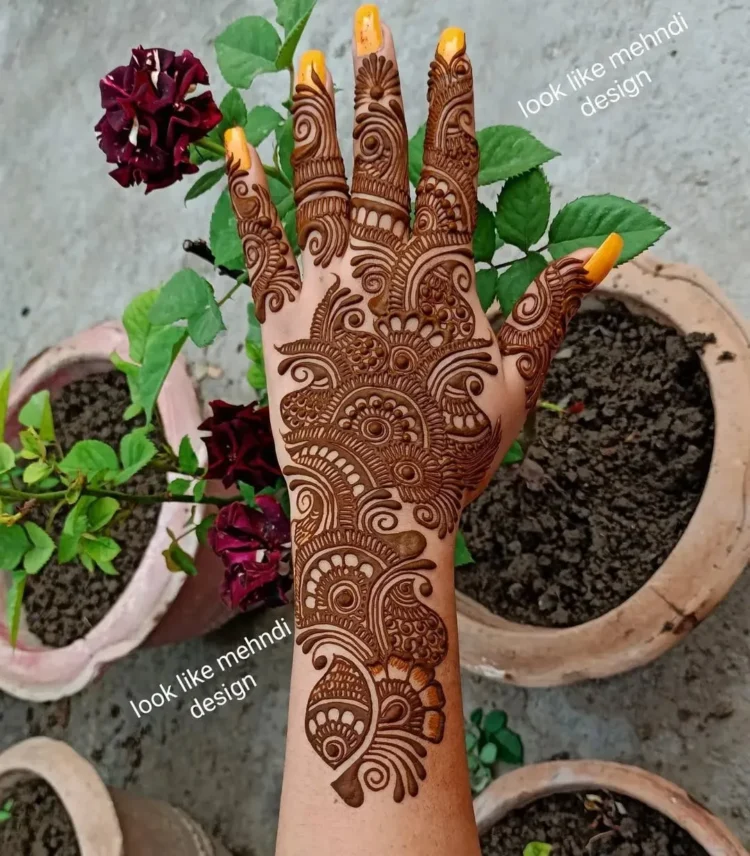
141. Paisley column from fingers to wrist. Paisleys, peacock curls and fine fill run in one wide column from the fingers to the wrist, and every finger is filled. The brown stain is even across the dense work.
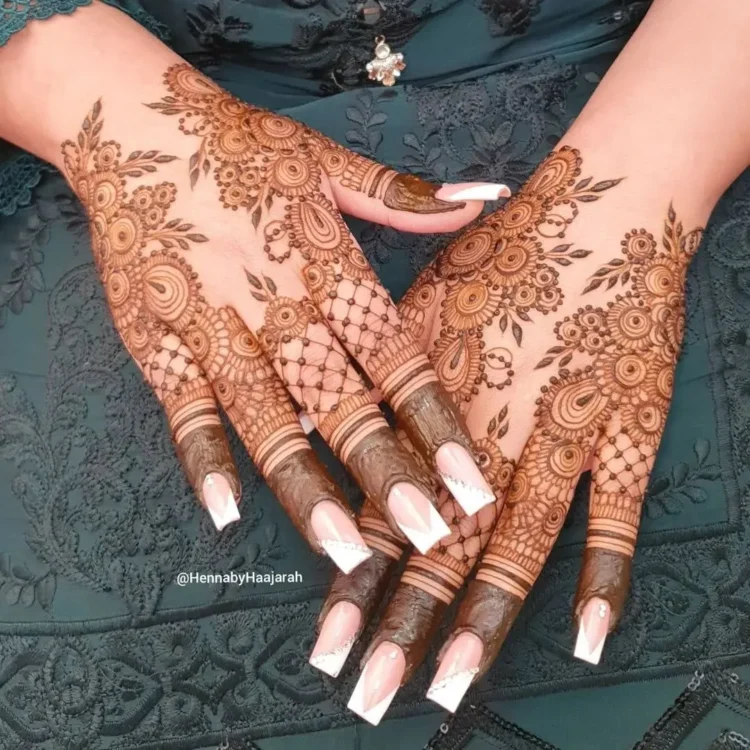
142. Floral clusters with net fingers. Dense flower clusters with teardrop petals cover both hands, two fingers carry net and the tips are dipped.
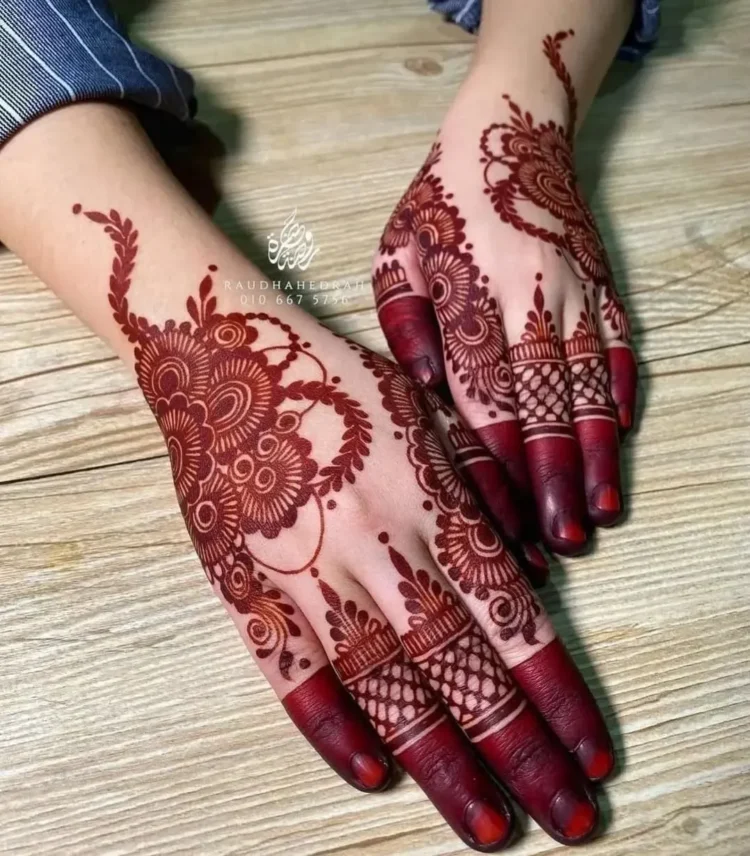
143. Maroon florals with dipped tips. A floral cluster with a curved leaf vine fills each hand, net covers some fingers and the fingertips are fully dipped in a deep maroon.
Why the Back of the Hand Stains Lighter
Henna dye (lawsone) binds to keratin in the outer layer of the skin. The palm has a much thicker outer layer than the back of the hand, so it takes more dye and stains darker. The same paste that turns the palm maroon often leaves the back of the hand a shade lighter and fades from it sooner, usually within one to two weeks.
- Use slightly thicker lines. More paste on the skin means more dye. Filled leaves and thick outlines stain darker than hairline work.
- Keep the paste on longer. Leave it for 6 to 8 hours or overnight, not the 1 to 2 hours that may be enough on the palm.
- Seal the paste. Once it is dry, dab on lemon juice and sugar so it stays moist and stuck to the skin.
- Keep the hand warm. Warm skin takes more dye; many people hold the hand over the steam of cloves heated in a pan.
- Scrape, do not wash. Remove the dry paste with a spoon or a little oil and avoid water for 12 to 24 hours.
Natural henna never stains black. Products sold as “black henna” may contain PPD (p-phenylenediamine), a hair dye chemical that can cause blisters and lasting skin reactions, as the US Food and Drug Administration explains in its fact sheet on henna and black henna.
How to Choose a Back Hand Layout for Your Hand
- Short or wide hand: choose a diagonal Arabic bel. The line from the wrist to one finger makes the hand look longer.
- Long, slim hand: a centre mandala or a haath phool chain fills the space without crowding it.
- Short nails or short fingers: keep the fingers light with thin bands and leave the tips bare, or use V-shaped dipped tips that point toward the nail.
- Long nails: full finger patterns, net and dipped tips look balanced with long nails.
- Rings and bracelets: leave a gap where the ring sits, or draw the chain of a haath phool so the real ring becomes part of it.
- Full coverage: a jaal or lattice covers the whole hand evenly and hides small uneven lines.
Which Back Hand Mehndi Design Suits Which Occasion
| Occasion | Style | Time, both hands |
|---|---|---|
| Bride | Full hand to forearm | 3 to 6 hours |
| Mehndi night guest | Arabic bel or jaal | 30 to 60 min |
| Eid and Chand Raat | Mandala or floral | 20 to 40 min |
| Karwa Chauth, Teej | Indian full back hand | 1 to 2 hours |
| Office, everyday | Booti or thin trail | 10 to 15 min |
| Children | Booti or small flower | 5 to 10 min |
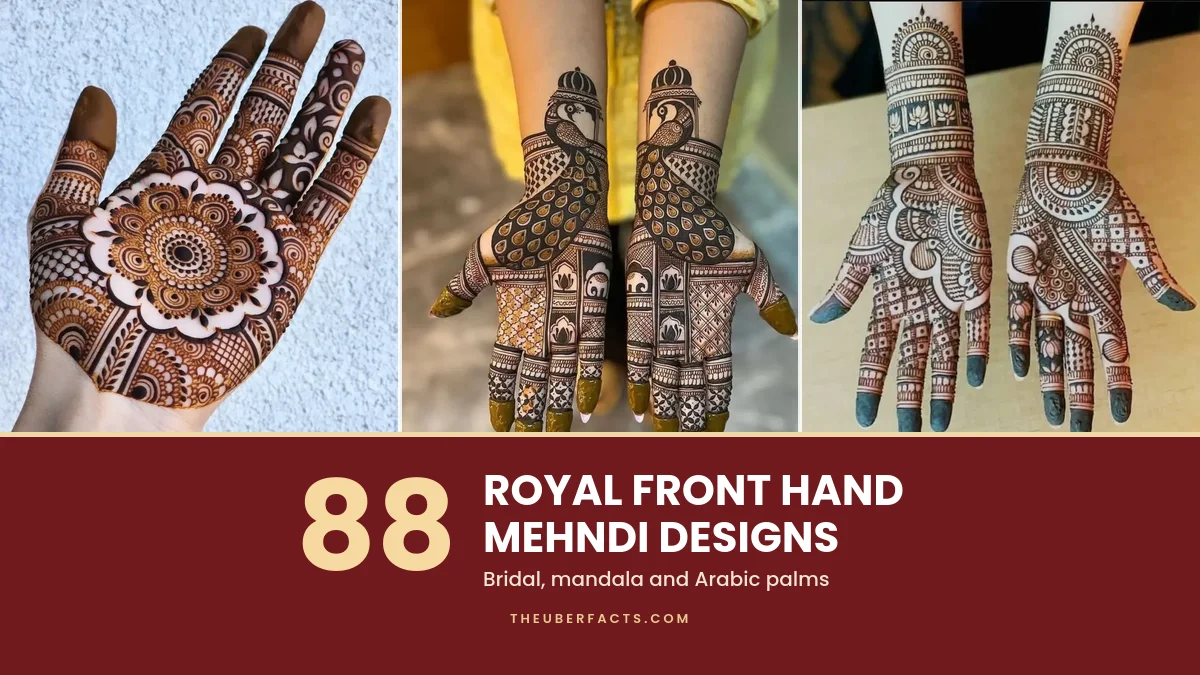
For festival ideas see our Eid mehndi designs, and for the palm side of the same hand see our front hand mehndi designs. Grooms can find simpler patterns in our dulha mehndi designs.
Back Hand Mehndi Design FAQs
Which back hand mehndi design is easiest for beginners?
Scattered booti, such as small flowers and leaf sprigs, is the easiest because each motif is tiny and stands alone. A single floral trail along one side of the hand is the next step up.
Why is my mehndi lighter on the back of the hand than on the palm?
The palm has a thicker outer skin layer, which takes more henna dye. The back of the hand has thinner skin, so it stains a shade lighter and fades sooner. Thicker lines and a longer paste time help.
How long should I keep mehndi on the back of my hand?
Keep the paste on for at least 6 hours, and overnight if you can. The stain will keep darkening for 24 to 48 hours after the paste comes off.
How long does back hand mehndi last?
Natural henna on the back of the hand usually lasts about 1 to 2 weeks. It fades faster with frequent washing, hand sanitiser and dish soap.
What is the difference between Arabic and Indian back hand mehndi?
Arabic mehndi uses bold lines in a diagonal bel and leaves open skin between motifs. Indian and Pakistani mehndi fills most of the hand with fine detail such as paisleys, lace and jaal.
Should mehndi go on the back of both hands?
Usually yes. Many people match both hands, or mirror the design so the bel runs toward the outside of each hand. A lighter design on one hand is also common.


Comments 4