
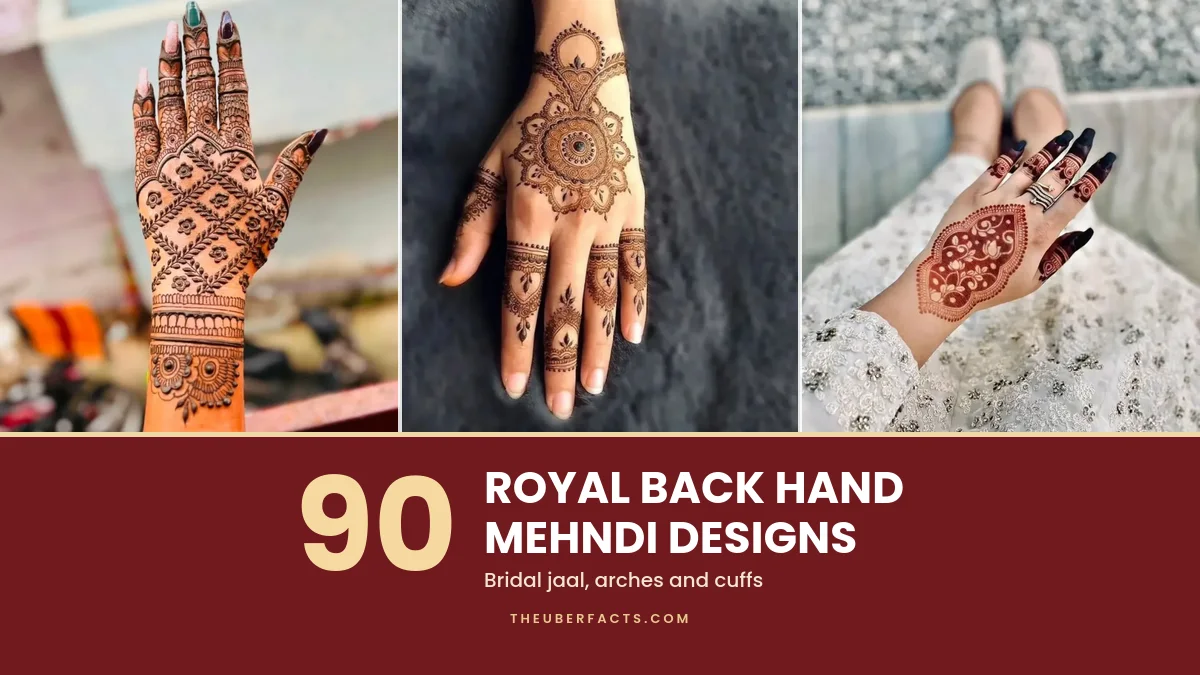
A royal back hand mehndi design covers the back of the hand from the knuckles to the wrist with dense, finely drawn detail that is meant to look like jewellery: lace arches over the knuckles, a jaal (net) across the hand, layered cuffs at the wrist and patterned fingers. It takes longer than an everyday design and is usually chosen by brides and by close family at a wedding, when the hands will be seen and photographed for days.
This page shows 90 royal back hand mehndi designs, each with a photo and a note on its motifs, coverage and difficulty. They are grouped by what defines them: full bridal coverage, arch and dome shapes, lattice work, jewellery motifs, circle flower clusters, Arabic florals, bold shaded outlines and simple royal designs for a quicker finish. If you only want a light pattern, our back hand mehndi designs collect the easier everyday styles.
What Makes a Back Hand Mehndi Design Royal
- Density: little bare skin is left between motifs. Fills such as jaal, dots and fine shading take the place of open space.
- Symmetry: the pattern is built around a centre line or a central medallion, and both hands are usually drawn as a matching pair.
- Jewellery shapes: cuffs that look like bangles, a chain from finger to wrist like a haath phool, pendants and hanging drops.
- Architecture: scalloped arches, pointed domes and window-shaped panels that recall the cusped arches of Mughal buildings.
- Layered cuffs: two or more bands stacked at the wrist, each with a different fill.
- Finished fingers: every finger carries bands, net or caps, often ending in dipped fingertips.
Royal vs Simple Back Hand Mehndi
| Feature | Simple back hand | Royal back hand |
|---|---|---|
| Coverage | Trail or half the hand | Whole back hand and fingers |
| Line work | Bold, lots of open skin | Fine lines, dense fill |
| Main motifs | Rose, leaf, small mandala | Jaal, arches, domes, cuffs |
| Symmetry | Often one-sided | Balanced, mirrored pairs |
| Time per hand | 10 to 20 min | 30 to 60 min |
| Best for | Eid, parties, guests | Bride, close family |
Bridal Royal Back Hand Mehndi Designs with Full Coverage
A bridal royal back hand mehndi design leaves almost no bare skin between the knuckles and the wrist. The fingers are fully patterned, the cuffs often continue up the forearm, and the darkest results come from paste that stays on overnight. Plan on one to two hours for the backs of both hands alone. For designs that also fill the palm, see our full hand mehndi designs.
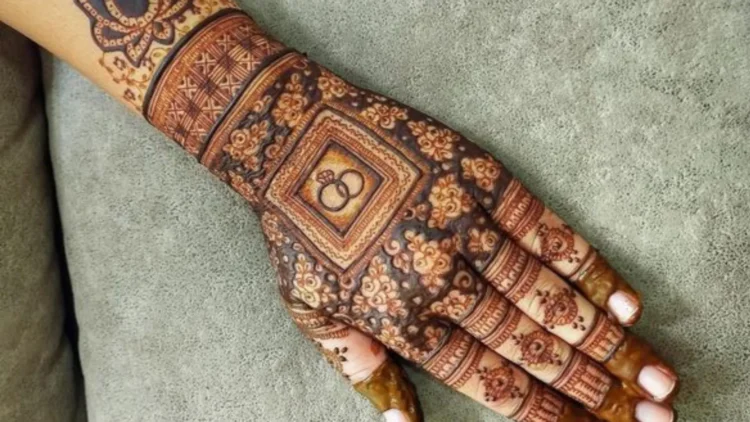
1. Square medallion with linked rings. A square frame sits in the middle of the hand with two linked rings drawn inside it, and small flower clusters on a filled dark ground cover the rest. A criss-cross cuff closes the wrist, while the fingers carry stacked bands and tiny rosettes.
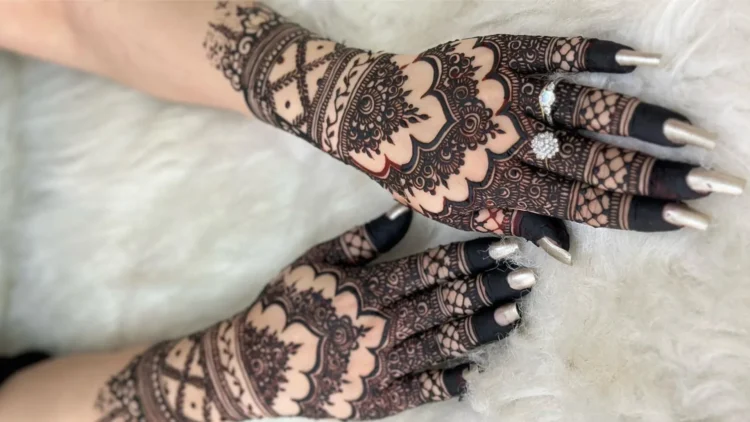
2. Lace arches with dipped fingertips. Scalloped lace arches frame a central paisley over the knuckles, and an X-crossed band marks each wrist. The stain is a very deep brown, and every fingertip is dipped solid above a net of jaal.
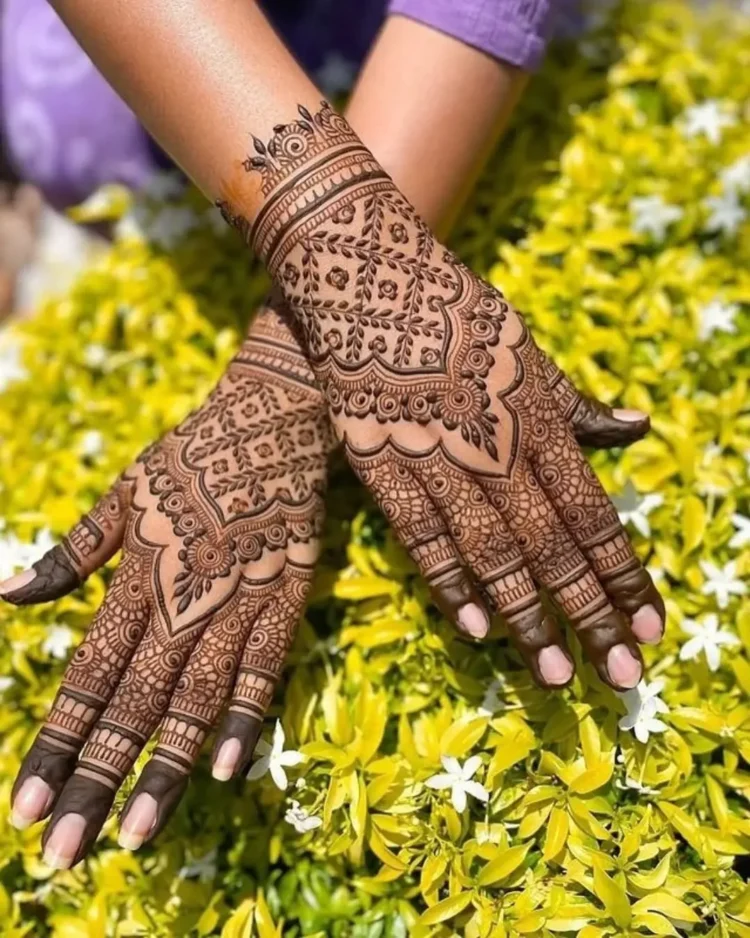
3. Vine jaal inside an arched panel. Each hand carries a panel shaped like a pointed arch, filled with a jaal of small vines and edged with ring-and-dot borders. Fingers are banded from base to tip, and the tips are dipped.
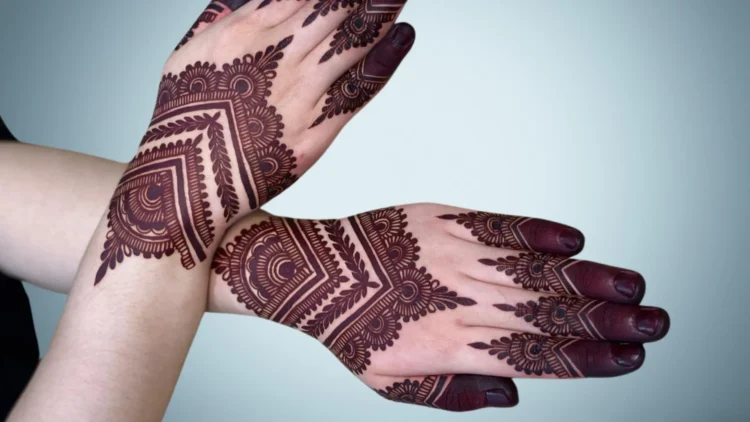
4. Chevron bands in deep maroon. Layered chevron bands point toward the wrist and end in small dome shapes, which gives a strong geometric outline. The maroon stain and solid fingertips show how dark henna can get after a long paste time.
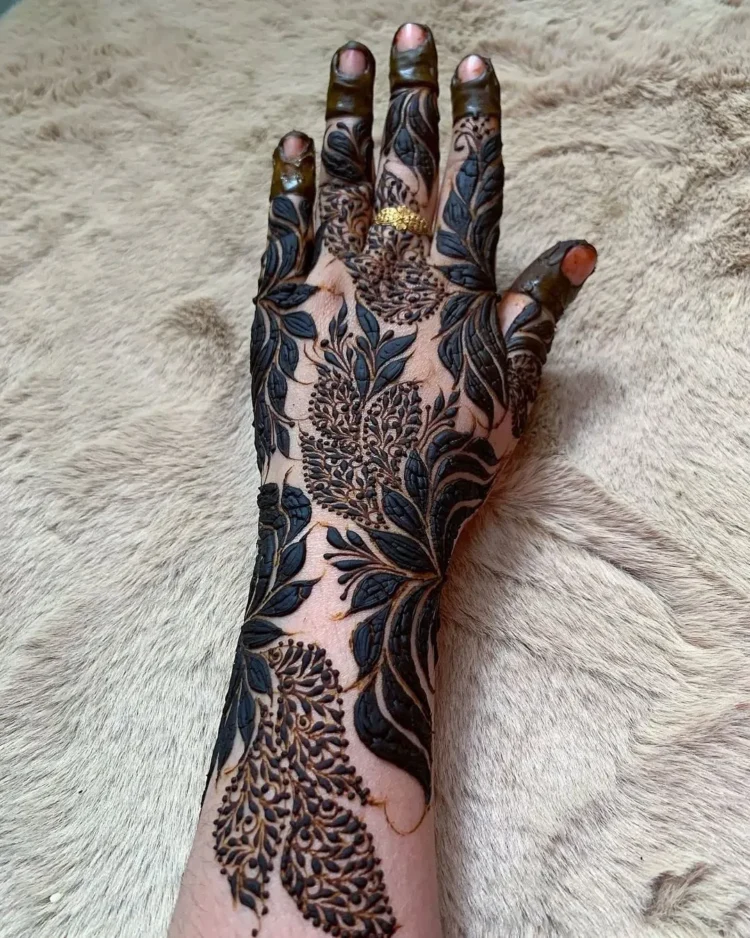
5. Bold leaves over fine jaal. Large solid leaves are laid over a fine jaal fill that continues up the forearm, so almost no skin shows. The paste is still on the fingertips here, which is how a bride keeps it on for the darkest stain.
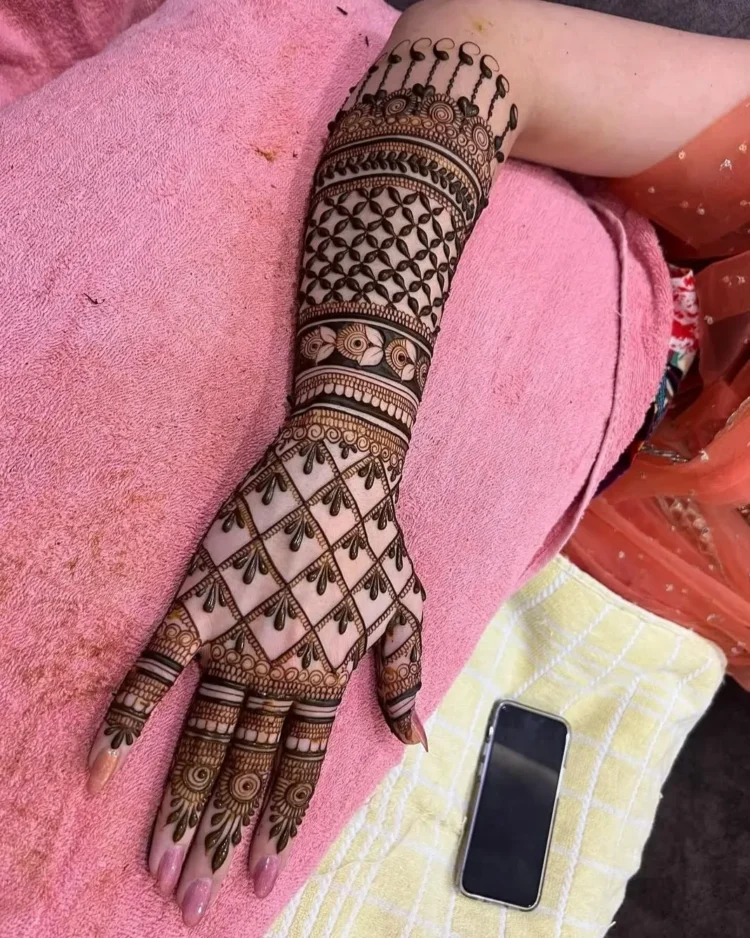
6. Lattice hand with stacked forearm cuffs. A diamond lattice with leaf drops covers the hand, and four different cuffs climb the forearm. The top edge ends in a fringe of hanging drops that looks like a row of small bells.
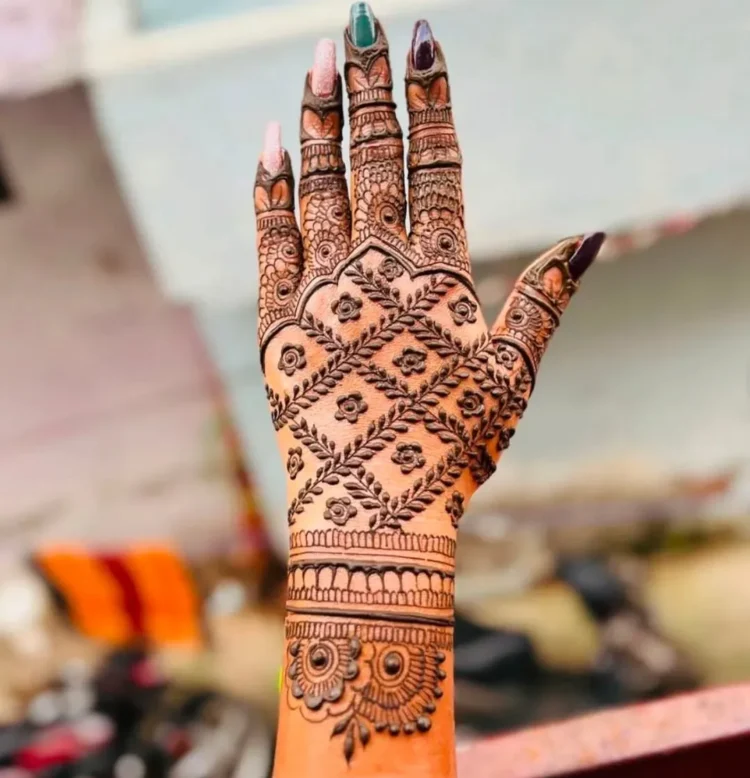
7. Leaf vine lattice with wide wrist cuffs. Leaf vines cross to form a diamond grid with a small flower in each space, all under an arched top edge. Below it, two wide banded cuffs and a row of flowers wrap the wrist.
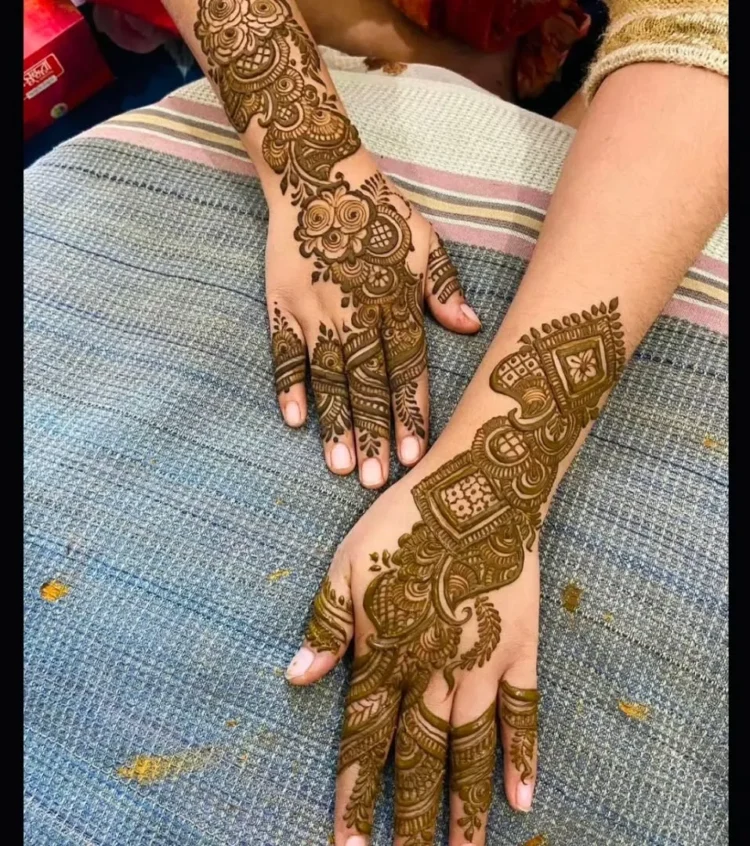
8. Forearm panels in fresh paste. Diamond and square panels alternate with flowers along the hand and forearm, shown in olive green paste that has not yet been removed. A forearm-length design like this is usually kept for the bride herself.
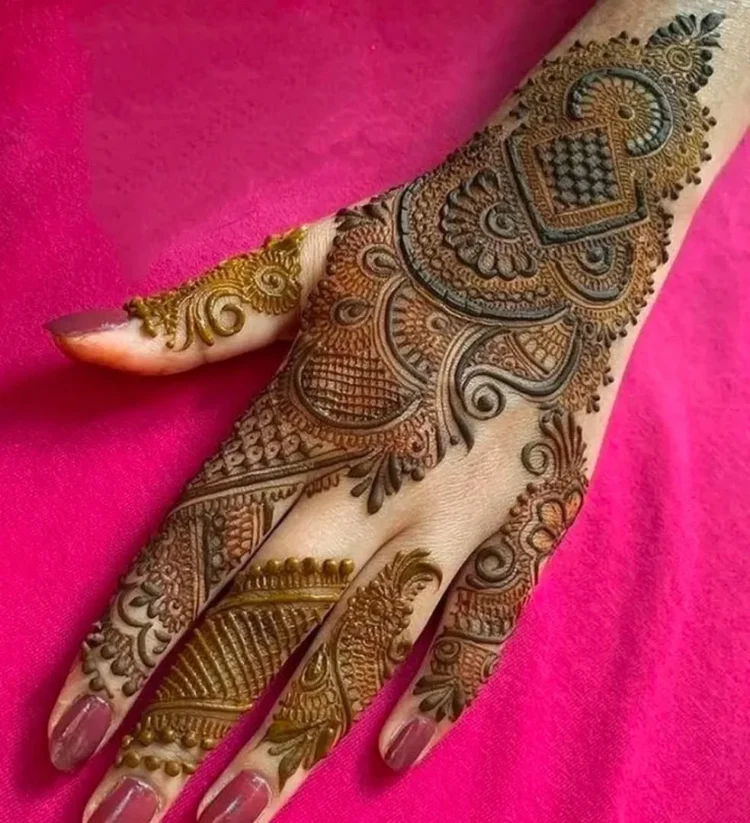
9. Paisley with a checkered dome. A checkered diamond under a dome-shaped outline sits near the wrist, with paisleys and swirls flowing down to the knuckles. The fingers are filled with diagonal lines in the traditional Indian and Pakistani manner.
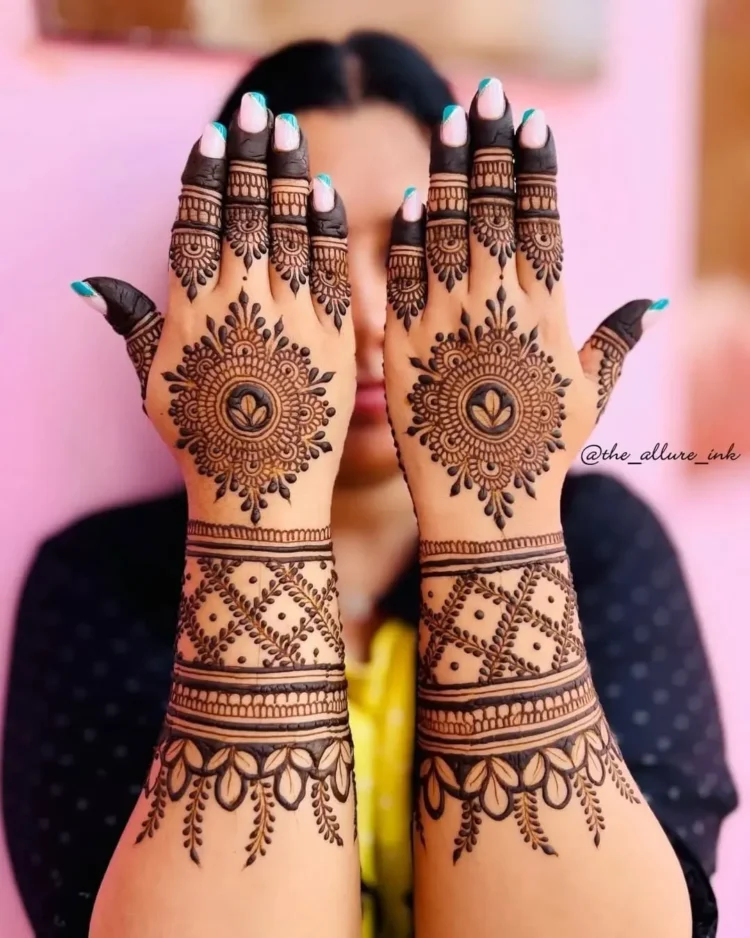
10. Twin mandalas with lattice forearm cuffs. Both hands carry the same round mandala with a small bud at the centre, and a criss-cross lattice band framed by stacked lines runs up each forearm. A fringe of leaves hangs from the top cuff, and every fingertip is dipped dark.
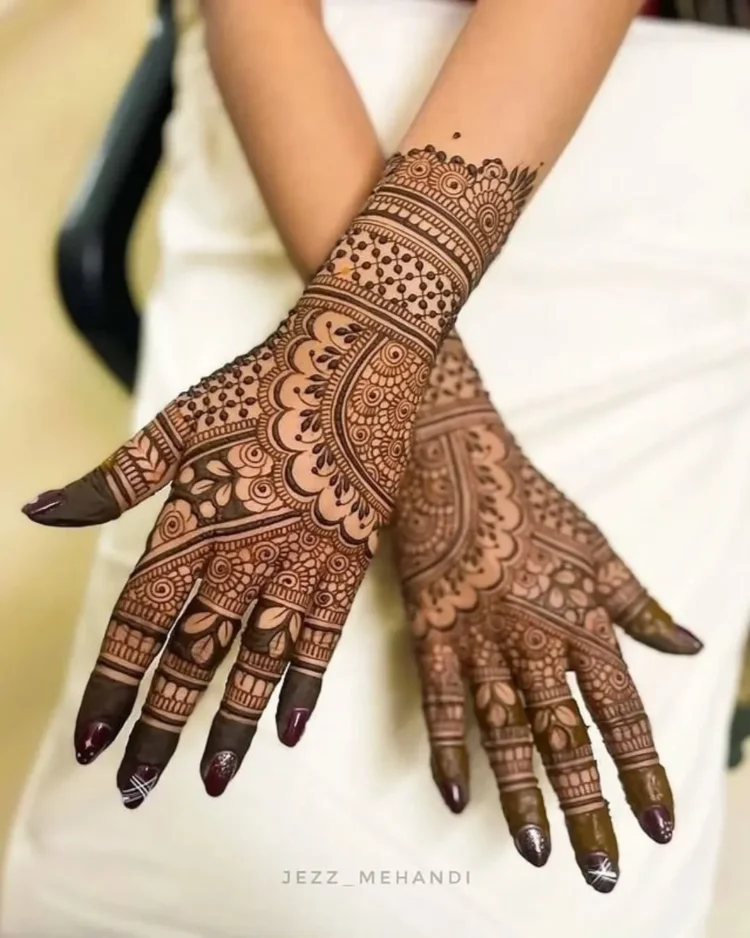
11. Scalloped sweeps on crossed hands. Wide scalloped curves sweep across each hand between areas of dot grid and small flowers, and the pattern continues past the wrist in stacked bands. The fingers carry leaf motifs and bands, with the tips still coated in paste.
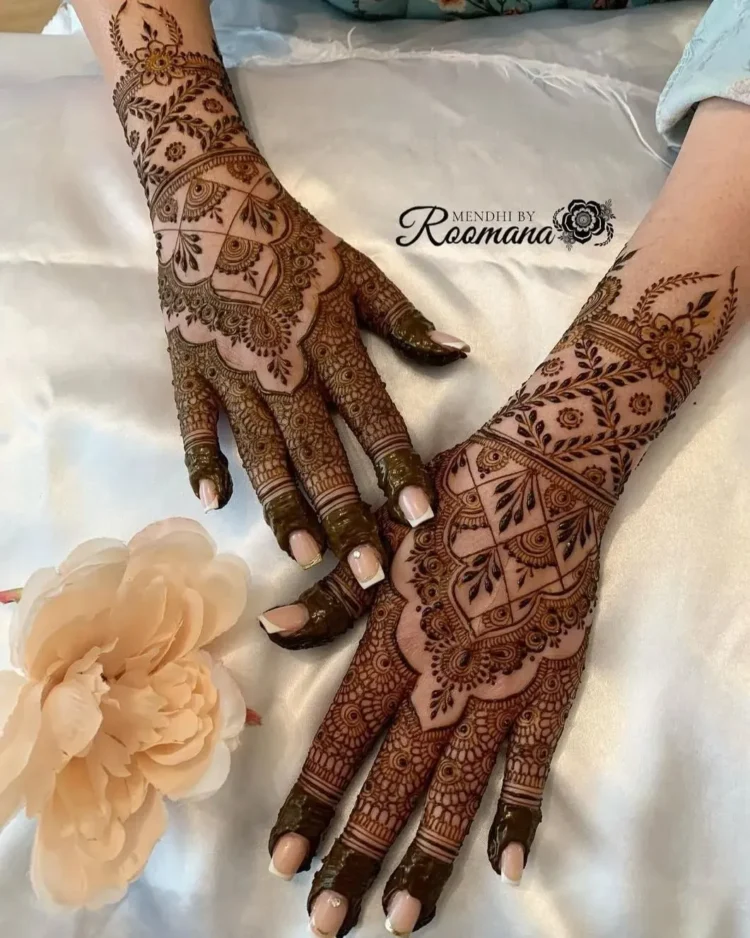
12. Pointed panel with leafy wrist vines. A pointed panel divided by crossing lines sits on each hand under a lace edge, and leafy vines climb from it toward the forearm. Dense fill covers the fingers, and the paste is still on the tips.
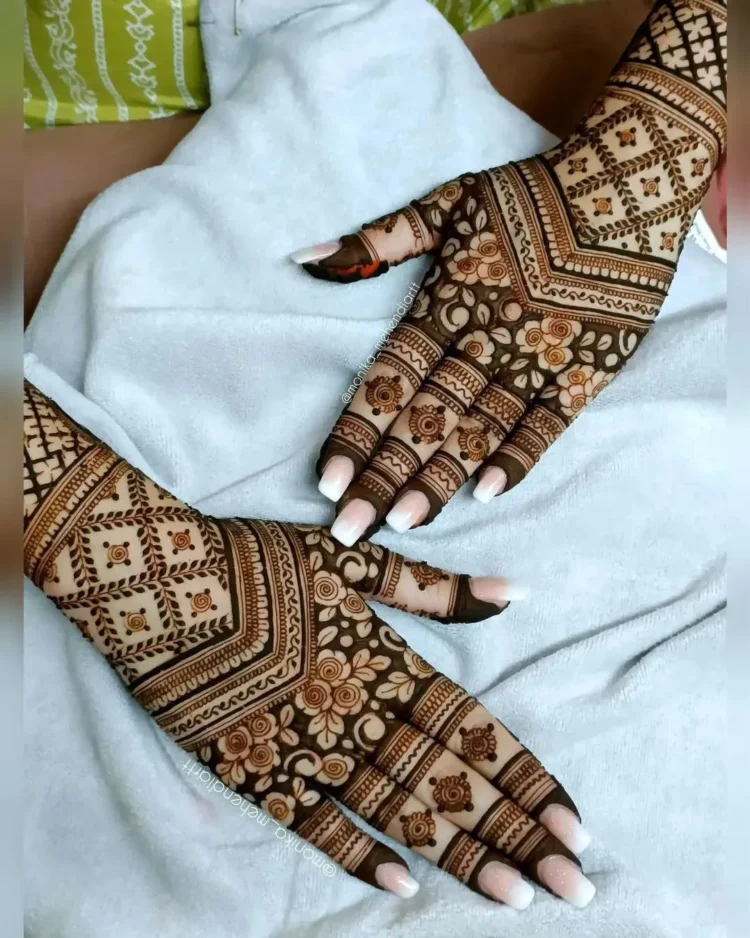
13. Chevron border over a diamond vine grid. A diamond grid of leaf vines with a small motif in each space covers the forearm, and a chevron border separates it from a hand filled with small roses. Banded fingers with tiny flowers end in dipped tips.
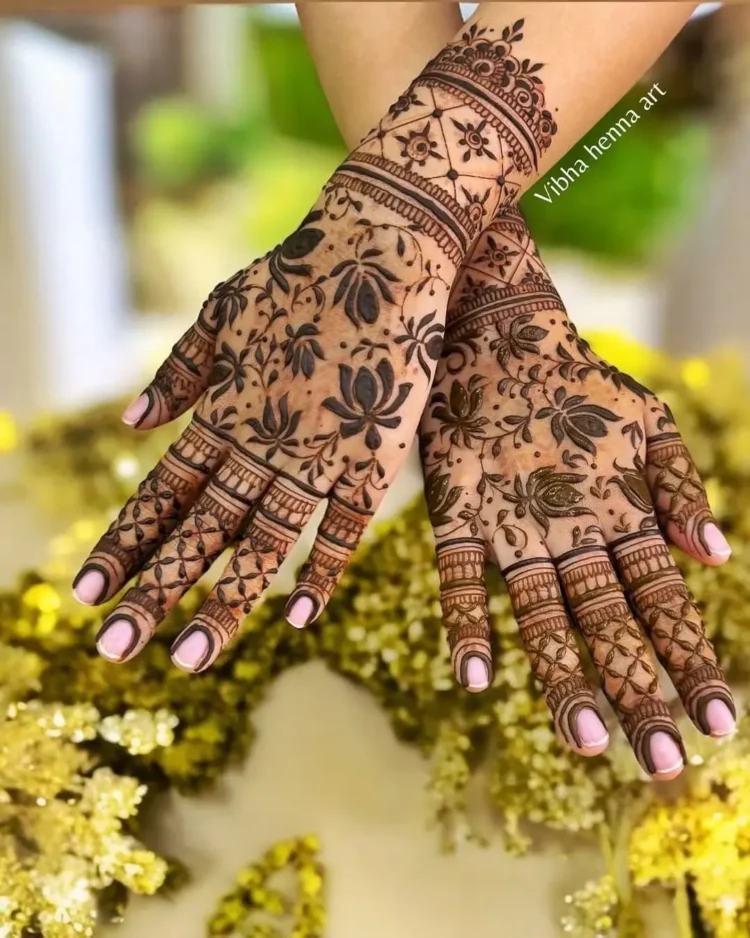
14. Lotus vines with a lattice wrist cuff. Solid dark lotus flowers on thin vines are scattered across both hands, so the skin between them stays visible. A lattice cuff with small flowers sits at each wrist, and the fingers carry criss-cross and banded fills.
Royal Back Hand Mehndi Designs with Arches, Domes and Layered Cuffs
Many royal designs borrow the outline of a building or a piece of jewellery. A scalloped edge across the knuckles reads like a palace arch, a pointed panel reads like a dome, and stacked bands at the wrist look like bangles. These shapes give the design a clear frame, so they work even when the coverage is only medium.
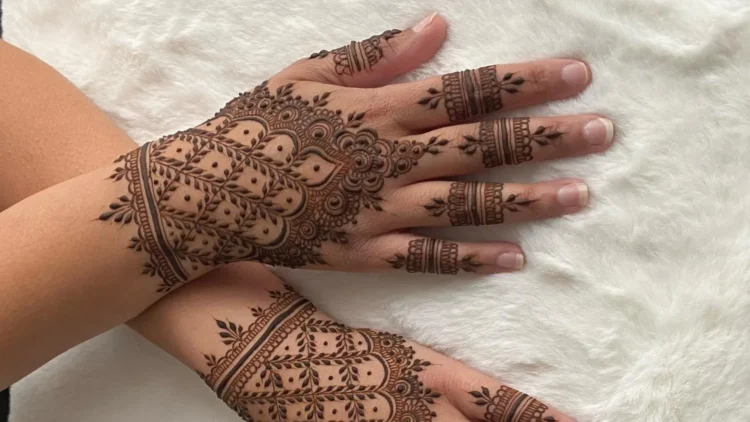
15. Scalloped dome cuff with vine columns. The wrist cuff rises into a row of scalloped domes and is filled with upright vine columns and dots. Each finger gets only one band and a leaf sprig, which keeps the top half light.
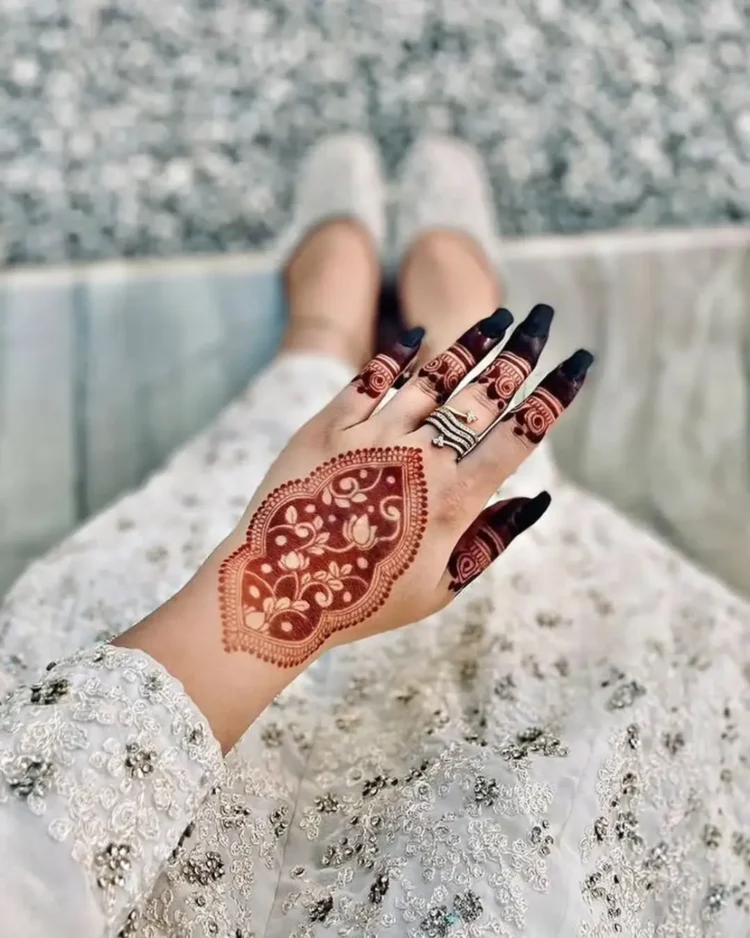
16. Arched window medallion in red. One medallion shaped like an arched palace window fills the back of the hand, with flowers and swirls left as bare skin inside a filled ground. The fingertips are dipped dark and the rest of the hand stays bare.
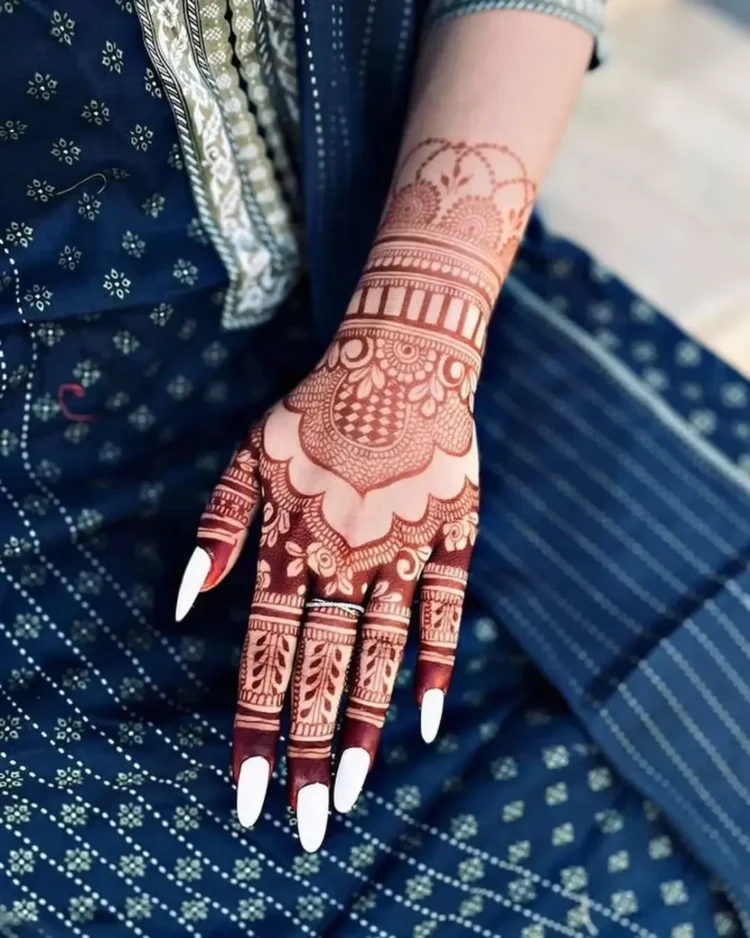
17. Fan arch with a bangle cuff. A fan-shaped arch with a checkered centre spans the knuckles, a cuff of upright bars sits at the wrist like a bangle, and a scalloped dome rises above it. Leaf columns and dipped tips finish the fingers.
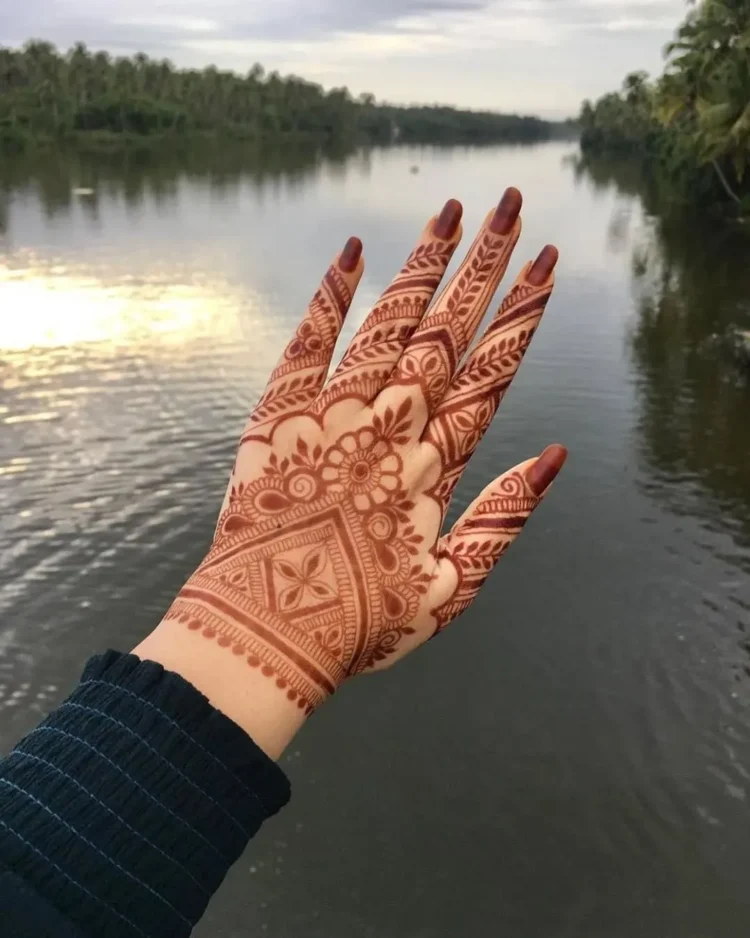
18. Diamond medallion under a flower arch. A diamond with a four-petal centre sits near the wrist, and a scalloped arch of flowers crosses the knuckles. The fingers carry slanted leaf bands, and a dotted edge closes the design at the wrist.
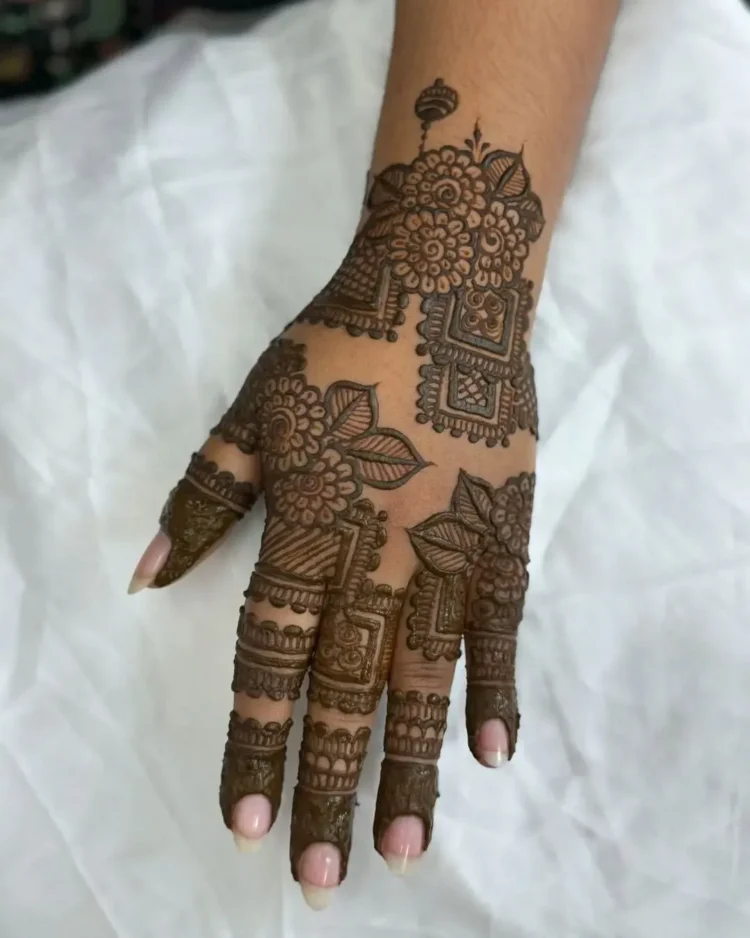
19. Dome finial with square panels. A small dome-shaped finial tops the design at the wrist, followed by flowers, broad leaves and square panels filled with grid work. Every finger is banded right to the tip.
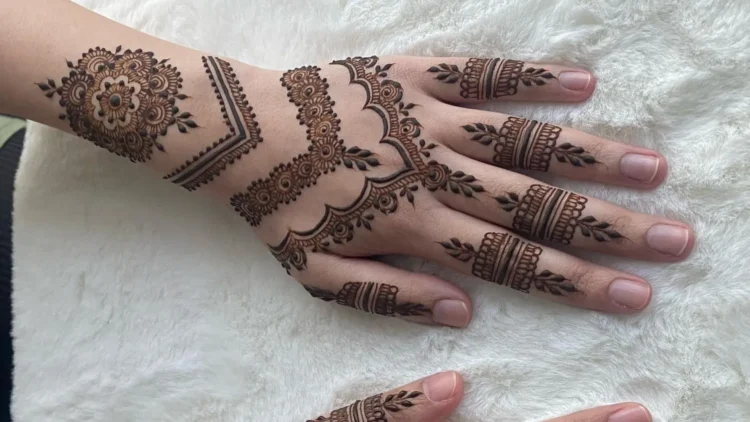
20. Chevron bands with a wrist mandala. A separate mandala sits on the wrist, two chevron bands point toward it, and a scalloped arch line crosses the hand. Leaf-tipped bands on each finger keep the look neat and geometric.
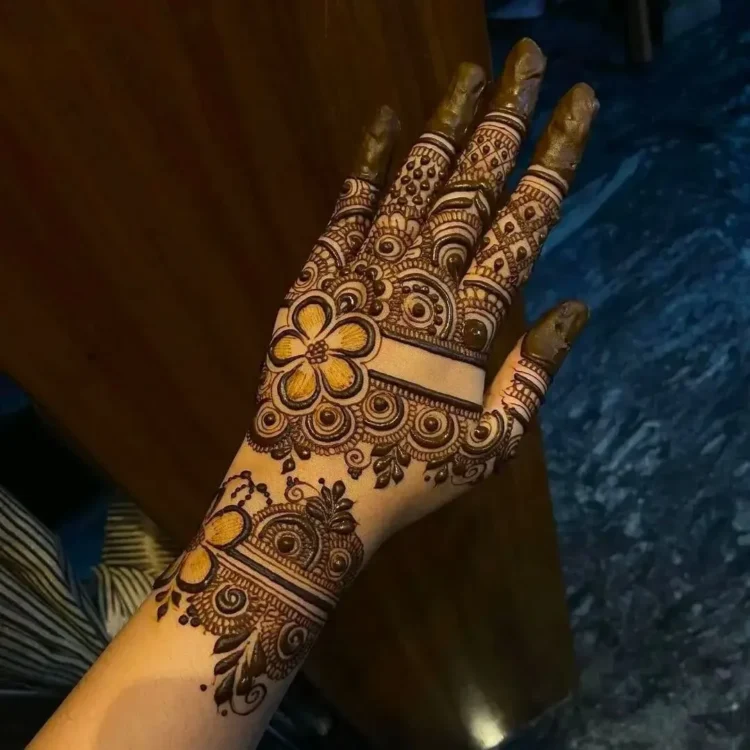
21. Five-petal flower with layered cuffs. A large five-petal flower sits on the hand, a strip of bare skin runs across the knuckles, and a second cuff with its own flower wraps the wrist. The paste is still on the fingertips, so the colour will deepen.
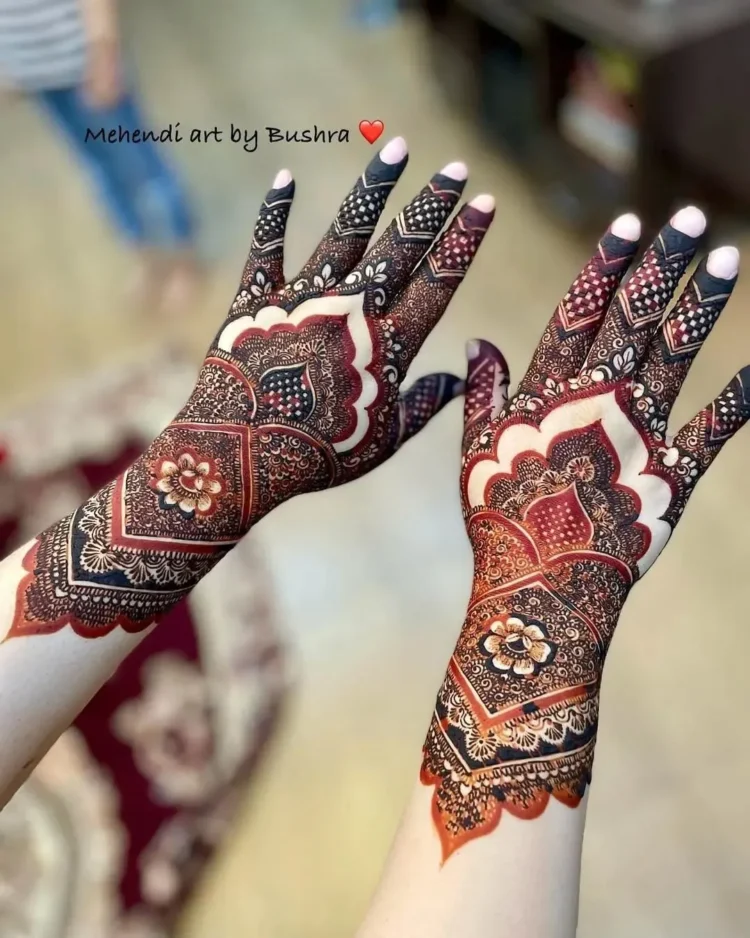
22. Red scalloped arches with diamond panels. A wide scalloped arch outlined in red spans the knuckles of each hand, with a diamond panel and a bare-skin flower below it. Dot grids and chevrons cover the fingers, and a scalloped lace edge closes the design at the wrist.
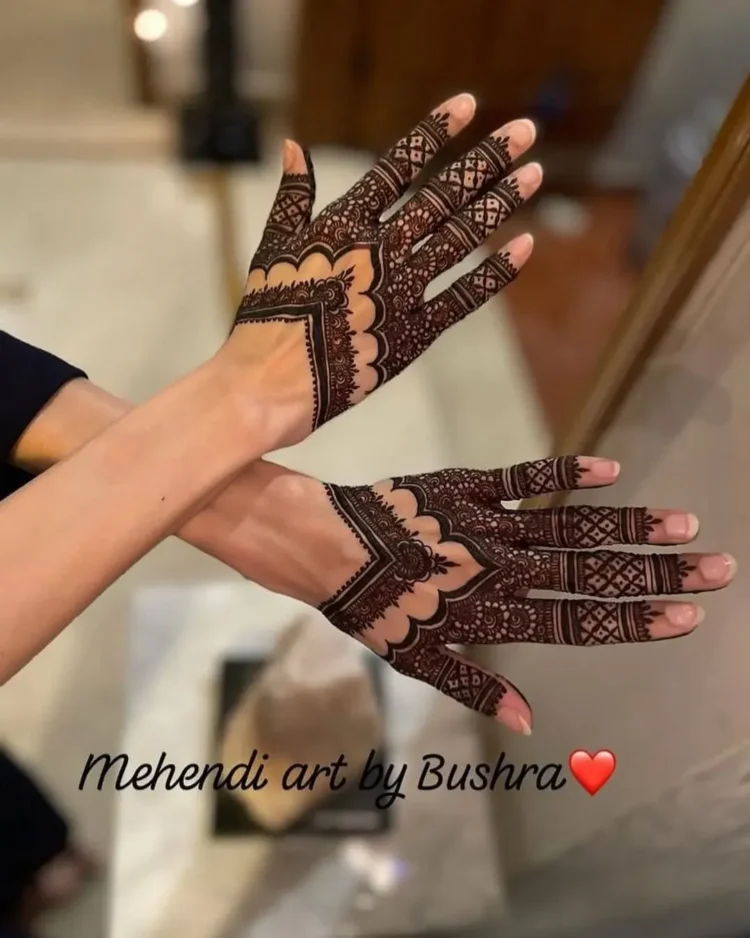
23. V edge with lace scallops. A V-shaped border with scallops along its inner edge cuts across each hand, so the wrist side stays bare and all the fill sits toward the fingers. Each finger has several bands with net, dots or checks.
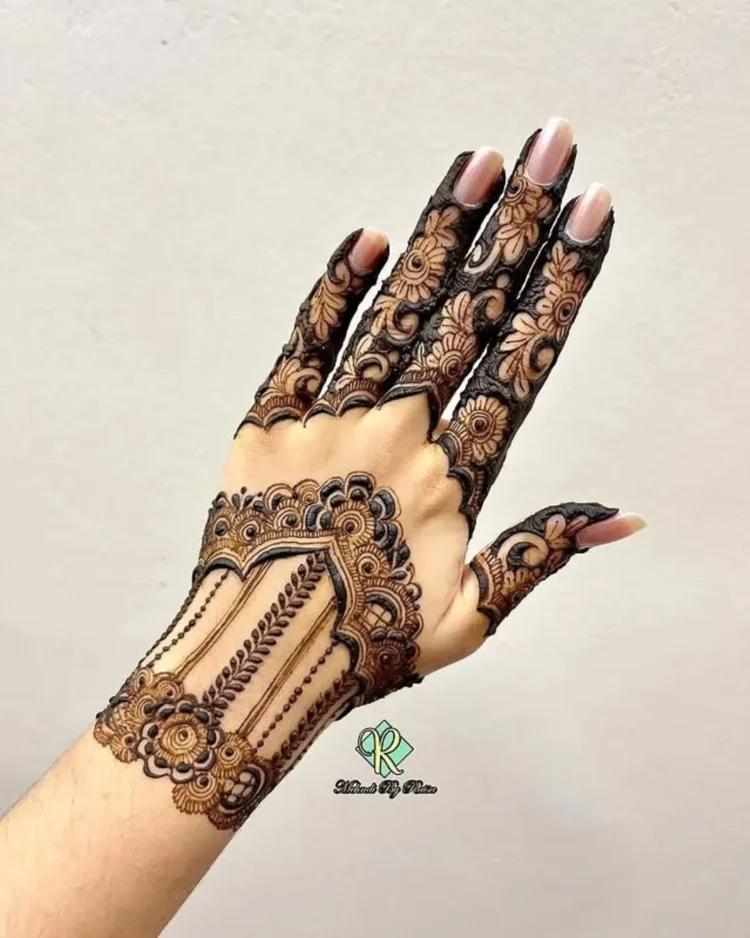
24. Arched gateway with pillar lines. A scalloped arch rests on two long pillar lines at the wrist, with a leaf column between them, much like a palace gateway. Bare skin separates it from the fingers, which carry dark outlined flowers in a bold style.
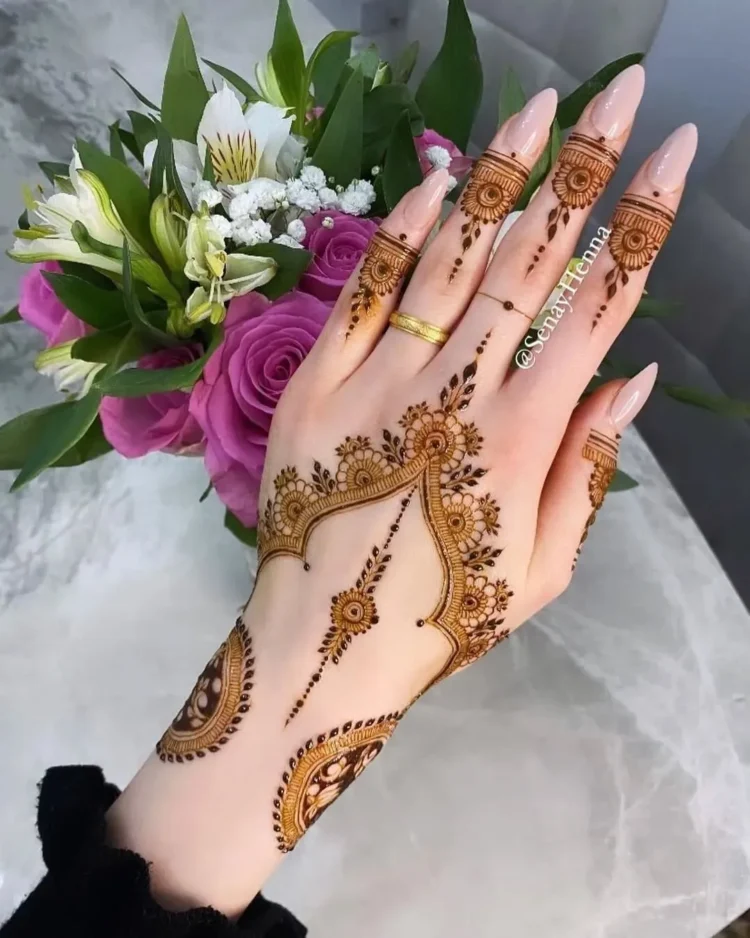
25. Pointed arch with a hanging pendant. One thin line traces a pointed arch over the hand, edged with small flowers, and a beaded pendant hangs from its peak toward the wrist. Two half-circle motifs mark the wrist, and the fingers carry single rings and flowers.
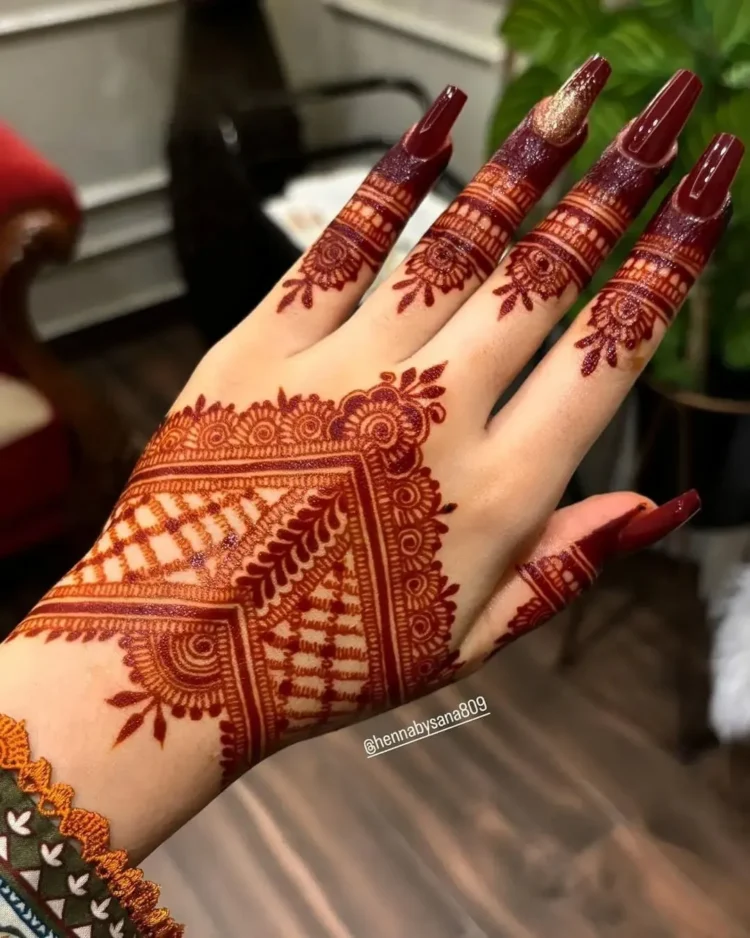
26. Half diamond panel in maroon. A large half-diamond panel along the side of the hand is split into lattice and herringbone sections and edged with spirals and leaves. The fingers carry round flowers and bands in the same deep maroon.
Jaal and Lattice Royal Mehndi Design for Back Hand
Jaal is a net of crossing lines, and it is the fill that most often turns a plain back hand design into a royal one. Small dots, leaves or flowers inside each diamond add texture. A fine cone tip and even pressure matter most here, because any wobble is easy to see in a repeating grid.
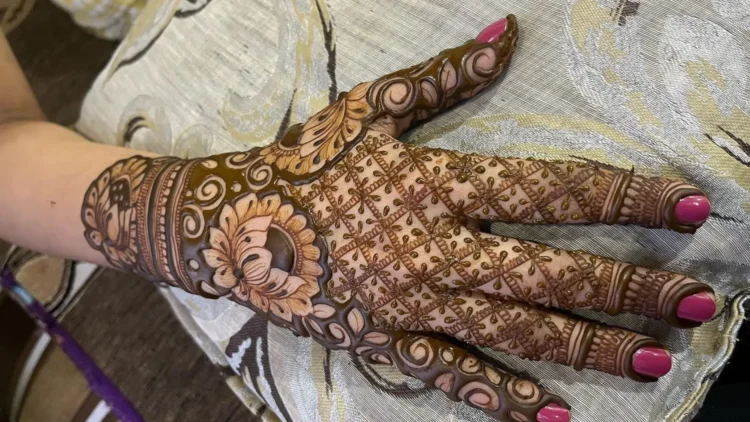
27. Lotus with diamond lattice. A lotus with filled petals and swirls anchors the wrist, and a diamond lattice with tiny leaves covers the rest of the hand up to ringed fingertips. The fresh golden colour will darken over the next two days.
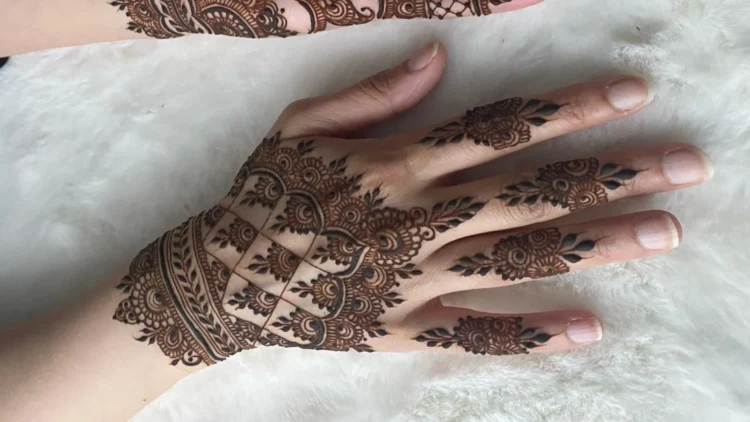
28. Grid panel with finger rosettes. A leaf-vine cuff and a grid panel with small motifs fill the lower half of the hand. Each finger then carries a single rosette with leaves, a tidy way to finish without full coverage.
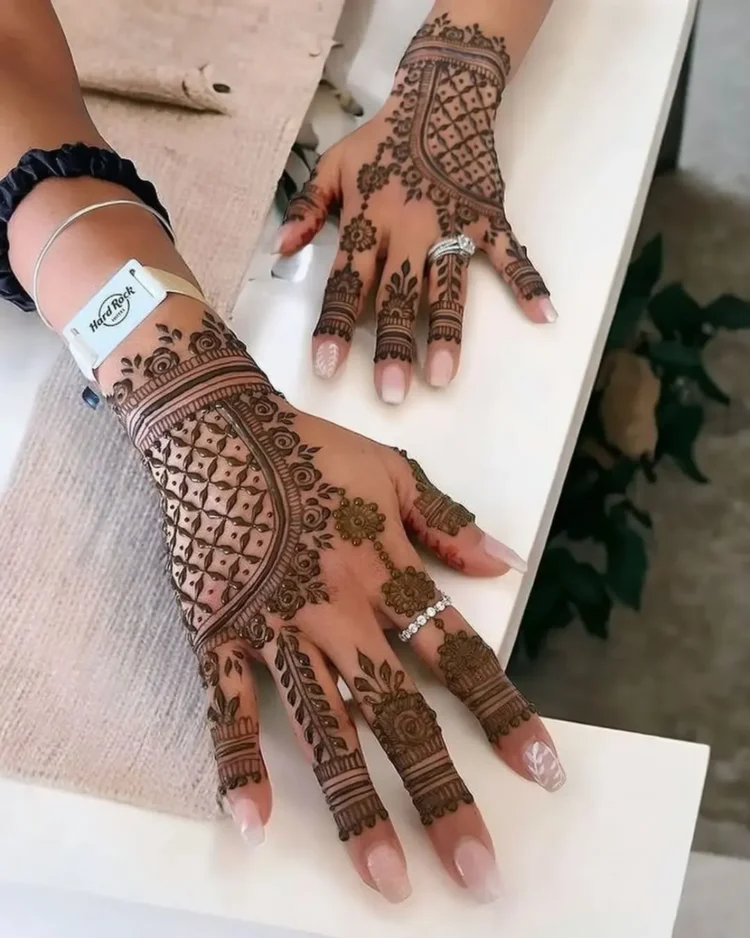
29. Half-moon lattice with a finger chain. A half-moon of criss-cross lattice spreads from the wrist with a border of small roses, and a chain of flowers runs up to a ring motif on the middle finger. The second hand repeats the lattice in a lighter form.
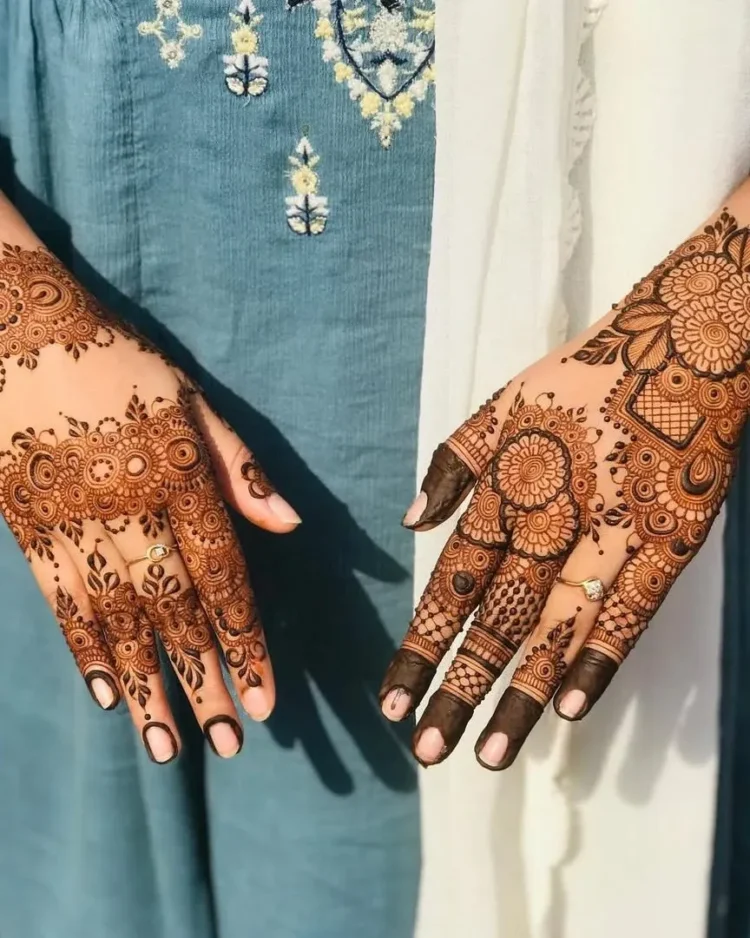
30. Two hands, two lattice styles. One hand has a broad band of ring motifs across the knuckles, the other has large flowers beside net squares and fully dipped fingers. The pair shows how two different fills can still read as a set.
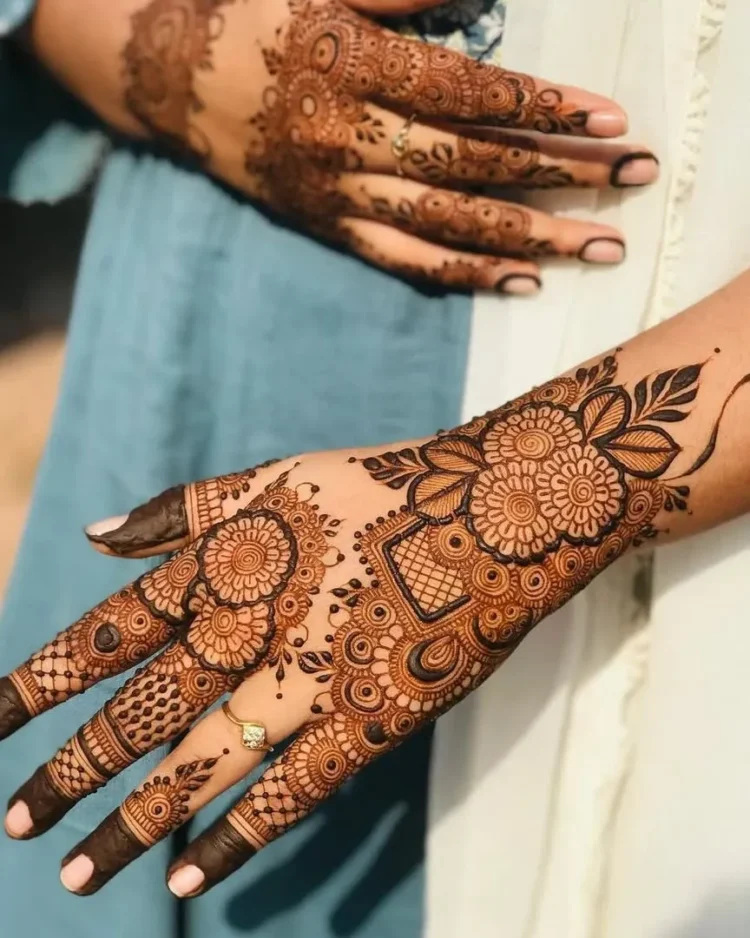
31. Many-petalled blooms with a net square. Large many-petalled flowers with filled leaves sit beside a square panel of fine net. The fingers carry mesh and dot fills and end in dipped tips.
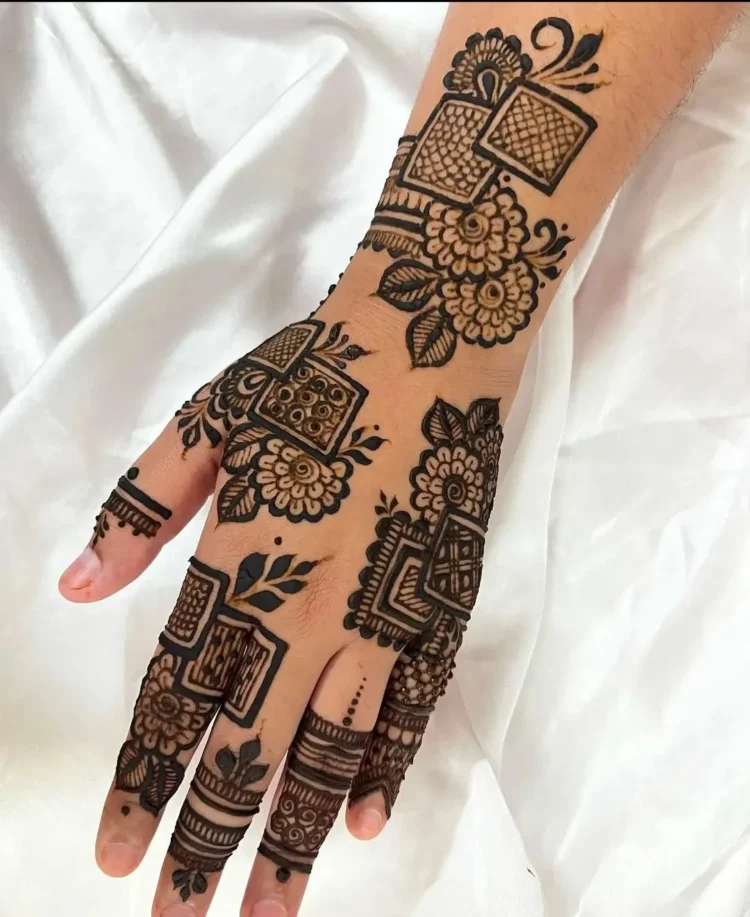
32. Bold outlines with net boxes. Thick dark outlines frame net-filled squares, flowers and solid leaves from the fingers up the forearm. This bold outline style, often called Khaleeji, reads clearly even from a distance.
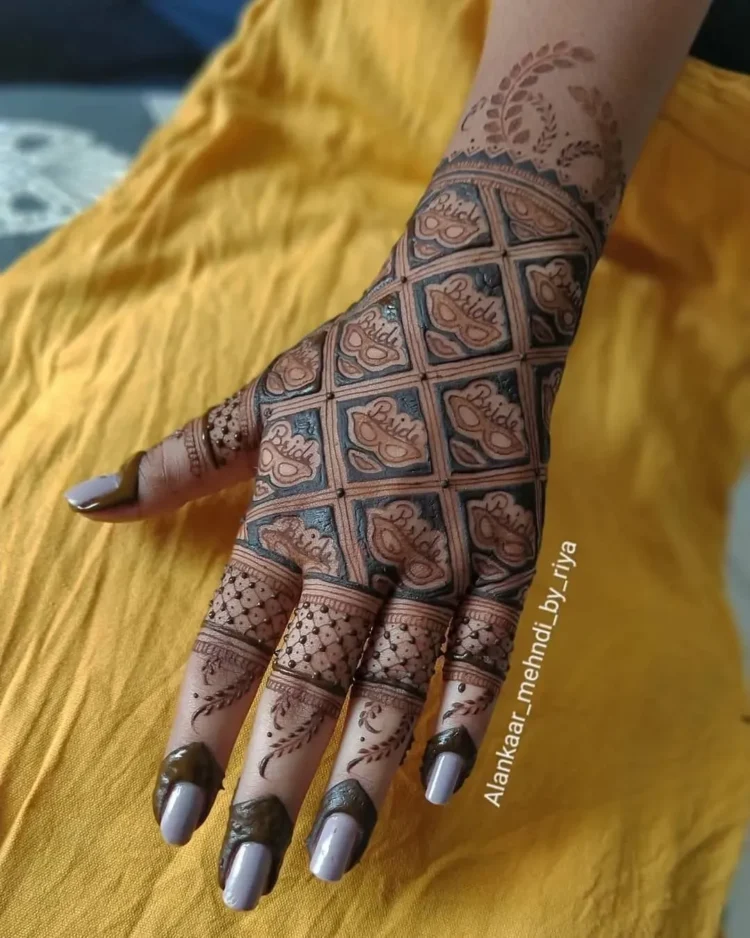
33. Diamond tiles with bare-skin motifs. A grid of filled diamond tiles covers the hand, each holding one bare-skin motif, and two leaf sprigs rise above the wrist like a crest. The fingers mix net, dot fill and leaf sprigs above tips still coated in paste.

34. Rosette grid with a lace wrist band. Small rosettes joined by thin lines form an open grid, with a tiny bud in each gap. A lace band closes the wrist, and the fingers carry stacked bands with leaf tips.
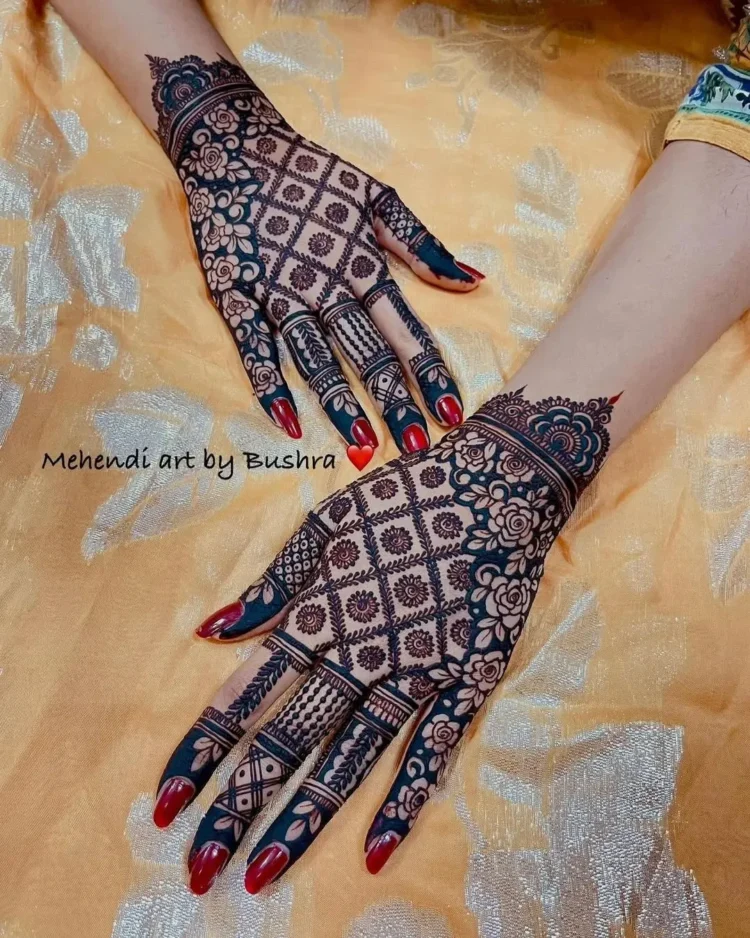
35. Flower lattice with rose borders. A diamond lattice with a small flower in each space fills the centre of each hand, while columns of roses run down both sides. The top edge rises into a dome, and the fingers carry leaf, net and chevron bands.
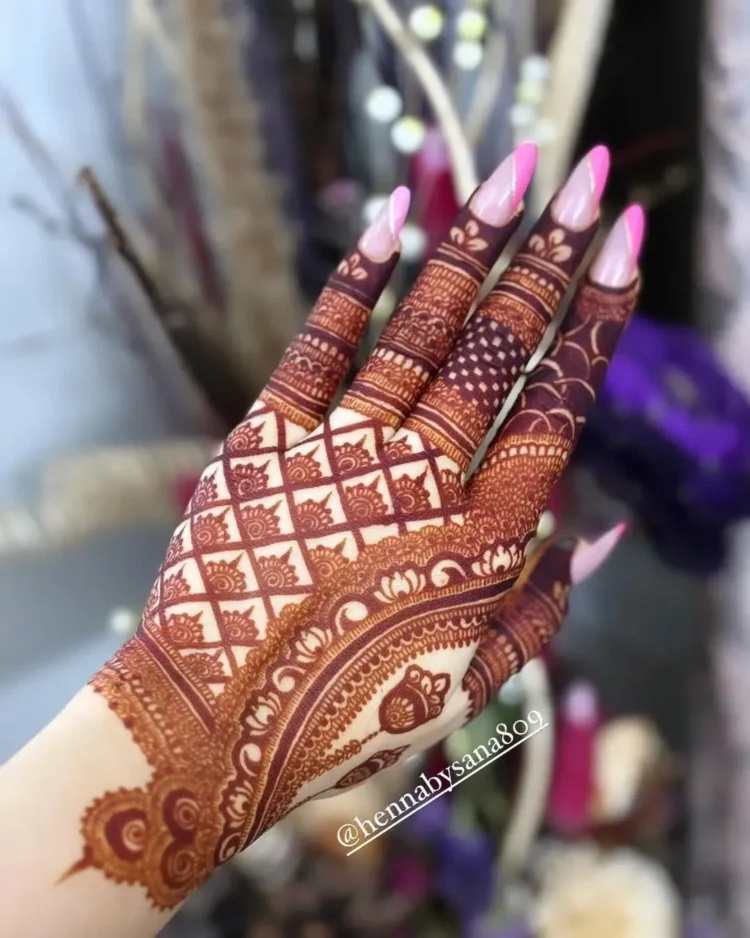
36. Paisley lattice with a curved border. Each diamond of the lattice holds a small fan-shaped paisley, and a wide border of flowers and dots curves around it toward the wrist. A small lantern motif sits near the thumb, and the fingers mix bands, dot mesh and solid tips.
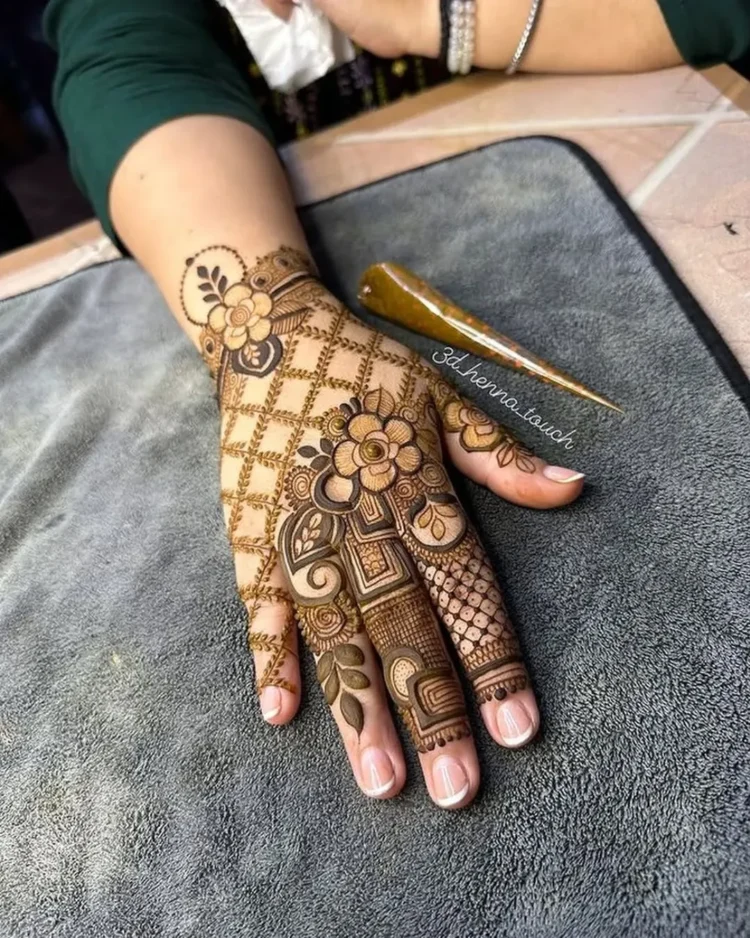
37. Dot lattice with shaded roses. A lattice drawn with dotted lines covers most of the hand, and two shaded roses with small squares break it up near the knuckles. The fingers carry checks, dots and leaves in a warm golden brown.
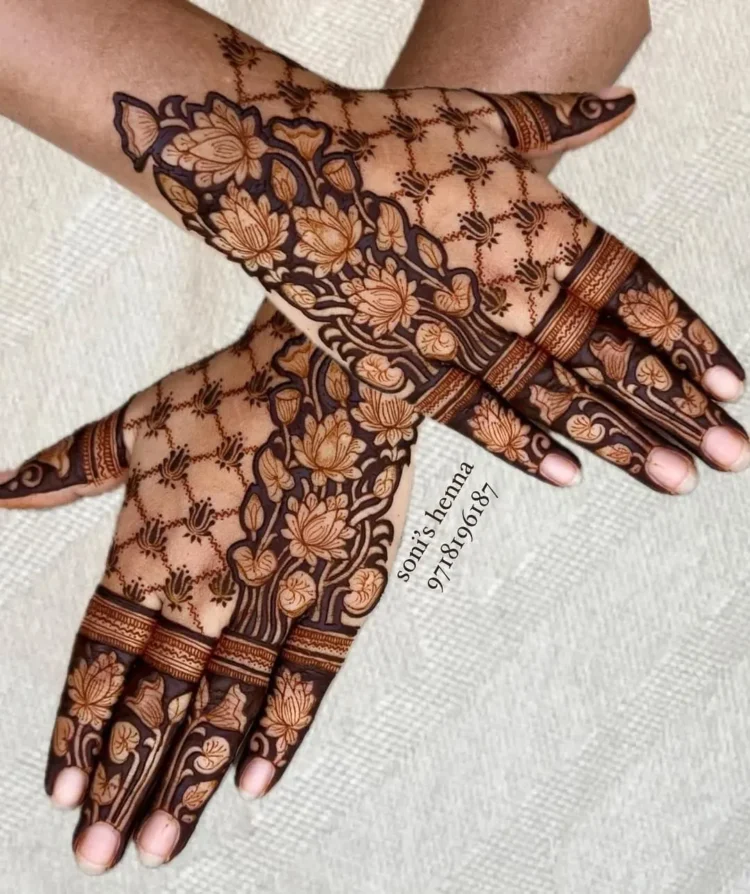
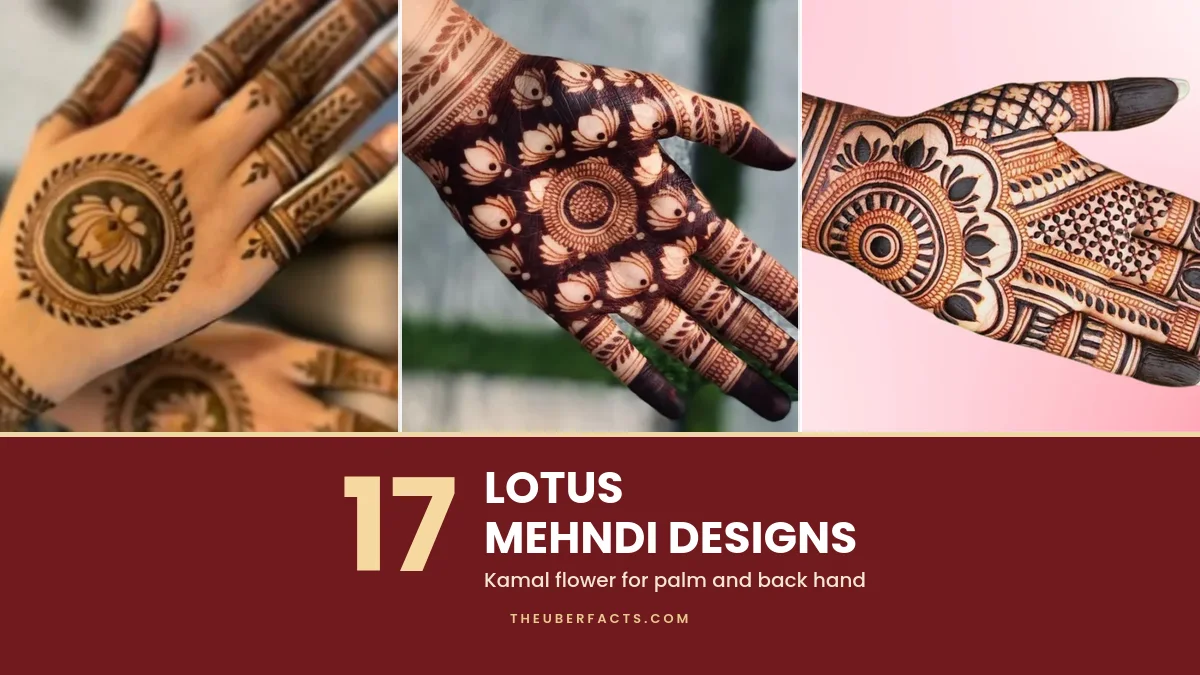
38. Lotus border over a trellis. A thick border of lotus flowers and leaves runs along one side of each hand, and the rest is a trellis of thin lines with a tiny bud at every crossing. Wide bands mark the base of the fingers, which carry more lotus motifs.
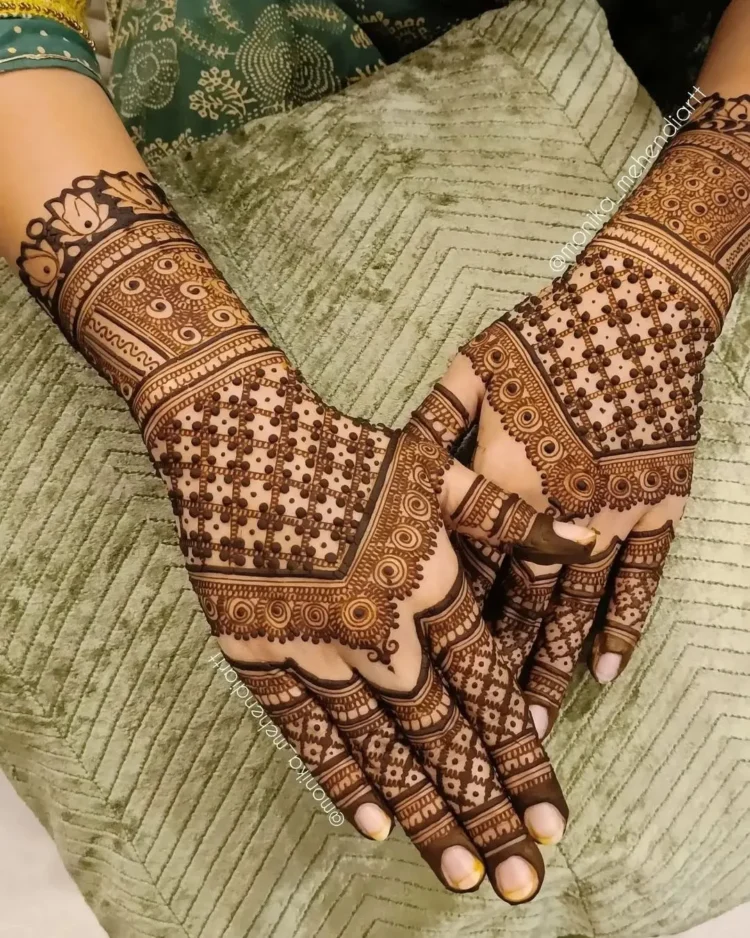
39. Dot flower grid with layered cuffs. A grid of tiny four-dot flowers covers the back of the hand and ends in a chevron edge with spirals. Several cuffs with dots, spirals and lotus shapes climb the forearm, and the fingers are banded down to dipped tips.
Jewellery Style Designs: Haath Phool Chains, Pendants and Mandalas
These designs copy jewellery directly. A haath phool is a hand ornament that joins a ring to a bracelet with chains, and mehndi artists draw the same idea with lines of dots. Pendants, drops and round medallions act like stones set into the pattern. For more patterns built around a central circle, see our circle mehndi designs, and for wrist bands on their own, our bracelet mehndi designs.
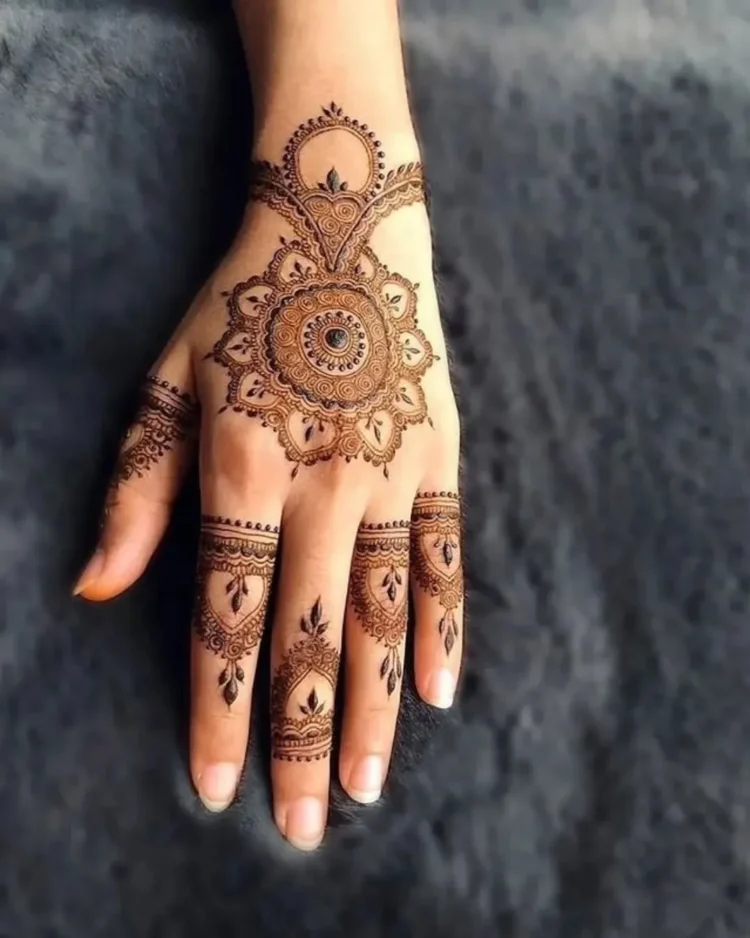
40. Mandala hung from a wrist arch. A mandala with a dark dot centre and pointed petals hangs from a horseshoe arch at the wrist, like a pendant on a bracelet. Each finger has a lace band with a small drop, and the skin around them is left bare.
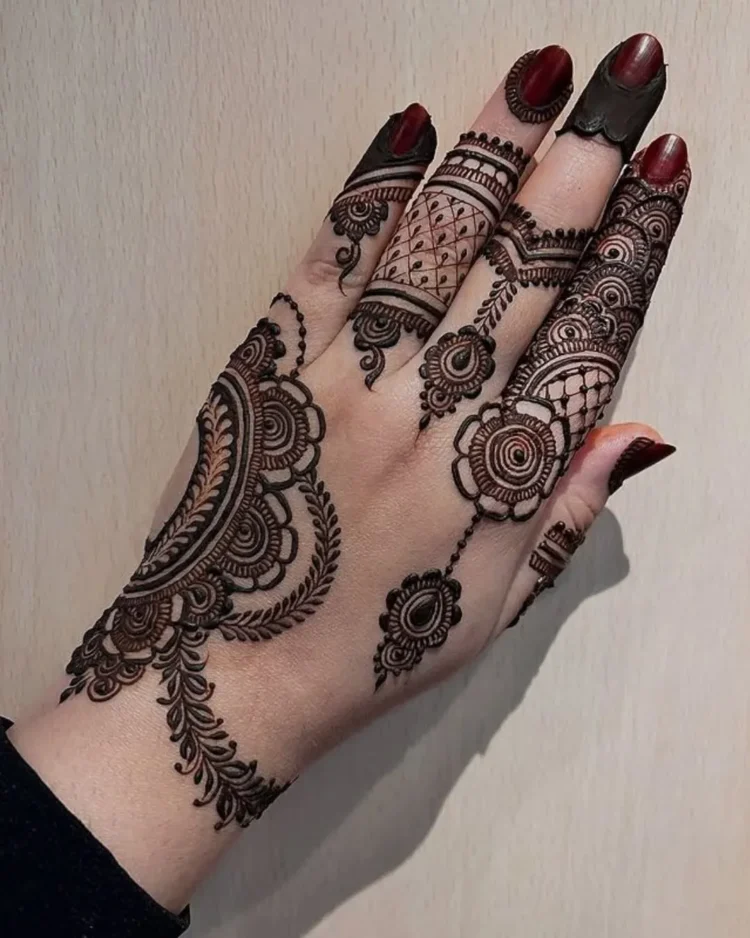
41. Teardrop pendant with a half mandala. A half mandala hugs the side of the hand and trails leaves toward the wrist, while a teardrop pendant hangs from a round flower on a short chain. The fingers mix net, rings and solid caps.
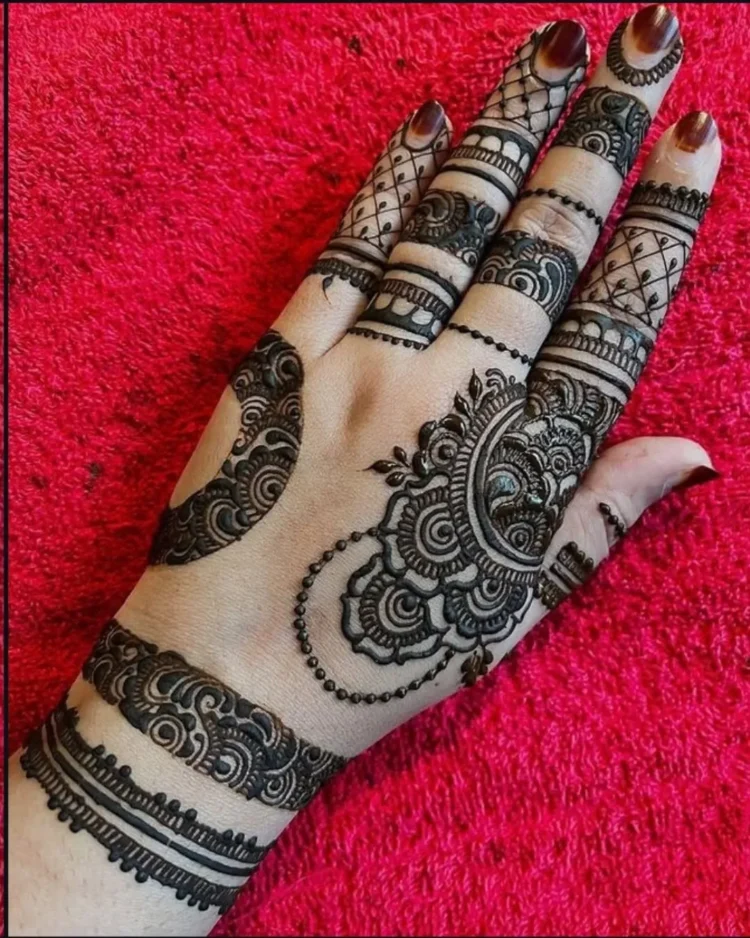
42. Looping dot chains and double bracelets. A swirling paisley sits in the centre with a looping chain of dots below it, and two wide bracelet bands wrap the wrist. Net and ring bands fill the fingers in the same very deep brown.
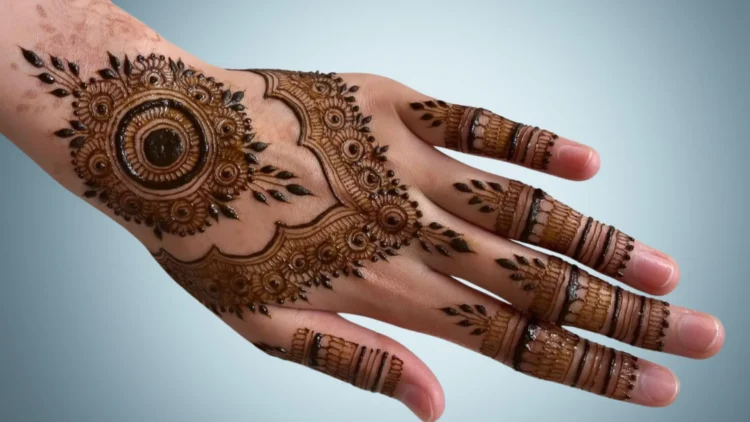
43. Dark-centre mandala with a lace arc. A mandala with a solid dark centre sits near the wrist, and a lace arc carries the pattern across the hand. Ringed bands with leaf tips on every finger complete a balanced medium-coverage design.
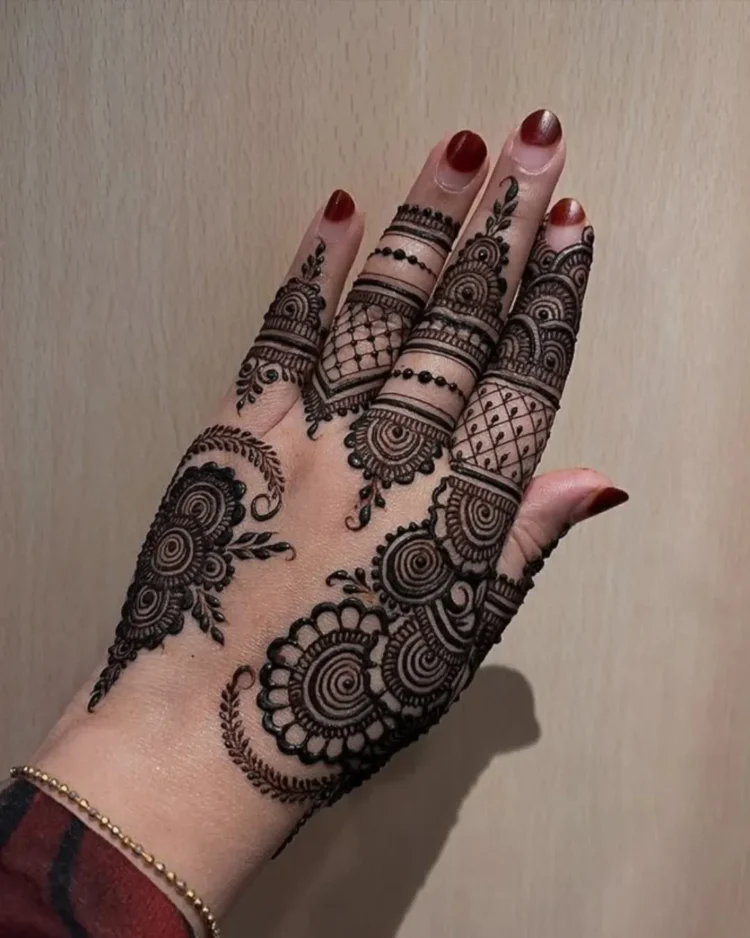
44. Spiral circles and dot chains. Circles filled with tight spirals cluster on the hand with leaf sprays, and the fingers alternate net, dot chains and solid bands. The spirals need a steady hand to keep the gaps even.
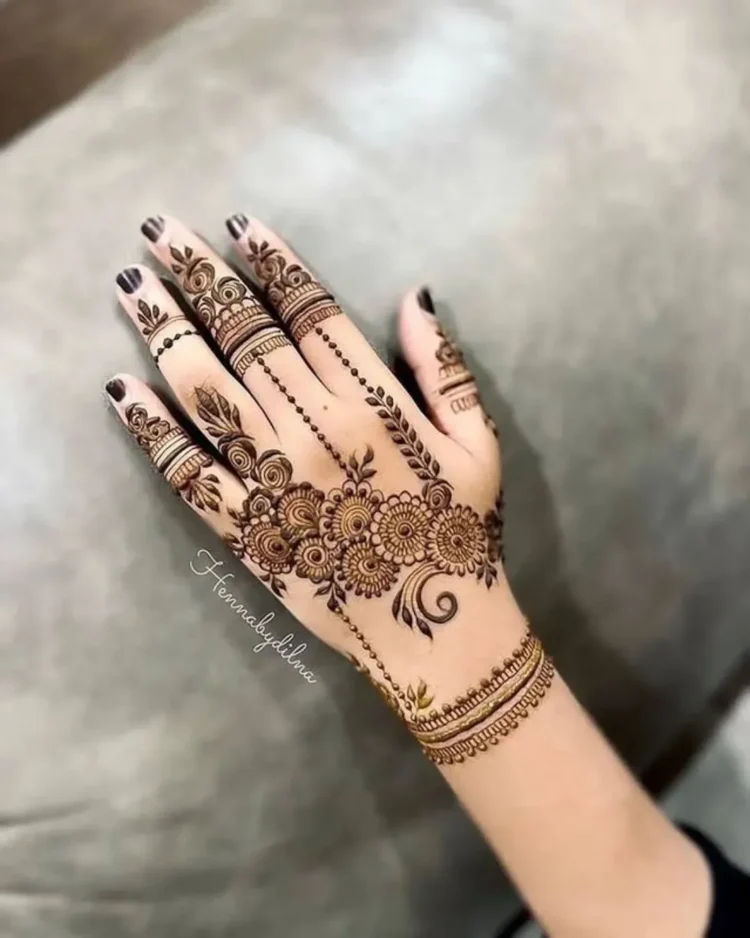
45. Flower band with a finger chain. A row of round flowers crosses the hand above a swirl, and a chain of dots links the middle finger to a bracelet at the wrist, like a haath phool. Each finger gets a short band with a leaf sprig.
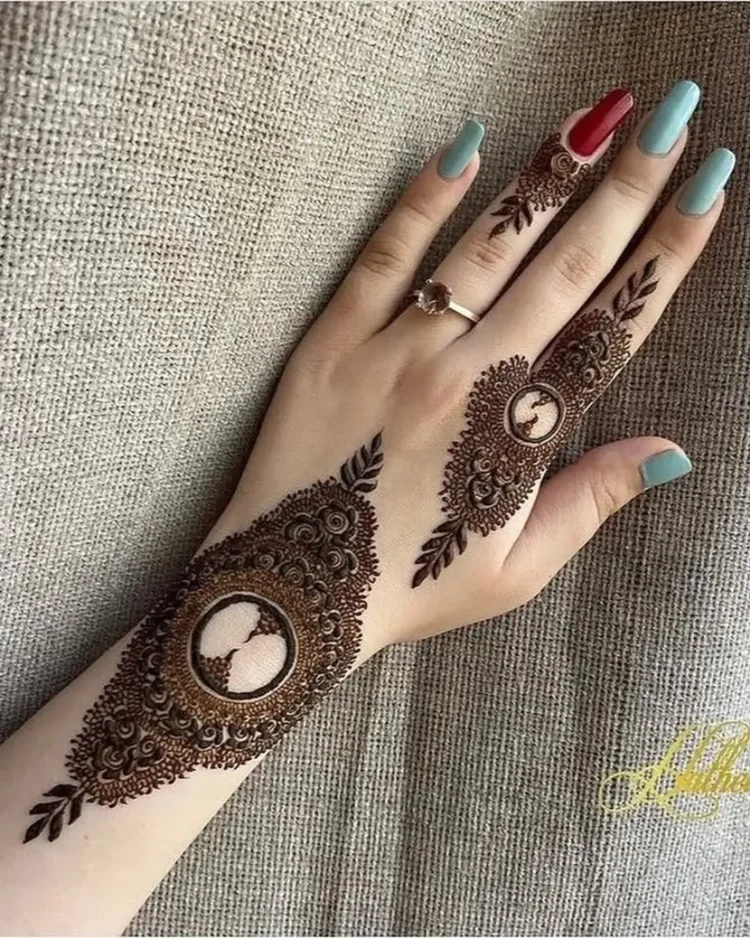
46. Oval medallion with a bare centre. An oval medallion of tight curls sits near the wrist with a bare centre and leaf sprays at both ends, like a large pendant. A smaller version leads up toward one finger, and the rest of the hand stays bare.
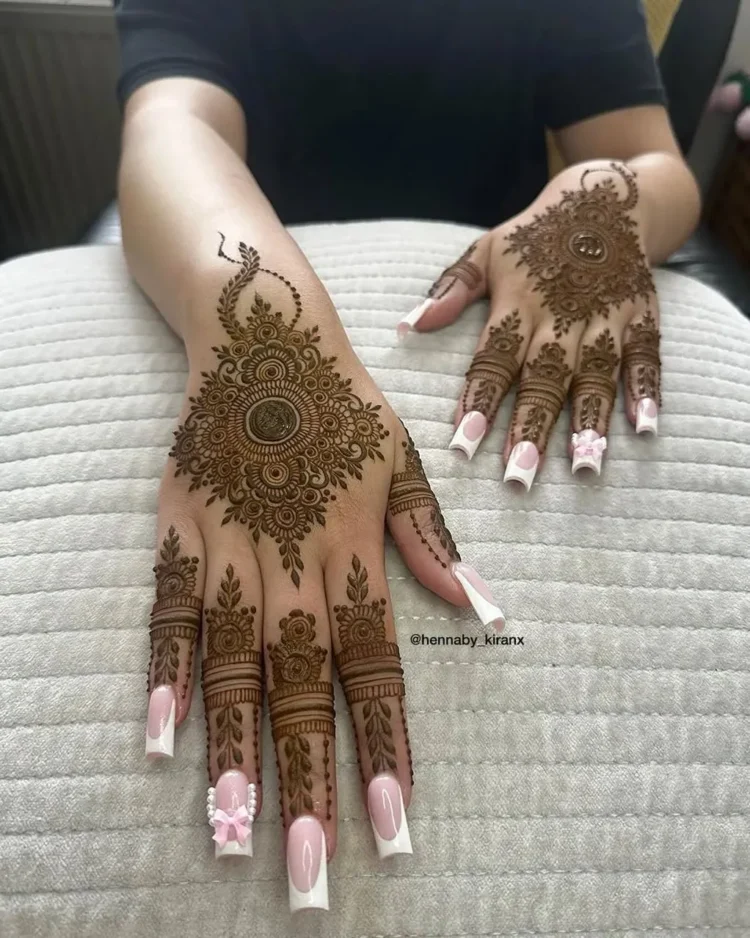
47. Round medallion with a curling tail. A large round medallion with a solid centre sits in the middle of the hand, and a curling line of dots rises from it toward the wrist. The fingers carry leaf columns and bands, and the second hand repeats the medallion at a smaller size.
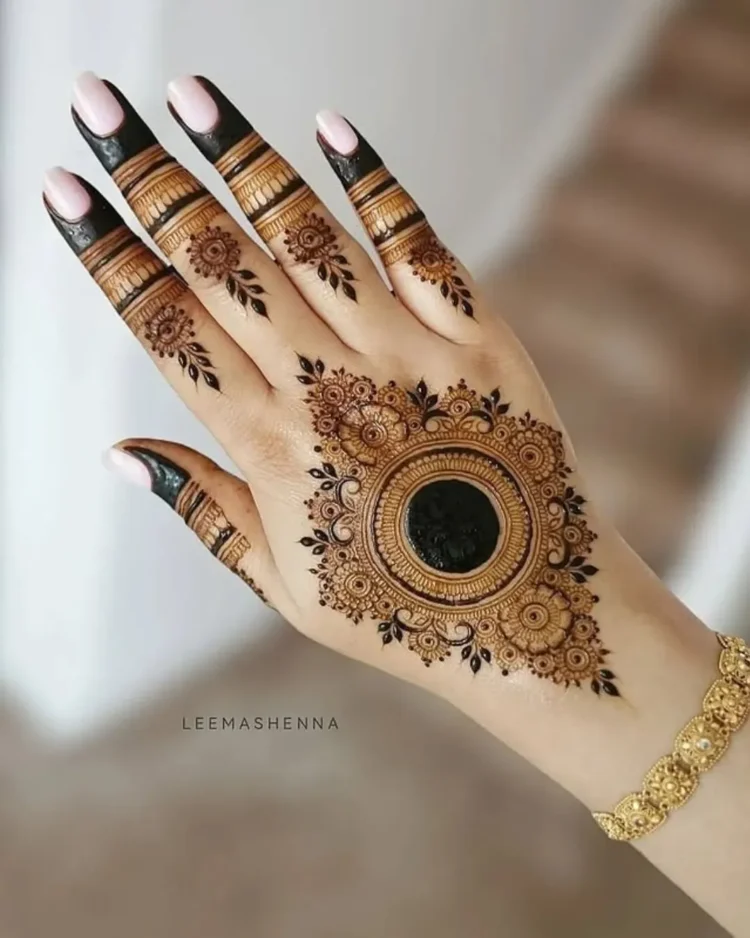
48. Dark disc medallion with dipped tips. A solid dark disc sits inside a ring of fine fill, with small flowers and leaves around it, like a stone in a setting. The fingers carry bands and single flowers, and the tips are dipped in paste.
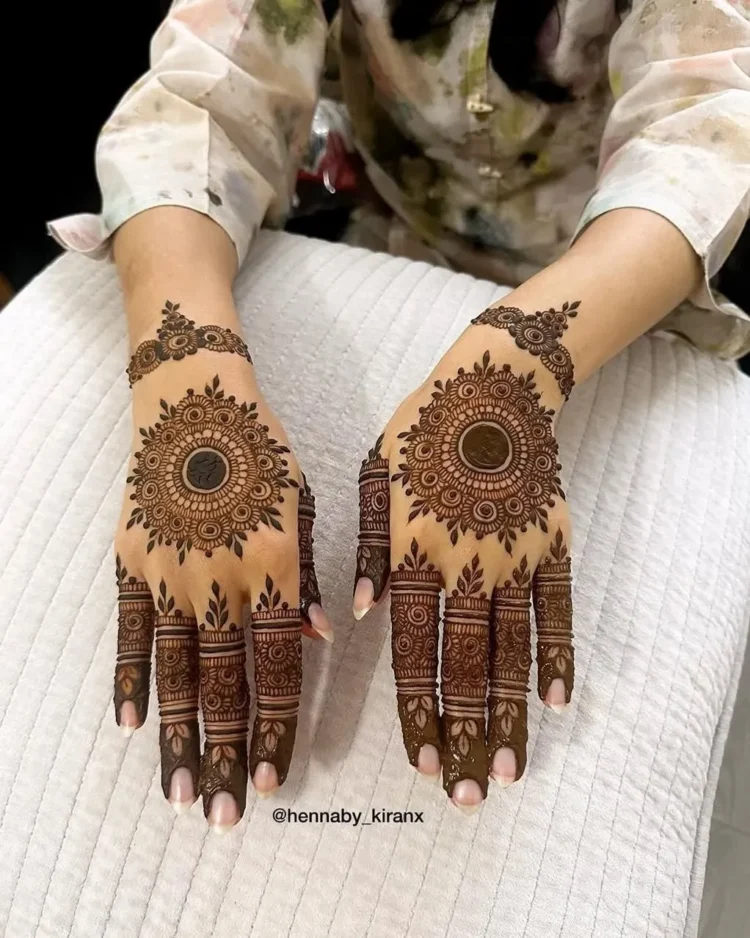
49. Matching mandalas with wrist bracelets. Each hand carries the same large mandala with a dark centre, and a short bracelet motif sits on each wrist. Leaf and band patterns fill the fingers down to dipped tips.
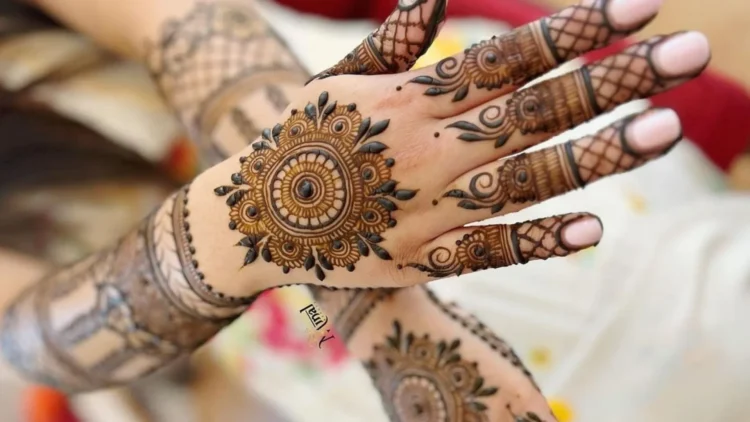
50. Leaf-tipped mandala with net fingers. A round mandala with a dark centre and a ring of pointed leaves sits on the hand, and a dotted line marks the wrist. The fingers alternate between net fill and spiral bands, with a matching mandala on the second hand behind.
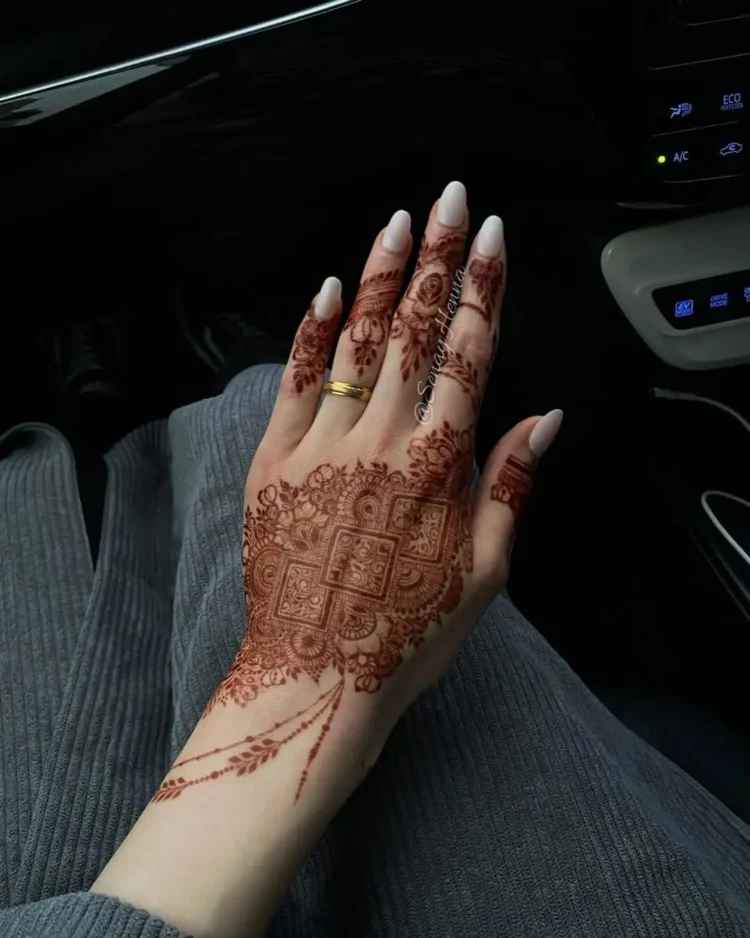
51. Interlinked squares with long tassels. Interlinked square frames form the centre of a dense medallion of flowers, and long strands of leaves hang from it past the wrist like tassels. Single flowers sit on the fingers in the same red stain.
Royal Back Hand Mehndi Designs with Circle Flower Clusters
Round flowers drawn as rings of small circles and dots are the base of many modern royal back hand designs. Clusters of them are stacked on the hand, joined by leaf sprigs or dotted chains, and paired with net fill on one or more fingers. The coverage is medium, so the look is rich but quicker to draw than full bridal jaal.
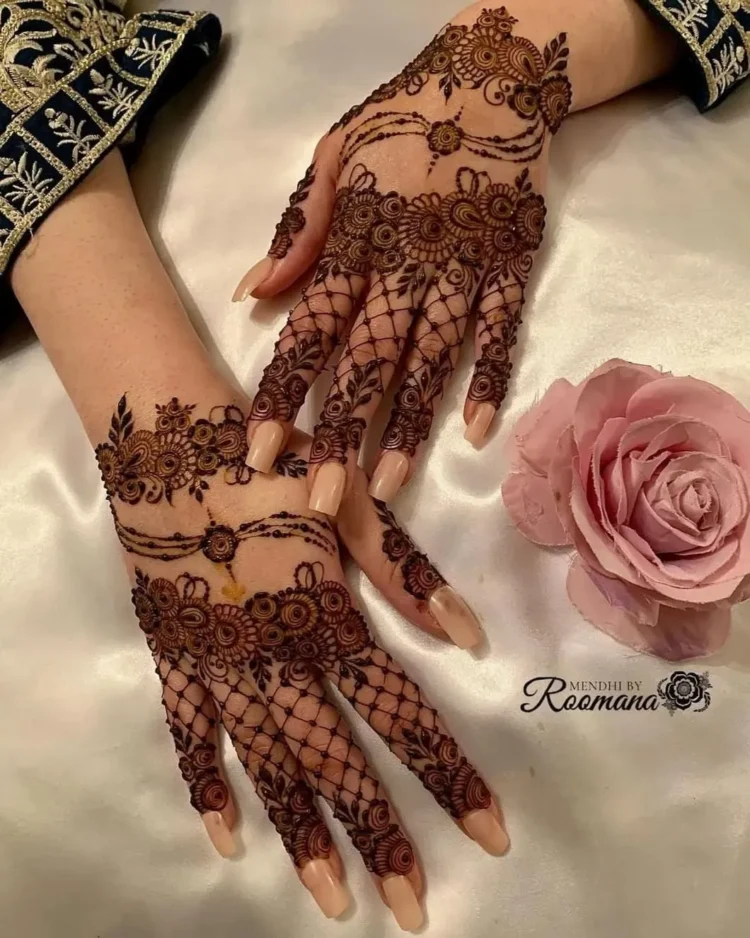
52. Flower bands with dotted swags. Two bands of round flowers cross each hand, with a swag of dotted chains and a small flower hanging between them. Net fill covers the fingers below, so the hand reads as a jewelled cuff above a lace glove.
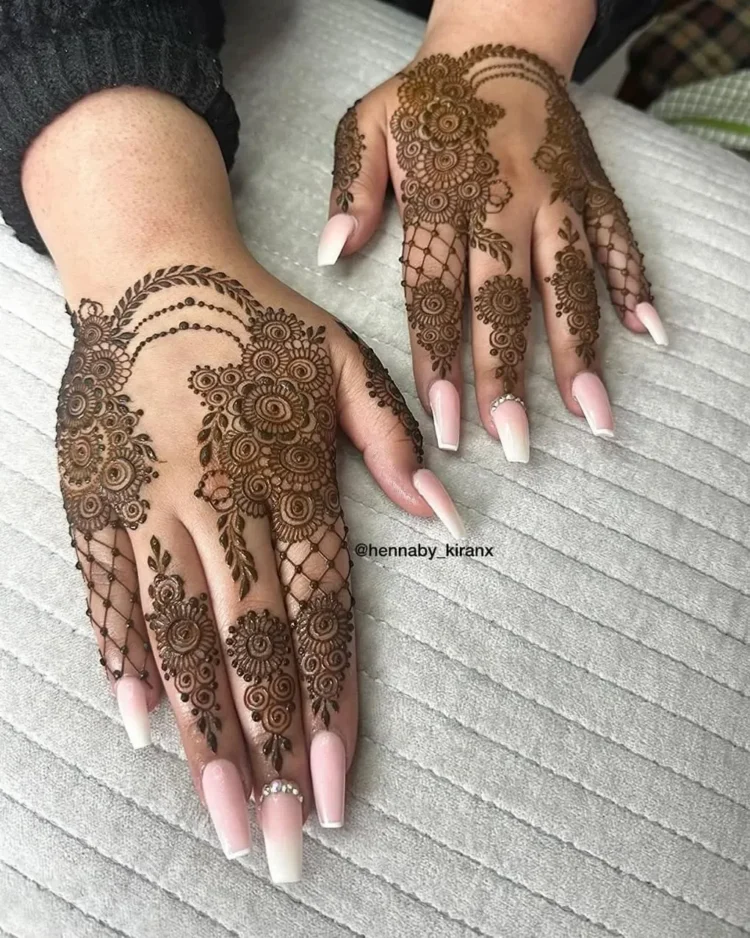
53. Flower clusters with curved dot chains. Circle flowers are stacked along one side of each hand, and curved chains of dots arc toward the wrist. Net fill alternates with single flower motifs on the fingers.
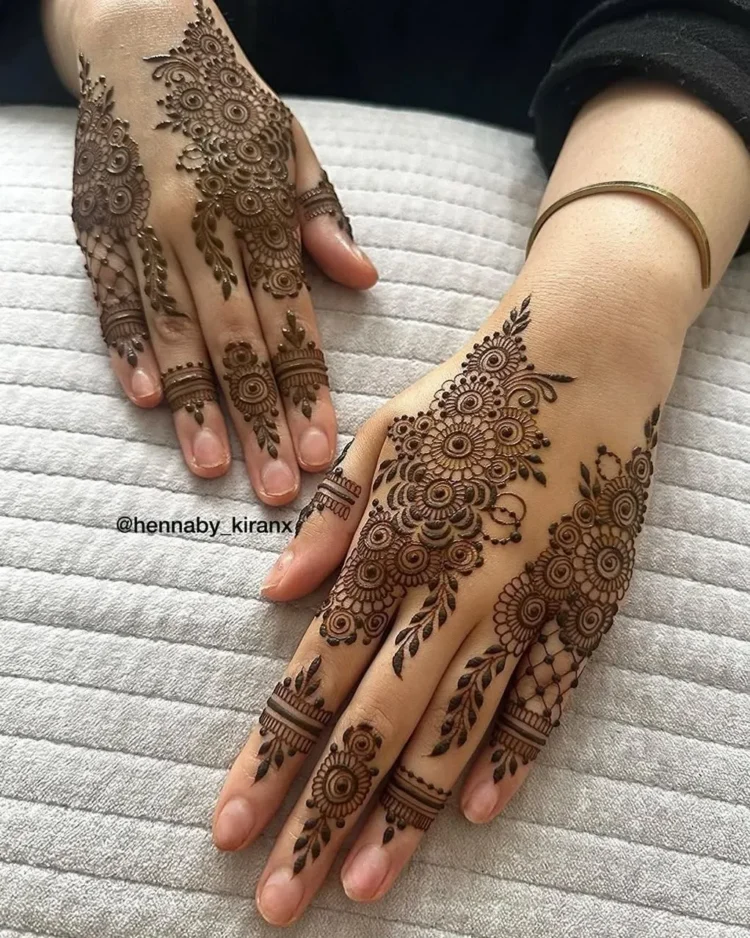
54. Diagonal circle flower trail. Circle flowers run in a diagonal trail from the wrist to the knuckles, with leaf sprigs filling the gaps. Bands, single flowers and one net finger finish each hand.
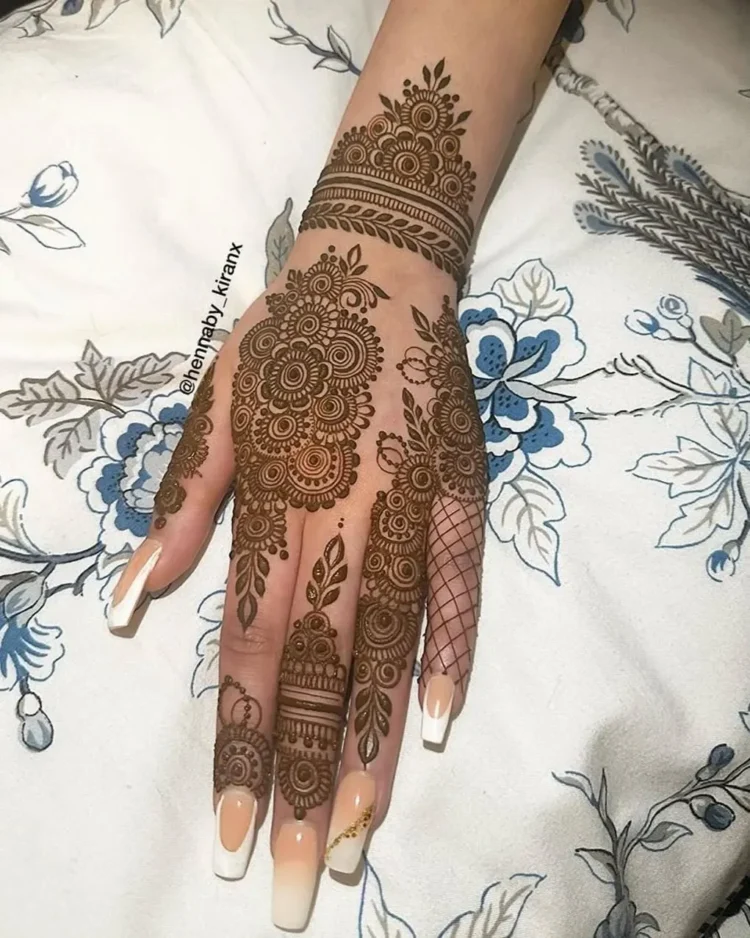
55. Domed wrist cuff with a flower cluster. A cuff of leaf bands rises into a small dome of flowers at the wrist, and a large cluster of circle flowers covers the middle of the hand. One finger carries net and the others carry flowers and bands.
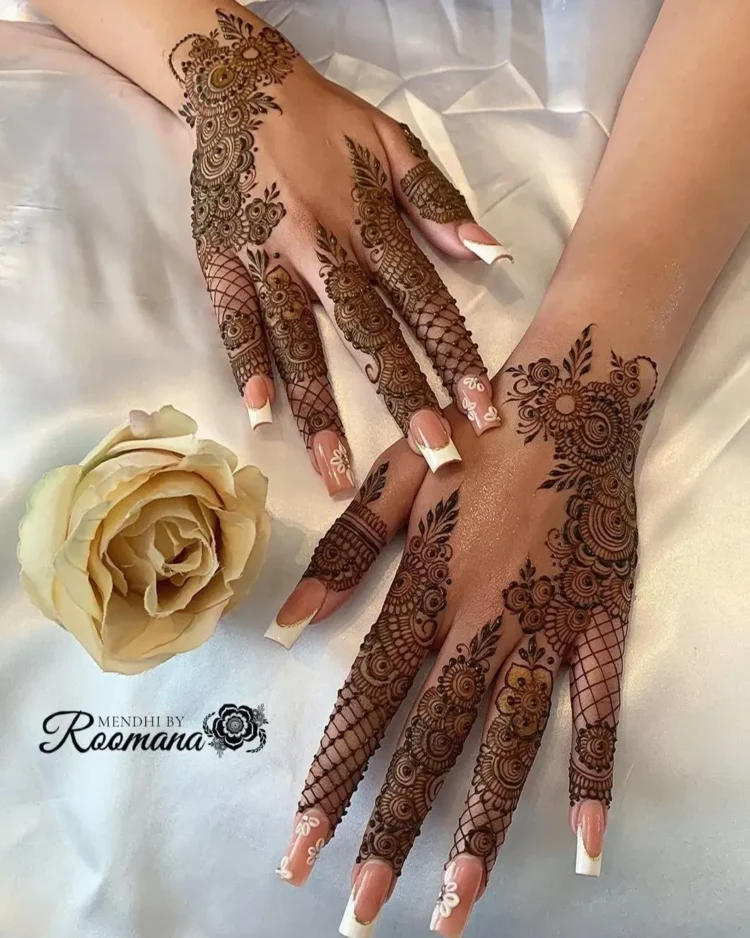
56. Side flower columns with net fingers. Columns of circle flowers run along the outer edge of each hand, with leaf sprays reaching toward the centre. Net fill and flower bands alternate on the fingers, leaving the middle of the hand bare.
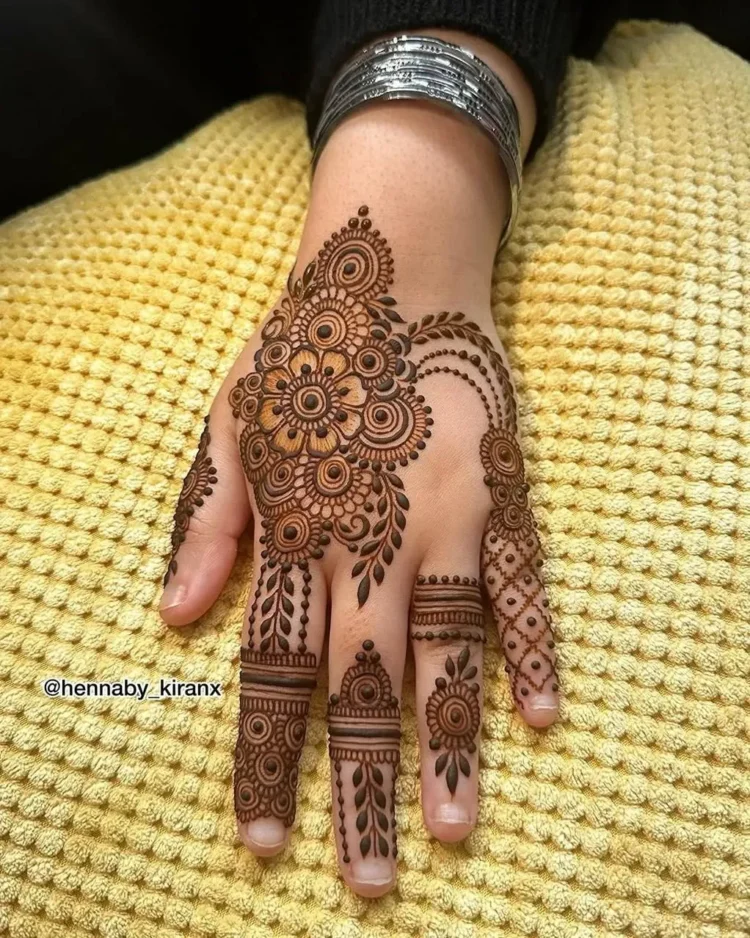
57. Large flower with a dotted arc. A large flower made of rings and dots sits on the hand with a curved line of dots arcing to one side. Leaf columns, bands and a dotted lattice cover the fingers.
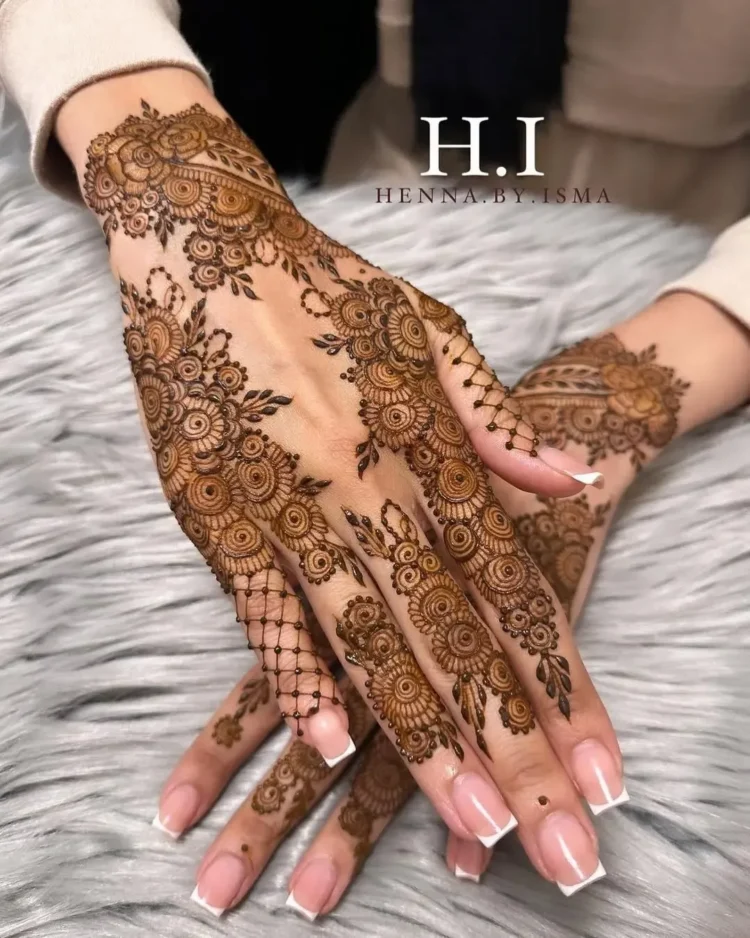
58. Rich flower cluster with bead net. Dense clusters of circle flowers cover the hand in a golden brown stain, and one finger carries a net of dots that looks like beadwork. The second hand underneath repeats the pattern.
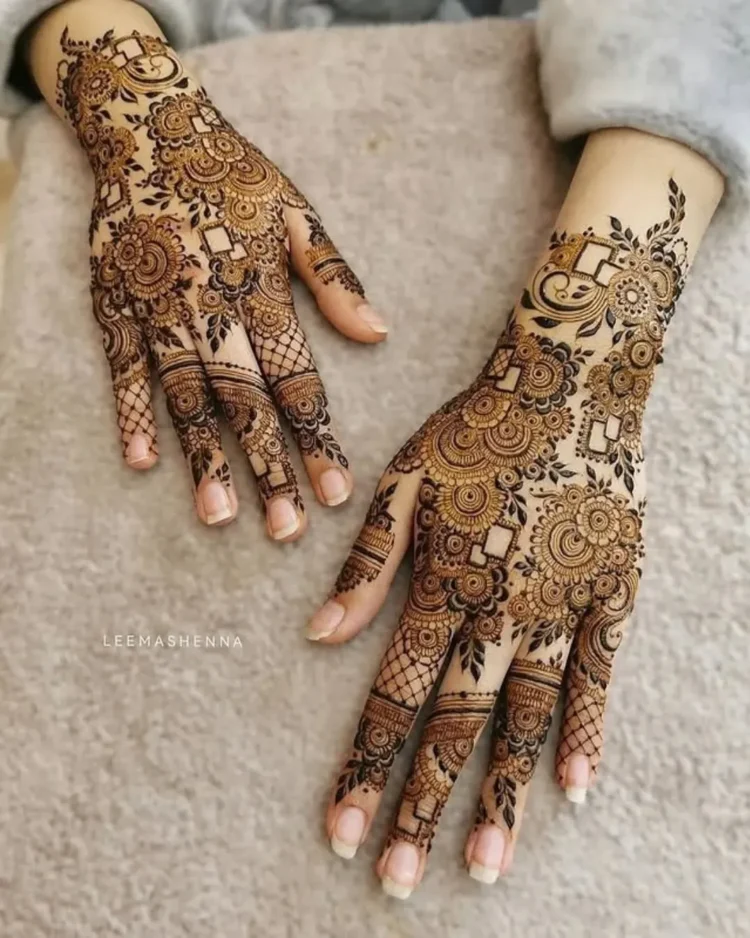
59. Circle flowers with small square frames. Circle flowers fill both hands, broken up by small square frames and leaf sprigs. Net and bands cover the fingers, and the stain is a warm golden brown.
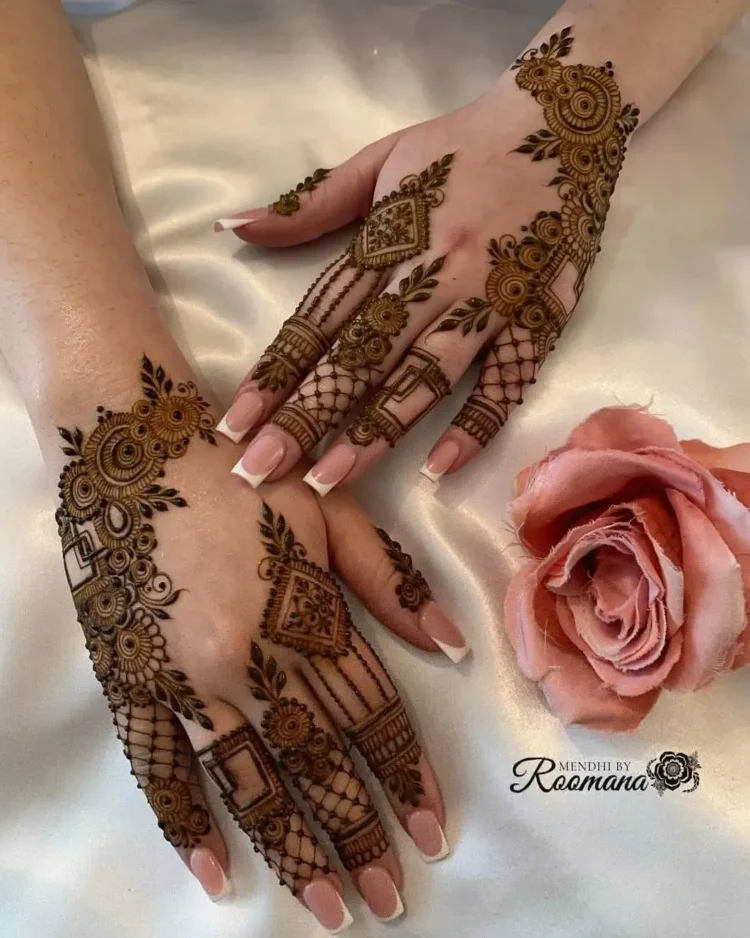
60. Diamond pendant with chain fingers. A small diamond motif hangs on the hand with fine lines running from it up the fingers like chains, and a column of circle flowers and square frames runs along the side. Net and bands fill the remaining fingers.
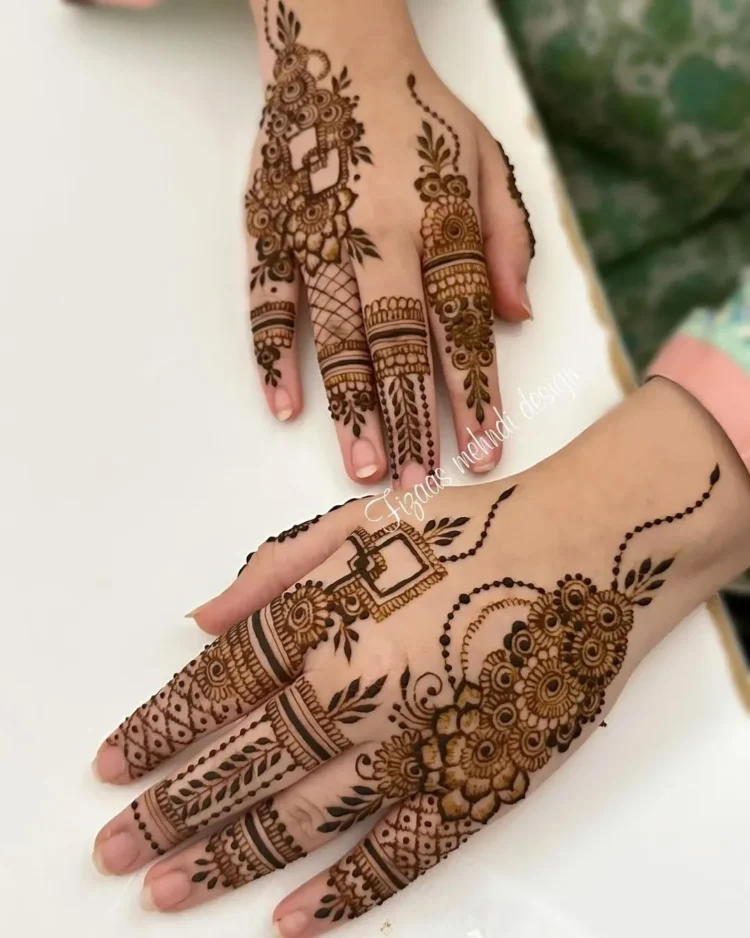
61. Square frames with flower clusters. Two linked square frames sit near the knuckles, and a cluster of circle flowers trails toward the wrist on a dotted line. The fingers mix net, leaf columns and bands.
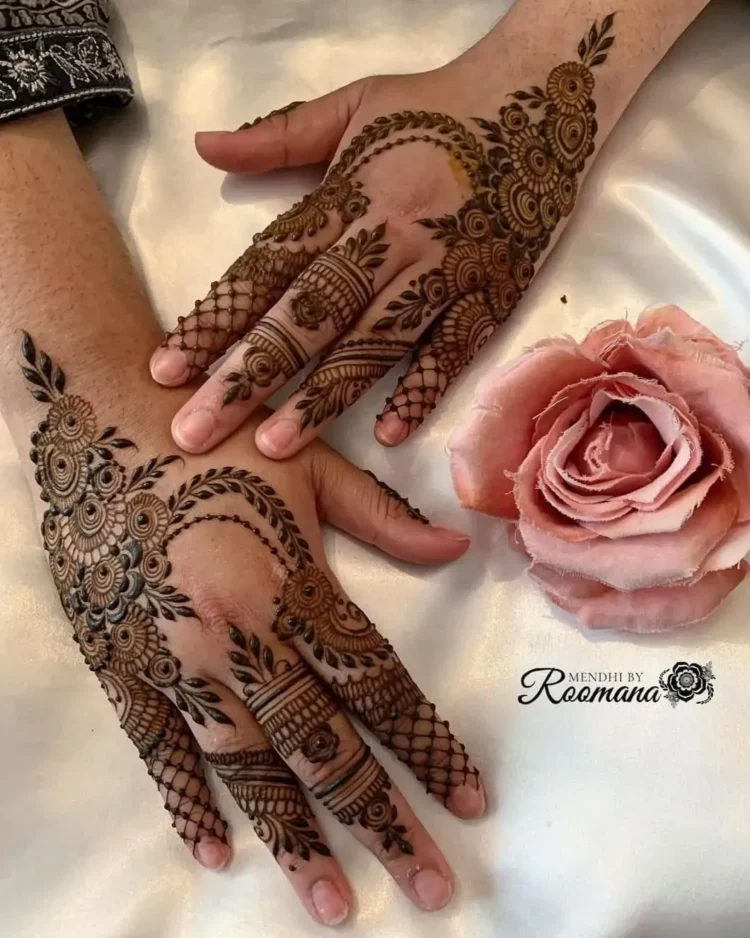
62. Leafy arcs with flower clusters. Thin leafy arcs swing across both hands and end in clusters of circle flowers along the edge. Net fill and single bands cover the fingers.
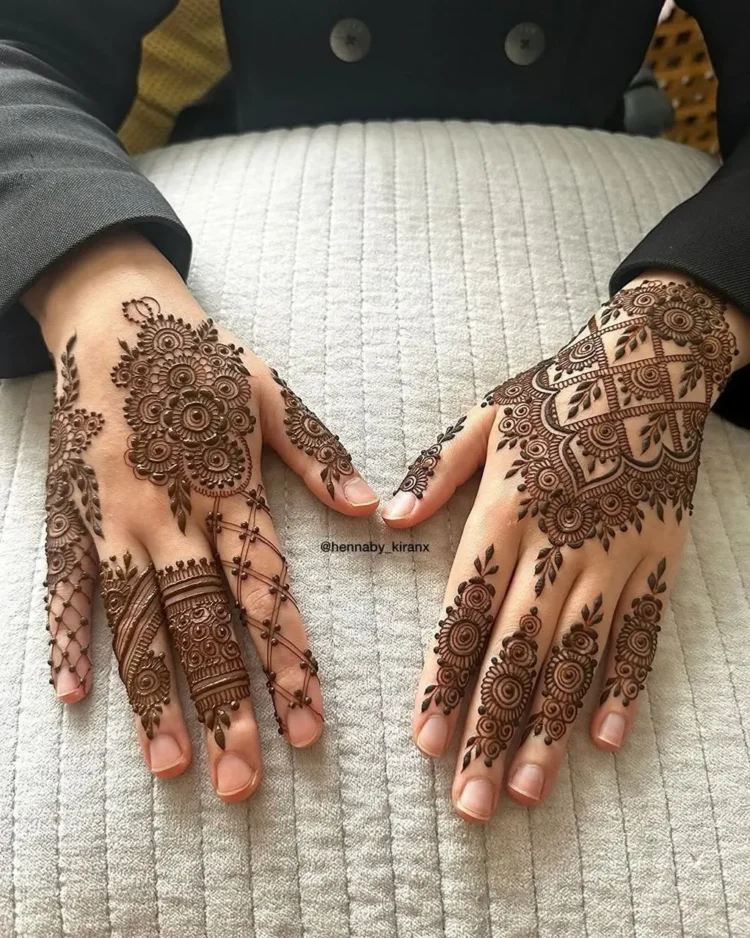
63. Mandala hand and lattice hand. One hand has a round flower cluster with crossing dotted lines on the fingers, the other a lace lattice with leaves above circle flowers on each finger. The two hands are drawn as a matched but different pair.
Arabic Rose and Floral Royal Back Hand Mehndi Designs
Arabic mehndi, popular in the Gulf and widely worn in Pakistan and India, places a trail of flowers diagonally across the hand and leaves open skin around it. A royal version adds shading inside the petals, larger blooms and patterned fingers. Rose lovers will find more in our rose mehndi designs.
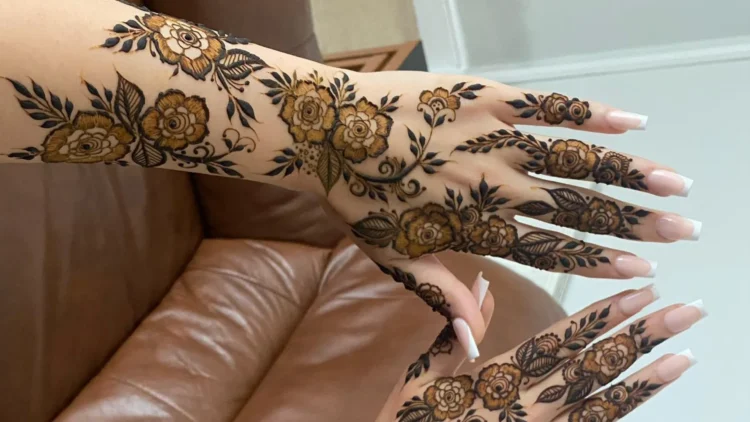
64. Shaded rose trail on both hands. Large roses with shaded petals and pointed leaves trail from the forearm over the back of the hand, and rose clusters continue on the fingers. The shading inside each petal gives a raised look.
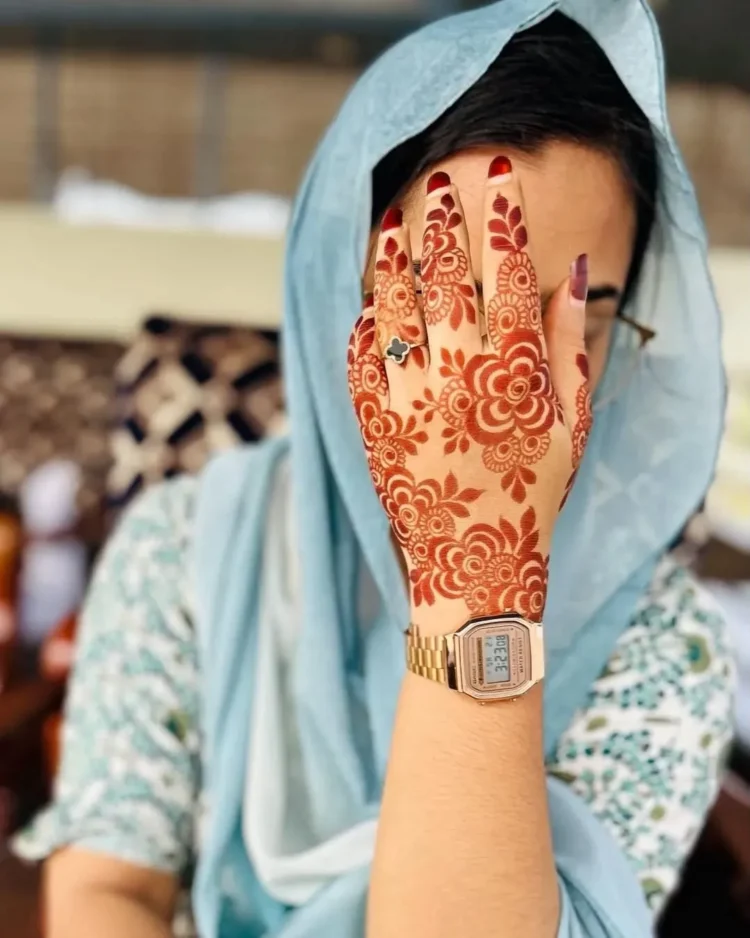
65. Bright red rose cascade. Layered roses run diagonally across the back of the hand and up the fingers in a bright orange-red stain. That shade is typical of the first day and usually deepens to red-brown within two days.
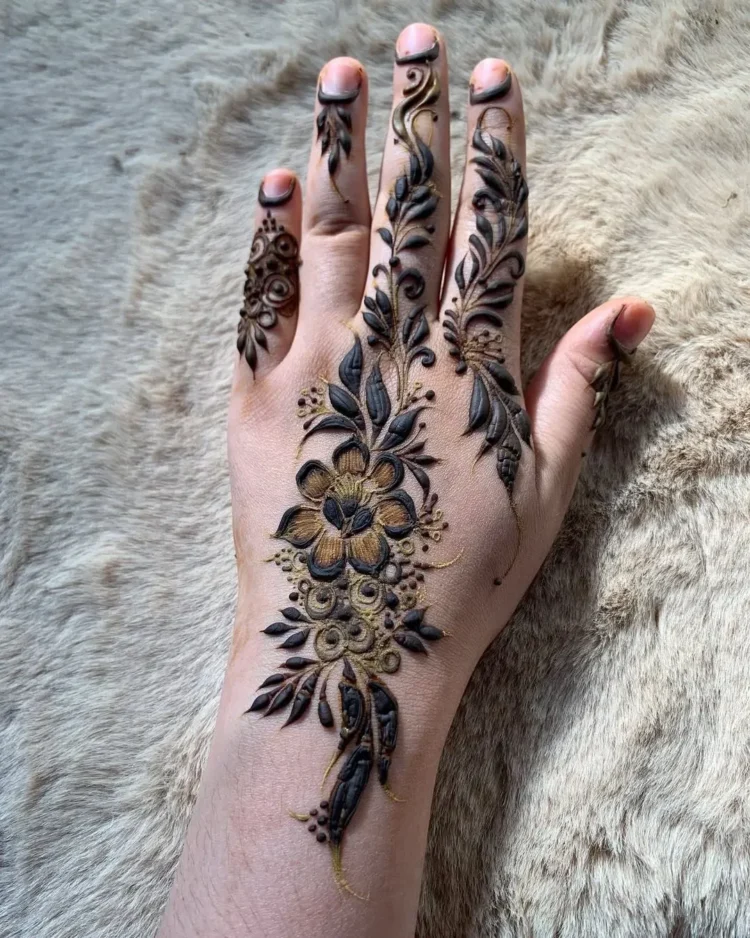
66. Dark outlined flower with golden shading. A large flower with dark outlines and golden inner shading sits mid-hand, and long leafy stems climb two fingers. The contrast between outline and fill is the whole effect.
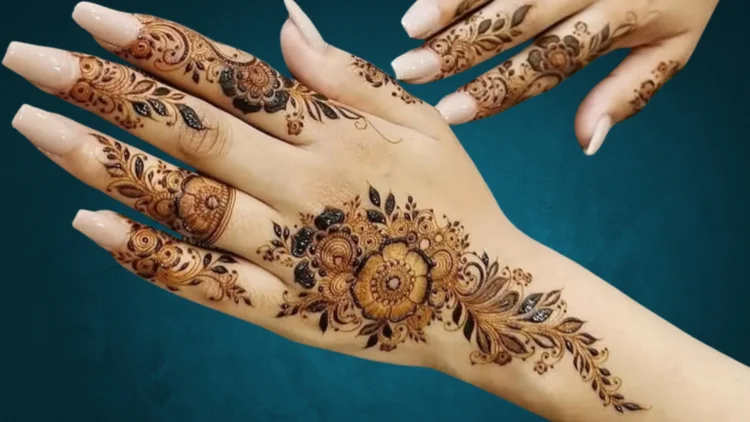
67. Single flower with a leafy trail. One full flower sits on the back of the hand with a long trail of leaves toward the wrist, and small flowers decorate the fingers. It gives a wedding guest a royal look in far less time than a bridal design.
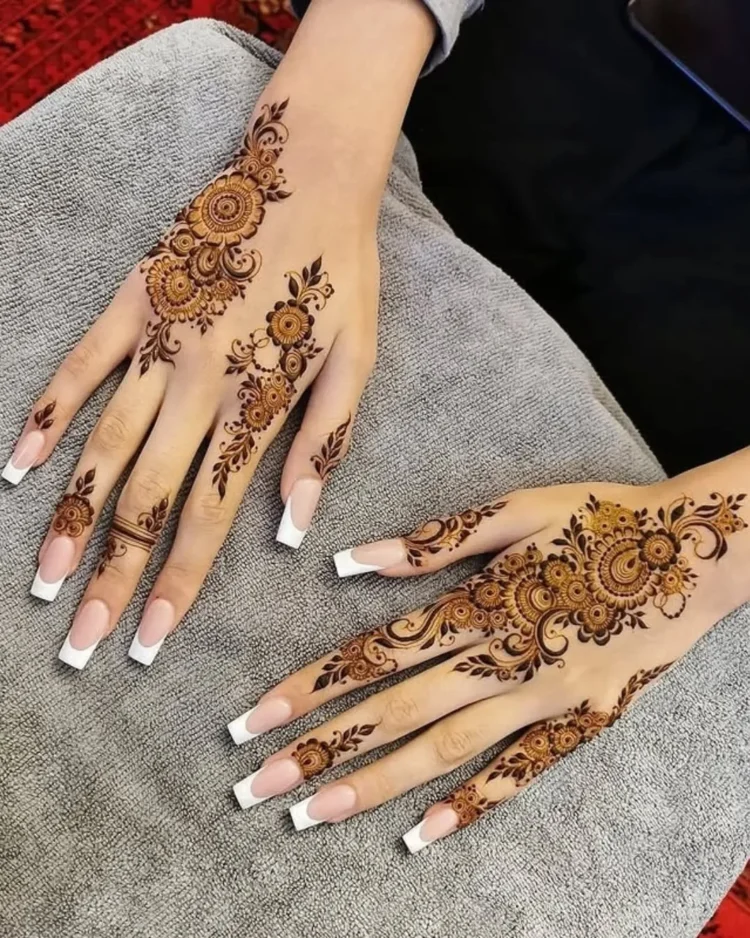
68. Diagonal flower trails on both hands. Both hands carry a diagonal trail of round flowers and curling leaves, with single motifs on the fingers. The open skin between the flowers keeps it light enough for an Eid party.
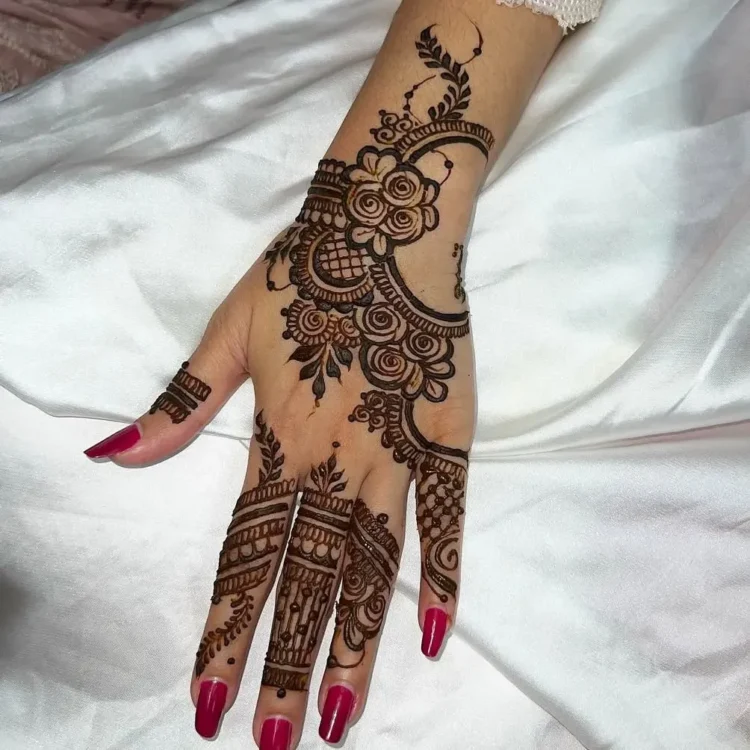
69. Roses with a checker panel and crescent. Bold roses and a small checkered panel sit inside a sweeping crescent line, and the fingers carry wide bands. The deep brown colour suits a design with this many solid fills.
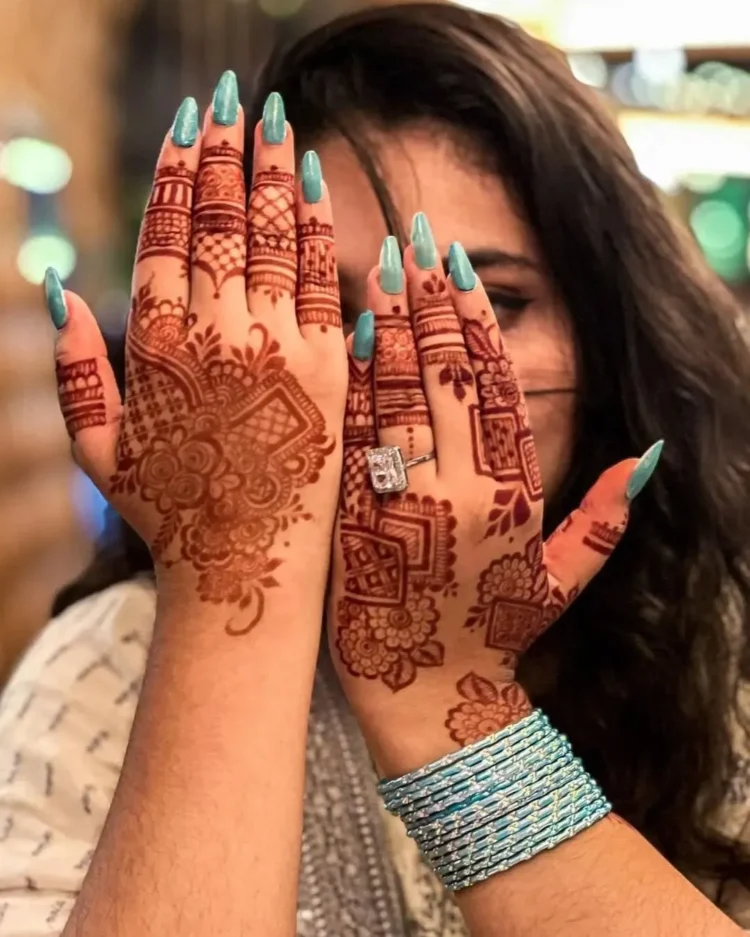
70. Floral and geometric pair. One hand shows a floral cluster beside a net square, the other a stack of diamond shapes, and both have banded fingers. Held up together, the two hands read as one planned set.
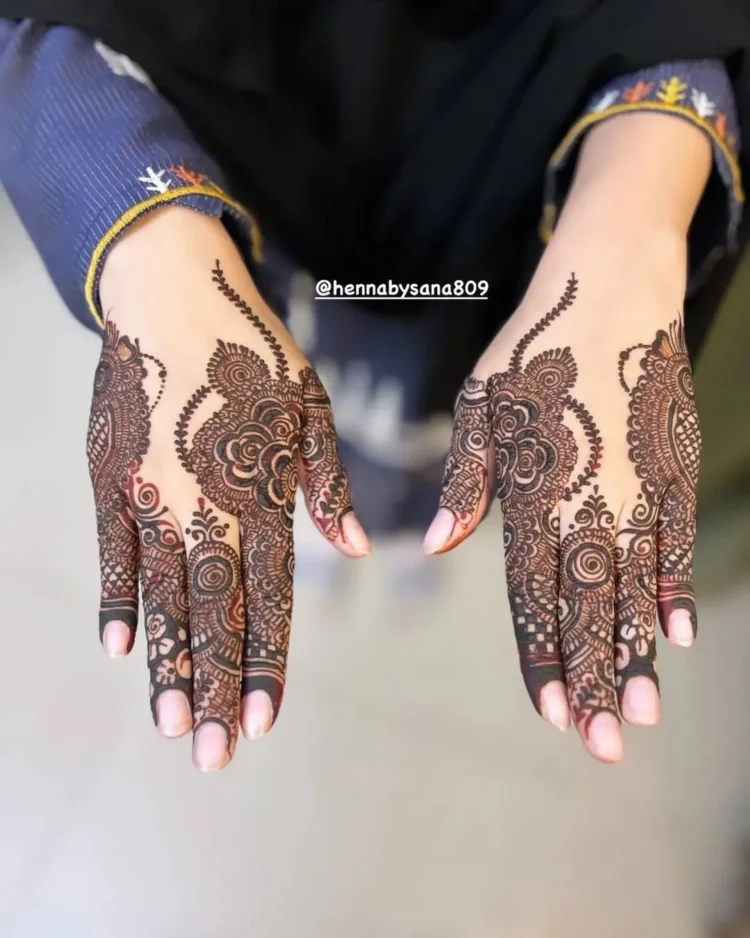
71. Dark paisley trails on both hands. A paisley trail with a large rose runs from each wrist to the knuckles, with thin vine stems rising above it. Mixed fills cover the fingers, and the tips are dipped solid.
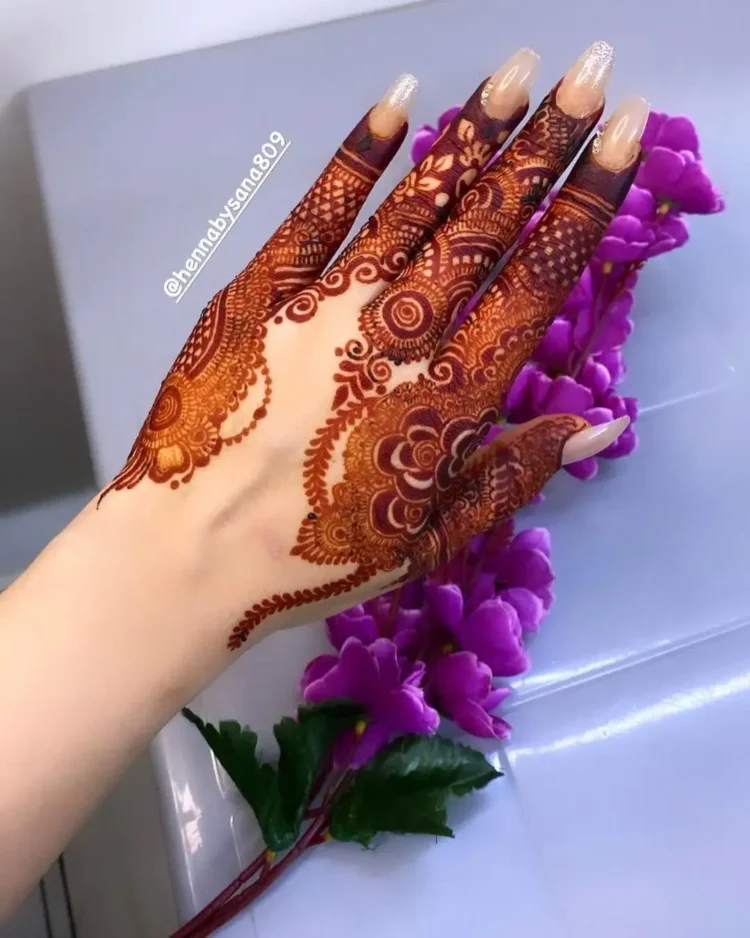
72. Orange rose with a side mandala. A large rose near the thumb and a half mandala on the outer edge are joined by paisley trails across the hand. The fingers mix net, checks and flowers, all in a bright orange stain.
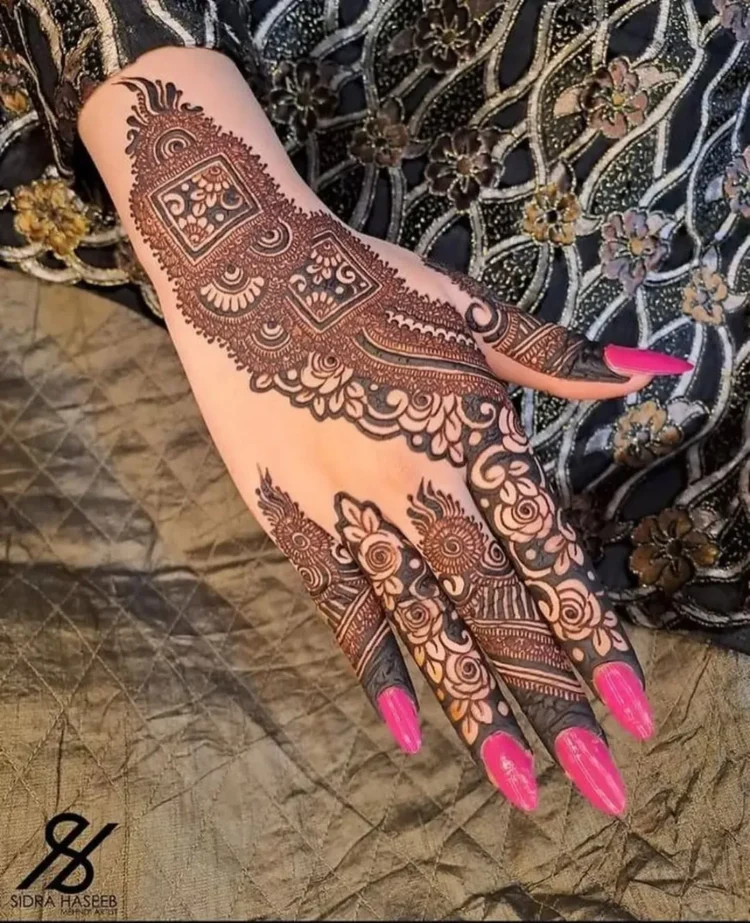
73. Square panels along a side trail. A broad trail of square panels, crescents and roses runs along the edge of the hand with a lace border on the inner side. The fingers carry roses and fine fills down to dark tips.
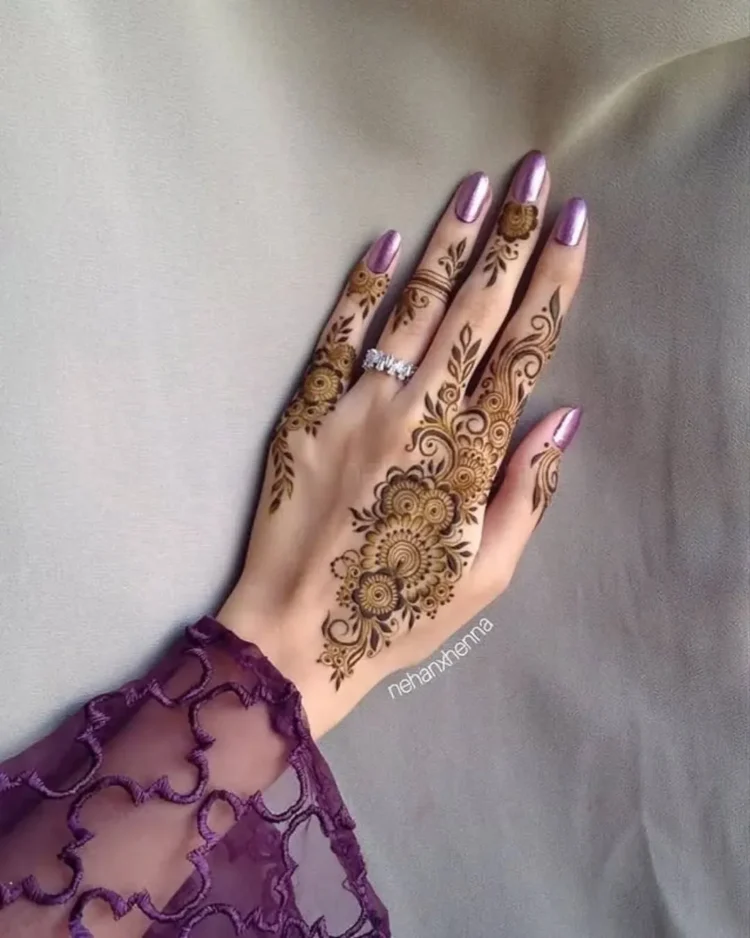
74. Golden flower spray with a finger vine. A spray of circle flowers and curls sits near the wrist, and a single curling vine climbs one finger. Small flowers on the other fingers keep the design light.
Bold Outline and Shaded Royal Back Hand Mehndi Designs
This style, often called Khaleeji, draws thick dark outlines around large flowers and fills them with lighter shading, so the motifs look raised. The fingertips are often fully coated. It suits a bride or guest who wants a bold, graphic look rather than fine jaal.
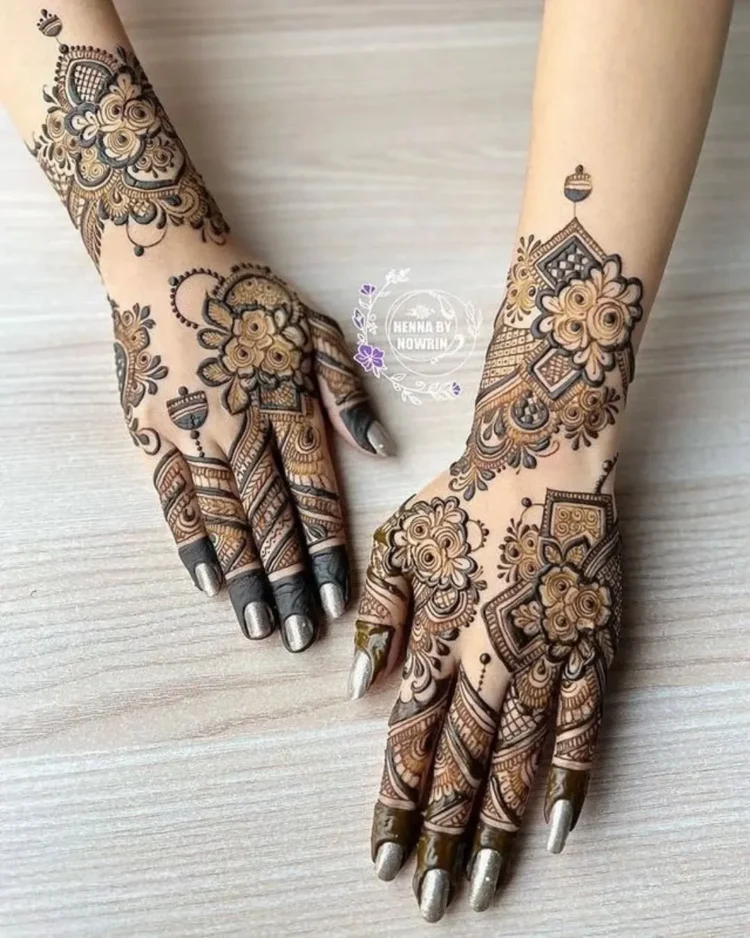
75. Shaded roses with hanging lamps. Shaded roses with dark outlines sit beside checkered squares and small hanging lamp motifs on both hands. The fingers carry diagonal bands and are coated at the tips.
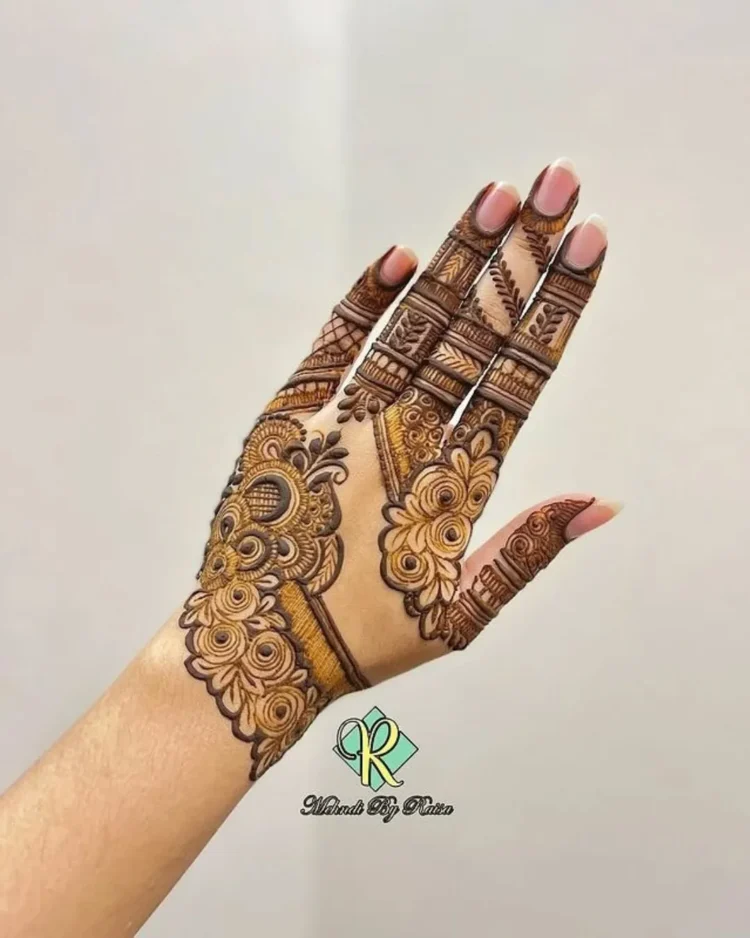
76. Outlined roses with a slanted band. Golden roses with heavy outlines cluster along the side of the hand and over the wrist, cut by a slanted band. The fingers carry leaf lines and bands, and the middle of the hand stays open.
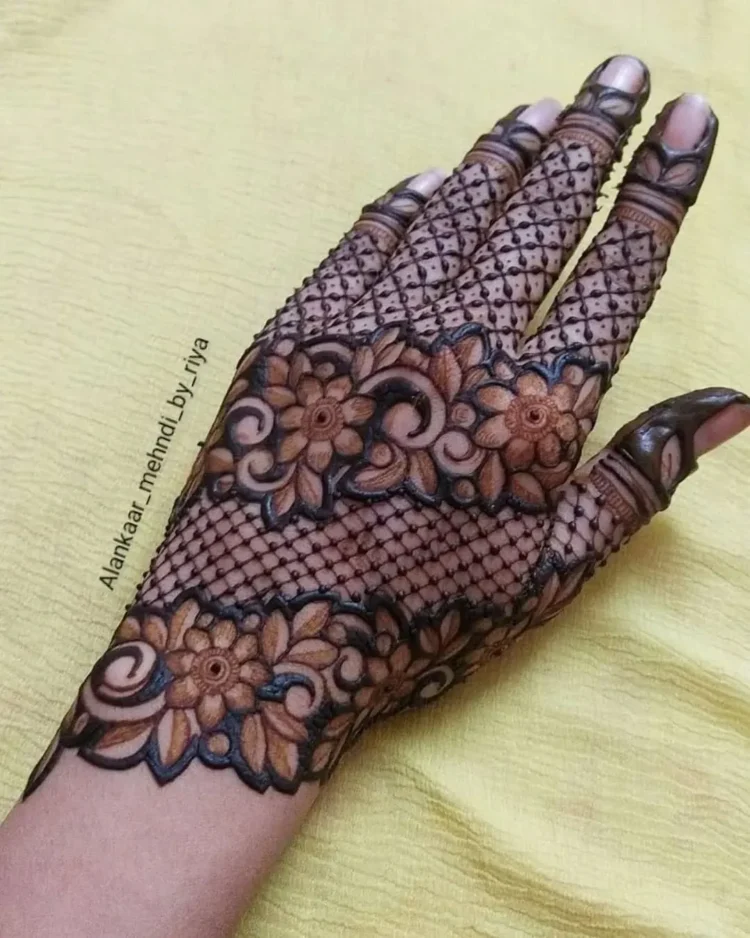
77. Outlined flower bands with net. Two bands of outlined flowers and swirls cross the hand with a band of net between them, and net continues up every finger. The dark edges against the lighter fill give a strong contrast.
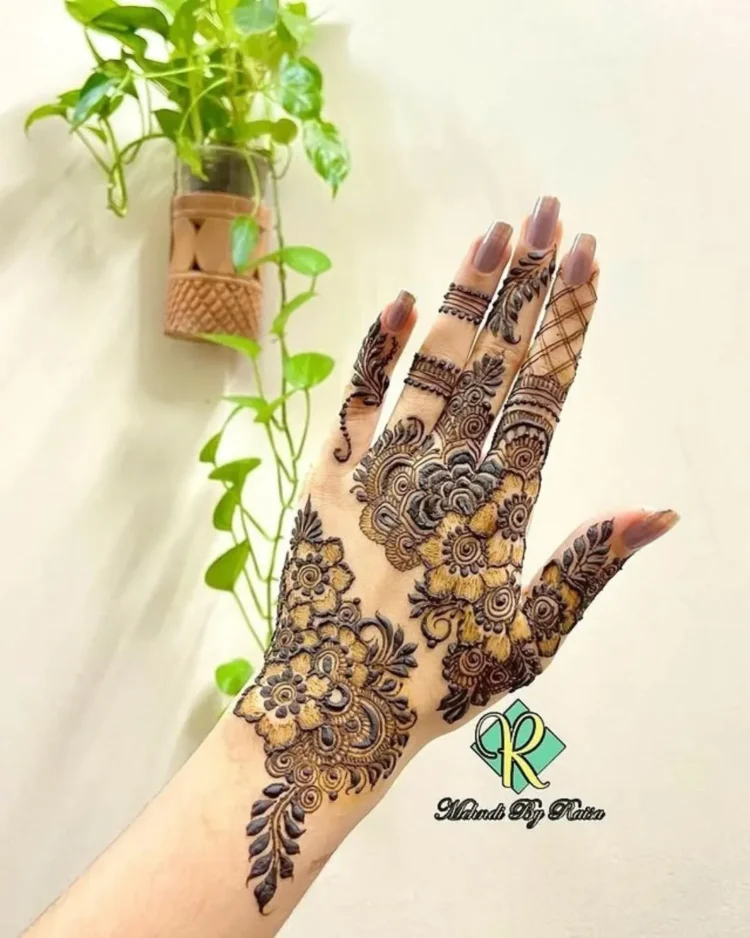
78. Shaded blooms up the hand. Large blooms with dark outlines and golden fill climb from the wrist to the fingers, with leafy sprigs at the base. One finger carries criss-cross lines and the others carry bands and leaves.
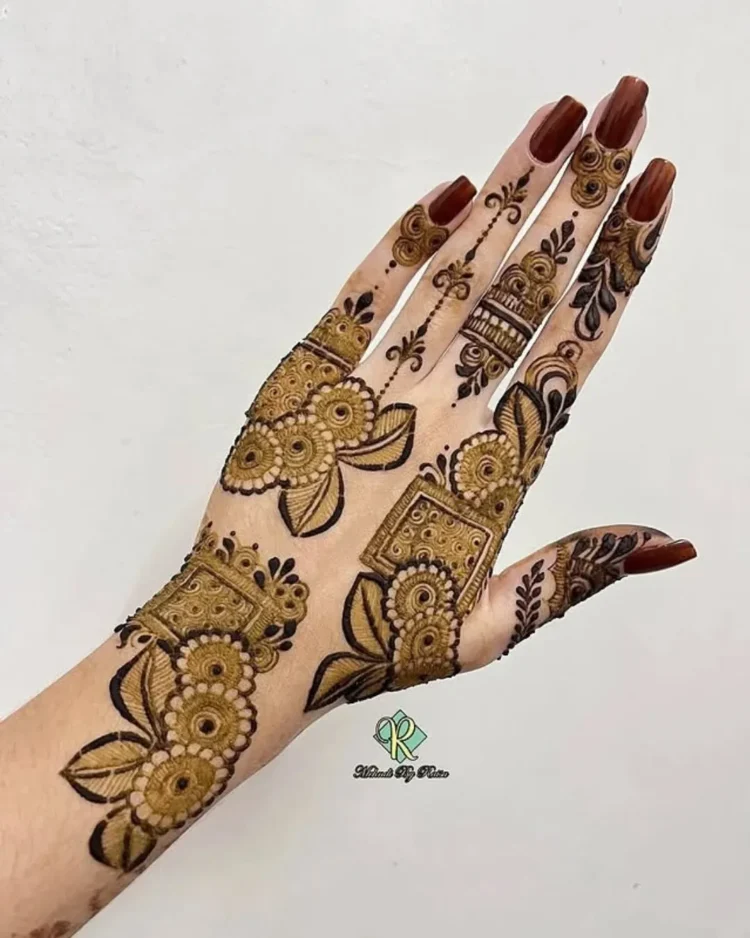
79. Golden circle flowers with square panels. Round flowers with dotted centres, square panels and broad leaves form two columns from the wrist to the fingers. Golden fill inside dark outlines gives the whole design a raised look.
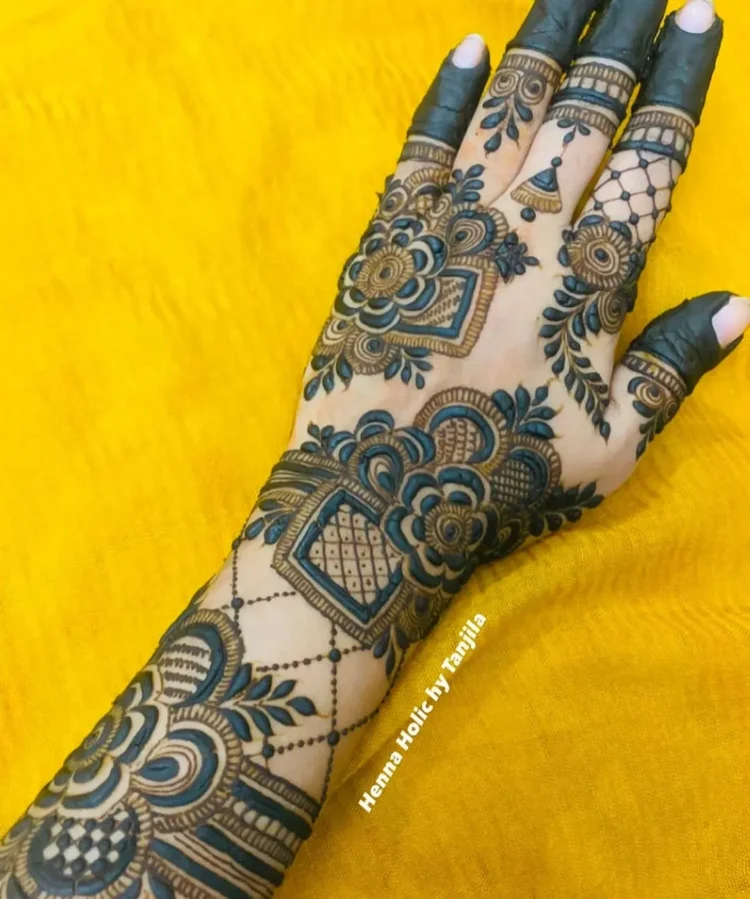
80. Long arm design with checkered panels. Dark outlined flowers, square panels and a checkered block run from the fingers far up the forearm, with a dotted jaal between them. A small bell motif hangs on the middle finger, and the other tips are coated.
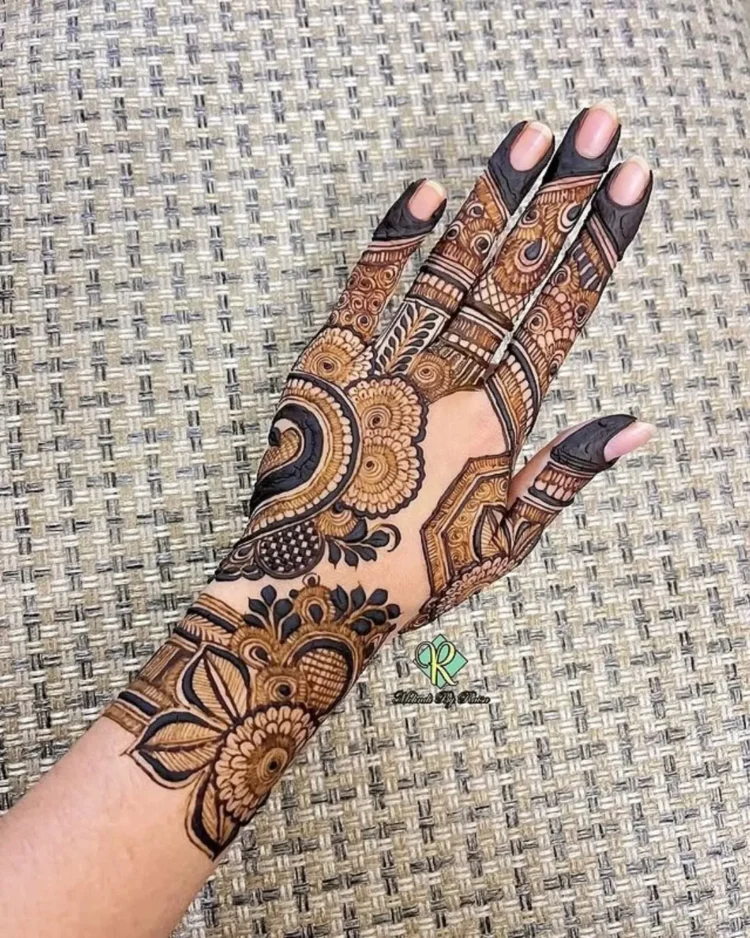
81. Crescent swirl with an angled frame. Outlined flowers, a dark crescent swirl and dot fill cover the hand and wrist, and an angled frame wraps the base of the index finger. The fingertips are coated in paste.
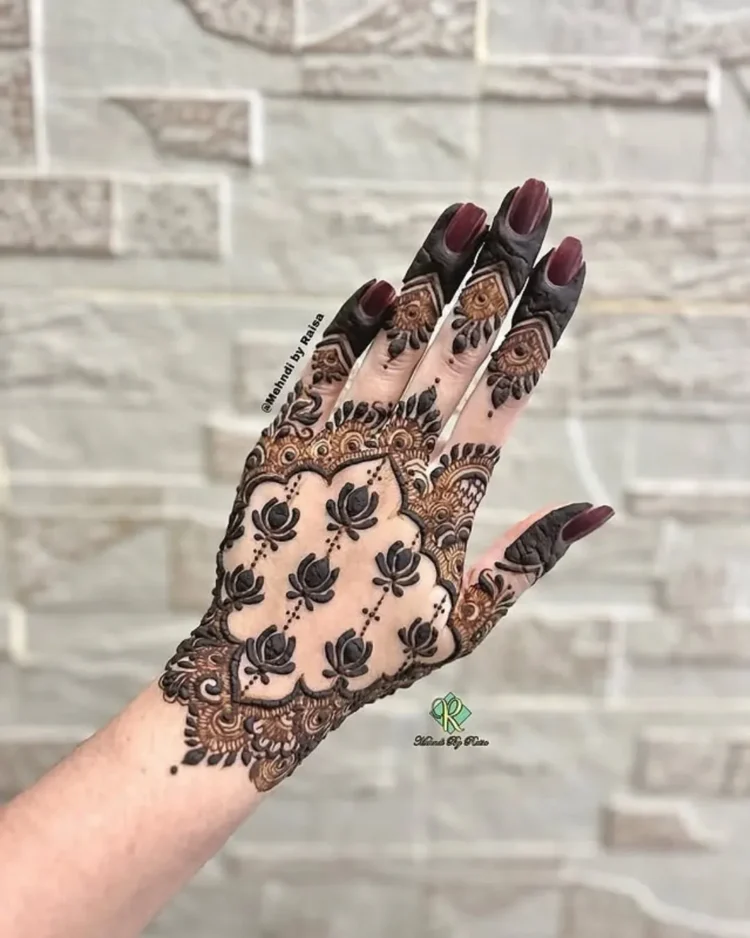
82. Lotus buds in a scalloped panel. Dark lotus buds hang on dotted strings inside a scalloped panel that leaves the skin bare between them. A lace edge frames the panel, and the fingertips are fully coated.
Simple Royal Back Hand Mehndi Designs
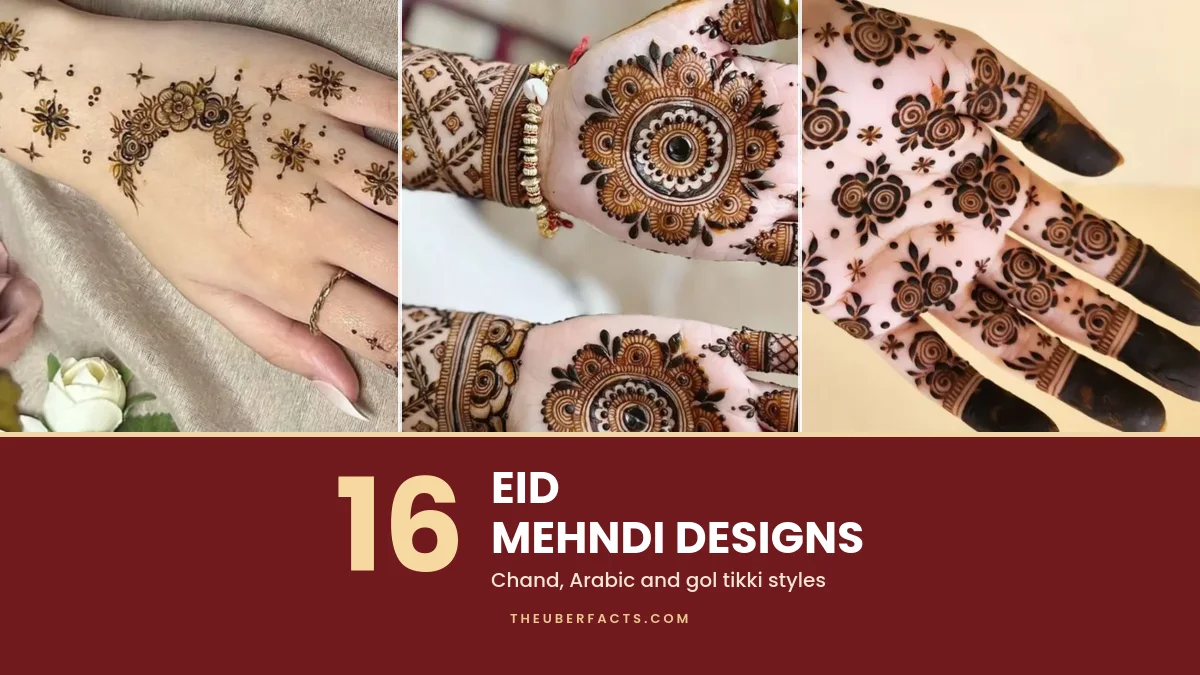
A simple royal back hand mehndi design keeps one royal element, such as a medallion, a dense trail or finished fingers, and leaves the rest of the hand bare. These take roughly 10 to 20 minutes per hand and are the best start for anyone new to fine line work. They also suit festivals, as our Eid mehndi designs show.
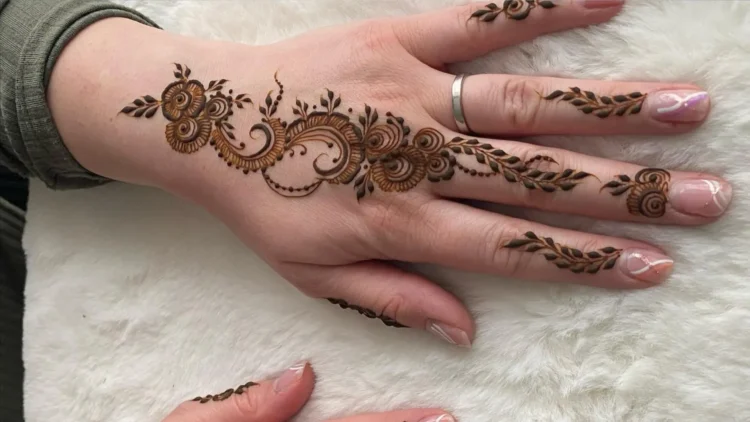
83. Rose and swirl trail to one finger. Roses and swirls form a single curving line from the wrist to the index finger, and the other fingers get leaf sprigs. A beginner can draw it with a medium cone tip.
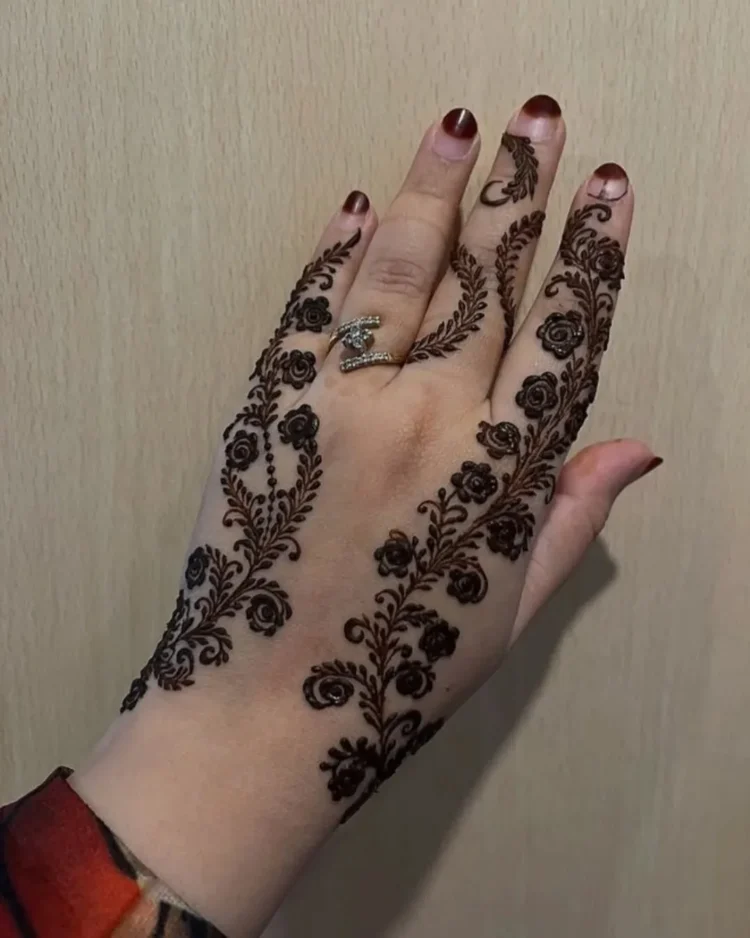
84. Twin rose vines. Two vines of small roses and leaves run from the fingers toward the wrist, one of them ending in a short dotted line. Keeping the thin stems even is the only real challenge.
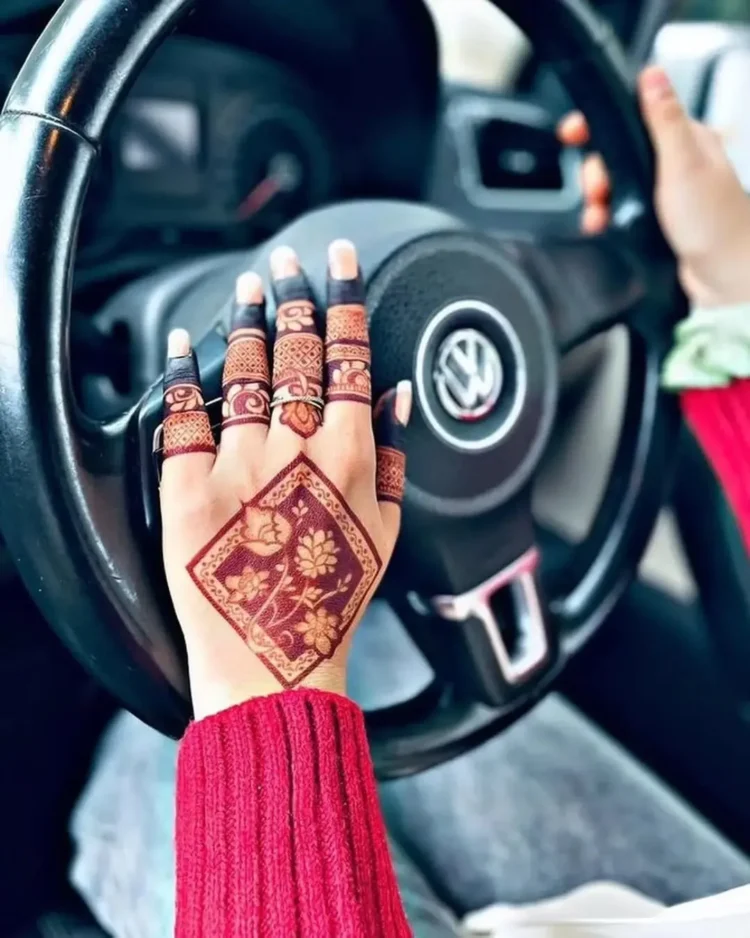
85. Diamond box with bare-skin flowers. A single filled diamond holds flowers left as bare skin, and each finger carries a different band pattern. It is quick to apply and still looks finished in photos.
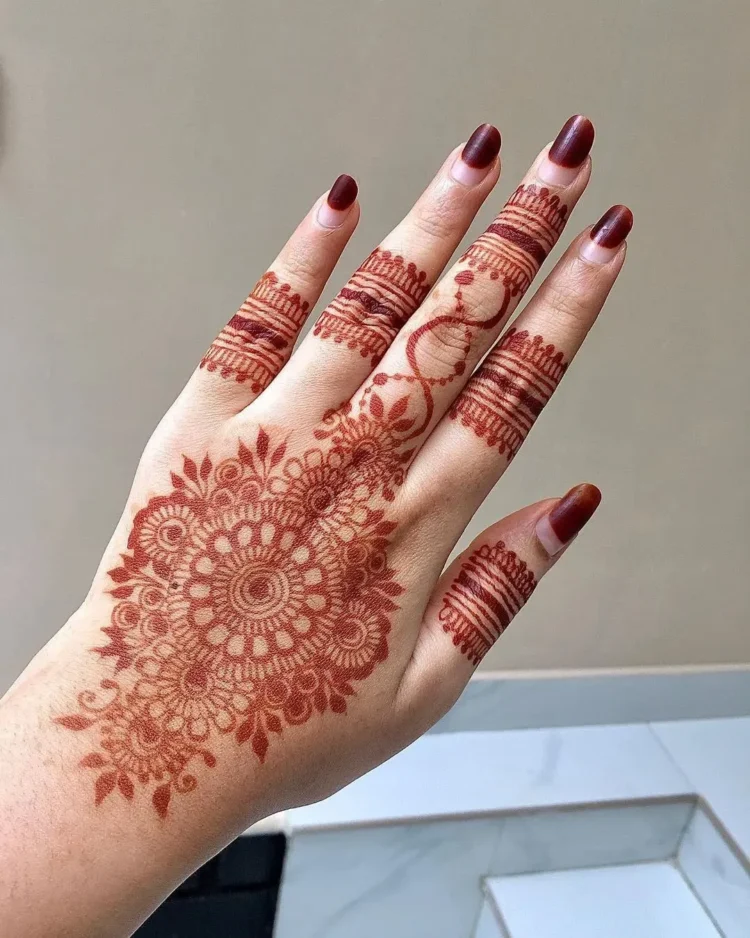
86. Off-centre red mandala. A large round mandala of rings and petals is placed off-centre toward the thumb, with stacked bands on four fingers and a looping line on the middle one.
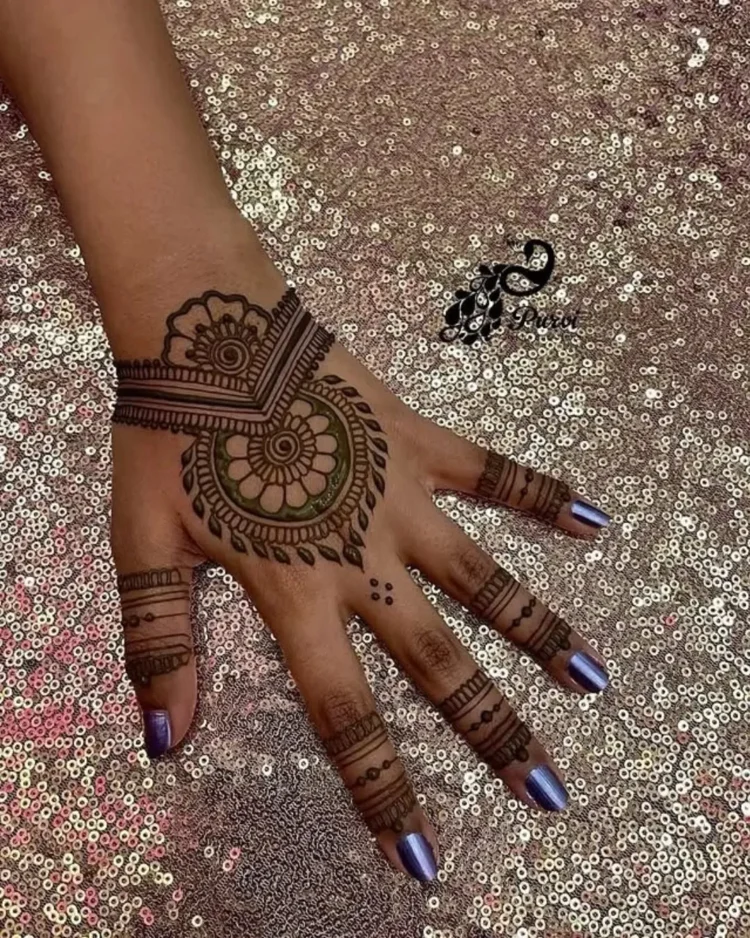
87. Spiral mandala with V bands. A mandala with a spiral centre sits under two V-shaped bands that start at the wrist, with a fan-shaped flower above them. Thin rings on the fingers and three dots finish it.
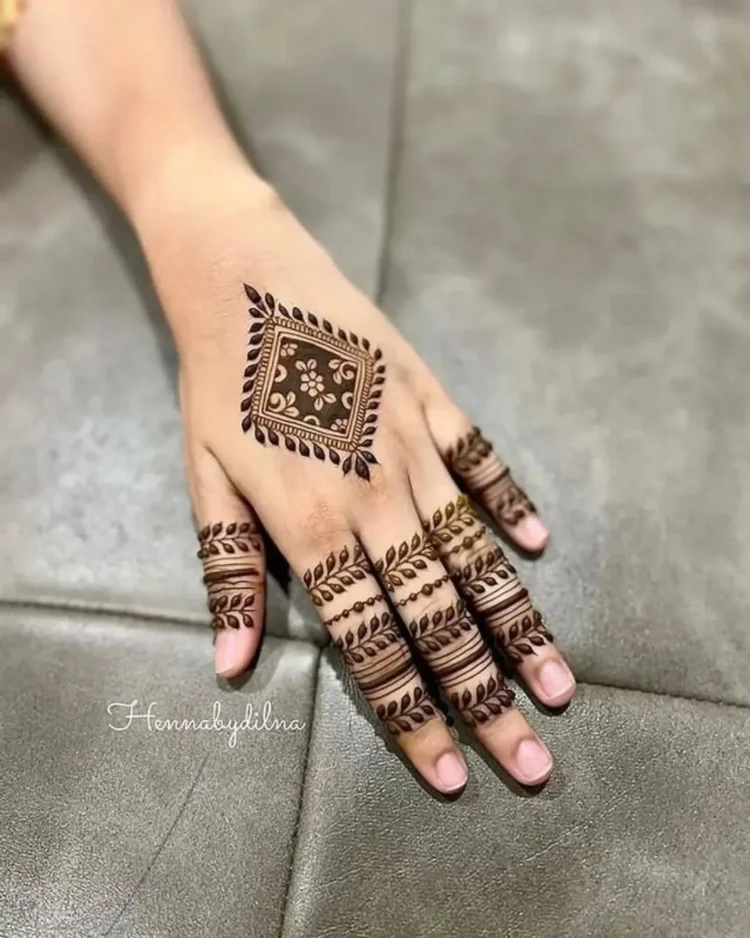
88. Diamond medallion with leaf rings. One diamond medallion with a bare-skin flower inside a dark square sits on the hand, edged with small leaves. Leaf vine rings repeat on every finger, which is quick to draw and easy to keep even.
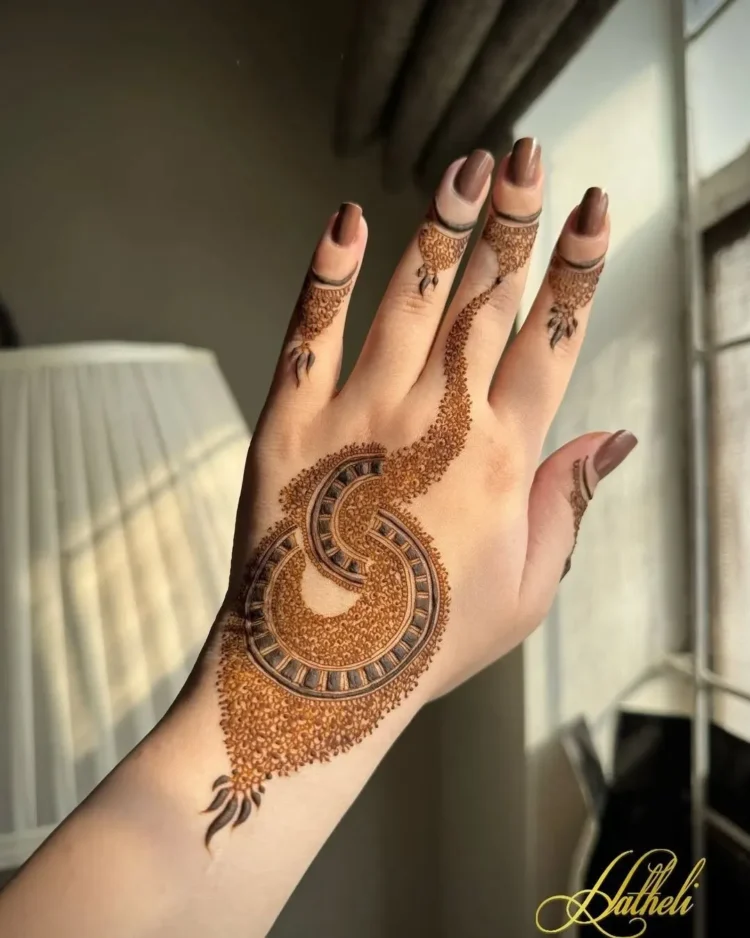
89. Dotted swirl with a finger trail. A large C-shaped swirl filled with tiny dots and crossed by short bars curls over the hand, and a dotted trail runs up the middle finger. Small leaf tips cap the other fingers.
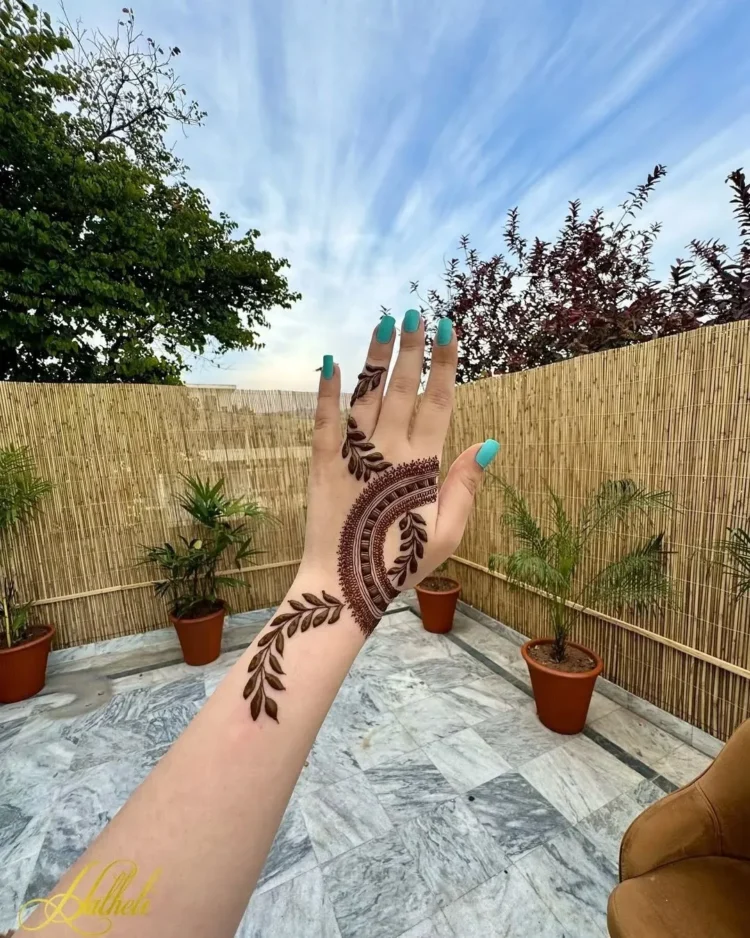
90. Half sun with a leaf vine. A half-circle of fine rays sits at the side of the wrist, and leaf vines run from it up one finger and down the forearm. Most of the hand is left bare.
Time, Skill and Who a Royal Back Hand Design Suits
- Style families: Indian and Pakistani bridal (dense, fine fill), Arabic (a diagonal floral trail with open skin), Khaleeji (bold outlines and shading) and Indo-Arabic, which mixes Arabic florals with Indian jaal and cuffs.
- Skill level: intermediate for simple and Arabic royal designs, advanced for full bridal coverage with jaal and symmetrical cuffs.
- Time to apply: 10 to 20 minutes per hand for a simple royal design, 30 to 60 minutes per hand for a dense one, and longer when the pattern continues up the forearm.
- Who it suits: the bride, her sisters, mother and close friends at the mehndi night, and anyone dressing up for Eid, an engagement or Karwa Chauth.
- Paste time: at least 6 hours and ideally overnight, because the skin on the back of the hand stains lighter than the palm.
- Stain colour: bright orange when the paste comes off, deepening to red-brown or maroon over 24 to 48 hours.
- How long it lasts: about one to two weeks on the back of the hand, a little less than on the palm.
A bride usually pairs a royal back hand design with a matching palm, so see our royal front hand mehndi designs for the other side and our royal finger mehndi designs for finger details. Patterns for the groom are in our dulha mehndi designs.
How to Keep Fine Lines Sharp in a Royal Design
- Use smooth paste. Sift the henna powder through a fine cloth and let the mixed paste rest for several hours. Lumps block a fine tip and break the line.
- Cut a small tip. Snip only the very end of the cone so the line stays thin. A cone with a fine plastic or metal nozzle also works.
- Lift, do not drag. Hold the tip just above the skin and let the paste fall into place. Pressing the tip onto the skin smears the line.
- Keep the pressure even. Squeeze from the top of the cone, and wipe the tip on a tissue every few minutes to stop blobs.
- Plan the order. Work so that your drawing hand never rests on lines that are still wet.
- Fix mistakes at once. A damp cotton bud lifts a wrong line before it stains.
- Seal and protect. Once the paste is dry, dab on lemon juice mixed with sugar so it stays on the skin, and keep the hand away from water for the first 12 hours.
Very dark designs look striking, but natural henna never stains true black. Cones sold as black henna can contain PPD (p-phenylenediamine), a hair dye chemical that can cause serious skin reactions, as the US FDA warns. Use a natural henna cone and test a small dot on the inner arm a day before the wedding.
Royal Back Hand Mehndi Design FAQs
What is a royal back hand mehndi design?
It is a dense, finely detailed design that covers the back of the hand from the knuckles to the wrist and usually the fingers too. Typical features are jaal, lace arches, layered wrist cuffs and motifs that copy jewellery, such as chains and pendants.
How is a royal design different from a simple back hand design?
A simple design uses a few bold motifs with a lot of bare skin, often as one diagonal trail. A royal design fills most of the hand with fine lines, is balanced around a centre, and finishes every finger.
How long does a royal back hand mehndi design take?
A dense royal design takes about 30 to 60 minutes per hand for an experienced artist, and more if it continues up the forearm. A simple royal design can be done in 10 to 20 minutes per hand.
Is a royal back hand design only for brides?
No. Brides wear the fullest versions, but sisters, mothers and close friends often choose a lighter royal design for the mehndi night. A single medallion or an Arabic floral trail also works for Eid and engagements.
How do I get a dark back hand mehndi design?
Keep the paste on for at least 6 hours or overnight, seal it with lemon and sugar, and scrape it off instead of washing. Avoid water for 12 to 24 hours. The stain keeps darkening for about two days.
Can a beginner draw a royal back hand mehndi design?
Start with one royal element, such as a medallion with banded fingers or a rose trail, before trying full jaal. Practise straight lines, dots and even curves on paper until the pressure feels steady.